Honolulu, Hawaii: The Calm Harbor Behind the Name
A captain who sailed into Honolulu’s harbor in 1794 called it Fair Haven, and that’s just how early scholars translated the Hawaiian name Honolulu. The city took its name from that sheltered water: hono for the harbor, lulu for the calm.
Hono and lulu
W. D. Alexander, who compiled the list of Hawaiian geographic names for the U.S. Coast and Geodetic Survey after annexation, explained the name in his 1903 report. Hono, he wrote, is “an obsolete word for harbor,” and it shows up in a long run of place names. His example at the top of that run: “Hono-lulu, quiet harbor or Fair Haven.”
The second half is the easy one. Lorrin Andrews’s 1865 dictionary defines lulu as “a calm spot at the leeward of an island or precipice,” and as an adjective, “calm.” Hono is harder. The 1922 revision of that same dictionary lists it first as stitching or sewing, and only further down as “a cave or bay; a sheltered spot on the sea; a sheltered place.” Close to a harbor, but not quite the word. That’s why the translations wobble a little depending on where you look:
- Alexander (1903): “quiet harbor or Fair Haven.”
- C. J. Lyons, a scholar of Hawaiian, as Thomas Thrum summed up his reading in 1922: “a quiet harbor,” from hono, “a hollow or valley with a bay or bight in front of it,” and lulu, “a calm leeward spot.”
- Thrum’s list of Hawaiian place names, printed with the 1922 dictionary: “fair haven.”
- The federal place-names database (GNIS) today: “fair haven,” from hono, “harbor,” and lulu, “smooth,” “quiet.”
They split the first word differently, but every version lands on the same picture: a calm, protected harbor.
Captain Brown’s Fair Haven
The English name came from a trader. Alexander’s Brief History of the Hawaiian People, written in 1891 for the Hawaiian Kingdom’s Board of Education, says Captain Brown, in the schooner Jackal, with Captain Gordon in the sloop Prince Lee Boo, “entered the harbor of Honolulu, (which he had discovered and named ‘Fair Haven’), November 21st, 1794.”
Brown didn’t get to enjoy it long. He sold arms and ammunition to Kalanikupule, the ruler of Oahu, for a war against his uncle Kaeo, who ruled Maui. On January 1, 1795, Alexander writes, the chief Kamohomoho “suddenly boarded the vessels with an armed force, killed the two captains and made the rest prisoners.”
The old books don’t line up perfectly on the details. Andrews’s 1865 timeline puts the “first discovery of Honolulu harbor” in December 1794 and calls the ships “Jackall and Prince Leboo, American.” Thrum, in 1922, connects the name to “Captain Brown, of the English ship Butterworth,” and says only that Brown was “said to” have given it. Alexander does put a Captain Brown on the Butterworth a year earlier, in 1793, carrying the Maui chief Kahekili to Kauai. Thrum’s verdict on the English name was simple: since the Hawaiian name already meant a quiet harbor, “Fairhaven” was “not amiss.”
Kou, and “Honorora”
The harbor had a Hawaiian name of its own, too. Alexander’s 1903 list enters it as “Honolulu Harbor or Kou.” He doesn’t translate Kou, so neither will we.
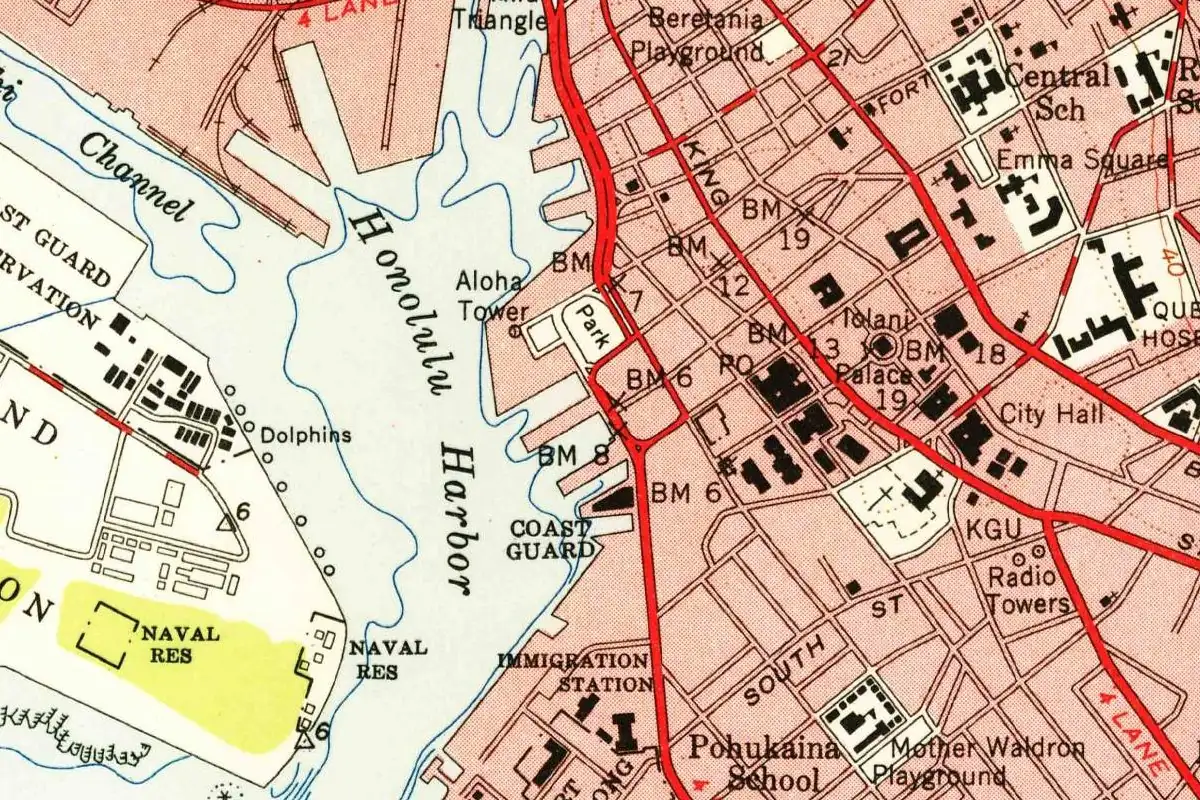
Foreign sailors had their own trouble with the city’s name. Peter Corney, a trader who sailed these waters between 1813 and 1818, wrote it “Honorora” and described “the village and harbour of Honorora” as the largest on the island, because “the natives collect from all other parts to be near the shipping.” If you look at the 1953 map above, you can see where all those ships ended up: the words “Honolulu Harbor” running right down the channel past Aloha Tower.
Sources & further reading
- W. D. Alexander, Hawaiian Geographic Names (U.S. Coast and Geodetic Survey, Report for 1902, Appendix 7, 1903), pp. 395, 403. Hono as “an obsolete word for harbor” and “Hono-lulu, quiet harbor or Fair Haven” (p. 395); “Honolulu Harbor or Kou” (p. 403).
- W. D. Alexander, A Brief History of the Hawaiian People (1891), pp. 138, 141–142. Brown on the Butterworth in 1793 (p. 138); Brown “discovered and named ‘Fair Haven’” and entered the harbor on November 21, 1794 (p. 141); the attack of January 1, 1795 (p. 142).
- Thomas G. Thrum, “Wrestling with Place Names,” Hawaiian Annual for 1922, pp. 82–84. C. J. Lyons’s reading of hono and lulu, and the name “said to have been given” by Captain Brown of the Butterworth (p. 84).
- Thomas G. Thrum, “Hawaiian Place Names,” in Andrews and Parker, A Dictionary of the Hawaiian Language (1922), p. 633; dictionary entry hono, p. 144. “Honolulu: fair haven.” In the body of the same dictionary (p. 144), hono is first “a stitching; a sewing,” and further down “a cave or bay; a sheltered spot on the sea.”
- Lorrin Andrews, A Dictionary of the Hawaiian Language (1865). Lulu, “a calm spot at the leeward of an island or precipice”; the timeline entry for December 1794.
- Peter Corney, Voyages in the Northern Pacific (Thrum, 1896), p. 97. The spelling “Honorora” and the village by the shipping.
- GNIS feature 366212 (U.S. Geological Survey). The federal record: “fair haven,” from hono and lulu.
Spot something wrong, or know more? Tell us here. You can also email us or use our contact page. Corrections are noted here with their date, never made silently.