Pearl City, Hawaii: The Railroad Town's Unexplained Name
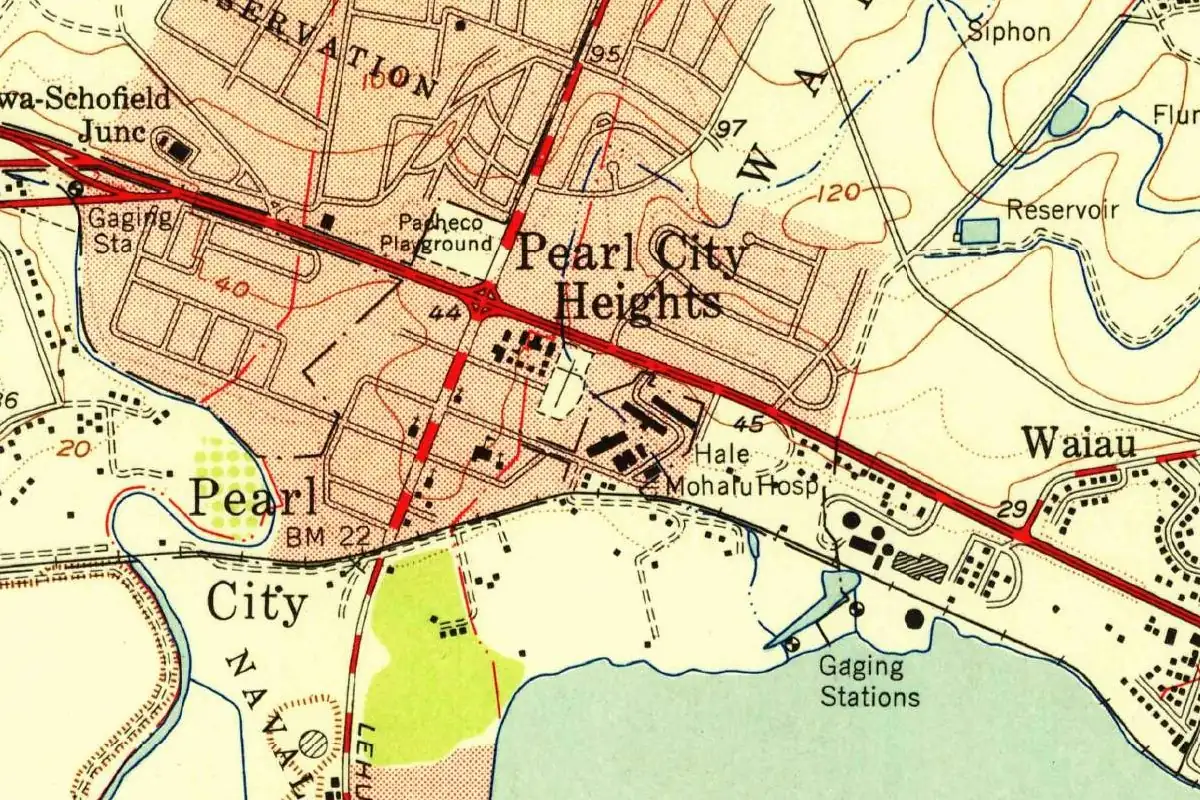
No record from 1890 that we’ve found says who named Pearl City, Hawaii, or why, though the railroad that laid it out on Pearl Harbor sold lots that year. The harbor next door had been “Pearl” water since at least the 1810s, and that’s as close as the old record gets to an answer.
Lots by the train
The Oahu Railway and Land Company built the town to sell it. The Hawaiian Annual for 1891, looking back on 1890, reports that the company’s sales of lots “at Pearl City, recently laid out at Manana, Ewa,” lived up to everything the promoter had predicted. About 110 lots went at the first offering for $44,000, and a second sale a week later brought in $22,795 for 58 more.
The company’s own ad in the same annual, signed by general manager B. F. Dillingham, gives you the sales pitch. It promised reservoirs of “pure water,” streets 60 to 80 feet wide, lots on “Lehua, Woodlawn and Manana Avenues,” and a deal on the train: buyers and their families could ride to and from Pearl City at one cent a mile, second class, for nine years from September 1, 1890. The land ran “from the point of a peninsula, projecting one and a half miles south from the main land into Pearl Harbor, to the top of the Koolau Mountain Range.” Its last line was blunt: “Those who would find a safe and profitable investment will invest at Pearl City at an early date.”
The name shows up, the reason doesn’t
The name was in use before the lots went on sale. The Friend, a monthly paper in Honolulu, reported in July 1890 that the annual Sunday-school picnic on Kamehameha Day, June 11, was held at a grove at “Pearl City,” thanks to the railroad. The same issue still described the view from the line “between Aiea and Manana,” the name of the land the town was laid out on. In November it announced that lots at “this new rural village” were about to go to auction, and in January 1891 it listed “the successful sales of building lots at Pearl City” among the year’s public improvements.
None of those pieces says where the name came from. Neither does the annual’s report, the railroad’s ad or the federal place-names record. The survey list of Hawaiian geographic names that W. D. Alexander published in 1903 just enters “Pearl City; (village); Ewa; Oahu,” with no meaning in brackets.
The stories you’ll find came later. The history blog Images of Old Hawaiʻi says the railroad held a contest in the newspaper to name the new town, that “Pearl City” won, and that the public named Lehua, the main street, too. Paul Yardley’s 1981 biography of Dillingham, published for the B. F. Dillingham Company, puts it a little differently: “A special committee had chosen the name ‘Pearl City,’ after passing over such suggestions as ‘Dillinghampton,’ ‘Dillingmania,’ and ‘Benville.’” We haven’t found an 1890 newspaper, report or ad that records a contest or a committee, so for now both stay versions without a source from the time.
Why the harbor was “Pearl”
The water’s name has a better paper trail. Peter Corney, a trader who sailed to the islands between 1813 and 1818, described an inlet west of Honolulu called “Wy Momi, or Pearl Water.” Momi, says the 1922 Hawaiian dictionary, is “a pearl; the pearl of the oyster.” Corney saw why. “There are many divers employed here,” he wrote, “diving for the pearl oysters, which are found in great plenty.” His crew gave King Kamehameha an oyster dredge, and the king was “highly delighted.”
The Hawaiian Annual for 1903 picked up the same thread. “Pearl Harbor was more frequently referred to in early days as Pearl River,” it says, “and took its name, evidently, from the existence there of pearl oysters at one time.” Notice the “evidently.” Even in 1903, it was a reasonable reading of old accounts, not a record of someone choosing the name.
One harbor, a lot of names
You can count the names this one body of water has worn in the old sources. Corney’s “Wy Momi” and “Pearl Water.” The annual’s “Pearl River,” which The Friend also used for a railroad picnic in December 1889. “Pearl Lochs,” the name Alexander used in his 1903 list, right next to Pearl City. And a Hawaiian name the 1922 dictionary gives as Awalau, “many channels,” which it calls the “Hawaiian name for Pearl Harbor.” The railroad’s 1890 ad already used the one that stuck: Pearl Harbor. A town on that shore called Pearl City is easy to understand, but nobody at the time put the connection in writing. For the harbor a few miles east, see how Honolulu got its name.
Sources & further reading
- Hawaiian Almanac and Annual for 1891, p. 147 and advertising pages. The 1890 lot sales “at Pearl City, recently laid out at Manana, Ewa” (p. 147); the Oahu Railway and Land Company ad signed by B. F. Dillingham, with the fares, the avenues and the peninsula “into Pearl Harbor” (advertising pages at the back of the book; the page numbers can’t be read reliably in the scan).
- The Friend (Honolulu), July 1890, pp. 52–53; November 1890, p. 85; January 1891. The view “between Aiea and Manana” (p. 52); the June 11 picnic at “Pearl City” (p. 53); “Pearl City Lots” about to be auctioned (p. 85); the “Retrospect for 1890” and the second sale of December 6, 1890 (January 1891). The January 1890 issue records the December 1889 excursion “to Pearl river.”
- Paul T. Yardley, Millstones and Milestones: The Career of B. F. Dillingham, 1844–1918 (1981). The “special committee” and the rejected names. We could search the scanned text but not read the full book or its notes.
- Images of Old Hawaiʻi (history blog), posts on Pearl City. The newspaper contest story, with no source from 1890 that we could see.
- Hawaiian Almanac and Annual for 1903, p. 72. Pearl Harbor, “Pearl River,” named “evidently” for pearl oysters, citing Corney.
- Peter Corney, Voyages in the Northern Pacific (Thrum, 1896), pp. 99–100. “Wy Momi, or Pearl Water”; divers “diving for the pearl oysters”; the oyster dredge given to Kamehameha.
- Andrews and Parker, A Dictionary of the Hawaiian Language (1922), pp. 75, 439. Awalau, “Hawaiian name for Pearl Harbor” (p. 75); momi, “a pearl” (p. 439).
- W. D. Alexander, Hawaiian Geographic Names (1903), p. 420. Pearl City (village) and Pearl Lochs, Ewa, Oahu.
- GNIS feature 363226 (U.S. Geological Survey). The federal record for Pearl City, silent on the name too.
Spot something wrong, or know more? Tell us here. You can also email us or use our contact page. Corrections are noted here with their date, never made silently.