Lahaina, Hawaii: From Lele to a Day of Cruelty
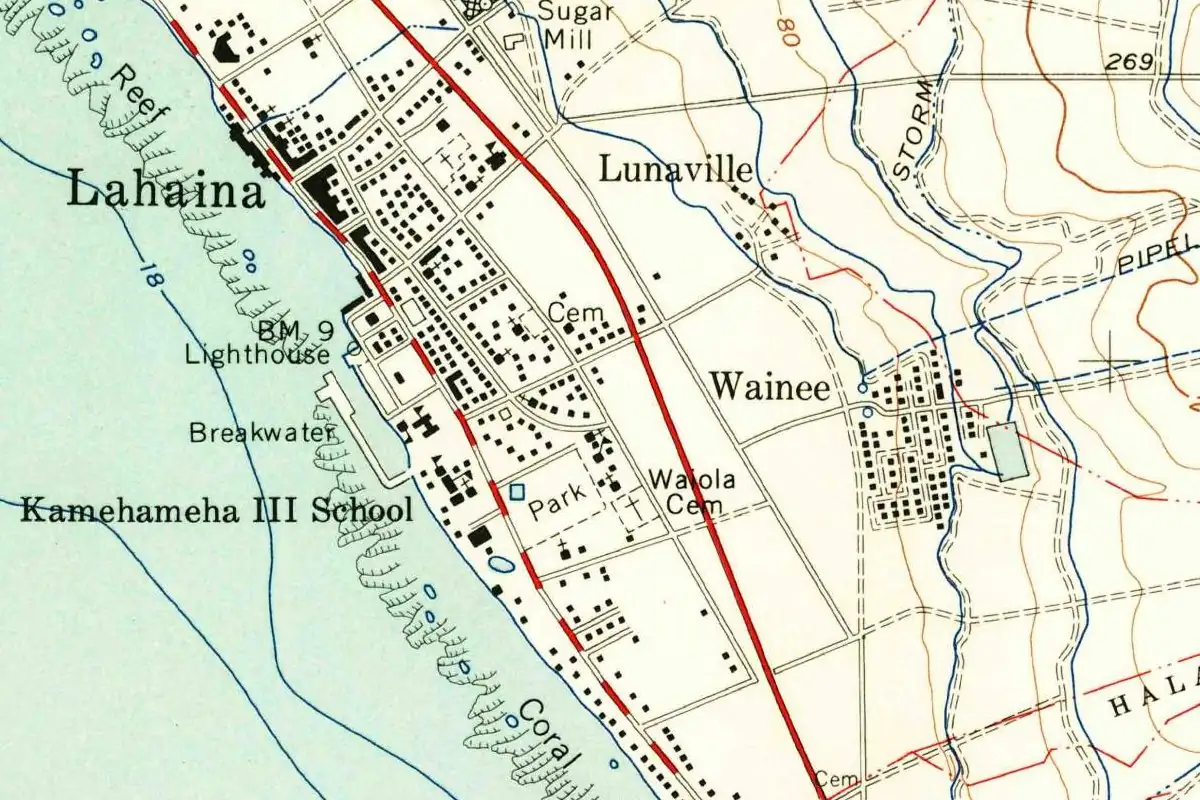
Before anyone called it Lahaina, the Maui town was known as Lele, and the newer name has been read as a cruel day or a chief’s complaint about the sun. Which of those stories is true is something the old writers argued about and never settled.
Lele, and a name before that
The older name is the best-documented part. The Hawaiian Annual for 1908 says Lahaina “is said by early native writers to have had two other names in ancient times, it being first known as Honoapiilani. Subsequently this was changed to Lele, and in later times to Lahaina.”
Abraham Fornander, a judge on Maui who collected Hawaiian traditions, tells you when Lele was still in use. Writing in 1880 about the brothers Kakae and Kakaalaneo, who ruled Maui and Lanai together, he says they “kept their court at Lahaina, which at that time still preserved its ancient name of Lele.” He adds that tradition remembers Kakaalaneo as the one who planted the breadfruit trees “for which the place in after times became so famous.”
Three stories for one name
So when did Lele become Lahaina, and why? Thomas Thrum, who was then extending the official list of Hawaiian place names, took that on in the Hawaiian Annual for 1922. He started from an article in the Star-Bulletin of July 13, 1920, which gave two versions of “How Lahaina Got Its Name.” We haven’t seen that article. Everything here about it comes from Thrum’s summary.
The first version said the name came from “laha aina,” which Thrum translates as “proclaiming land.” He had fun with it, saying it introduced “the pioneer Ad Club of the islands, boosting the charms of Maui, in the eleventh century.” He also had a real objection: it “would not give us the accent on the last syllable as Hawaiians pronounce it.”
Thrum found the second version “more reasonable.” From his summary, that seems to be the one where the name started as “an exclamation of a bald-headed chief at the severity of the sun’s heat.” But he read the name his own way. Split as La-hai-na, he wrote, it would be “a day of calamity, or cruelty.” His dictionary list from the same year says the same thing in three words: “day of cruelty.” The pieces are in the 1922 dictionary too. La is “the sun,” and also “day,” and haina is “cruel; unmerciful; hard-hearted.”
A cruel day, but which one?
Thrum’s theory was that the name remembers a real disaster. He pointed to the wars that hit Lahaina after the death of Kekaulike and the invasions of Alapainui of Hawaii, “about 1735.” Then he admitted the problem with his own idea: “the change of name must have taken place earlier than this date.” In the time of Kakae and Kakaalaneo, which he put “about 1630,” the place “was still known as Lele.” When the change came after that, he said, “is not clear.”
In the end he didn’t pick. Whether the name began with the bald chief and the sun, he wrote, “or is an expression of the populace at the mercilessness of the victors, it was an historic day to be remembered by name for coming generations.”
The list that left it blank
There’s one more clue, and it’s a quiet one. W. D. Alexander’s 1903 list of Hawaiian geographic names puts a meaning in brackets after a name only “when known.” Lahaina appears as a district, a town and a roadstead, and it gets no brackets at all. So you’ve got a 1903 list that left the meaning blank, a 1920 newspaper story, known only through Thrum, about a bald chief and the sun, and a 1922 scholar who offered a cruel day and then poked holes in his own dating.
Sources & further reading
- Thomas G. Thrum, “Wrestling with Place Names,” Hawaiian Annual for 1922, pp. 82–86. The Star-Bulletin versions of July 13, 1920, as Thrum summarized them (the newspaper itself wasn’t consulted); “laha aina”; the bald-headed chief and the sun’s heat; “a day of calamity, or cruelty”; Lele “about 1630”; Alapainui “about 1735”; the change of name “earlier than this date” (p. 86).
- Hawaiian Almanac and Annual for 1908, p. 21. Honoapiilani, then Lele, then Lahaina, “said by early native writers.”
- Abraham Fornander, An Account of the Polynesian Race, vol. 2 (1880), p. 82. Kakae and Kakaalaneo kept court at Lahaina, which “still preserved its ancient name of Lele”; the breadfruit trees.
- Andrews and Parker, A Dictionary of the Hawaiian Language (1922), pp. 92, 347–348, 655. Haina, “cruel” (p. 92); la, “the sun” and “day” (pp. 347–348); Thrum’s place-name list, “Lahaina: day of cruelty” (p. 655).
- W. D. Alexander, Hawaiian Geographic Names (1903), pp. 399, 414. Meanings given “when known” (p. 399); Lahaina listed with no meaning (p. 414).
- GNIS feature 361678 (U.S. Geological Survey). The federal record for Lahaina. It doesn’t explain the name.
Spot something wrong, or know more? Tell us here. You can also email us or use our contact page. Corrections are noted here with their date, never made silently.