How Wailuku, Hawaii Got Its Name: "Water of Slaughter"
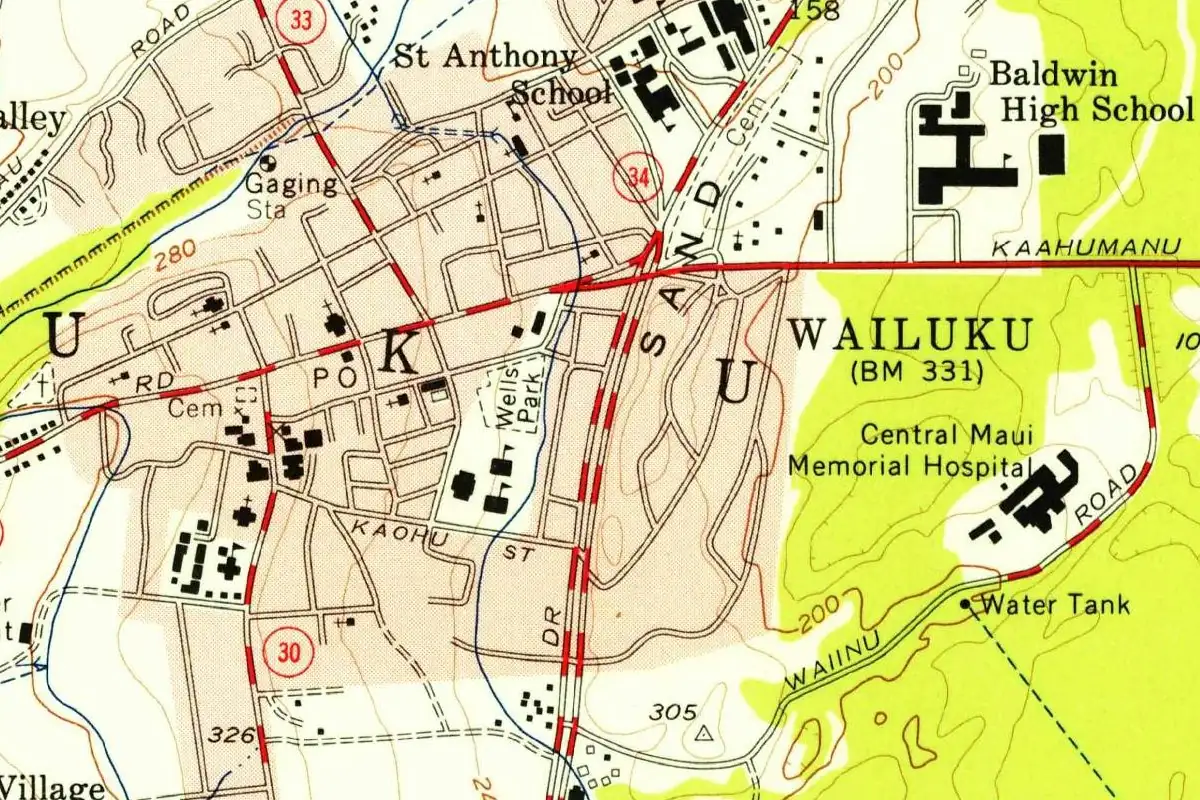
The name Wailuku, Hawaii, comes out grim in English: both of the early official lists of Hawaiian place names translate it “water of slaughter.” The Maui town carries the name of the district around it, and the translation is about as clear as Hawaiian place names get. Why the place got that name is another matter.
Wai and luku
You can take the word apart with an 1865 dictionary. Wai is water, and W. D. Alexander, whose 1903 list of Hawaiian names was printed in a federal survey report, noted that its compounds “are numerous,” from Waimanalo, “brackish water,” to Wailua, “two waters.” Luku is the dark half. Lorrin Andrews’s dictionary defines it as “slaughter; a destruction of people on a large scale,” and as “the rooting out or utter destruction of a people.”
Put them together and you get what both lists say. Alexander’s 1903 entry reads “Wailuku; [water of slaughter]; (district); Maui,” with the town listed a few lines below. Thomas Thrum’s list for the 1922 Hawaiian dictionary agrees, word for word: “water of slaughter. District, Maui.”
The battle in Iao Valley
There was a slaughter here, and the story of it involves water. In the summer of 1790, Alexander writes in his 1891 history, Kamehameha moved his fleet to Kahului and “marched to the Wailuku Valley,” where he beat the Maui army under the sons of Kahekili. “No mercy was shown to the vanquished.” In a footnote, Alexander adds: “It is said that the brook Iao was choked with the corpses of the slain, whence the battle was called ‘Kapaniwai’ (the damming of the waters).” Andrews’s 1865 timeline records it the same way: “The battle called Kapaniwai was fought between Kamehameha and Kalanikupule at Wailuku, Maui.”
It’s tempting to connect the two. The early books don’t. The battle got a name of its own, Kapaniwai, and neither Alexander nor Andrews says the district was named for it. They use the name Wailuku for the place where it was fought.
Wailuku, twice
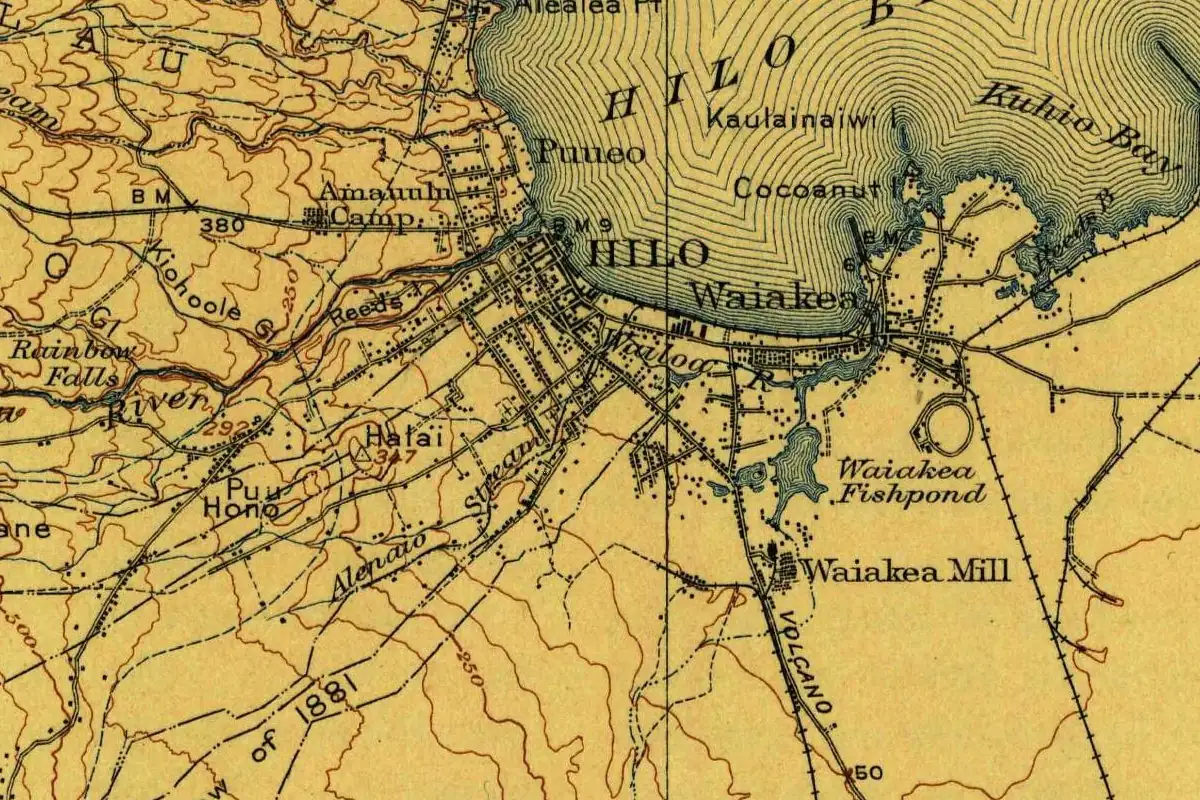
There’s another reason to be careful with a single story. The name isn’t only on Maui. Alexander’s list has a Wailuku district, a land section and a stream on Maui, and also a Wailuku stream on the island of Hawaii, in the district of Hilo. You’ll run into that one again in the story of Hilo. Whatever slaughter the name remembers, the same words were put on water on two islands, and none of the early sources tells you which came first or what happened there. The meaning is on record. The story behind it isn’t.
Sources & further reading
- W. D. Alexander, Hawaiian Geographic Names (U.S. Coast and Geodetic Survey, Report for 1902, Appendix 7, 1903), pp. 395, 424. The compounds of wai, “water” (p. 395); “Wailuku; [water of slaughter]; (district); Maui,” plus the Maui land section, stream and town and the Wailuku stream in Hilo (p. 424).
- Thomas G. Thrum, “Hawaiian Place Names,” in Andrews and Parker, A Dictionary of the Hawaiian Language (1922), p. 673. “Wailuku: water of slaughter. District, Maui.”
- Lorrin Andrews, A Dictionary of the Hawaiian Language (1865). Luku, “slaughter; a destruction of people on a large scale”; the 1790 entry for the battle of Kapaniwai at Wailuku.
- W. D. Alexander, A Brief History of the Hawaiian People (1891), p. 129. Kamehameha’s march to the Wailuku Valley in 1790 and the note on the name Kapaniwai.
- GNIS feature 364757 (U.S. Geological Survey). The federal record for Wailuku; its history field is empty.
Spot something wrong, or know more? Tell us here. You can also email us or use our contact page. Corrections are noted here with their date, never made silently.