Newton, Kansas: A Santa Fe Town With a Boston Name
Newton, Kansas, borrowed its name from Newton, Massachusetts, and that name itself began as plain “new town” when the place split off from Cambridge. So a Kansas cattle town of 1871 ended up with a name first given to a Boston suburb.
The stockholders’ town
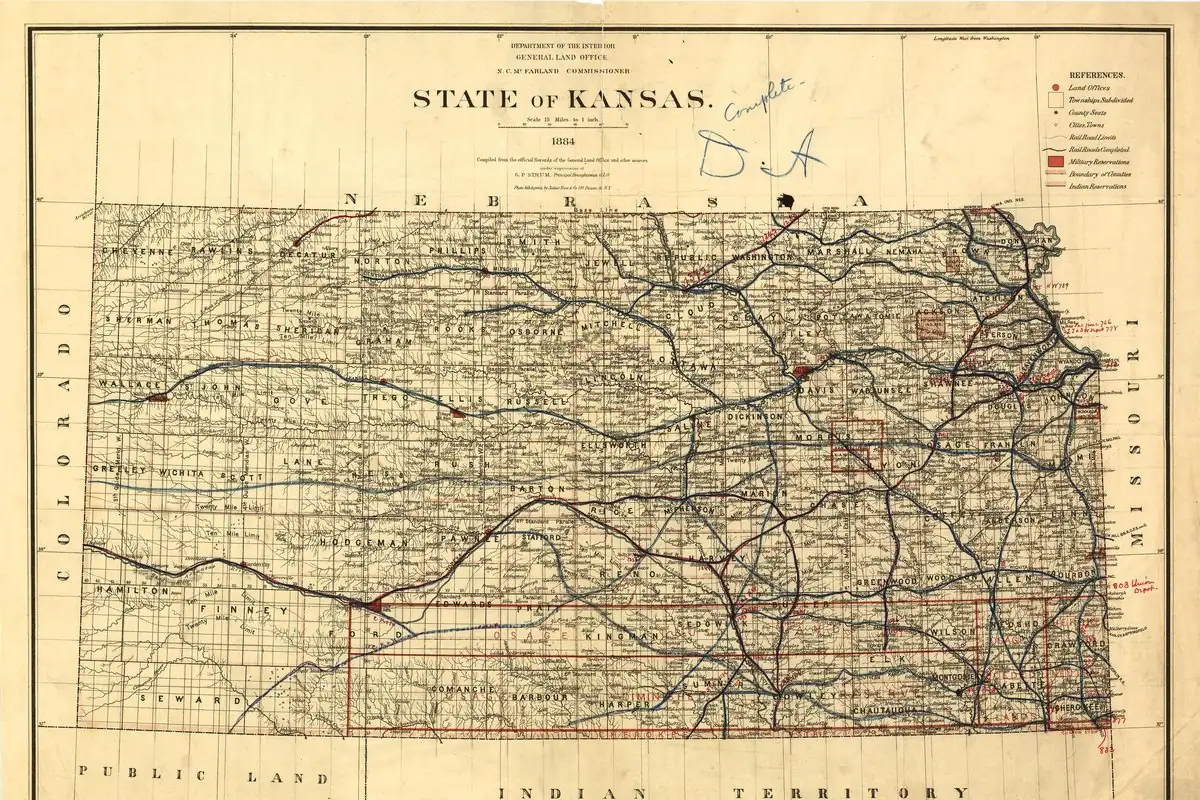
The railroad explains the borrowing. The 2003 nomination of Newton’s Main Street to the National Register of Historic Places says: “The town was named after Newton, Massachusetts, a suburb of Boston, which was home to many of the Santa Fe Railroad stockholders.” The Atchison, Topeka and Santa Fe had planned to run its line between Emporia and Wichita, according to the nomination, but a land dispute with the Osage pushed the railhead to a spot north of Wichita, and a new town went up there.
Henry Gannett, writing for the U.S. Geological Survey in 1905, gave the Kansas city one short line: “named from the city in Massachusetts.” His entry for the Massachusetts Newton tells you where that name came from. It was “originally a part of Cambridge, and when separated called ‘new town,’ afterwards contracted to Newton.”
Who actually chose the name in Kansas goes unrecorded in these accounts.
A year of cattle
The town filled up fast. According to William G. Cutler, whose History of the State of Kansas came out in 1883, the first frame building on the site was moved in from Darlington township late in March 1870 and used as a blacksmith shop. When R. W. P. Muse, a judge and the mayor by the time Cutler wrote, first came on May 10, 1871, people were already settled on the town site, and frame stores went up “daily” after that.
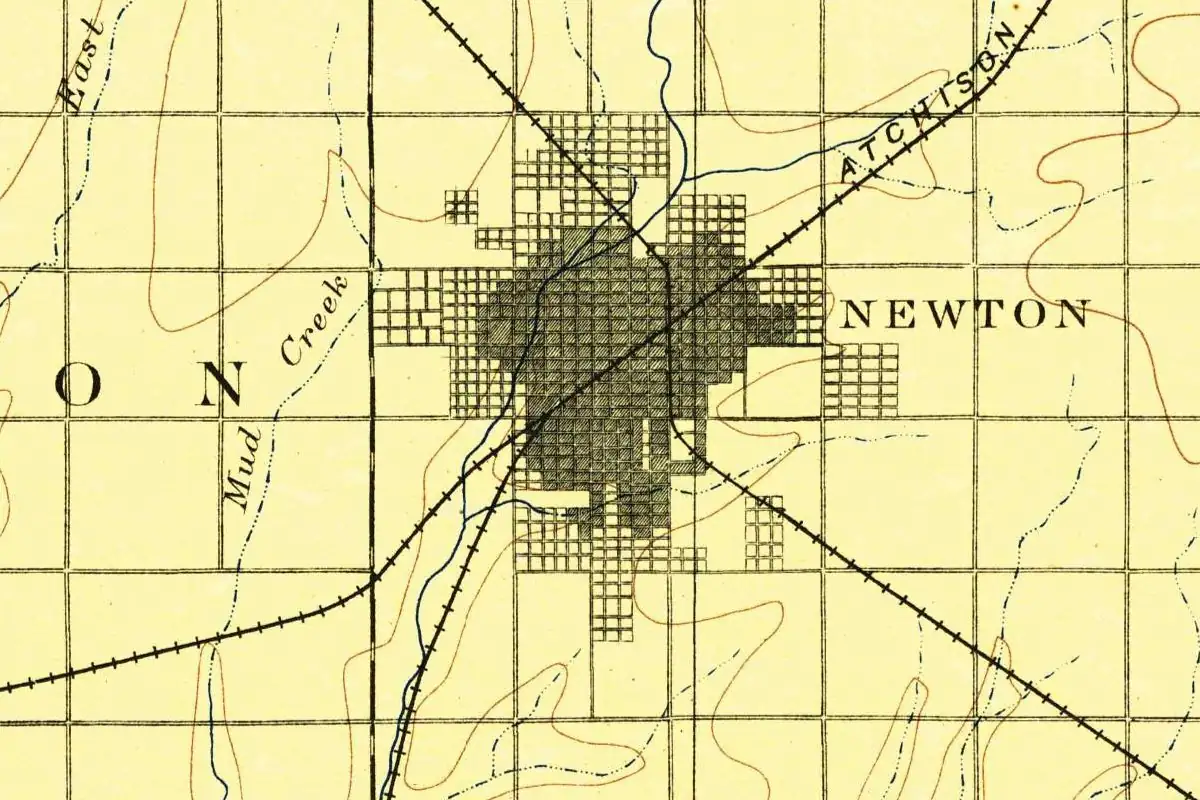
The Atchison, Topeka & Santa Fe was completed to Newton on July 17, 1871, Cutler writes, and Newton became the shipping point for the Texas herds that had gone to Abilene on the Kansas Pacific. The nomination says this cut the cattle drive by seventy miles (113 km). Saloons took “nearly every other building” in the business district, with names like “Do Drop In,” “The Side Track” and “Gold Rooms,” and the part of town called Hyde Park had fifteen buildings given over to “social amusement.” Cutler dates the “cow-boy reign” from June 1871 to January 1, 1873, and he warns that the death toll had been “greatly exaggerated.” Muse’s own count, he says, was twelve killed.
It didn’t last. The nomination says Newton’s time as the railhead ended in May 1872, when the Santa Fe finished a spur to Wichita and the cattle trade moved there. Newton’s declaration of incorporation is dated February 22, 1872, just before that, and the nomination says the railroad made the town its main division point in 1873.
Still on the tracks
Blackmar’s Kansas: A Cyclopedia of State History (1912) calls Newton a division point of the Santa Fe and counts 7,862 people there in 1910. The railroad never left the middle of town. The nomination says Main Street “is still bisected by expansive railroad tracks,” with the Santa Fe depot as one of its landmarks, so if you walk Main Street today, you’ll cross the railroad in the middle of downtown.
Quick answers
Is Newton, Kansas, named after Isaac Newton?
No. It was named after Newton, Massachusetts, home to many of the Santa Fe Railroad’s stockholders (NRHP nomination, 2003; Gannett, 1905).
What does the name Newton mean?
“New town.” Gannett says the Massachusetts Newton was “originally a part of Cambridge, and when separated called ‘new town,’ afterwards contracted to Newton.”
Why did Newton lose the cattle trade?
The Santa Fe finished a spur to Wichita in May 1872, and the cattle shipping moved there, according to the National Register nomination.
Key dates
- 1870Late March: the first frame building on the future town site is moved in from Darlington township.
- 1871July 17: the Atchison, Topeka & Santa Fe is completed to Newton, and the cattle herds start coming.
- 1871August 19: the original plat of Newton is filed.
- 1872February 22: Newton's declaration of incorporation is dated.
- 1872May: a Santa Fe spur to Wichita takes the cattle trade away.
- 1873January 1: by Cutler's account, the town's "cow-boy reign" is over.

Getting there
Open Newton in Google Maps
Opens in a new tab. The pin is the center of Newton in the USGS place-name record.
The closest airports, Amtrak stations and intercity bus stops, measured in a straight line from the center of Newton.
Airports
- Wichita Dwight D Eisenhower Ntl (ICT) 28 mi 45 km
- Salina Regional (SLN) 54 mi 87 km
Amtrak trains
- Newton station (NEW) under 1 mi 0 km
- Hutchinson station (HUT) 32 mi 51 km
Intercity buses
- Beeline Express Amtrak Connecting Service · Newton under 1 mi 0 km
- BeeLine Express-Village Travel Newton (Amtrak) under 1 mi 0.1 km
- FlixBus Wichita KS (WIC) 25 mi 40 km
Distances are as the crow flies, not by road. We don't list schedules or fares because they change; check with the airline, Amtrak or the bus company before you go. Official data (FAA commercial service airports (2025), FAA airport locations, Amtrak stations and Intercity Bus Atlas) from the FAA and the U.S. Bureau of Transportation Statistics, checked Nov 6, 2026.
Sponsored
Staying in Newton?
Compare hotels in Newton, Kansas, on Expedia.
See hotels in NewtonWe may earn a commission if you buy through this link. It never changes what we write. Read our affiliate disclosure
Historical Sources & References
- Henry Gannett, The Origin of Certain Place Names in the United States, 2nd ed. (1905), p. 224. Newton, Kansas, “named from the city in Massachusetts,” and the Massachusetts Newton’s “new town” origin.
- National Register of Historic Places nomination, Newton Main Street Historic District (2003). The name taken from Newton, Massachusetts, home of many Santa Fe stockholders, the Osage land dispute, the plat of August 19, 1871, incorporation dated February 22, 1872, the shift to Wichita in May 1872 and the division point of 1873.
- William G. Cutler, History of the State of Kansas (1883), Harvey County, part 2. The first building of 1870, Muse’s arrival on May 10, 1871, the railroad of July 17, 1871, the saloons and Hyde Park, and the “cow-boy reign.”
- Frank W. Blackmar, ed., Kansas: A Cyclopedia of State History, vol. 2 (1912), pp. 367-368. Newton as a Santa Fe division point and its population in 1910.
- GNIS feature 484319 (U.S. Geological Survey). The gazetteer record for Newton in Harvey County, which says it was “Founded in 1871 and incorporated as a city in 1872.”
Spot something wrong, or know more? Tell us here. You can also email us or use our contact page. Corrections are noted here with their date, never made silently.