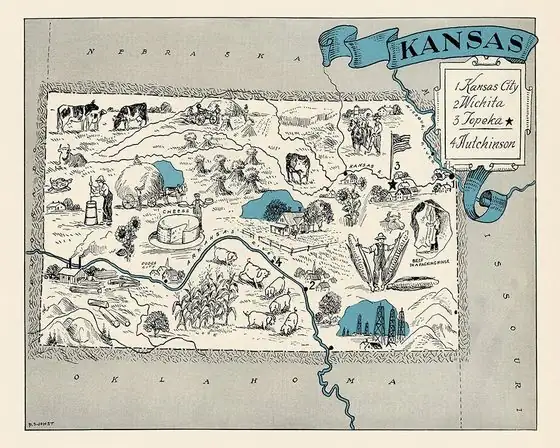
Wamego, Kansas: A Potawatomi Name and a Water Story
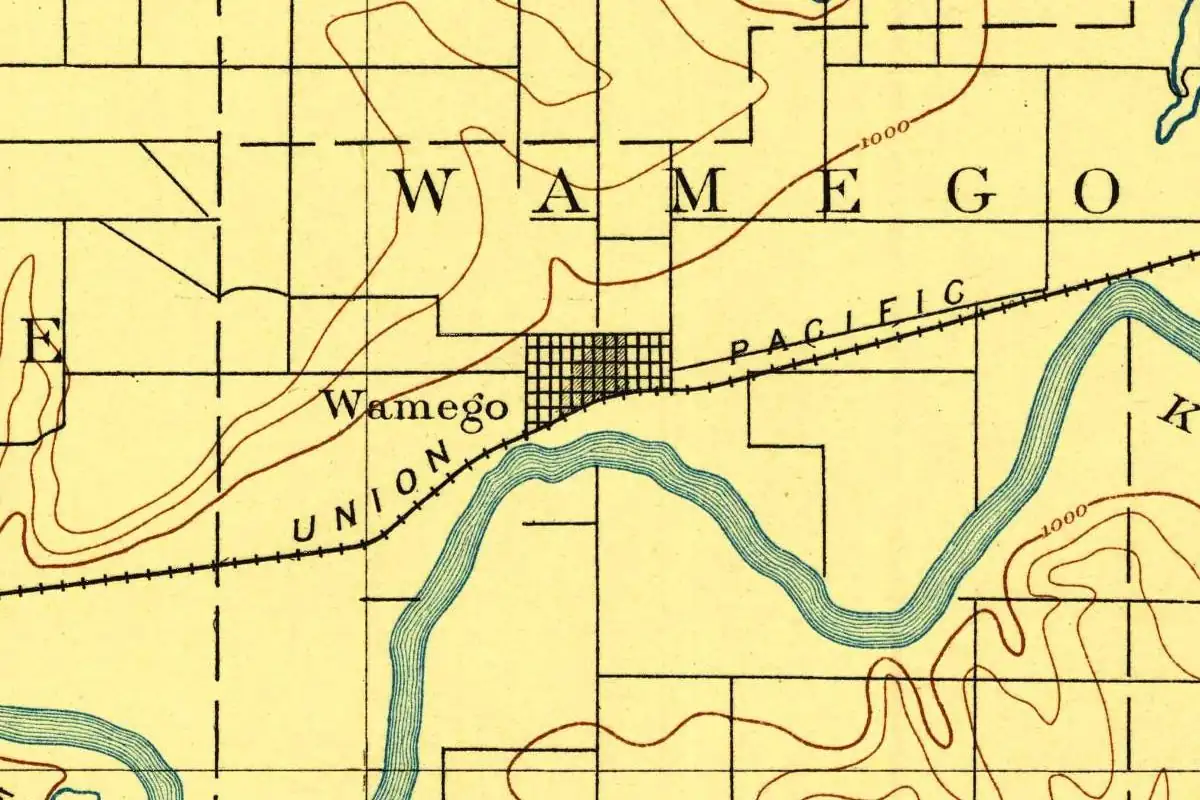
Wamego, Kansas, honors a Potawatomi man named Wamego, according to the Citizen Potawatomi Nation, but a 1905 government book gave two other explanations. We give the most weight to the Nation’s account, and we lay out the others so you can see where they came from.
Wamego of the Potawatomi
The Citizen Potawatomi Nation published the history of the Wamego family in 2025. It says Wamego was among the Potawatomi forced from their homes in 1838 on what’s remembered as the Trail of Death: 859 people made to walk 660 miles (1,062 km) from northern Indiana to eastern Kansas, and more than 40 died on the way. In Kansas he had a son, Joseph Che-quas Wamego, baptized at St. Marys on January 19, 1858.
The Nation is direct about the town: “The town of Wamego, Kansas, later received its name in 1866 in honor of Wamego of the Potawatomi, whose pursuit of peace helped to ensure the survival of his people.” His descendants are one of the Nation’s founding families.
Wamego’s name is on paper from those years. The Potawatomi treaty of 1861, printed in Charles J. Kappler’s Indian Affairs: Laws and Treaties (1904), opens:
“Articles of a treaty made and concluded at the agency on the Kansas River, on the fifteenth day of November, in the year of our Lord one thousand eight hundred and sixty-one, by and between Wm. W. Ross, commissioner on the part of the United States, and the undersigned chiefs, braves, and head-men of the Pottawatomie Nation…”
Among the signatures is “Wa-me-go, his x mark.”
What Gannett heard
Henry Gannett’s The Origin of Certain Place Names in the United States, a Geological Survey bulletin of 1905, gave two explanations in one entry. The first: the place was “said to be so named because formerly there was no water in the village. An Indian word meaning ‘clear of springs.’” The second: “Other authorities say that it was named for an Indian chief whose name meant ‘running waters.’”
Those two meanings point in opposite directions, and Gannett doesn’t name his informants for either one. We don’t translate the name here. The sources we read don’t agree on what the word means, and the Nation’s account, the one that comes from his own people, doesn’t give a translation.
A Union Pacific town on the Kaw
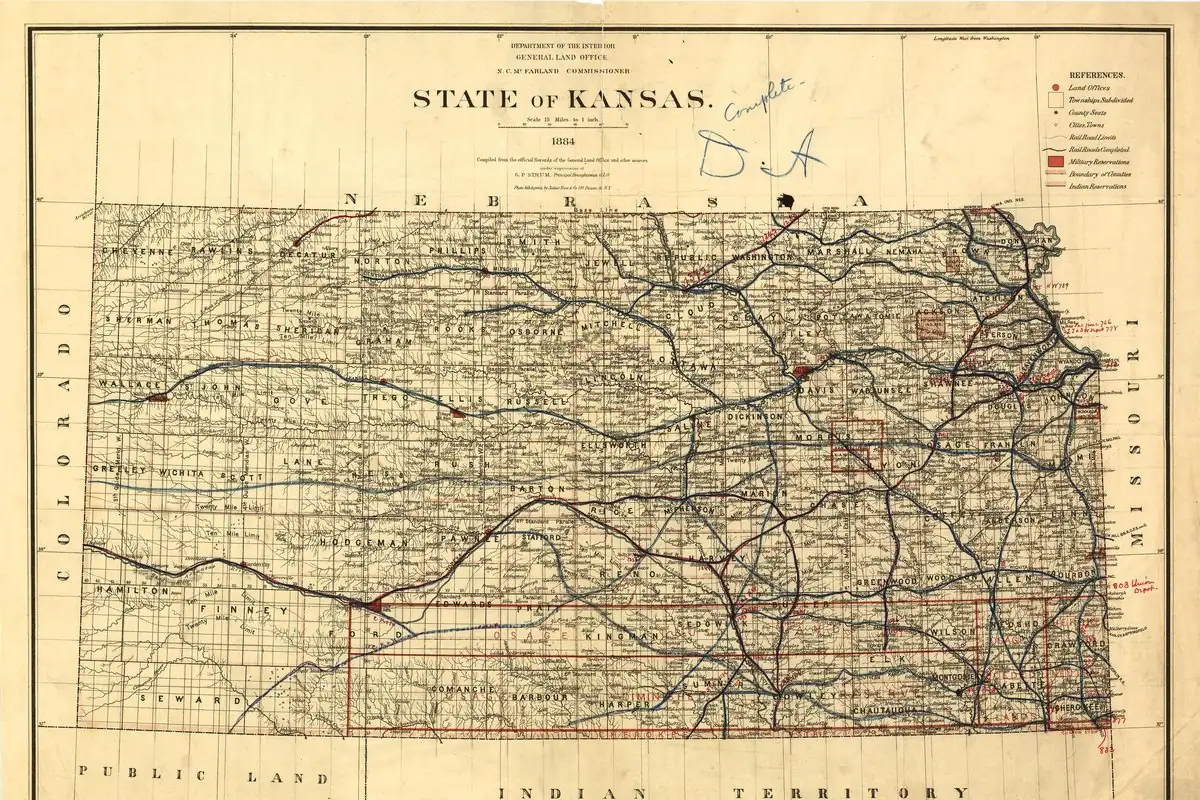
The town itself came with the railroad. In William G. Cutler’s account, published in 1883 in his History of the State of Kansas, Hugh S. Walsh, general agent of the Wamego Town Site Company, filed the plat on June 12, 1866, and more additions followed in 1870. Wamego sat “on the banks of the Kaw,” another name for the Kansas River, and at the end of the first division of the Kansas Division of the Union Pacific, 104 miles (167 km) from Kansas City. That meant a roundhouse and shops, and work for “a very considerable number of laborers.” A wagon bridge over the river, paid for mostly with bonds the townspeople voted, brought farm produce from Wabaunsee County across to the Wamego station. The town was incorporated in 1869, the Geological Survey’s record says. Neither Cutler nor Blackmar’s 1912 Kansas cyclopedia says anything about where the name came from.
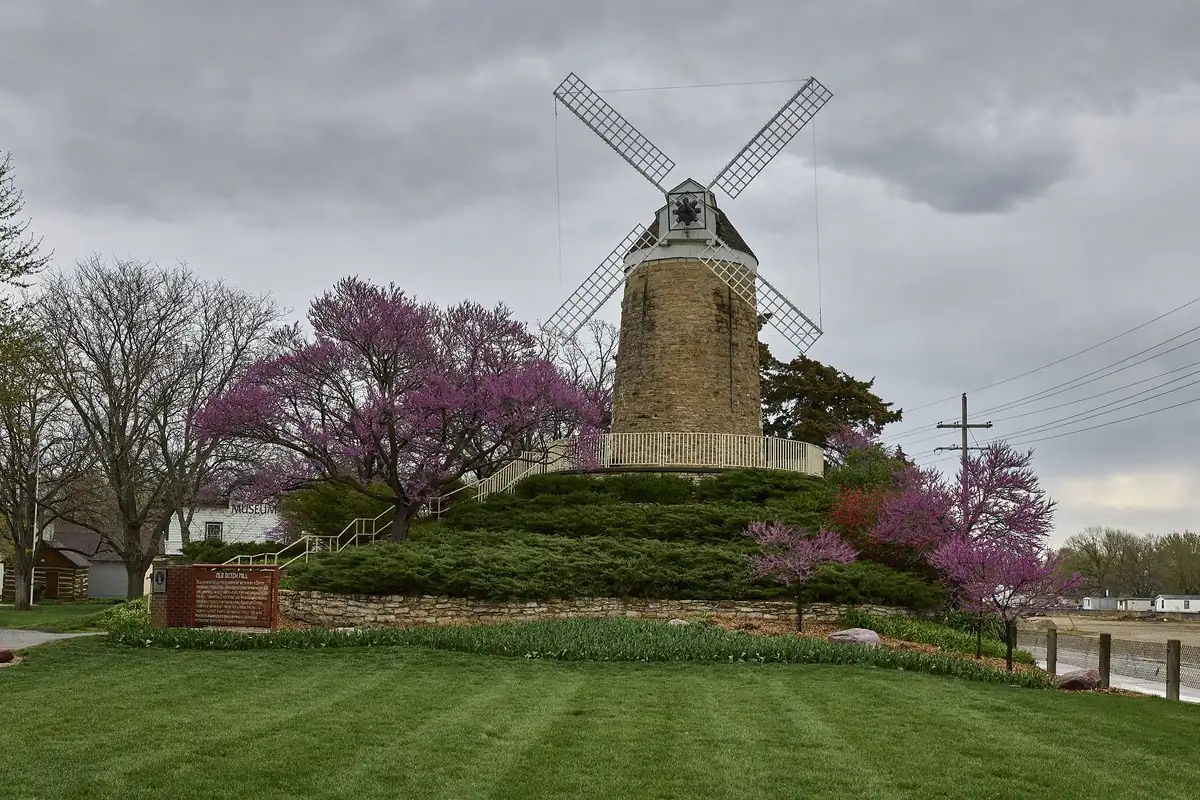
If you visit, look for the stone windmill in the photo below. The Library of Congress record says it was built in 1879 as a flour and cornmeal mill ten miles (16 km) out of town and later taken apart and moved into Wamego stone by stone.
Quick answers
Who was Wamego?
A Potawatomi man who survived the forced removal of 1838 and signed the treaty of November 15, 1861, according to the Citizen Potawatomi Nation. His name appears among the treaty’s signers as “Wa-me-go, his x mark” (Kappler, 1904).
Does Wamego mean “running water”?
That’s one of two meanings in Gannett’s 1905 bulletin, which also gives “clear of springs.” The two contradict each other, and we didn’t find a source that settles it.
When did Wamego get its name?
In 1866, the year the Nation gives and the year Hugh S. Walsh filed the town plat for the Wamego Town Site Company (Cutler, 1883).
Key dates
- 1838Wamego is among the Potawatomi forced west from northern Indiana to eastern Kansas on the Trail of Death.
- 1858January 19: his son, Joseph Che-quas Wamego, is baptized at St. Marys, Kansas.
- 1861November 15: Wa-me-go signs the Potawatomi treaty made at the agency on the Kansas River.
- 1866June 12: Hugh S. Walsh of the Wamego Town Site Company files the town plat.
- 1869Wamego is incorporated, according to the U.S. Geological Survey.
Getting there
Open Wamego in Google Maps
Opens in a new tab. The pin is the center of Wamego in the USGS place-name record.
The closest airports, Amtrak stations and intercity bus stops, measured in a straight line from the center of Wamego.
Airports
- Manhattan Regional (MHK) 20 mi 32 km
- Salina Regional (SLN) 78 mi 125 km
- Kansas City International (MCI) 85 mi 137 km
Amtrak trains
- Topeka station (TOP) 36 mi 58 km
- Lawrence station (LRC) 60 mi 96 km
Intercity buses
- Greyhound Manhattan KS 14 mi 22 km
- FlixBus Topeka BP To Go 36 mi 57 km
Distances are as the crow flies, not by road. We don't list schedules or fares because they change; check with the airline, Amtrak or the bus company before you go. Official data (FAA commercial service airports (2025), FAA airport locations, Amtrak stations and Intercity Bus Atlas) from the FAA and the U.S. Bureau of Transportation Statistics, checked Nov 6, 2026.
Sponsored
Staying in Wamego?
Compare hotels in Wamego, Kansas, on Expedia.
See hotels in WamegoWe may earn a commission if you buy through this link. It never changes what we write. Read our affiliate disclosure
Historical Sources & References
- Citizen Potawatomi Nation, “Wamego family history” (2025). Wamego on the Trail of Death, his son Joseph Che-quas Wamego, the town named in 1866 in his honor and his signature on the 1861 treaty.
- Charles J. Kappler, ed., Indian Affairs: Laws and Treaties, vol. 2 (1904), p. 824. The full treaty of November 15, 1861, with its opening and the signature “Wa-me-go, his x mark.” Online edition of the Oklahoma State University Libraries.
- Henry Gannett, The Origin of Certain Place Names in the United States, 2nd ed. (1905), p. 314. Both of Gannett’s explanations: no water in the village, “clear of springs,” and a chief whose name meant “running waters.”
- William G. Cutler, History of the State of Kansas (1883), Pottawatomie County, part 6. The plat of June 12, 1866, the additions of 1870, the Union Pacific division point 104 miles (167 km) from Kansas City and the wagon bridge.
- Frank W. Blackmar, ed., Kansas: A Cyclopedia of State History, vol. 2 (1912), p. 875. The 1866 plat by Hugh S. Walsh, the shops and roundhouse, and the population of 1,714 in 1910.
- GNIS feature 476420 (U.S. Geological Survey). The USGS entry for Wamego in Pottawatomie County, with its coordinates and the note “Platted in 1866 and incorporated in 1869.”
Spot something wrong, or know more? Tell us here. You can also email us or use our contact page. Corrections are noted here with their date, never made silently.