Parsons, Kansas: Named for the Judge Behind the Katy
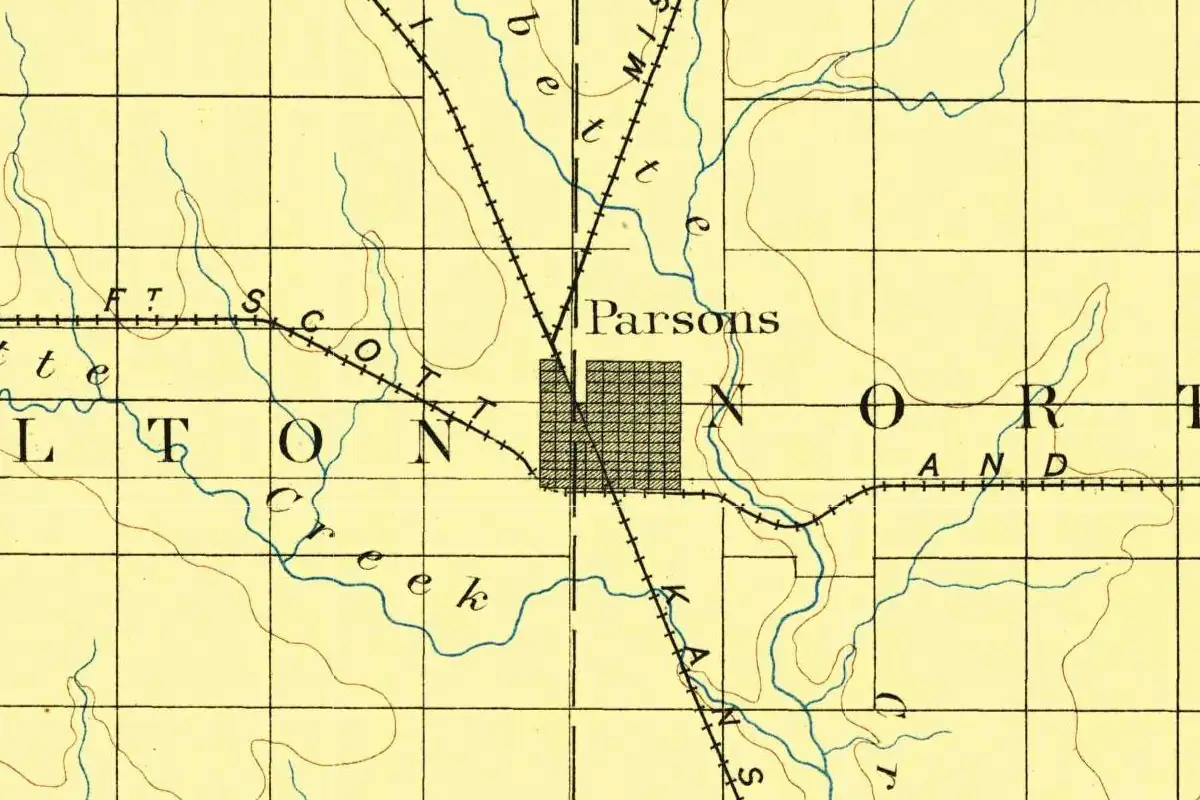
Parsons, Kansas, got its name from Levi Parsons, a judge turned railroad president whose line laid track onto the town site on May 20, 1870. Within a year nearly a whole neighboring town had packed up and moved there.
A judge who went into railroads
The Kansas Historical Society, which keeps his papers, describes him as a New York lawyer who went to California after gold was found, served as the first judge of the Supreme Court in San Francisco from 1850, made a fortune and put it into railroads. He was “the principal promoter and first president of the Missouri, Kansas and Texas Railroad,” the society says, and “the railroad center of Parsons, Kansas, was named for him when it was founded in 1871.” He and Col. Robert Smith Stevens called their road the “Katy.” It began building in 1868 as the Union Pacific Railway, Southern Branch, running diagonally from Junction City toward Chetopa.
Cutler’s state history of 1883 gives the same answer in different railroad terms: “The town was named in honor of Levi Parsons, president of the Neosho Division of the M. P. R. R. Co.” That’s the Missouri Pacific, which is what Cutler calls the line through Parsons. The name of the company changes from source to source; the man doesn’t. Henry Gannett’s Origin of Certain Place Names (1905) calls him “Judge Levi Parsons, a prominent railroad official.”
A town company and track at full speed
Cutler tells the founding in detail. The line was being pushed toward Indian Territory “with all possible energy” to win the right of way through it. Track reached the site on May 20, 1870, and kept going at a mile (1.6 km) a day. That fall L. F. Olney of Parkersville came to survey and plat the town, and a town company was already in place, with R. S. Stevens as president and O. B. Gunn, H. D. Minck, A. D. Jaynes, J. R. Barrett and N. S. Goss. An agent bought up the farm claims, 2,560 acres in all.
If you had come that winter, you’d have found people who didn’t wait for the plat. They lived “temporarily in wagons, tents, and hastily-built board houses,” Cutler says. On March 8, 1871, the company opened its books, and Abraham Carey paid $500 for the first lot, on the corner of Forest and Central avenues.
Ladore moves in
Then came the neighbors. Ladore, five miles (8 km) northwest in Neosho County, had about a thousand people, and Cutler writes that it “was almost wholly moved to Parsons.” Two smaller towns, Montana, about nine miles (14 km) southeast on the Neosho, and Labette, eight miles (13 km) southeast, gave up some of their people too. On April 25, 1871, Parsons became a city of the third class.
If you read Cutler’s list of firsts, two stand out. The first sermon, by the Presbyterian Rev. H. H. Cambern in 1871, was preached in a saloon, “a whisky barrel being used as a desk or pulpit.” And the first baby born in town was named Parsons Dana, son of W. W. and Nancy J. Dana. R. S. Stevens gave him a town lot.
Quick answers
Who was Levi Parsons?
Levi Parsons (1822-1887) was a lawyer and judge from New York who became the first president of the Missouri, Kansas and Texas Railroad (Kansas Historical Society). Cutler (1883) calls him president of the Neosho Division of the line through town.
What does “Katy” have to do with Parsons?
The Katy was the nickname Levi Parsons and Robert Smith Stevens gave their railroad, the Missouri, Kansas and Texas, according to the Kansas Historical Society. Stevens also headed the Parsons town company.
Where did the first people of Parsons come from?
Many came from Ladore, a town of about a thousand people five miles (8 km) to the northwest, which Cutler says “was almost wholly moved to Parsons.” Montana and Labette sent some too.
Key dates
- 1868The railroad later called the Katy starts building from Junction City toward Chetopa as the Union Pacific Railway, Southern Branch.
- 1870May 20: track laying reaches the site of Parsons and goes on at a mile (1.6 km) a day.
- 1871March 8: the town company opens its books, and Abraham Carey buys the first lot for $500.
- 1871April 25: Parsons becomes a city of the third class.
- 1887Levi Parsons dies.
Getting there
Open Parsons in Google Maps
Opens in a new tab. The pin is the center of Parsons in the USGS place-name record.
The closest airports, Amtrak stations and intercity bus stops, measured in a straight line from the center of Parsons.
Airports
- Joplin Regional (JLN) 44 mi 71 km
- Tulsa International (TUL) 86 mi 139 km
- Kansas City International (MCI) 138 mi 223 km
Intercity buses
- Jefferson Lines Chanute 26 mi 42 km
Distances are as the crow flies, not by road. We don't list schedules or fares because they change; check with the airline, Amtrak or the bus company before you go. Official data (FAA commercial service airports (2025), FAA airport locations, Amtrak stations and Intercity Bus Atlas) from the FAA and the U.S. Bureau of Transportation Statistics, checked Nov 6, 2026.
Sponsored
Staying in Parsons?
Compare hotels in Parsons, Kansas, on Expedia.
See hotels in ParsonsWe may earn a commission if you buy through this link. It never changes what we write. Read our affiliate disclosure
Historical Sources & References
- William G. Cutler, History of the State of Kansas (1883), Labette County, part 4. The track of May 20, 1870, the town company, the name “in honor of Levi Parsons,” the first lot of March 8, 1871, Ladore’s move, the city charter of April 25, 1871, the saloon sermon and Parsons Dana.
- Kansas Historical Society, Levi Parsons papers. Parsons’s life from 1822 to 1887, his San Francisco judgeship, his role as first president of the Missouri, Kansas and Texas, the “Katy” nickname and the 1868 start as the Union Pacific Railway, Southern Branch.
- Henry Gannett, The Origin of Certain Place Names in the United States, 2nd ed. (1905), p. 238. “Named for Judge Levi Parsons, a prominent railroad official.”
- GNIS feature 469782 (U.S. Geological Survey). Parsons’s line in the national names register, with coordinates and the note that it was founded in 1870 and became a city in 1871.
Spot something wrong, or know more? Tell us here. You can also email us or use our contact page. Corrections are noted here with their date, never made silently.