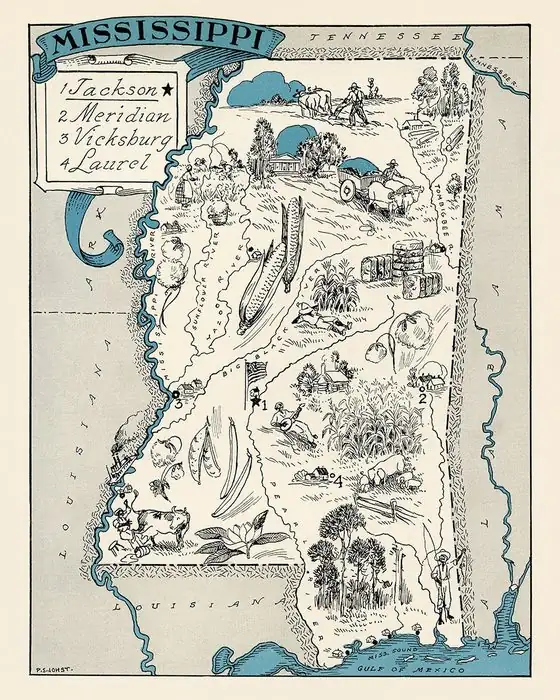
Meridian, Mississippi: A Word Mistaken for Junction
Meridian, Mississippi, got its name from a town founder who, according to the state’s 1938 guidebook, believed the word meant junction. Whatever the dictionary says, the man was standing where two railroads were about to cross, and the name stuck to the station and then to the city.
Two railroads and one plantation
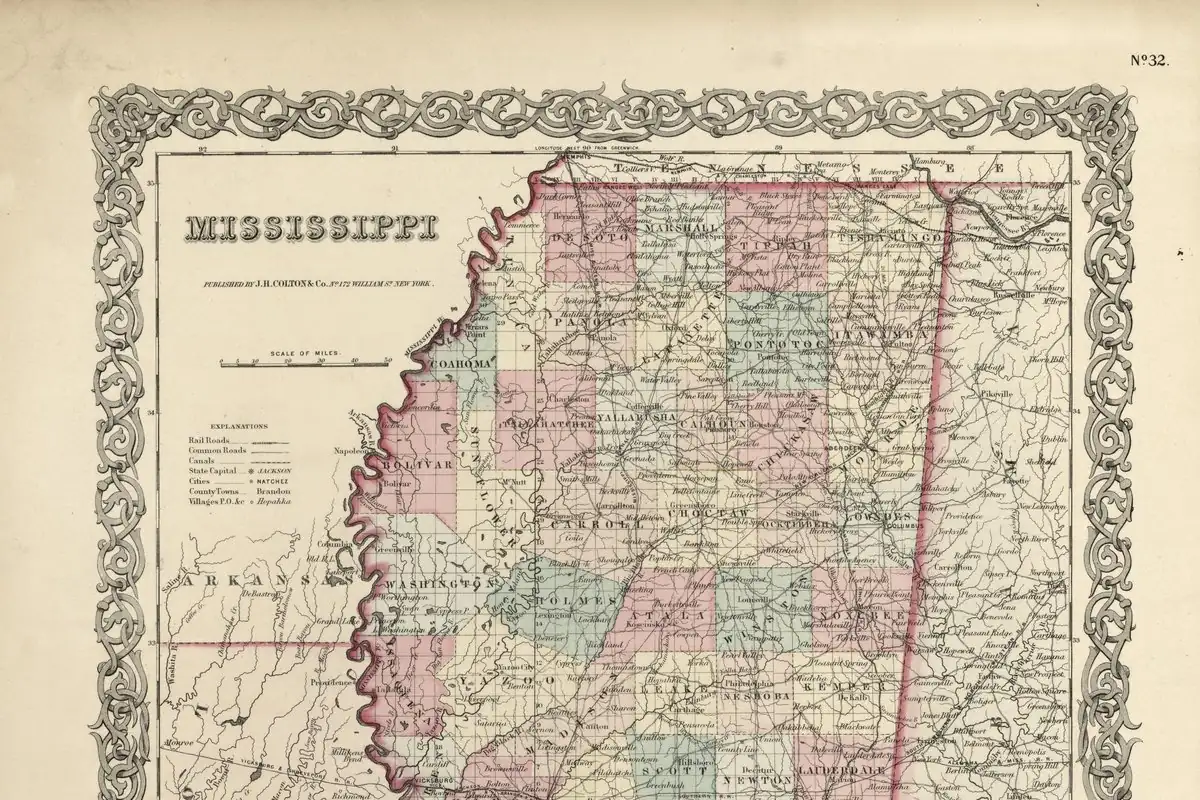
Back in 1831, the Federal Writers’ Project guide says, Richard McLemore came from South Carolina and cleared a plantation where the city stands today. In 1854 plans were made for the Vicksburg & Montgomery, an east-west line, to cross the Mobile & Ohio, which ran north to south near the state’s eastern edge. “Their junction was to be on McLemore’s plantation.”
McLemore sold the land to L. A. Ragsdale and J. T. Ball, whom the guide calls “pioneer railroad men,” and they “immediately built the one-room, red and yellow ‘union station.’” The train from Vicksburg didn’t actually roll in until 1861.
A sign that went up every morning
This is where the guide tells the story you came for. The farm families who’d been there first and the families who came in with the railroads each thought they ran the place, and the contest got worse over the name. The guide puts it this way:
“Each morning the first would nail up the sign ‘Meridian,’ and each night the second would tear it down to make way for his own ‘Sowashee.’”
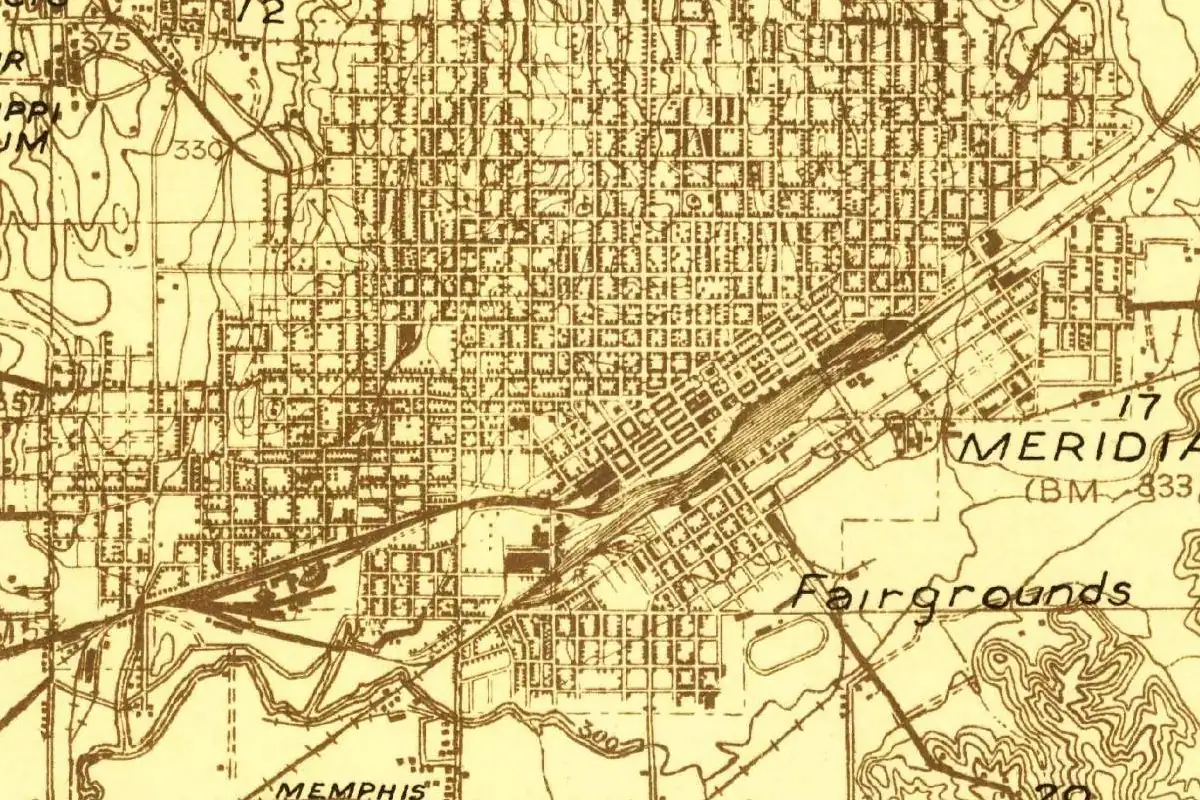
The first man was the one who believed “meridian” was “synonymous with junction.” The second, backed by the farmers, wanted the name of the nearby creek, Sowashee, which the guide glosses as “mad river” without saying which language the word comes from. The railroad workers kept coming, and in the end “Meridian” stayed on the station for good. The two men had also staked out different street plans, and the guide blames that fight for the jumble of streets “intersecting at curious angles” that, in 1938, still gave the city its look. You can check it on the map above.
Ball’s post office and Ragsdale City
Dunbar Rowland’s 1907 encyclopedia of Mississippi tells it with less drama and different rivals. In his version the Mobile & Ohio, which hardly thought the spot worth a switch, called its flag stop “Sowashee Station,” from the creek. Ragsdale bought out the plantation owner, Ball bought 80 acres, and both began laying off town lots. “Mr. Ragsdale’s plat was for ‘Ragsdale City;’ Mr. Ball’s for ‘Meridian,’ he having first secured a postoffice by that name.”
In the end the post office decided it. “The postoffice name was adopted for the charter,” Rowland writes, and the city of Meridian became a legal corporation on January 10, 1860. In his entry on Lauderdale County he sums the early years up in one line: until 1854 the place was a junction point “whose very name was in dispute.”
Put the two books side by side and you get one name with two rival names behind it. Rowland names Ball as the Meridian man and Ragsdale City as the other choice; the guide names both men but never says which one wanted which name, and it makes Sowashee the rival. Neither book gives any other reason for the word than the guide’s “junction.”
The 1921 survey map shows what that junction turned into: tracks cutting straight through town, with the blocks on either side set at different angles.
Quick answers
Why is it called Meridian, Mississippi?
Because a founder liked the word. The 1938 state guide says one of the two town fathers believed “meridian” meant junction and chose it for the new railroad crossing.
Which other names did Meridian almost have?
Sowashee Station. That’s what the Mobile & Ohio called its flag stop there, after a nearby creek, according to Rowland (1907). A rival founder wanted “Ragsdale City” for his own plat.
Who named Meridian?
John T. Ball, in Rowland’s account: he got a post office called Meridian, and that name went into the city’s charter of January 10, 1860. The WPA guide tells a similar story but doesn’t say which of its two founders picked the name.
Key dates
- 1854Plans are made for the Vicksburg & Montgomery to cross the Mobile & Ohio on Richard McLemore's plantation (WPA guide).
- 1860The legislature grants the charter of the city of Meridian on January 10 (Rowland).
- 1861The first Vicksburg & Montgomery train arrives from Vicksburg (WPA guide).
Getting there
Open Meridian in Google Maps
Opens in a new tab. The pin is the center of Meridian in the USGS place-name record.
The closest airports, Amtrak stations and intercity bus stops, measured in a straight line from the center of Meridian.
Airports
- Key Field (MEI) Meridian 4 mi 6 km
- Hattiesburg/Laurel Regional (PIB) Moselle 72 mi 116 km
Amtrak trains
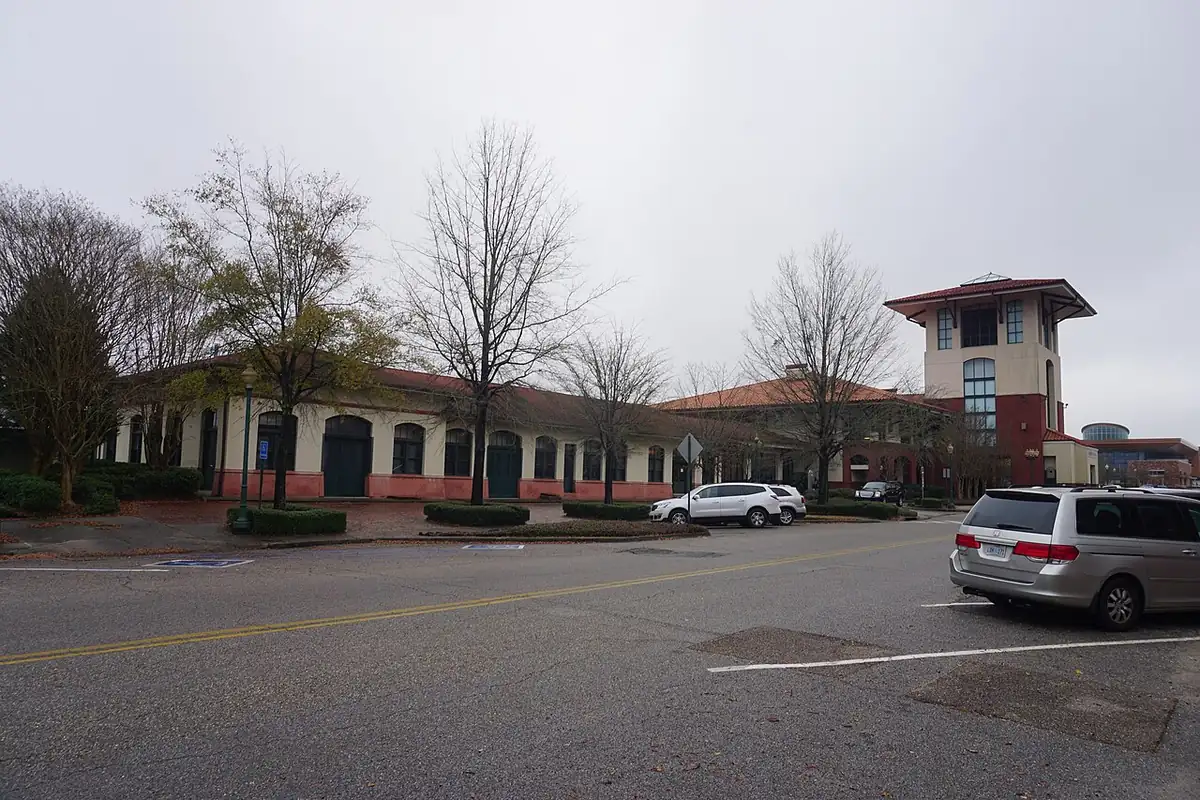
- Meridian station (MEI) under 1 mi 0.7 km
- Laurel station (LAU) 53 mi 85 km
Intercity buses
- Greyhound Meridian Bus Stop under 1 mi 0.7 km
Distances are as the crow flies, not by road. We don't list schedules or fares because they change; check with the airline, Amtrak or the bus company before you go. Official data (FAA commercial service airports (2025), FAA airport locations, Amtrak stations and Intercity Bus Atlas) from the FAA and the U.S. Bureau of Transportation Statistics, checked Nov 6, 2026.
Sponsored
Staying in Meridian?
Compare hotels in Meridian, Mississippi, on Expedia.
See hotels in MeridianWe may earn a commission if you buy through this link. It never changes what we write. Read our affiliate disclosure
Historical Sources & References
- Federal Writers’ Project, Mississippi: A Guide to the Magnolia State (1938), pp. 228-229. McLemore’s plantation, the planned crossing of 1854, the “union station,” the founder who thought “meridian” meant junction, the nightly fight over the sign and the tangled street plans.
- Dunbar Rowland, ed., Mississippi, vol. 2 (1907), pp. 58 and 218-219. “Sowashee Station,” the rival plats for Ragsdale City and Meridian, Ball’s post office and the charter of January 10, 1860.
- GNIS feature 673491 (U.S. Geological Survey). The national gazetteer listing for Meridian, in Lauderdale County.
Spot something wrong, or know more? Tell us here. You can also email us or use our contact page. Corrections are noted here with their date, never made silently.