Caliente, Nevada: Hot Springs, and a Post Office Cut the S
Caliente, Nevada, was laid out in 1901 as Calientes, for its hot springs, and lost the final s when the post office opened that summer. Before that, the place in the Meadow Valley Wash had been Dutch Flat and then simply Culverwell, after the ranch family that owned it.
Culverwell’s ranch and a railroad standoff
The City of Caliente’s own history runs through the names in order. In the early 1870s the meadow was known as Dutch Flat, with the Jackman Ranch on it. In 1874 the ranchers Charles and William Culverwell bought that ranch and renamed it Culverwell Ranch, “later referred to as ‘Culverwell.’” They made a living ranching and selling hay to the mining camps at Pioche and Delamar.
Then two railroads wanted the same narrow canyon. E. H. Harriman’s Oregon Short Line and Union Pacific was building in from Utah, and Senator William Clark’s new San Pedro, Los Angeles and Salt Lake claimed the same ground. The canyon was wide enough for only one set of tracks. The fight ended in 1901 at the ranch, and here the two official accounts don’t quite agree on who held the gun. The city says William Culverwell “ended the Harriman-Clark battle with his shotgun.” The state historical marker gives the shotgun to “rancher Charles Culverwell,” who then allowed one railroad grade through his meadows. Either way, it was a Culverwell.
From Calientes to Caliente
Once the two railroads made peace, the city says, “Culverwell became ‘Calientes’ (the Spanish word for hot) after the hot springs found in a cave at the base of the surrounding mountains.” The town was surveyed, and on August 3, 1901, a post office opened and “postal officials renamed the town Caliente, dropping the ‘s’.”
You don’t have to take the city’s word for the spelling change alone. The two-volume state history Sam P. Davis edited in 1913 says the same thing in fewer words: “Calientes was laid out in 1901, and held that name until the Post Office was established when it dropped the final ‘s.’” As for the word itself, Henry Gannett’s 1905 place-name book, writing about the Caliente towns of California, calls it “the Spanish form for ‘hot,’ ‘vehement.’”
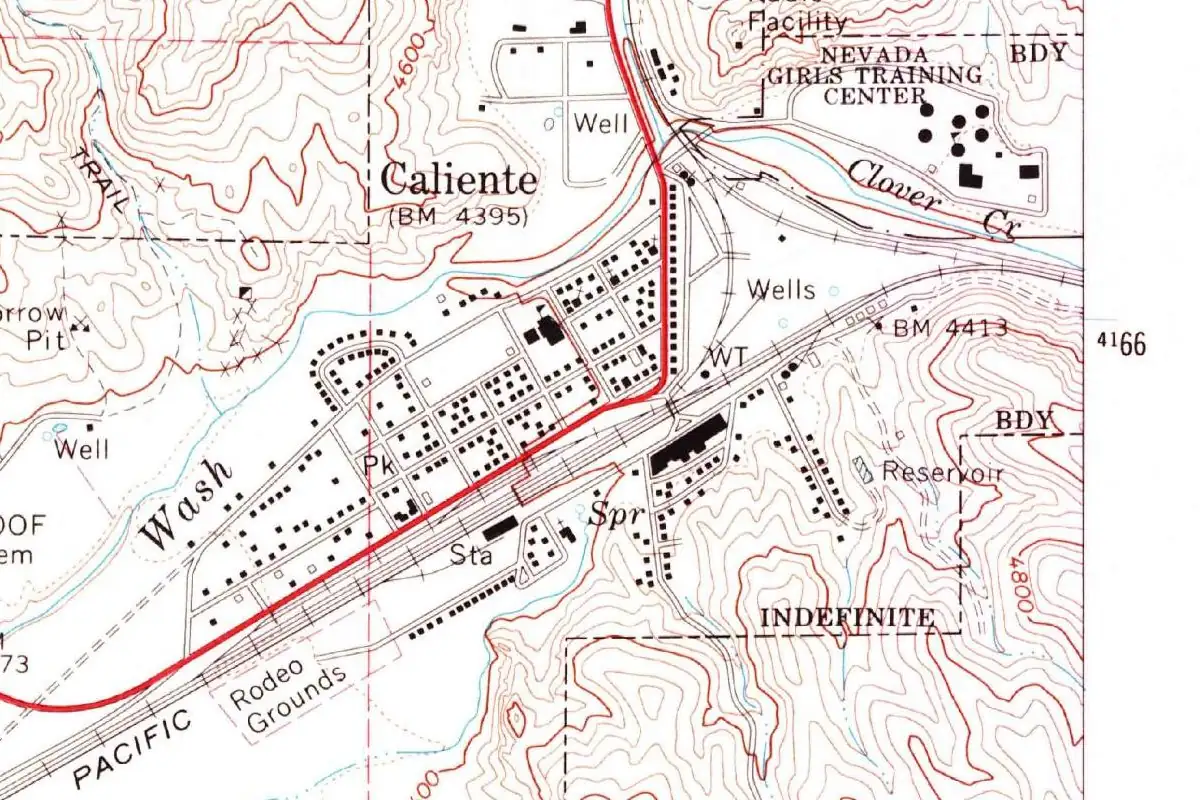
On the 1970 survey map you can spot a spring, marked “Spr,” just across the tracks from the station. The map doesn’t say whether that one is hot, so don’t read too much into it.
A division point in the wash
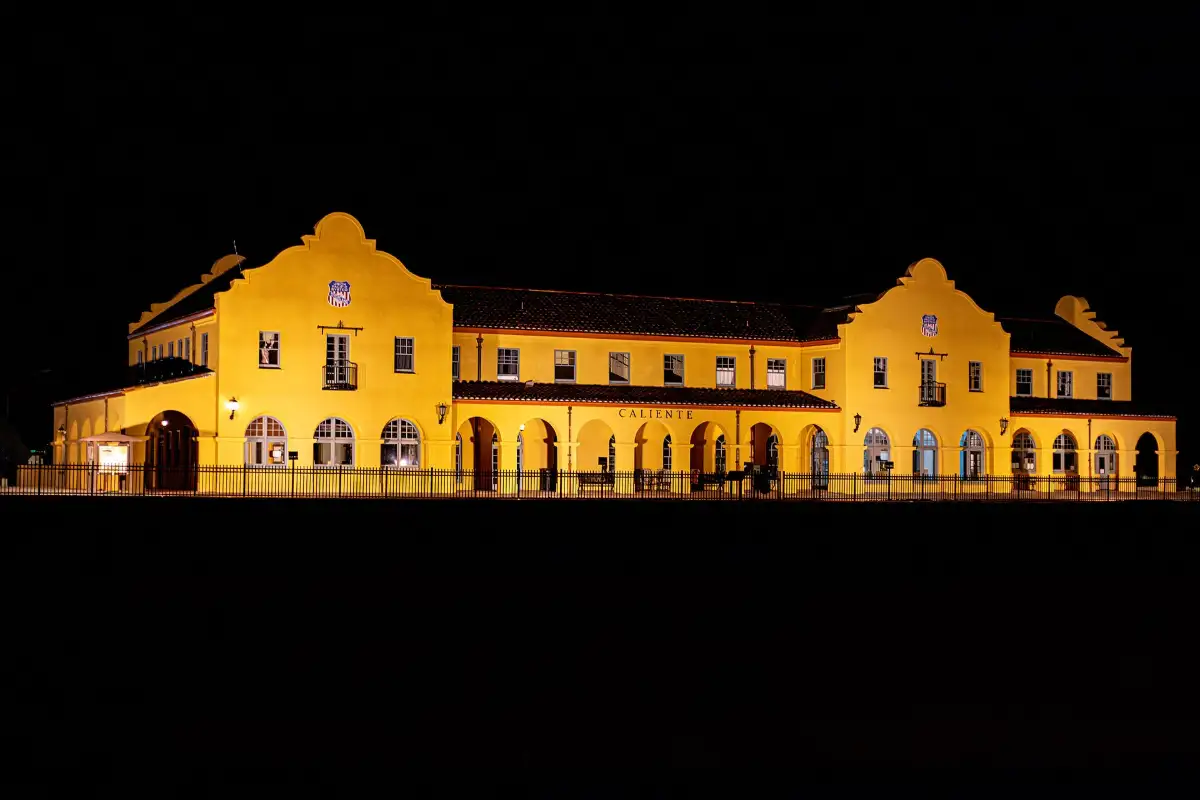
Once the line was finished in 1905, Caliente became a division point, and the state marker says the population boom came with railroad workers, most of them immigrants from Austria, Japan and the Ottoman Empire. By 1910, according to the city, it was the largest town in Lincoln County, with 1,755 residents. The big Mission Revival depot followed in 1923, serving as a civic center and a hotel as well as a station.
Quick answers
What does Caliente mean?
Hot. The City of Caliente calls it “the Spanish word for hot,” and Gannett (1905) gives “hot” and “vehement” for the same word.
Why is Caliente, Nevada, called Caliente?
For the hot springs in a cave at the base of the nearby mountains, according to the city’s history. The town was first called Calientes.
Why did Caliente drop the s?
Postal officials shortened the name when the post office opened on August 3, 1901, the city says, and Davis’s 1913 history agrees that the town lost the final “s” with the post office.
Key dates
- 1874Charles and William Culverwell buy the Jackman Ranch and rename it Culverwell Ranch (City of Caliente).
- 1901The right-of-way fight ends at the Culverwell ranch; Calientes is laid out, and a post office opens on August 3 as Caliente (City of Caliente; Davis).
- 1905The railroad line is completed and Caliente becomes a division point (City of Caliente; state marker).
- 1923The large Mission Revival depot is built (state marker).
Getting there
Open Caliente in Google Maps
Opens in a new tab. The pin is the center of Caliente in the USGS place-name record.
The closest airports, Amtrak stations and intercity bus stops, measured in a straight line from the center of Caliente.
Airports
- St George Regional (SGU) St. George 68 mi 109 km
- Cedar City Regional (CDC) 78 mi 125 km
- Harry Reid International (LAS) Las Vegas 112 mi 180 km
Intercity buses
- Salt Lake Express Beaver Dam 59 mi 95 km
Distances are as the crow flies, not by road. We don't list schedules or fares because they change; check with the airline, Amtrak or the bus company before you go. Official data (FAA commercial service airports (2025), FAA airport locations, Amtrak stations and Intercity Bus Atlas) from the FAA and the U.S. Bureau of Transportation Statistics, checked Nov 6, 2026.
Sponsored
Staying in Caliente?
Compare hotels in Caliente, Nevada, on Expedia.
See hotels in CalienteWe may earn a commission if you buy through this link. It never changes what we write. Read our affiliate disclosure
Historical Sources & References
- City of Caliente, “History of the City of Caliente”. Dutch Flat and the Jackman Ranch, the Culverwells’ purchase in 1874, the right-of-way fight, “Calientes” for the hot springs, the post office of August 3, 1901, and the 1,755 residents of 1910.
- Sam P. Davis, ed., The History of Nevada, vol. 2 (1913), p. 947. “Calientes was laid out in 1901, and held that name until the Post Office was established when it dropped the final ‘s.’”
- Nevada State Historic Preservation Office, State Historical Marker No. 55. Charles Culverwell’s shotgun, the railroad workers, the division point of 1905 and the depot of 1923.
- Henry Gannett, The Origin of Certain Place Names in the United States (1905), p. 64. Caliente as “the Spanish form for ‘hot,’ ‘vehement’” (entry for the California towns).
- GNIS feature 847266 (U.S. Geological Survey). The national place-name index entry for Caliente, in Lincoln County, founded in 1901.
Spot something wrong, or know more? Tell us here. You can also email us or use our contact page. Corrections are noted here with their date, never made silently.