Asbury Park, New Jersey: A Methodist Bishop's Beach Town
The town honors Francis Asbury, the pioneer bishop of American Methodism. James A. Bradley, a New York brush manufacturer, bought the land north of the Ocean Grove camp-meeting grounds on January 24, 1871, laid out lots and parks, and named the place Asbury Park in the bishop's honor, according to an 1885 county history.
A brush maker at the camp meeting
James A. Bradley, a New York brush maker who bought the land in 1871, named his new seaside town Asbury Park in honor of Methodist bishop Francis Asbury. To see why a beach town got a bishop’s name, you have to start one lake to the south, at Ocean Grove.
Ocean Grove was a Methodist camp-meeting ground on the shore. Franklin Ellis’s 1885 History of Monmouth County lets Bradley tell his own story there. In May 1870 he ran into David H. Brown on Broadway in New York, heard about the new grounds, and bought the first lot ever sold at Ocean Grove. He and a helper named John Baker camped there in an unfinished building, with carriage cushions for pillows, and woke up on June 10 to Baker’s verdict: “Mr. B., this is a wilderness place.”
The land across the lake
During that August’s camp meeting, Bradley says, people kept asking who owned the land on the other side of the lake. He and Rev. William B. Osborn pushed through the briars until they reached Sunset Lake, and they liked what they saw. The trouble was the owner wouldn’t sell in pieces. It was all or nothing, all “five hundred acres.”
A group of eight backers cooled off by autumn. Then Bradley heard that Bishop Simpson of the Methodist Episcopal Church was urging the Ocean Grove Association to buy the land, so it wouldn’t fall into the hands of someone who didn’t share their aims. The price was about $90,000. The association voted no, and Bradley bought it himself.
George F. Bacon’s 1892 booklet Asbury Park & Ocean Grove quotes a writer who made the motive even plainer. The land was bought by “a capitalist who was moved to do so by the fear that it might fall into hands inimical to the religious objects held in view at the great camp-meeting grounds just below.” Bacon then names the capitalist: Bradley, “the head of a great brush manufacturing concern in New York City.”
How it got the name
Ellis gives the purchase and the naming together, on page 865:
“This and two other tracts were purchased of Luther Elting, January 24, 1871, the three tracts containing six hundred and fifty-eight acres. A portion of the first tract mentioned was platted and laid out into lots fifty by one hundred and fifty feet, fronting on avenues from seventy-five to one hundred feet in width. The parks were also located and the place was named Asbury Park, in honor of Bishop Francis Asbury.”
The “first tract” is the one the town stands on, which Ellis puts at 387 acres. Bradley’s own memory was “five hundred acres,” and the Asbury Park Museum’s timeline also says 500. So the numbers don’t match exactly, but the date and the name do. The museum dates the naming to the same January 24, 1871.
Ellis says the parks were laid out at the same time, but he doesn’t explain why “Park” ended up in the name, and neither do Bacon or Gannett. So treat any reason you hear for it as a guess.
Who Francis Asbury was
Henry Gannett’s 1905 USGS bulletin on place names calls Francis Asbury “the pioneer bishop of Methodism in America” and notes that several towns in the southern states carry his name too. Bacon’s quoted writer used nearly the same words: “the pioneer bishop of the Methodist Church in America.”
Asbury wasn’t a stranger to this part of New Jersey. Ellis says his journal records trips to Monmouth, the county seat, in 1785 and 1786, 1791 and 1795. He wasn’t always charmed. On October 28, 1795, he wrote that some things practiced “in the Jersies” were “more brutish and diabolical than in any other of the States,” adding that in New England “They learn civility there at least.” You can decide for yourself whether naming a town after him decades later was a compliment the county had earned.
The Asbury Park Museum describes Bradley as a “devout convert to Methodism” who was inspired by Asbury’s teachings and by the Ocean Grove camp. Bacon’s quoted writer adds one more detail: Bradley’s title deeds banned making or selling liquor.
From lots to a city
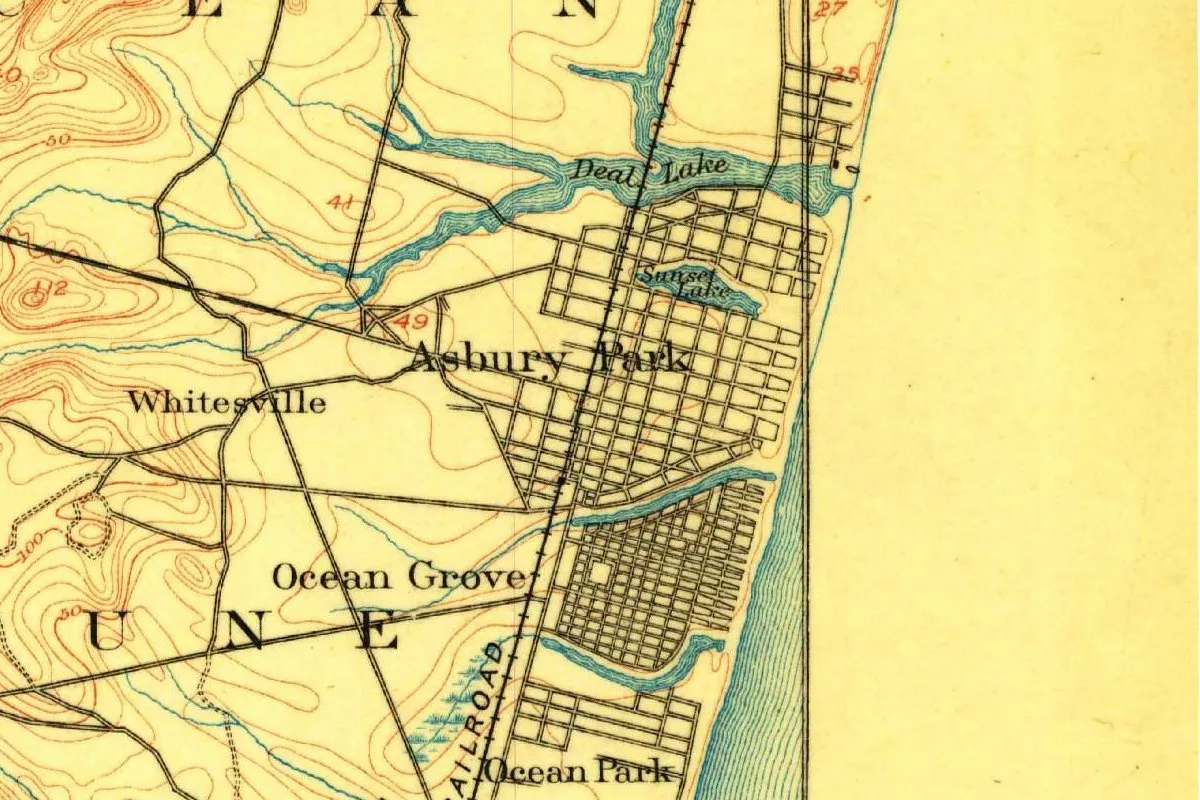
Park Hall, a two-story frame hall put up right away, served, Ellis says, as headquarters for nearly every church, society and business in the young town. On the 1888 survey sheet above, you can see how it turned out: a full street grid between Deal Lake, which Ellis says was once called Great Pond, and the narrow lake that separates it from Ocean Grove, which he gives as Long Pond, now Wesley Lake.
An act to incorporate Asbury Park followed in 1874. Ellis dates it to March 4, while the museum’s timeline says the borough was incorporated on March 26. The museum adds that Asbury Park didn’t become a self-governing city until 1893.
Quick answers
Who was Asbury Park named after?
Francis Asbury, the pioneer Methodist bishop in America. Ellis’s 1885 county history says the place was named “in honor of Bishop Francis Asbury.”
Who founded Asbury Park?
James A. Bradley, a New York brush manufacturer. He bought the land on January 24, 1871, after the Ocean Grove Association decided not to buy it.
How big was Bradley’s purchase?
Sources differ. Ellis gives 387 acres for the town tract and 658 acres for all three tracts; Bradley recalled “five hundred acres,” and the town museum also says 500.
Key dates
- 1795October 28: Bishop Francis Asbury writes in his journal about a visit to Monmouth, one of several trips he made there.
- 1870June 10: Bradley wakes up after his first night camping at Ocean Grove, where he had bought the first lot ever sold.
- 1871January 24: Bradley buys the land from Luther Elting. The place is laid out and named Asbury Park for Bishop Asbury.
- 1874An act to incorporate Asbury Park passes. The 1885 county history dates it March 4; the town's museum says March 26.
- 1893Asbury Park becomes a self-governing city, according to the Asbury Park Museum.
Getting there
Open Asbury Park in Google Maps
Opens in a new tab. The pin is the center of Asbury Park in the USGS place-name record.
The closest airports, Amtrak stations and intercity bus stops, measured in a straight line from the center of Asbury Park.
Airports
- John F Kennedy International (JFK) New York 31 mi 51 km
- Newark Liberty International (EWR) 34 mi 54 km
Amtrak trains
- Metropark station (MET) 29 mi 47 km
- New Brunswick station (NBK) 30 mi 48 km
Intercity buses
- Monsey Trails Squankum & Kennedy 13 mi 21 km
- OurBus South Amboy - Cheesequake, NJ (Southbound side bus parking area across from service area building) 22 mi 36 km
- Suburban Transit Monroe Town - Stonebridge 24 mi 39 km
Distances are as the crow flies, not by road. We don't list schedules or fares because they change; check with the airline, Amtrak or the bus company before you go. Official data (FAA commercial service airports (2025), FAA airport locations, Amtrak stations and Intercity Bus Atlas) from the FAA and the U.S. Bureau of Transportation Statistics, checked Nov 13, 2026.
Sponsored
Staying in Asbury Park?
Compare hotels in Asbury Park, New Jersey, on Expedia.
See hotels in Asbury ParkWe may earn a commission if you buy through this link. It never changes what we write. Read our affiliate disclosure
Sponsored
Want the spooky side of Asbury Park?
The name has its story above. For the ghost stories, US Ghost Adventures runs walking ghost tours in Asbury Park.
See ghost tours in Asbury ParkWe may earn a commission if you book through this link. It never changes what we write. Read our affiliate disclosure
Historical Sources & References
- Franklin Ellis, History of Monmouth County, New Jersey (1885), pp. 390, 853 and 864-865. Asbury’s journal visits to Monmouth and the October 28, 1795 entry (p. 390); Long Pond, “now called Wesley Lake” (p. 853); Great Pond (now Deal Lake), Bradley’s account of Ocean Grove in 1870, the August walk to Sunset Lake, “five hundred acres,” Bishop Simpson and the $90,000 price (pp. 864-865); the purchase from Luther Elting on January 24, 1871, the 387- and 658-acre figures, the naming “in honor of Bishop Francis Asbury,” Park Hall and the act of March 4, 1874 (p. 865).
- George F. Bacon, Asbury Park & Ocean Grove (1892), pp. 18-19. The quoted account of the “capitalist” who named the town after Bishop Asbury and banned liquor in his deeds, and the identification of that man as Bradley.
- Henry Gannett, The Origin of Certain Place Names in the United States (USGS, 1905), p. 29. Asbury Park named for Francis Asbury, “the pioneer bishop of Methodism in America.”
- Asbury Park Museum, Asbury Park Year By Year. The 500 acres, the naming dated January 24, 1871, and the borough incorporation of March 26, 1874.
- Asbury Park Museum, A Short History of Asbury Park. Bradley as a “devout convert to Methodism” and the move to a self-governing city in 1893.
- GNIS feature 874396 (U.S. Geological Survey). Asbury Park’s listing in the Geographic Names Information System, with Monmouth as its county.
- U.S. Geological Survey, Asbury Park sheet (1888). The 1888 sheet, surveyed in 1884, from which the map above was cropped.
Spot something wrong, or know more? Tell us here. You can also email us or use our contact page. Corrections are noted here with their date, never made silently.