Promontory, Utah: The Summit, Not the Point
Promontory, Utah, the railroad town where the rails met in 1869, took its name from the Promontory Mountains, and it sat on a summit, not on a point. That last part matters, because a lot of people, starting with some reporters in 1869, put the golden spike in the wrong place.
A word for land that sticks out into water
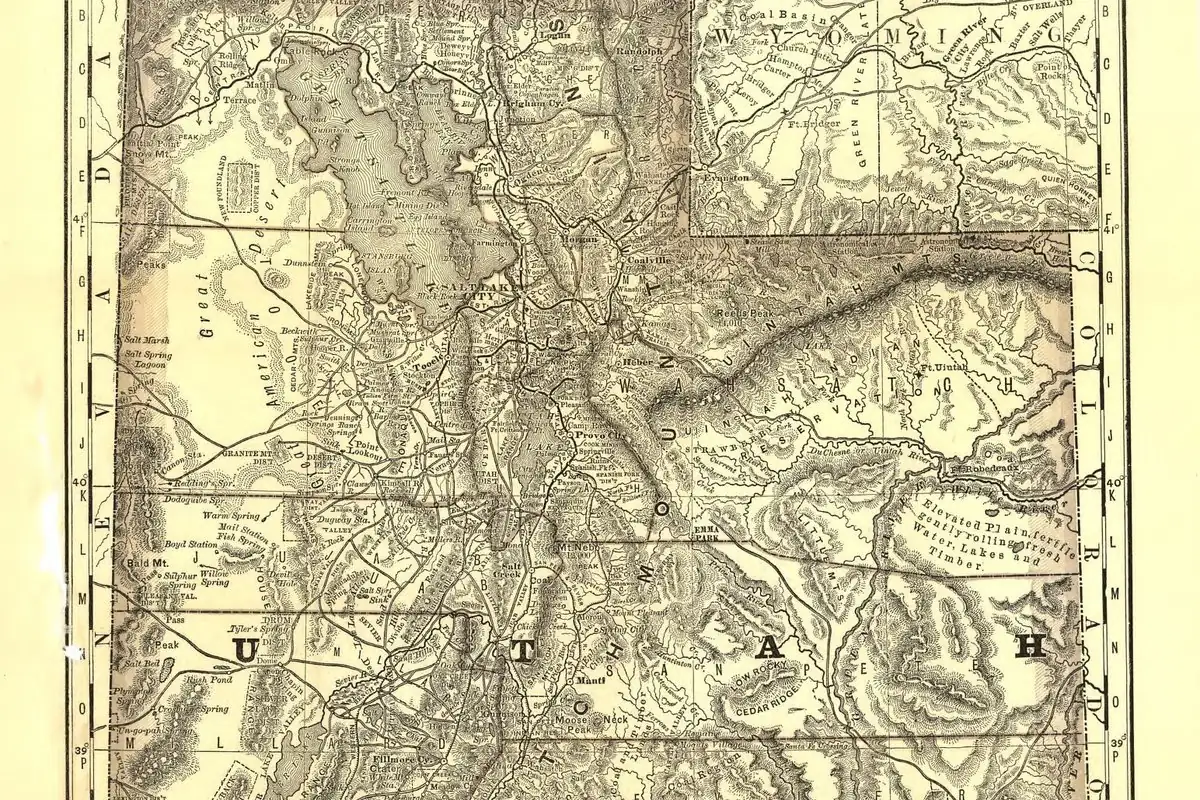
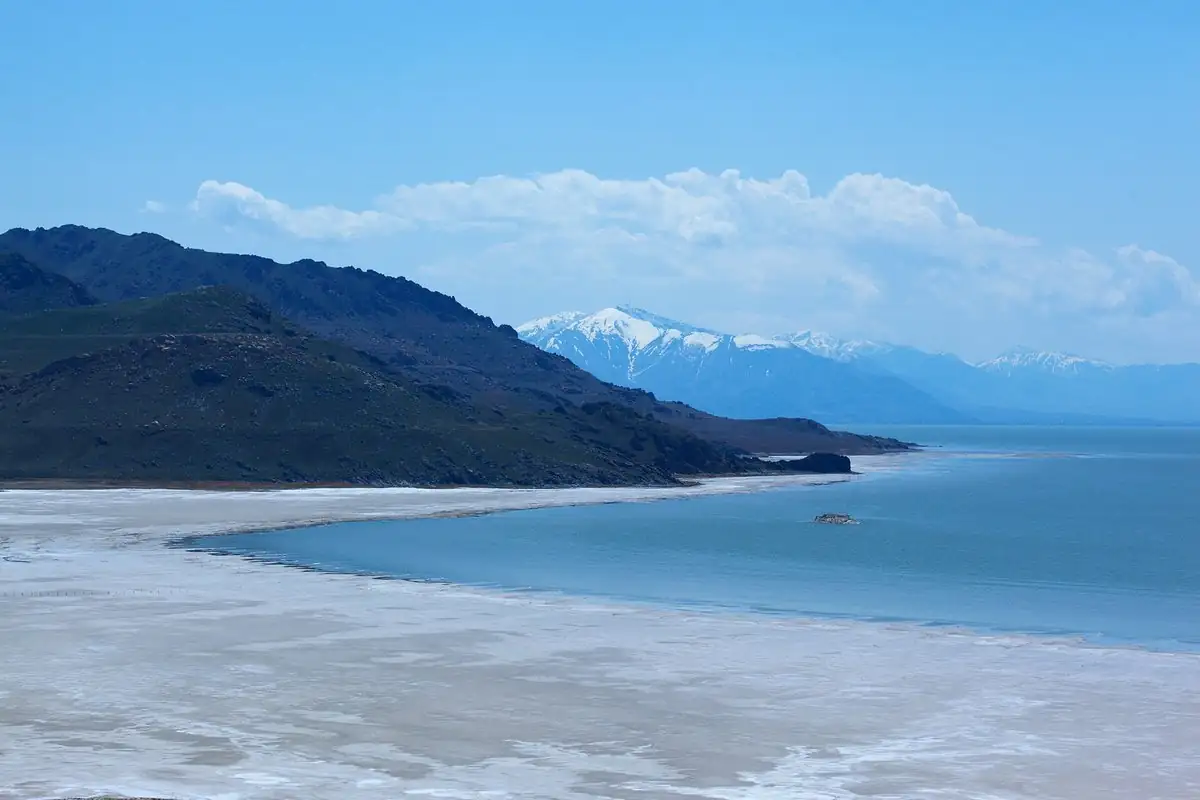
The National Park Service, which runs the site today, explains the name with a dictionary: a promontory is “a high point of land or rock projecting into a sea or other body of water.” Here the water is the Great Salt Lake. The Promontory Mountains run the length of the Promontory Peninsula, and the town grew at the highest point of the pass through them.
Henry Gannett’s 1905 book on American place names says much the same in his own terse way, though he puts the high point on the range rather than on the pass: the village was “so named because it is the highest point of the Promontory Range.” So the railroad didn’t name the town after a person or a company. It borrowed the name the mountains already had.
Why it’s not Promontory Point
Promontory Point is real, but it’s at the south end of that same peninsula. The Park Service puts it 35 miles (56 km) south of the place where the two railroads met. “For unknown reasons,” the park’s own FAQ says, some reporters and railroad officials in 1869 wrote that the line was finished at Promontory Point, and the mistake has been copied ever since in textbooks and films. The right name for the spot is Promontory Summit.
You can see how easy the mix-up was. Utah’s 1941 Writers’ Program guide lists a Promontory Point Station on the later railroad across the lake, “named for Promontory Mountain,” and adds that the place “where the last spike was driven” is about thirty miles (48 km) to the north.
A tent town for one season
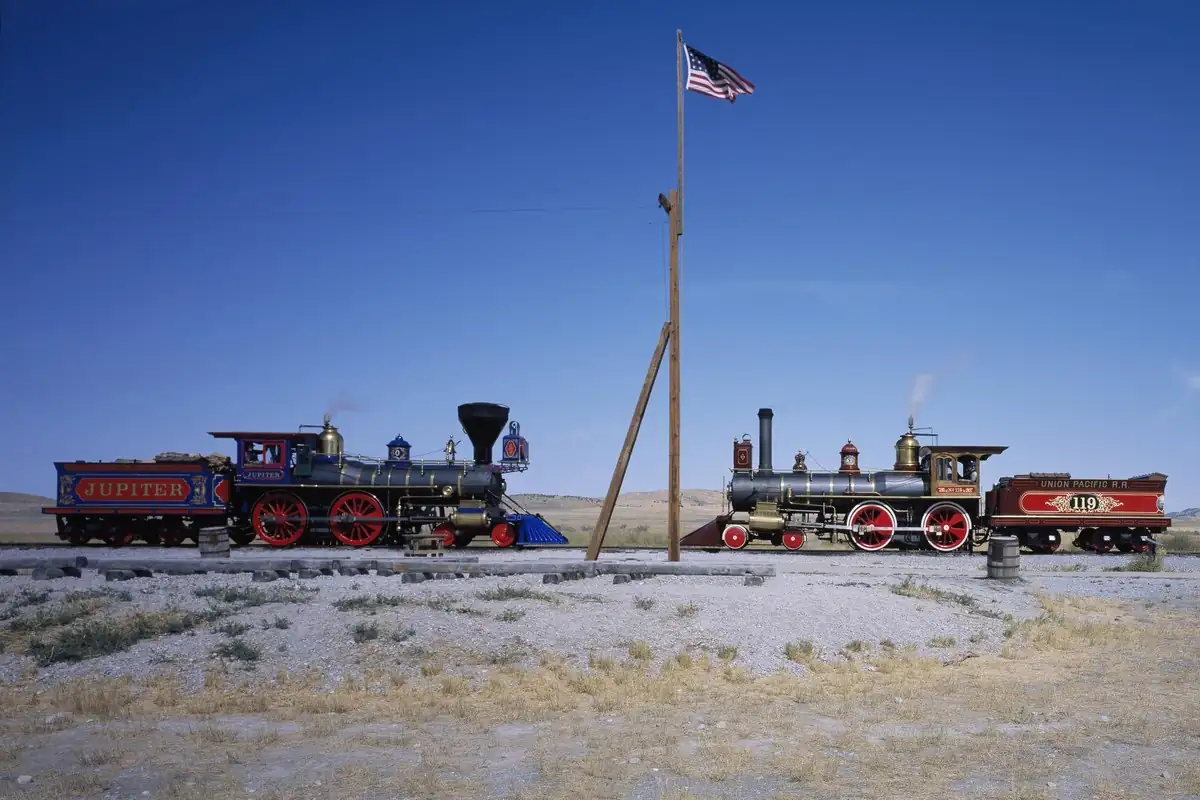
Congress settled the meeting place in April 1869, the guide says, “fixing Promontory as the point of junction.” The final spikes went in on May 10, 1869, with the Central Pacific’s Jupiter and the Union Pacific’s No. 119 nosed up to each other on the track. The engines you’d see there today are working replicas built in 1979, according to the Park Service.
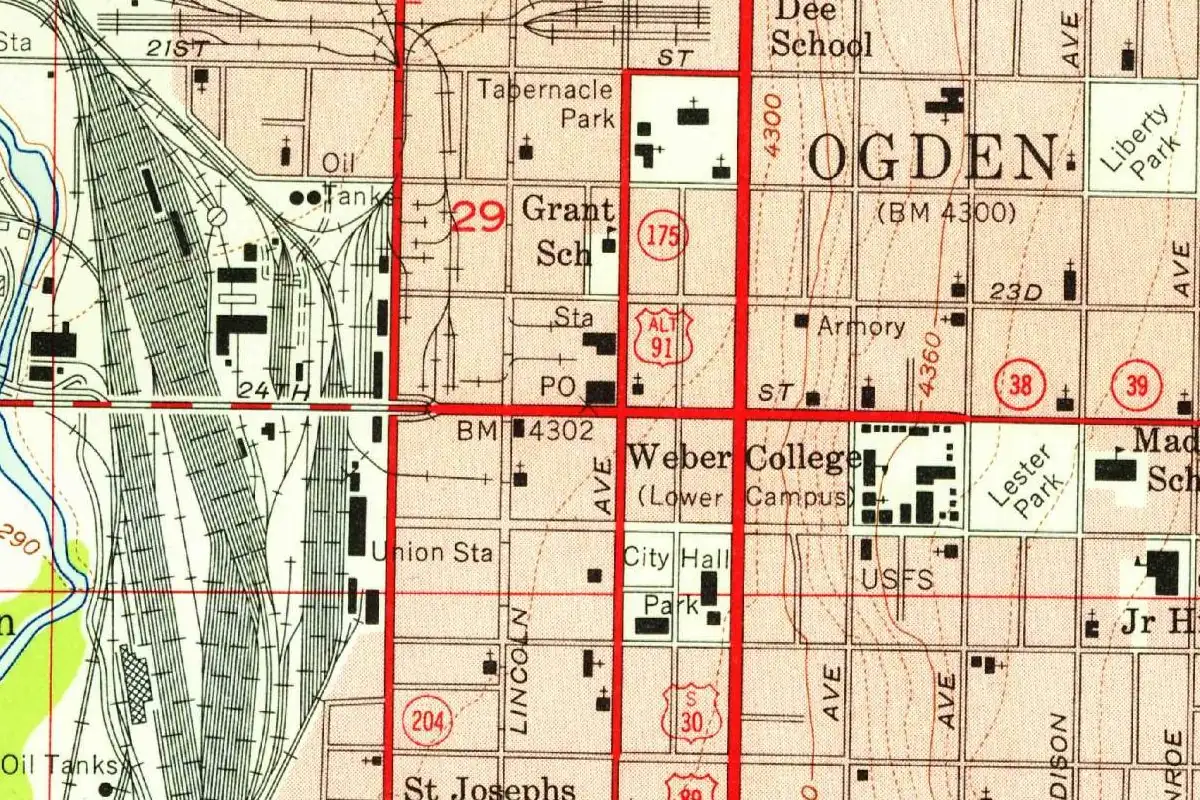
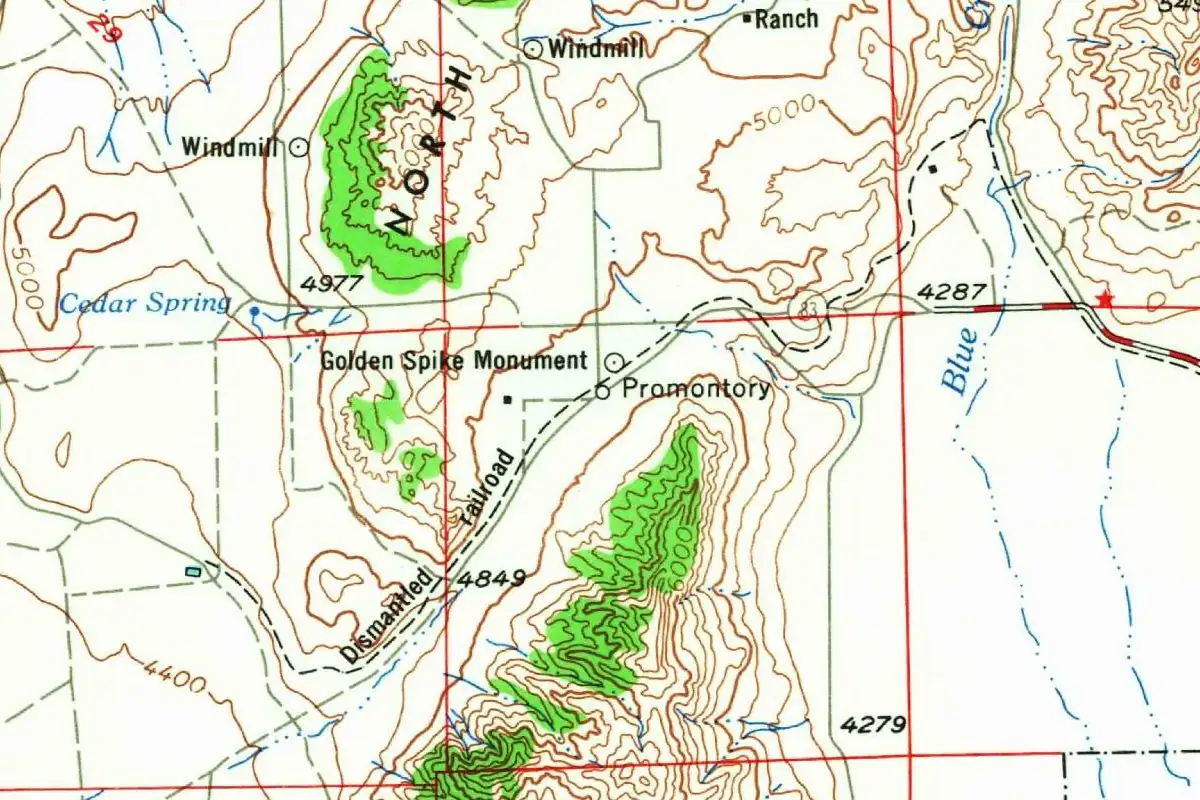
From May to December 1869, Promontory was where passengers and freight switched from one railroad to the other, and the park describes it as a wild town of gambling and “sporting women.” Then the junction moved to Ogden in 1870, and Promontory became mostly a helper station for railroad workers and their families. The Lucin Cutoff trestle across the lake was finished in late 1903 and took the main line away, and in 1942 the rails themselves were pulled up and sent to military depots. The government’s 1954 Brigham City map draws the old grade as a dashed line marked “Dismantled Railroad.”
By 1941 the guide was already writing the town’s epitaph:
“The gray glory of the past alone remains to vivify the windy summit on the Promontory Range.”
That’s the whole name in one sentence: a summit, on a range named for the way it pushes into the lake.
Quick answers
Was the golden spike driven at Promontory Point?
No. It was driven at Promontory Summit. The National Park Service says Promontory Point is 35 miles (56 km) to the south, and the mix-up goes back to some 1869 reports.
Why is it called Promontory?
Because of the Promontory Mountains. A promontory is high land jutting into water, and Gannett wrote in 1905 that the village was “so named because it is the highest point of the Promontory Range.”
Is Promontory, Utah, still a town?
Not really. The federal gazetteer lists it as a historical place, and the site is now part of Golden Spike National Historical Park.
Key dates
- 1869The Central Pacific and Union Pacific meet at Promontory Summit on May 10.
- 1870The junction moves to Ogden, and Promontory becomes mostly a helper station.
- 1903The Lucin Cutoff across the Great Salt Lake takes the main line away from Promontory.
- 1942The rails through Promontory are taken up for the war effort.
Getting there
Open Promontory in Google Maps
Opens in a new tab. The pin is the center of Promontory in the USGS place-name record.
The closest airports, Amtrak stations and intercity bus stops, measured in a straight line from the center of Promontory.
Airports
- Ogden-Hinckley (OGD) 40 mi 65 km
- Salt Lake City International (SLC) 65 mi 104 km
Amtrak trains
- Salt Lake City station (SLC) 68 mi 109 km
Intercity buses
- Salt Lake Express Tremonton 21 mi 34 km
- Greyhound Ogden UT (OGD) 40 mi 65 km
Distances are as the crow flies, not by road. We don't list schedules or fares because they change; check with the airline, Amtrak or the bus company before you go. Official data (FAA commercial service airports (2025), FAA airport locations, Amtrak stations and Intercity Bus Atlas) from the FAA and the U.S. Bureau of Transportation Statistics, checked Nov 6, 2026.
Sponsored
Staying in Promontory?
Compare hotels in Promontory, Utah, on Expedia.
See hotels in PromontoryWe may earn a commission if you buy through this link. It never changes what we write. Read our affiliate disclosure
Historical Sources & References
- Henry Gannett, The Origin of Certain Place Names in the United States, 2nd ed. (USGS Bulletin 258, 1905), p. 254. Promontory, a village in Boxelder County, “so named because it is the highest point of the Promontory Range.”
- National Park Service, “Frequently Asked Questions,” Golden Spike National Historical Park. What a promontory is; the town at the highest point of the pass; Promontory Point 35 miles (56 km) south and the 1869 mistake; the junction town of 1869, the move to Ogden, the Lucin Cutoff and the rails pulled up in 1942; the replica engines.
- Writers’ Program, Utah: A Guide to the State (1941), pp. 130-132 and 487. Congress “fixing Promontory as the point of junction”; the ceremony of May 10, 1869; “the windy summit on the Promontory Range”; Promontory Point Station “named for Promontory Mountain.”
- GNIS feature 1437660 (U.S. Geological Survey). The Geological Survey’s entry for Promontory (historical), at the same point as Promontory Summit in Box Elder County.
Spot something wrong, or know more? Tell us here. You can also email us or use our contact page. Corrections are noted here with their date, never made silently.