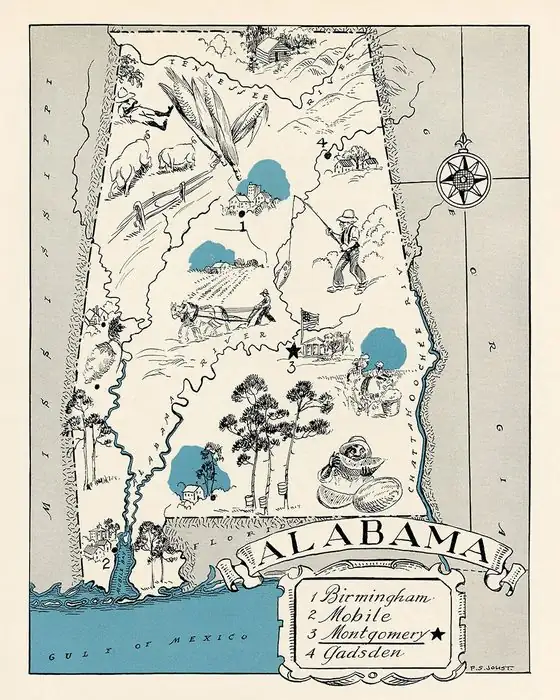
Gadsden, Alabama: The Name the Steamboat Captain Turned Down
Gadsden is named for Col. James Gadsden of South Carolina, the man later known for the Gadsden Purchase. The town was first called Double Springs. After Capt. James Lafferty brought the first steamboat on July 4, 1845, the Hughes brothers offered to call it Lafferty's Landing; he declined, and Gadsden was chosen.
A captain who said no
In 1845 the Hughes brothers offered to name Double Springs for the first steamboat captain to arrive; he said no, and the town became Gadsden, Alabama. The name it got honors Col. James Gadsden of South Carolina. That’s the same Gadsden whose name went on the Gadsden Purchase, but the purchase came later.
So no, the town wasn’t named after a land deal in the Southwest. It was named after the man, before that deal made him famous.
Double Springs, a stagecoach stop
The City of Gadsden says the first sizable white settlement here was a tiny town called Double Springs. It started around 1825, when John Riley, whom the city describes as a mixed Indian-white settler, built a house near two springs. The place became a stop on the stagecoach route from Huntsville to Rome, Georgia, and the city says Riley’s house still stands as the oldest house in Gadsden.
The Encyclopedia of Alabama fills in the bigger picture. The whole region had been part of the Cherokee Nation. After Cherokee removal in the 1830s, the land opened up for homesteading and sale, and the town that became Gadsden grew in the 1840s, once steamboats started coming up the river.
Thomas M. Owen’s History of Alabama, published in 1921, agrees on the old name in one plain line: “The first name of Gadsden was ‘Double Springs.’” He tells the first house differently, though. Owen says Daniel Turrentine, of Georgia, came in 1845 and built the first house on the land inside the city limits, and that he was the town’s first merchant and tavern-keeper. The city points to Riley’s house. You can read that as two different “firsts,” or as one more place where old town histories don’t line up.
July 4, 1845: the steamboat Coosa
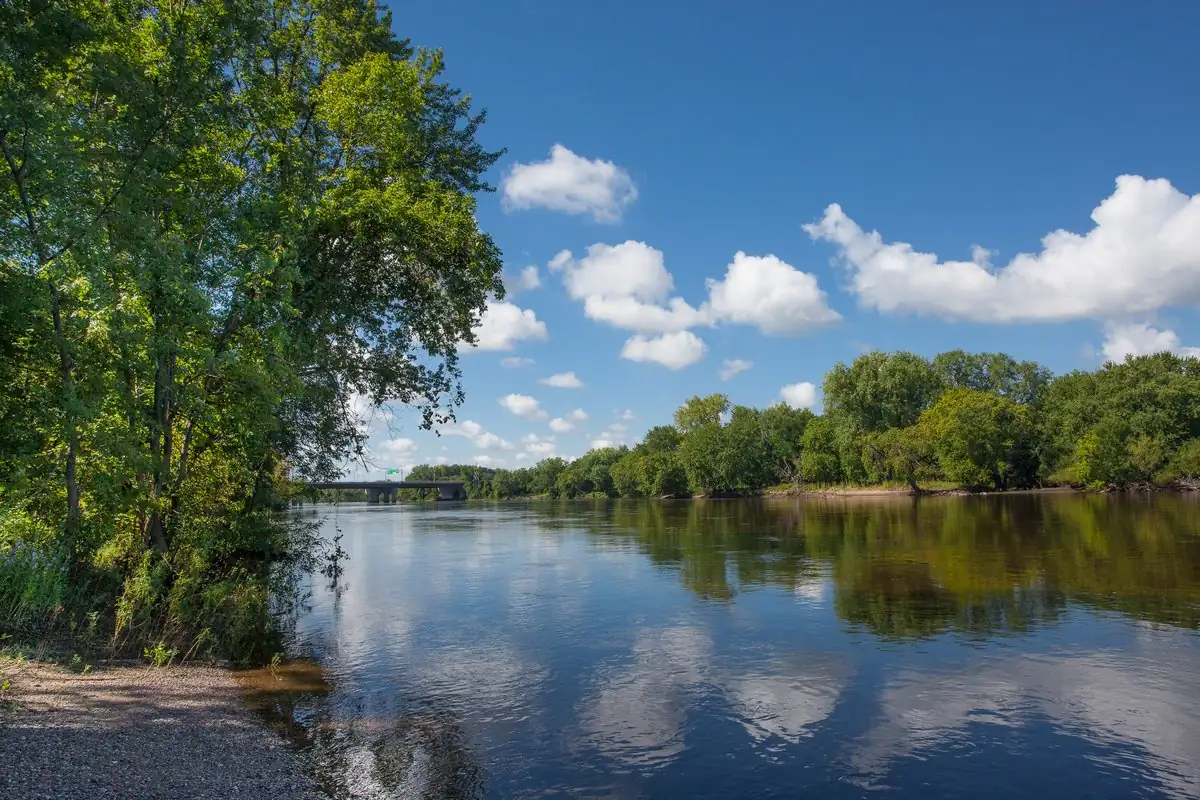
Here’s the moment the name changed. According to the city, Double Springs was “transformed” on July 4, 1845, when Capt. James Lafferty piloted the first steamboat to the area. The boat was aptly named the Coosa, like the river. Lafferty landed near where the Memorial Bridge is now.
The city’s history also says early settlers bought up much of the land between Lookout Mountain, the Coosa River and the mouth of Wills Creek, and that their land, with that of John S. Moragne and Joseph Rhea, became the first part of Gadsden. When the steamboat came in, the city says, the Hughes brothers offered to name the town “Lafferty’s Landing” in the captain’s honor.
Lafferty declined. Instead, the city says, “the name Gadsden was chosen, in honor of Colonel James Gadsden of South Carolina, famous for the later Gadsden Purchase.”
Notice what that sentence leaves out: who chose it. The city doesn’t say, the Encyclopedia doesn’t say, and Owen doesn’t mention the naming at all. We’d be guessing if we put a name on it. Owen does list the early settler families: Turrentine, Walker, Hughes, McMichael, Lafferty, Lay, Sansom, Hollingsworth, Woodliff and Moragne. A Lafferty family made his list, even if the name Lafferty never went on the sign.
Which James Gadsden?
There’s only one candidate in the sources. The Encyclopedia of Alabama says the town was renamed for Col. James Gadsden, “who was behind the Gadsden Purchase, in which the United States acquired lands in the Southwest.” Henry Gannett, compiling place-name origins for the U.S. Geological Survey in 1905, covered Gadsden, Alabama, and Gadsden County, Florida, in one entry on page 133: both “named for James Gadsden, the American statesman.”
The timing is the interesting part. The city’s own wording, “the later Gadsden Purchase,” tells you the order. The town took the name in 1845; the purchase that made it famous came afterward. If you’ve assumed Gadsden, Alabama, was named because of the purchase, you’ve got it backward.
From Double Springs to county seat
The new name stuck, but Gadsden wasn’t a county seat right away. The Encyclopedia of Alabama says it was incorporated as a county seat in 1867, inside a short-lived Baine County carved out of DeKalb County. Baine County was dissolved that same year, and Etowah County was created the next year, keeping Gadsden as its seat. Owen gives a different incorporation date, March 9, 1871, by act of the legislature, with a new charter in 1883. You’ll see both dates around.
By Owen’s time the steamboat landing had turned into a rail and factory town. He counted about 1,500 people in 1872 and 10,557 in 1910, five railroads, pipe works, an iron furnace, a car works and five iron ore mines close by. He gave the town’s altitude as 536 feet (163 m), on a plateau with Lookout Mountain, Sand Mountain, Red Mountain and the Colvin Mountains all around. It’s a long way from two springs and a stagecoach stop.
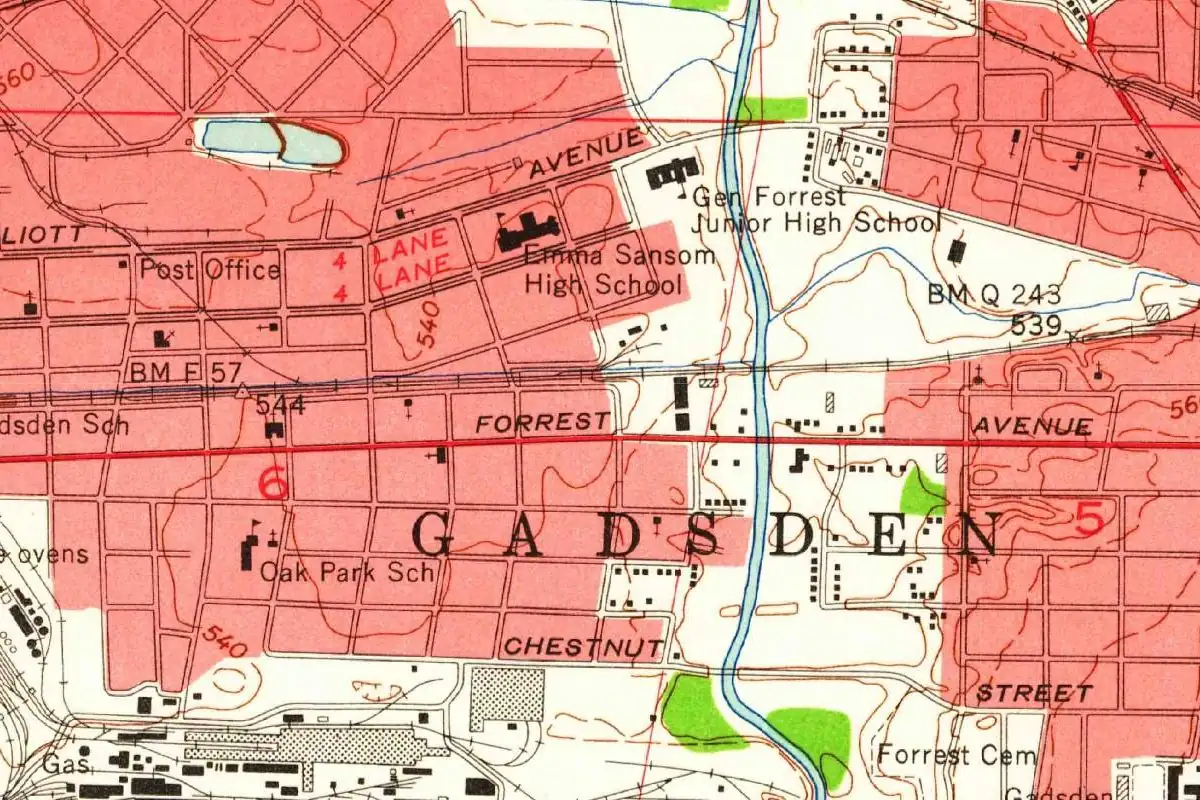
Look at the 1959 map above and you’ll see the Gadsden that came after: city blocks across the plateau, Forrest Avenue and Chestnut Street, and schools bearing the names of Emma Sansom and Gen. Forrest. The Encyclopedia of Alabama says Sansom, from the Gadsden area, helped Confederate general Nathan Bedford Forrest capture the Union raider Abel Streight and his men during the Civil War.
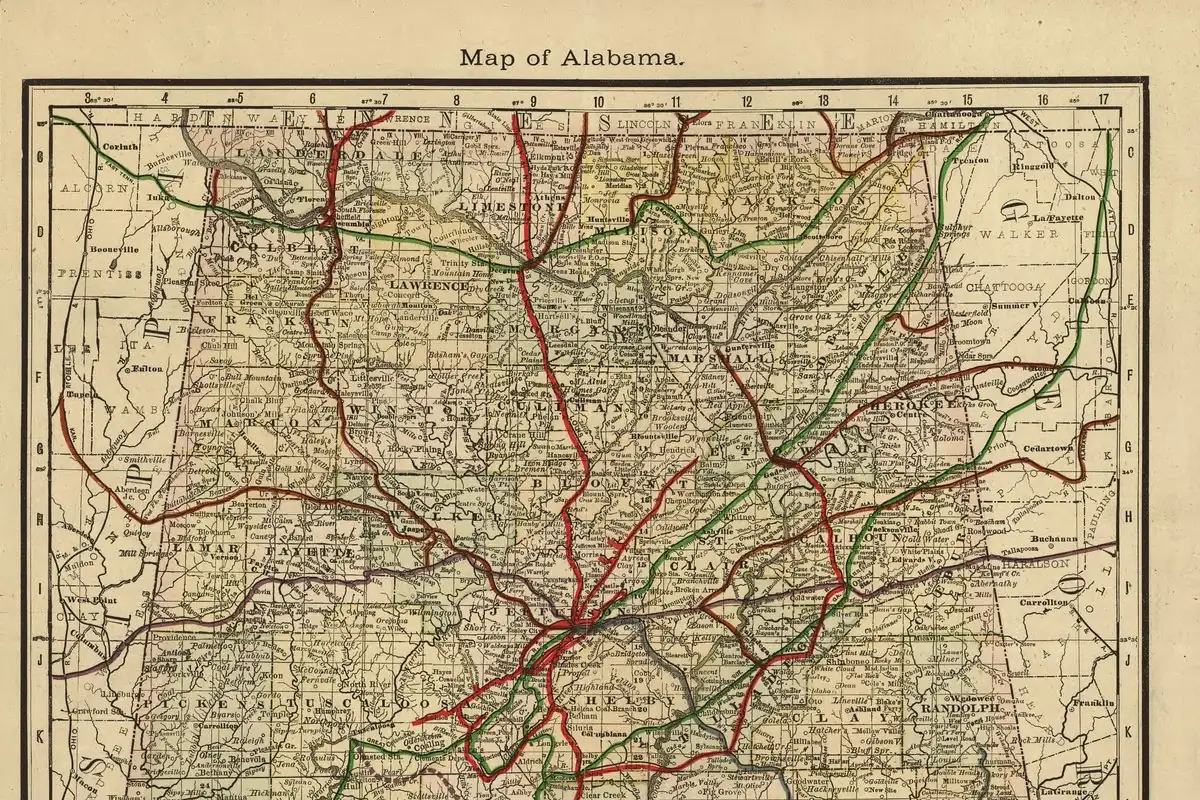
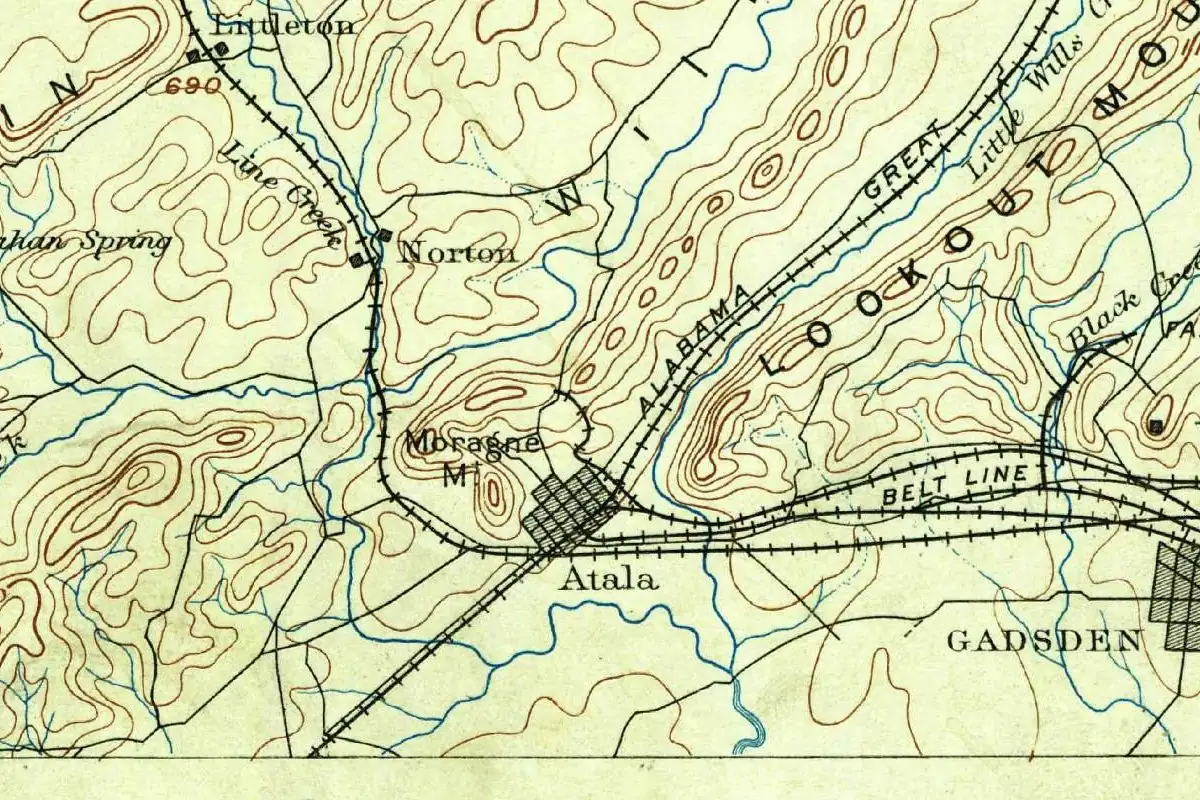
Owen put Gadsden at the southern end of Lookout Mountain, with Attalla about 5 miles (8 km) to the west, a neighbor whose name goes back to a much older settlement. The rest of the state’s towns, from the Tennessee Valley to the Gulf, are waiting on our Alabama page.
Quick answers
Who is Gadsden, Alabama, named after?
Col. James Gadsden of South Carolina, the man later known for the Gadsden Purchase, according to the city and the Encyclopedia of Alabama.
Was Gadsden named after the Gadsden Purchase?
No. The town took the name in 1845, and the city calls the purchase “later.” The town honors the man, not the deal.
What was Gadsden, Alabama, called before?
Double Springs, after the two springs where John Riley built his house around 1825. Owen’s 1921 history also gives Double Springs as the first name.
Why isn’t Gadsden called Lafferty’s Landing?
Because Capt. James Lafferty turned it down. The Hughes brothers offered to name the town for him after his steamboat arrived on July 4, 1845, and he declined.
Key dates
- 1825John Riley builds a house near two springs, the start of the stagecoach stop called Double Springs.
- 1845On July 4, Capt. James Lafferty brings the first steamboat, the Coosa; he turns down Lafferty's Landing, and the name Gadsden is chosen.
- 1867Gadsden is incorporated as a county seat within Baine County, according to the Encyclopedia of Alabama.
- 1871The legislature incorporates Gadsden on March 9, according to Owen's History of Alabama.
Things to do in Gadsden, Alabama
Noccalula Falls Park
The city park where Noccalula Falls drops more than 90 feet (27 m) into the Black Creek ravine, with paved trails through rock gardens, a pioneer village, a petting zoo and a miniature train.
Little River Canyon National Preserve
A national preserve on Lookout Mountain, the same ridge whose southern tip holds Gadsden, where the Little River runs along the mountaintop past waterfalls, canyon rims, boulders and sandstone cliffs.
Mary G. Hardin Center for Cultural Arts
Downtown home of the Gadsden Cultural Arts Foundation, with art exhibits, a school for the arts, dance classes and the Etowah Youth Orchestras, plus the Gadsden Symphony Orchestra.
Coosa Landing
The city's marina on the Coosa River, the river that brought the first steamboat to Double Springs in 1845, with a four-lane boat launch, a bait shop by the Broad Street Bridge and the start of the Riverwalk Trail, just under a mile (1.6 km) of boardwalk and gravel along the bank.
Getting there
Open Gadsden in Google Maps
Opens in a new tab. The pin is the center of Gadsden in the USGS place-name record.
The closest airports, Amtrak stations and intercity bus stops, measured in a straight line from the center of Gadsden.
Airports
- Birmingham-Shuttlesworth International (BHM) 53 mi 85 km
- Huntsville International-Carl T Jones Field (HSV) 61 mi 99 km
- Hartsfield/Jackson Atlanta International (ATL) 94 mi 152 km
Amtrak trains
- Anniston station (ATN) 27 mi 44 km
- Birmingham station (BHM) 58 mi 93 km
Intercity buses
- Greyhound Gadsden U-Haul under 1 mi 0.4 km
Distances are as the crow flies, not by road. We don't list schedules or fares because they change; check with the airline, Amtrak or the bus company before you go. Official data (FAA commercial service airports (2025), FAA airport locations, Amtrak stations and Intercity Bus Atlas) from the FAA and the U.S. Bureau of Transportation Statistics, checked Nov 14, 2026.
Sponsored
Staying in Gadsden?
Compare hotels in Gadsden, Alabama, on Expedia.
See hotels in GadsdenWe may earn a commission if you buy through this link. It never changes what we write. Read our affiliate disclosure
Historical Sources & References
- City of Gadsden, “Gadsden”. Double Springs and John Riley’s house of about 1825, still standing; the Huntsville-to-Rome stagecoach stop; the early settlers’ land with Moragne’s and Rhea’s; Capt. James Lafferty and the steamboat Coosa on July 4, 1845, near the Memorial Bridge; the offer of “Lafferty’s Landing”; “the name Gadsden was chosen, in honor of Colonel James Gadsden of South Carolina, famous for the later Gadsden Purchase.”
- Encyclopedia of Alabama, “Gadsden”. Cherokee Nation and Cherokee removal; Riley’s 1825 home at Double Springs; growth in the 1840s with the steamboats; “renamed for Col. James Gadsden, who was behind the Gadsden Purchase”; incorporation as a county seat in 1867 in Baine County and Etowah County the next year; Emma Sansom and Forrest.
- Thomas M. Owen, History of Alabama and Dictionary of Alabama Biography, vol. 1 (1921), pp. 639-640. “The first name of Gadsden was ‘Double Springs’”; Daniel Turrentine’s first house of 1845; incorporation on March 9, 1871, and the 1883 charter; the early settler families; the southern end of Lookout Mountain; 5 miles east of Attalla; population from 1872 to 1910, railroads, industries and the altitude of 536 feet.
- Henry Gannett, The Origin of Certain Place Names in the United States (1905), p. 133. “Gadsden; town in Etowah County, Alabama, and county in Florida, named for James Gadsden, the American statesman.”
- GNIS feature 157961 (U.S. Geological Survey). The U.S. gazetteer listing for Gadsden, a populated place in Etowah County.
- U.S. Geological Survey, Gadsden sheet (1959). The 1:24,000 sheet our map crop comes from, with downtown near its edge.
Spot something wrong, or know more? Tell us here. You can also email us or use our contact page. Corrections are noted here with their date, never made silently.