Glendale, Arizona: The Name Came Before the Town
Nobody has proved why Glendale, Arizona, got its name. Canal builder William J. Murphy was already calling his planned temperance town Glendale in 1888, and a 1992 Arizona Highways history says the evidence strongly suggests he just liked the sound. Others credit colonizer Burgess Hadsell, for glen and dale, or settlers from Glendale, Pennsylvania.
A town named on paper
Glendale, Arizona, had a name before its colonists came: canal builder William J. Murphy was calling his planned temperance town Glendale by 1888. Why he picked it, or whether he picked it at all, is a question nobody has settled.
The 1888 date comes from the Glendale Arizona Historical Society, whose timeline says that as early as 1888 “Murphy had plans for Temperance town site and referred to it as Glendale.” That’s three or four years before the first colonists showed up. So whatever the name meant, it wasn’t a description of a town. There wasn’t one yet.
A canal and a dry colony
Murphy was the man who put water on that land. The historical society says he took the contract for the Arizona Canal in 1883, a ditch about 40 miles (64 km) long across the north side of the Salt River Valley, and watched water flow through it in 1885. In 1888 he built Grand Avenue on a straight diagonal from Phoenix to Peoria, right through the land that would become Glendale.
Then he needed people. In late 1884, the society says, Murphy offered Burgess A. Hadsell, a well-known colonizer for the Brethren, ten sections of land below the canal, plus one more section donated for the colony itself. Hadsell said no. Dean Smith, writing in Arizona Highways for the town’s 100th anniversary in 1992, says Hadsell and two associates came out on a July day in 1885, felt the 110-degree heat and left for Southern California.
Murphy tried again late in 1891, and this time the weather was kind. Hadsell brought about 70 families, including 33 of his own relatives, to the Temperance Colony of Glendale. Every lot deed carried a clause against making, selling or handing out liquor on the property. Smith says Murphy hated “the Demon Rum,” his wife, Laura, was a teetotaler, and the new colony was the only town in the territory where you couldn’t buy a drink.
Three stories about one name
Smith is the one who laid out the arguments, and he didn’t pretend they were settled:
“For decades Glendale old-timers have debated the origin of their city’s name. Some claim Hadsell chose it because both “glen” and “dale” designate valleys. Others say early settlers from Glendale, Pennsylvania, named the community.”
The valley version
Glen and dale both mean a valley, as Smith puts it, and that’s the story that credits Hadsell. The catch is the timing. If Murphy was already using Glendale in 1888, the name was on the map of his plans before Hadsell agreed to come.
The Pennsylvania version
Some families did come from back East. The historical society says Glendale drew farmers from Pennsylvania and the Midwest. But no source here names a Glendale, Pennsylvania, family who picked the name, and the same 1888 date works against them too.
The Murphy version
This is the one Smith leans toward. In his words, “historical evidence strongly suggests Murphy chose the name simply because he liked the sound of it, before Hadsell or his people arrived.” That fits the historical society’s 1888 timeline. It still doesn’t come with a letter or a plat note in which Murphy explains himself, so it’s the likeliest answer, not a proven one.
1888, 1891 or 1892?
You’ll also see different founding dates, and they’re each measuring something different. The historical society’s timeline puts the official founding of the colony on February 27, 1892, when Murphy, the New England Land Company and Hadsell completed the survey and plat of the first residential area, Hadsell’s Addition to Glendale. The plat of the original town site followed in November 1892, and the post office opened that year with S. B. Stoner as postmaster. The society’s history page says the colony was established in the fall of 1891, when the families arrived. The U.S. place-name record says the town was “Named in 1892 when established by the New England Land Company…”
The town incorporated on June 18, 1910, and by 1916 James McClintock’s history of Arizona could place a beet sugar factory “at Glendale, about nine miles northwest of Phoenix,” about 14 km. The dry rule didn’t last forever. When Smith wrote in 1992, you could order “a schooner of suds” all over town. The name stuck, though, and it may come down to nothing more than a developer who liked how it sounded.
Quick answers
Who named Glendale, Arizona?
Nobody knows for sure. The three versions credit canal builder William J. Murphy, who was using the name by 1888; Burgess A. Hadsell; or settlers from Glendale, Pennsylvania. A 1992 Arizona Highways history leans toward Murphy, but no document shows who chose it.
Does Glendale mean “valley”?
Not as far as anyone can prove. Glen and dale both mean a valley, and one local story says Burgess Hadsell chose the name for that reason, but no record shows that’s why the town got it.
Was Glendale a dry town?
Yes. It began as the Temperance Colony of Glendale, and every lot deed banned making, selling or handing out liquor on the property.
When was Glendale, Arizona, founded?
It depends on the milestone. The colonists arrived in the fall of 1891, Hadsell’s Addition was platted on February 27, 1892, and the town incorporated on June 18, 1910.
Key dates
- 1885Water flows through William J. Murphy's Arizona Canal, about 40 miles (64 km) long, opening the northwest Salt River Valley to farming.
- 1888Murphy builds Grand Avenue from Phoenix to Peoria and already calls his planned temperance town site Glendale.
- 1891Fall: Burgess A. Hadsell brings about 70 families, many of them Brethren, to the Temperance Colony of Glendale.
- 1892February 27: Hadsell's Addition to Glendale is surveyed and platted; the town site plat follows in November.
- 1910June 18: the Town of Glendale is incorporated.
Getting there
Open Glendale in Google Maps
Opens in a new tab. The pin is the center of Glendale in the USGS place-name record.
The closest airports, Amtrak stations and intercity bus stops, measured in a straight line from the center of Glendale.
Airports
- Phoenix Sky Harbor International (PHX) 12 mi 20 km
- Mesa Gateway (IWA) 35 mi 56 km
Amtrak trains
- Maricopa station (MRC) 34 mi 55 km
Intercity buses
- FlixBus Glendale 59Th Ave / W. Hayward under 1 mi 1 km
- Greyhound Phoenix Glendale Bus Stop 4 mi 6 km
- Stagecoach Express Amtrak Connecting Service · North Phoenix Metro Center Transit Station 8 mi 13 km
Distances are as the crow flies, not by road. We don't list schedules or fares because they change; check with the airline, Amtrak or the bus company before you go. Official data (FAA commercial service airports (2025), FAA airport locations, Amtrak stations and Intercity Bus Atlas) from the FAA and the U.S. Bureau of Transportation Statistics, checked Nov 13, 2026.
Sponsored
Staying in Glendale?
Compare hotels in Glendale, Arizona, on Expedia.
See hotels in GlendaleWe may earn a commission if you buy through this link. It never changes what we write. Read our affiliate disclosure
Sponsored
Want the spooky side of Glendale?
The name has its story above. For the ghost stories, US Ghost Adventures runs walking ghost tours in Glendale.
See ghost tours in GlendaleWe may earn a commission if you book through this link. It never changes what we write. Read our affiliate disclosure
Historical Sources & References
- Dean Smith, “Safe from Sin,” Arizona Highways (February 1992). The three versions of the name (Hadsell’s “glen” and “dale,” settlers from Glendale, Pennsylvania, and Murphy liking the sound), the quoted passages, Hadsell’s 1885 visit and return late in 1891, the 70 families and 33 relatives, and the Murphys’ teetotaling.
- Glendale Arizona Historical Society, “Glendale Timeline”. Murphy referring to the town site as Glendale as early as 1888, Grand Avenue, the February 27, 1892, plat of Hadsell’s Addition, the November 1892 town site plat, the temperance clause, the 1892 post office and the June 18, 1910, incorporation.
- Glendale Arizona Historical Society, “History of Glendale”. The Arizona Canal of 1883-1885, Murphy’s offer to Hadsell in late 1884, the colony of fall 1891 and settlers from Pennsylvania and the Midwest.
- James H. McClintock, Arizona, Prehistoric, Aboriginal, Pioneer, Modern, vol. 2 (1916), p. 571. The beet sugar factory “at Glendale, about nine miles northwest of Phoenix.”
- GNIS feature 5060 (U.S. Geological Survey). Its history note: “Named in 1892 when established by the New England Land Company…” with the county and coordinates.
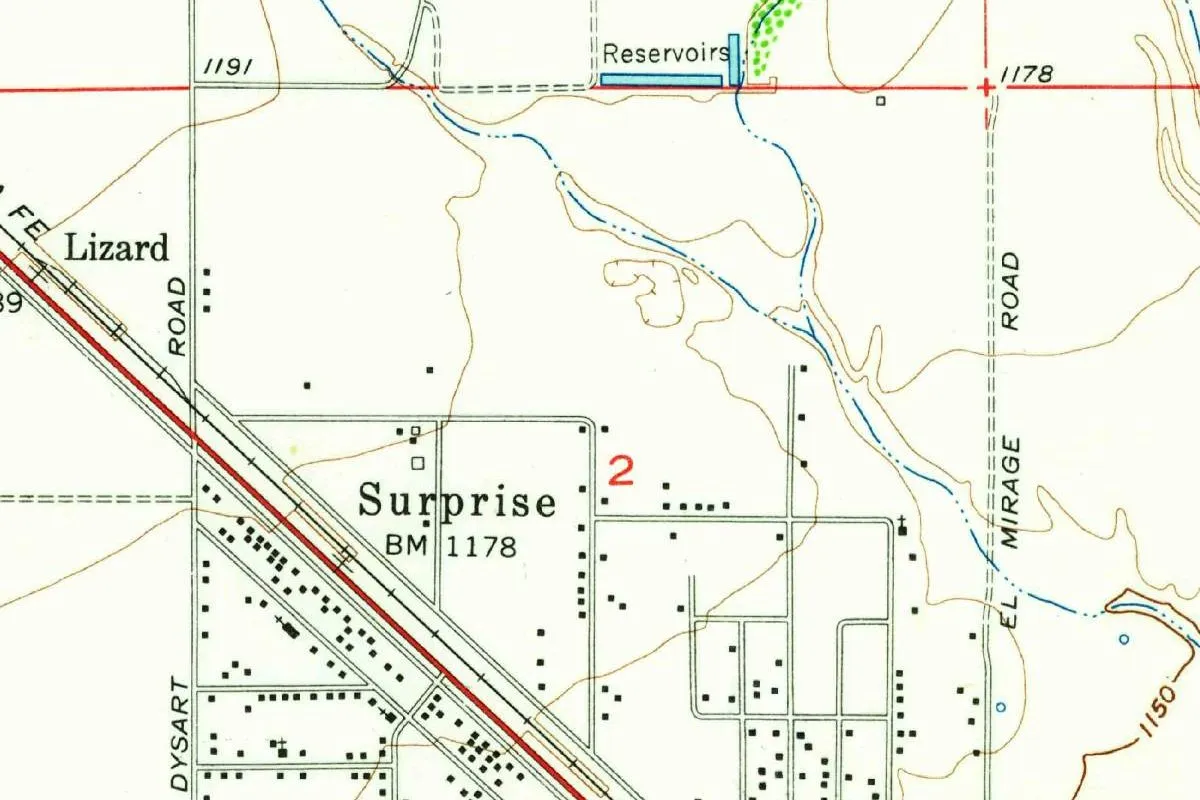
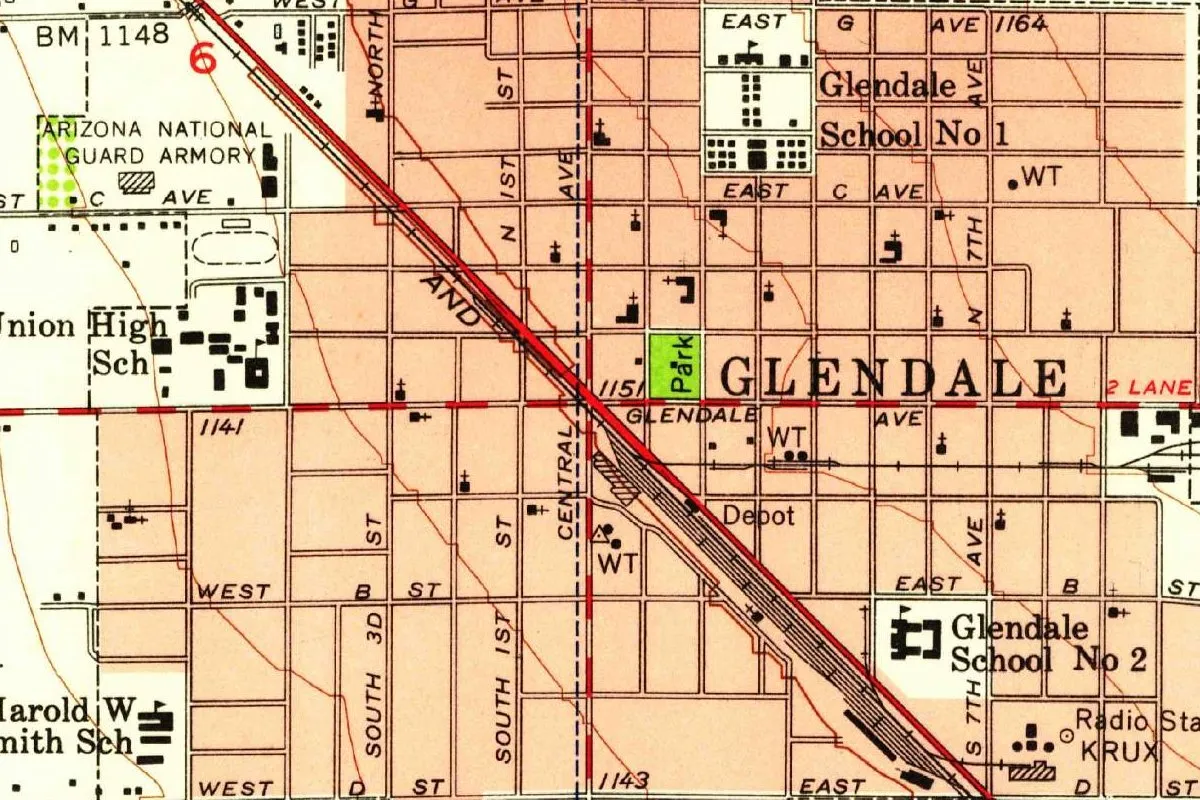
- U.S. Geological Survey, Glendale sheet (1957). The source of the map at the top of this page.
Spot something wrong, or know more? Tell us here. You can also email us or use our contact page. Corrections are noted here with their date, never made silently.