How to Pronounce Faneuil Hall—and Who It's Named For
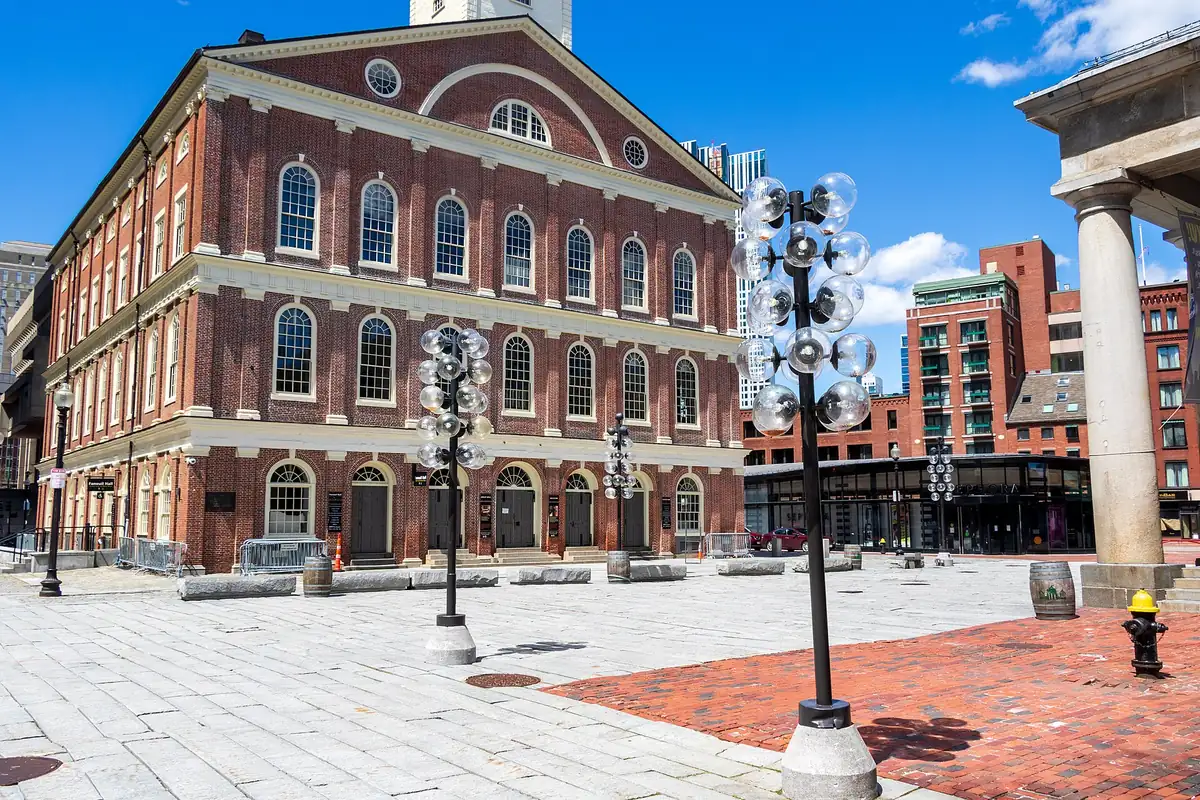
Faneuil Hall in Boston was named for Peter Faneuil in a 1742 town vote, decades before Revolutionary protests made the building famous. The name is tricky to say: you’ll hear both “FAN-yuh-wuhl” and the shorter “FAN-uhl.”
How Boston actually says “Faneuil”
Start with “FAN.” The rest is where people disagree.
Dictionary.com records several American versions of Faneuil, including one roughly like “FAN-yoo-uhl” and another like “FAN-uhl.” When Boston public broadcaster GBH asked two people who worked with the surrounding marketplace in 2016, they both favored “fan-uhl.”
So don’t assume someone has the wrong place just because you hear a different number of syllables.
Historian J. L. Bell has traced the problem much further back. In a discussion reproduced by historian John Fea, Bell points to eighteenth-century spellings such as “Fanuel” and “Fannel.” The surname was never as straightforward to pronounce as it looks on a street sign.
The town vote behind the name
In 1740, Boston merchant Peter Faneuil offered to pay for a permanent public marketplace. The completed building included a spacious meeting room upstairs that exceeded his initial offer, according to the 1742 town-meeting text.
The town accepted his gift. When the building was completed in 1742, Boston’s town meeting voted on September 13 to honor him by naming it Faneuil Hall.
This wasn’t a name invented centuries later by a tourism board. The 1885 printed edition of Boston’s town records preserves Thomas Hutchinson’s motion of September 13, 1742, unanimously approved by the town:
“the Hall over the Market place, be named Faneuil Hall, and at all times hereafter be called and known by that Name.”
— Boston Town Records, meeting of September 13, 1742; printed in Boston Record Commissioners, vol. 12 (1885), p. 308.
You can understand the original decision without confusing it with the building’s later fame. The name thanked the donor. The “Cradle of Liberty” nickname would come afterward.
A market downstairs, a meeting hall upstairs
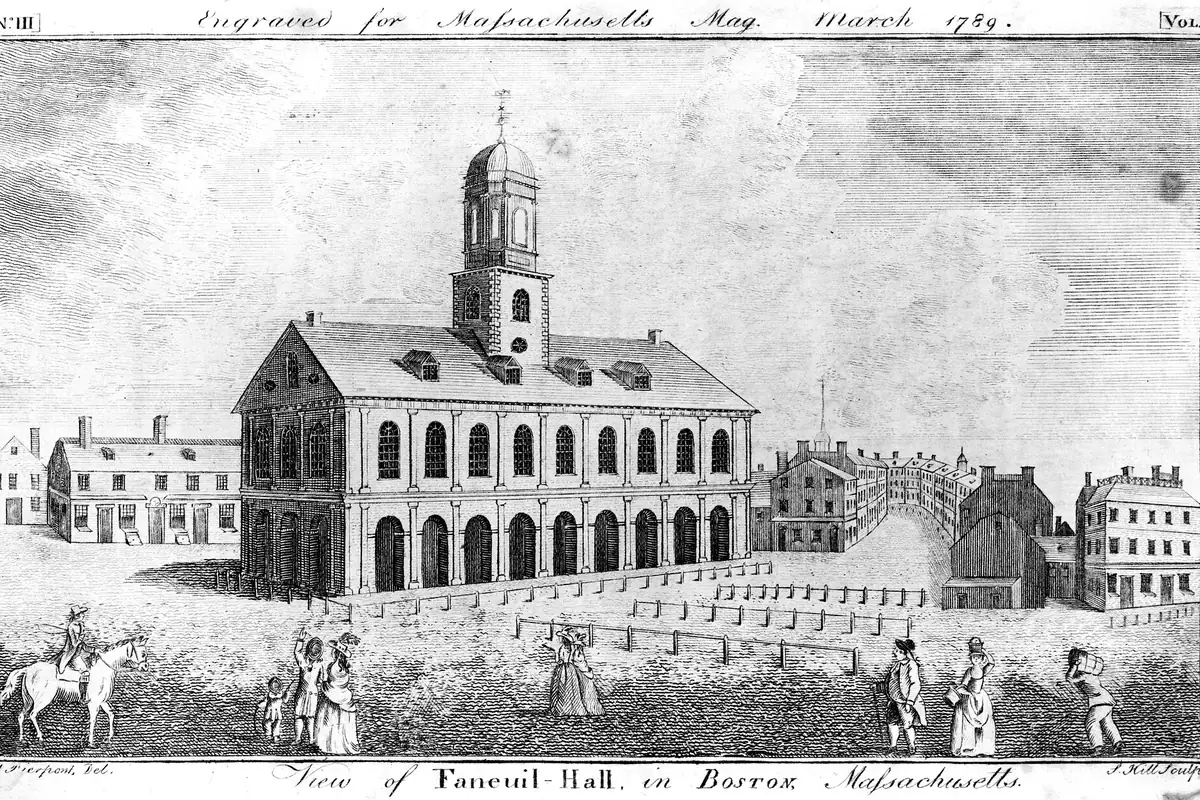
Peter Faneuil paid for a building that served two needs. Market stalls occupied the open ground floor, and town meetings took place in the room above.
Painter John Smibert prepared the first design. Carpenter Samuel Ruggles and master mason Joshua Blanchard helped construct it, according to the Historic American Buildings Survey and National Park Service.
A fire badly damaged the hall in 1761. Architect Charles Bulfinch enlarged it in 1805–1806, so the building you see today is not exactly the small market house Bostonians knew in 1742.
Look up at the cupola and you’ll spot another piece of that early story: a copper grasshopper weathervane made in 1742 by Shem Drowne. Unlike much of the later architectural detail, it dates back to the hall’s beginning.
Why a merchant’s gift became the “Cradle of Liberty”
By the 1760s, Faneuil Hall had become an important meeting place for people in Massachusetts challenging British policies. Samuel Adams and other colonial leaders spoke here as opposition to taxation grew.
The hall earned its “Cradle of Liberty” nickname from those gatherings. Later generations used the same room for abolitionist speeches, women’s suffrage advocacy and other arguments about American freedom.
That’s the complicated part of its identity: a meeting place celebrated for liberty still bears the name of a merchant who profited from slavery.
Peter Faneuil and the history behind his fortune
Peter Faneuil came from a French Huguenot family and grew wealthy in Atlantic commerce. National Park Service researchers found that he owned five enslaved people at his death and participated in networks that traded enslaved people and goods produced by enslaved labor.
That history needs precision. The Park Service explicitly says enslaved people were not sold inside Faneuil Hall. The connection lies in the donor’s life, his business and the wealth that financed the building, not in a documented slave market on the hall’s ground floor.
In October 2023, Boston City Council voted 10–3 for a resolution urging a change of the building’s name. The resolution did not itself rename the hall, which the National Park Service still calls Faneuil Hall.
The debate is part of the site’s continuing public history.
Faneuil Hall isn’t the whole Marketplace
There’s one more name that often causes confusion. “Faneuil Hall” is the historic 1742 building; “Faneuil Hall Marketplace” also includes the separate Quincy Market, North Market and South Market buildings.
Quincy Market opened for business in 1827; its cornerstone was laid in 1826. The larger market district took on its modern retail character when its redevelopment reopened in 1976, as GBH’s 40th-anniversary coverage in 2016 recalls. You can visit the historic hall and the shops on the same trip, but they aren’t all rooms in the original building.
The original name was chosen to preserve the memory of a donor. Today, you can hear Boston’s changing relationship with that memory in the debates the hall continues to host.
Quick answers
How do you pronounce Faneuil Hall?
You may hear “FAN-yuh-wuhl,” “FAN-yoo-uhl” or the shorter “FAN-uhl.” Dictionary.com records several U.S. pronunciations, and two local marketplace professionals told Boston broadcaster GBH in 2016 that they used “fan-uhl.”
Who was Faneuil Hall named after?
Peter Faneuil paid for the original public marketplace and meeting hall. Boston’s town meeting unanimously voted on September 13, 1742, to name it for him, with Thomas Hutchinson moving the motion.
Is Faneuil Hall the same as Quincy Market?
No. Faneuil Hall is the original historic public meeting hall completed in 1742; Quincy Market is a separate building next door, opened for business in 1827. The broader Faneuil Hall Marketplace includes Quincy Market and the North and South Market buildings.
Were enslaved people sold inside Faneuil Hall?
No, according to the National Park Service. Peter Faneuil did own enslaved people and take part in commerce connected to slavery, but that does not mean people were sold inside the donated market hall.
Key dates
- 1740Peter Faneuil offers to finance a new market-and-meeting hall.
- 1742Building opens; on September 13 Boston votes to give it his name.
- 1761A fire badly damages the hall.
- 1805–1806Architect Charles Bulfinch enlarges and transforms the building.
- 1827Quincy Market opens for business next door; its cornerstone was laid in 1826.
- 1976The redeveloped Faneuil Hall Marketplace reopens.
- 2023Boston City Council passes a resolution urging a name change; it does not in itself record a new official name.
Getting there
Open Faneuil Hall in Google Maps
Opens in a new tab. The pin is an approximate point for Faneuil Hall.
The closest airports, Amtrak stations and intercity bus stops, measured in a straight line from the center of Faneuil Hall.
Airports
- General Edward Lawrence Logan International (BOS) Boston 3 mi 4 km
- Worcester Regional (ORH) 42 mi 68 km
Amtrak trains
- Boston station (BON) under 1 mi 0.8 km
- Boston station (BOS) under 1 mi 0.9 km
Intercity buses
- Concord Coach Lines Boston South Station under 1 mi 0.9 km
- CandJ Bus Lines South Station (Boston) under 1 mi 0.9 km
- Boston Express Bus Boston South Station under 1 mi 0.9 km
Distances are as the crow flies, not by road. We don't list schedules or fares because they change; check with the airline, Amtrak or the bus company before you go. Official data (FAA commercial service airports (2025), FAA airport locations, Amtrak stations and Intercity Bus Atlas) from the FAA and the U.S. Bureau of Transportation Statistics, checked Nov 12, 2026.
Sponsored
Planning a visit?
Compare hotels near Faneuil Hall on Expedia.
See hotels nearbyWe may earn a commission if you buy through this link. It never changes what we write. Read our affiliate disclosure
Sponsored
Want the spooky side of Boston?
Faneuil Hall's name has its story above. For ghost stories, US Ghost Adventures runs walking ghost tours in Boston.
See ghost tours in BostonWe may earn a commission if you book through this link. It never changes what we write. Read our affiliate disclosure
Historical Sources & References
- National Park Service, “Faneuil Hall, ‘The Cradle of Liberty’”. Peter Faneuil’s gift and the original 1742 vote, with the building’s later political roles.
- NPS, “The Complicated Legacy of Peter Faneuil,” footnote 1. The September 13, 1742 vote and Peter Faneuil’s economic ties to slavery.
- City of Boston, Boston Records from 1729 to 1742, Record Commissioners vol. 12 (1885), printed pp. 306–308. Boston’s town-meeting records, printed in 1885; the 1742 naming motion is on p. 308.
- City of Boston, Re-dedication of the Old State House (1882), Appendix E, p. 146. A nineteenth-century city account of the hall, including the January 1761 fire.
- Historic American Buildings Survey, Faneuil Hall, MA-163 (1988), printed pp. 1–2. Original design, builders and the Bulfinch enlargement.
- National Park Service, Faneuil Hall Virtual Tour. Building’s construction, copper grasshopper, Great Hall and paintings.
- Dictionary.com, “Faneuil”. Several acceptable U.S. surname pronunciation variants.
- GBH, “Faneuil Hall Marketplace Celebrates Its 40th Anniversary” (2016). Local interview pronunciation and market history.
- John Fea, “How Do You Pronounce the Faneuil in Faneuil Hall?” (2012). Secondary excerpt of J. L. Bell’s historical spellings.
- NPS, Boston National Historical Park Frequently Asked Questions. Marketplace/Quincy distinction; no enslaved people sold inside historic hall.
- City of Boston, Council Resolution 2023-1633, October 25, 2023. A 10–3 resolution calling for name change.
- National Park Service, Faneuil Hall Market National Historic Landmark nomination 66000784. Dates the market district’s cornerstone to 1826 and opening to 1827.
- NPS, National Register of Historic Places, Faneuil Hall NRIS 66000368. Historic landmark status and location.
- Cambridge English Dictionary, U.S. pronunciation of Faneuil. American pronunciation /ˈfæn.jə.wəl/, approximated as “FAN-yuh-wuhl.”
- Library of Congress, View of Faneuil-Hall, W. Pierpont and Samuel Hill, March 1789. Original magazine frontispiece, published 1789; the engraving on this page.
Spot something wrong, or know more? Tell us here. You can also email us or use our contact page. Corrections are noted here with their date, never made silently.