How Worcester, Massachusetts, Got Its Name From England
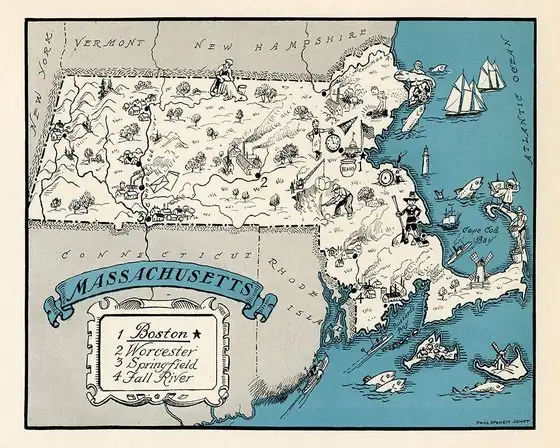
Worcester, Massachusetts, is named after Worcester in England. On September 10, 1684, the colony's General Court approved a request from Daniel Gookin, Thomas Prentice and Daniel Henchman that their plantation at Quinsigamond be called Worcester. The order doesn't say why, and local historians in 1837 and 1919 said the reason wasn't known.
A plantation that needed a name
Worcester, Massachusetts, has carried the name of Worcester, England, since September 10, 1684, and the order that named it never says why. Before that, the place was Quinsigamond, a name it shared with the pond on its eastern edge, and the colonial records spell it at least nine different ways.
William Lincoln, who published a history of the town in 1837, collected the versions he found in the old records: Quansiggemuck, Quinsigamug, Quonsiquomon, Quanciggugug and Quonsogogoag, among others. He settled on Quinsigamond because it had “been established by most general use.” The committee’s own petition of 1669 talks about settling a plantation “at or about Quansigamond Pond.”
The colony’s General Court had granted land around the pond to a committee led by Daniel Gookin, Thomas Prentice and Daniel Henchman, and they spent years trying to get a settlement going. The first try fell apart in 1675, when King Philip’s War reached the area and the few houses were left behind.
September 10, 1684: “be called Worcester”
The committee tried again in the early 1680s, with a survey, mills and lots laid out for new settlers. That’s when the name changed. Lincoln reports that on September 10, 1684, at the motion of Gookin, Prentice and Henchman, the Great and General Court granted their request
“that their plantation at Quansigamond be called Worcester.”
That one line is the whole paper trail. It tells you who asked and when, and it doesn’t say a word about why.
Why Worcester? The record is silent
Lincoln went looking for the reason and came up empty. In a footnote on the same page he wrote that the reasons for the choice “cannot now be ascertained,” and offered a guess, clearly labeled as one: the name “was probably adopted from the place of residence of some of the committee or planters in England.”
Charles Nutt, whose History of Worcester and Its People came out in 1919, didn’t get any further. “For some reason not known the name of an English city was selected,” he wrote. So you’ll find two local historians, 82 years apart, giving the same answer: they didn’t know.
The English side of the name isn’t in doubt. The City Clerk’s office says plainly that Worcester was named after Worcester, England. Henry Gannett’s 1905 federal guide to place names says the Massachusetts county and city were “named from the county in England,” which is a slightly different way of putting it, since the English city sits in a county of the same name. Lincoln, for his part, described the English Worcester of his day: a city on the Severn known for gloves and fine china, and the scene of a 1651 battle between Cromwell and the future Charles II. He never suggested any of that was the reason.
The battle does turn up in one modern explanation. A history page from UMass Chan Medical School says the community was renamed in 1684 “possibly” for Worcester, England, as “an angry gesture at King Charles II,” who had lost the Battle of Worcester in 1651. It’s an interesting idea, and the page itself flags it with “possibly.” It cites no source, though, and nothing in the 1684 order or in Lincoln and Nutt points that way. Until a document turns up, it’s a hypothesis, not the answer.
A name that had to survive two abandonments
Getting the name was easier than keeping the town. Lincoln tells how the second settlement emptied out once Queen Anne’s War began in 1702, leaving Worcester a name on paper with almost no one living there. A third group of settlers came in 1713, and this time it stuck.
On June 14, 1722, the legislature gave the inhabitants of Worcester the powers of a town, and they held their first town meeting on September 28. In 1731 a new county was carved out around it and given the same name. The City Clerk dates Worcester’s change from town to city to 1848.
So the name came first, and it waited almost 40 years for a town that could hold on to it.
Quick answers
Is Worcester, Massachusetts, named after Worcester, England?
Yes. The City of Worcester says it was named after Worcester, England. Gannett’s 1905 guide words it as “named from the county in England.”
What was Worcester called before it was Worcester?
Quinsigamond, the name of the pond on its eastern border, written in many spellings in the colonial records. The General Court renamed the plantation Worcester on September 10, 1684.
Why did the settlers choose the name Worcester?
No record says. Lincoln wrote in 1837 that the reasons “cannot now be ascertained” and guessed it was where some of the committee or planters came from in England; Nutt wrote in 1919 that the reason was “not known.” A modern UMass Chan Medical School page suggests a jab at Charles II after the 1651 Battle of Worcester, but offers no source.
When was Worcester founded?
It took three tries. Settlers first built houses there in the 1670s, the name was given in 1684, and the town was finally incorporated in 1722. It became a city in 1848.
Key dates
- 1675The first attempt at a settlement at Quinsigamond is abandoned during King Philip's War.
- 1684September 10: the General Court grants the committee's request that the plantation at Quinsigamond be called Worcester.
- 1702Queen Anne's War begins, and the second settlement is abandoned.
- 1713A third settlement begins, the one that lasts.
- 1722June 14: the legislature gives Worcester the powers of a town; the first town meeting follows on September 28.
- 1731A new county is created around Worcester and given the same name.
- 1848Worcester becomes a city, according to the City Clerk.
Getting there
Open Worcester in Google Maps
Opens in a new tab. The pin is the center of Worcester in the USGS place-name record.
The closest airports, Amtrak stations and intercity bus stops, measured in a straight line from the center of Worcester.
Airports
- Worcester Regional (ORH) 4 mi 6 km
- General Edward Lawrence Logan International (BOS) Boston 41 mi 66 km
Amtrak trains
- Worcester station (WOR) under 1 mi 0.6 km
- Framingham station (FRA) 20 mi 31 km
Intercity buses
- Peter Pan Bus Lines Worcester (Union Station) under 1 mi 0.6 km
- FlixBus Worcester Union Station under 1 mi 0.6 km
- OurBus Worcester, MA (Union Station - Franklin Street and Harding Street, next to Union Station Garage (Same bus stop as WRTA routes 1, 5, 14, 15, 16)) under 1 mi 0.6 km
Distances are as the crow flies, not by road. We don't list schedules or fares because they change; check with the airline, Amtrak or the bus company before you go. Official data (FAA commercial service airports (2025), FAA airport locations, Amtrak stations and Intercity Bus Atlas) from the FAA and the U.S. Bureau of Transportation Statistics, checked Nov 13, 2026.
Sponsored
Staying in Worcester?
Compare hotels in Worcester, Massachusetts, on Expedia.
See hotels in WorcesterWe may earn a commission if you buy through this link. It never changes what we write. Read our affiliate disclosure
Historical Sources & References
- William Lincoln, History of Worcester, Massachusetts (1837), pp. 2, 4, 32, 50, 58. The spellings of Quinsigamond and why Lincoln chose that one (p. 2); the committee’s 1669 petition for a plantation “at or about Quansigamond Pond” (p. 4); the court’s order of September 10, 1684, “that their plantation at Quansigamond be called Worcester,” and the footnote saying the reasons “cannot now be ascertained,” with his guess and his description of the English city (p. 32); the 1722 resolve and first town meeting (p. 50); the 1731 county act (p. 58); the abandonments of 1675 and 1702 and the 1713 resettlement (chapters I to IV).
- Charles Nutt, History of Worcester and Its People, vol. 1 (1919), p. 15. The committee’s petition, the date of the change, and “For some reason not known the name of an English city was selected.”
- Henry Gannett, The Origin of Certain Place Names in the United States (USGS, 1905), p. 331. “Worcester; county, and city in same county, in Massachusetts, named from the county in England.”
- City of Worcester, City Clerk, “Worcester History”. Named after Worcester, England; a town in 1722 and a city in 1848.
- UMass Chan Medical School, “Worcester: A History Lesson”. The suggestion that the 1684 name was “possibly” for Worcester, England, as “an angry gesture at King Charles II,” defeated at the Battle of Worcester in 1651, given without a source.
- GNIS feature 617867 (U.S. Geological Survey). Worcester’s place-name entry as a populated place in Worcester County, with its coordinates.
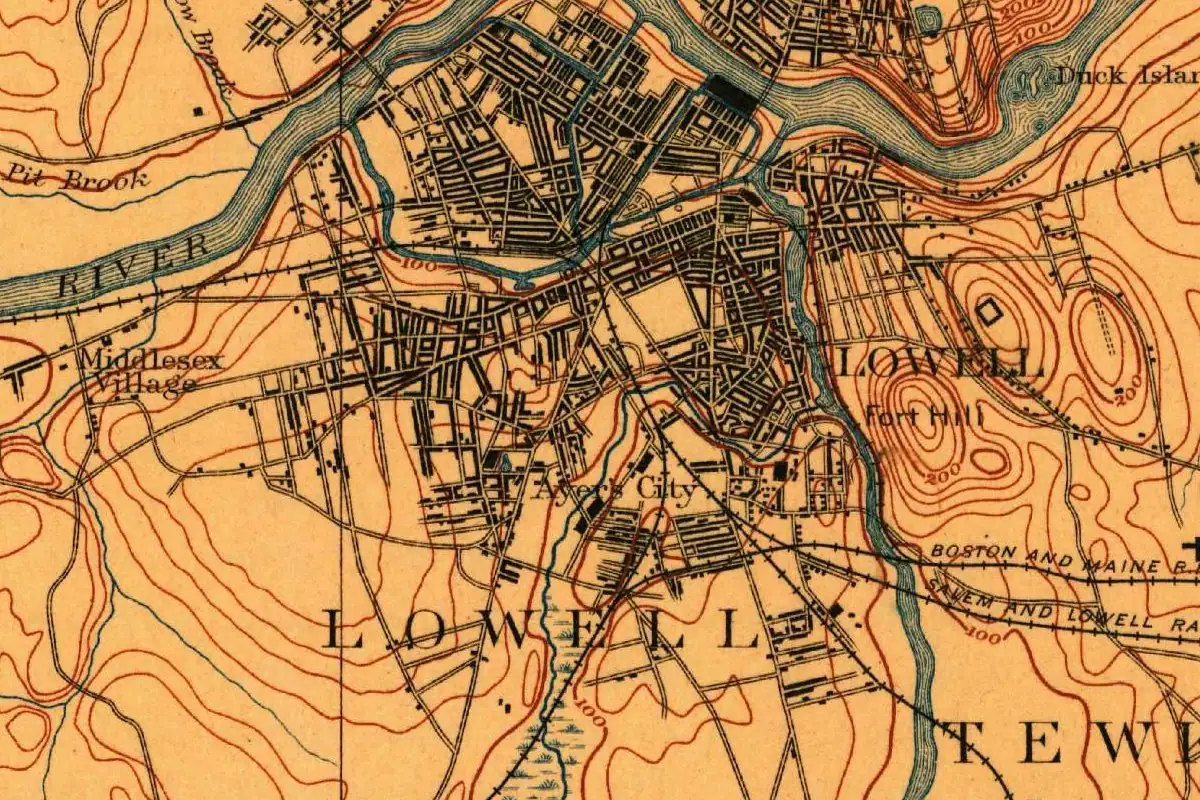
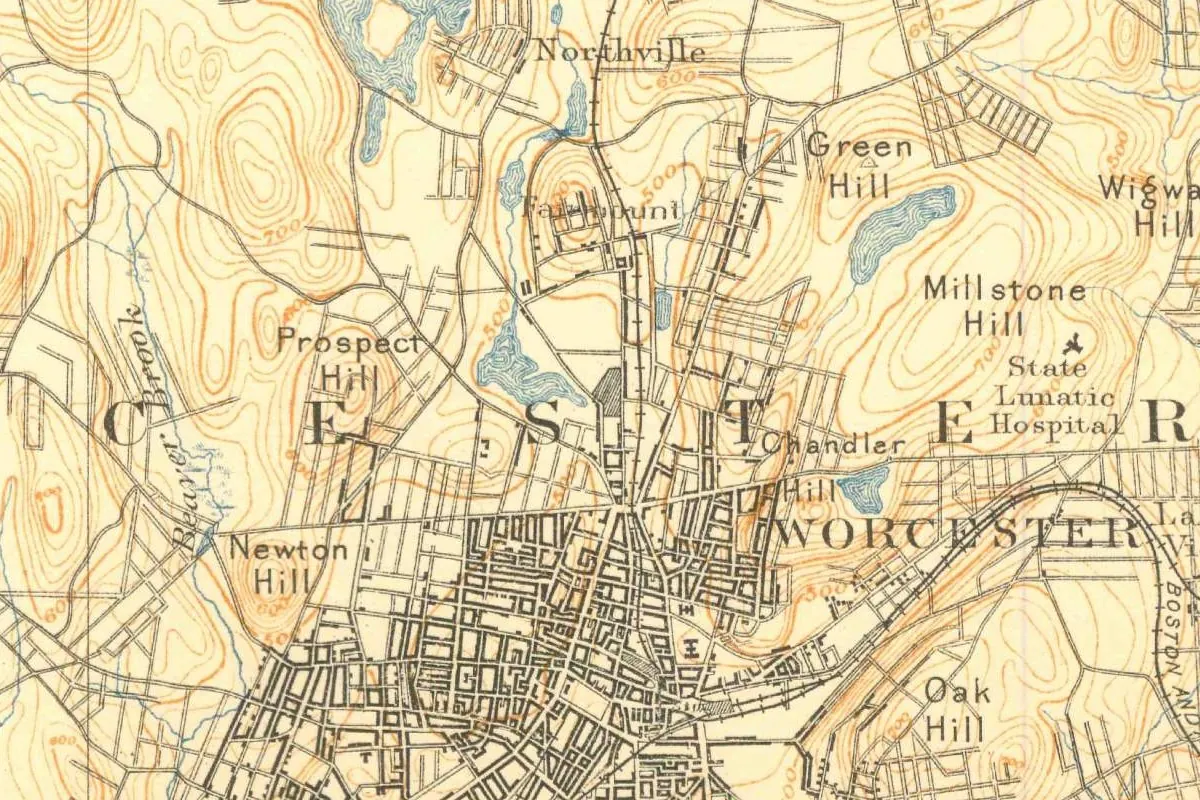
- U.S. Geological Survey, Worcester sheet (1885). The source of the map at the top of this page.
Correction, November 13, 2026: this page used to say flatly that nobody wrote down why the name was chosen. It now says the 1837 and 1919 histories found no recorded reason, and it adds the unproven suggestion that the name recalled the 1651 Battle of Worcester.
Spot something wrong, or know more? Tell us here. You can also email us or use our contact page. Corrections are noted here with their date, never made silently.