Lowell or Derby? How Lowell, Massachusetts, Got Its Name
Lowell is named for Francis Cabot Lowell, the Boston merchant who built the country's first working power loom and whose system of cotton manufacture the town was founded to use. He died in 1817, nine years before the town was incorporated. Nathan Appleton wrote that Kirk Boott had narrowed the choice to Lowell or Derby, and Appleton said Lowell.
Lowell, Massachusetts, came down to two names, Lowell or Derby, and Nathan Appleton, who was there, says it took him five words to settle it. The winner honored Francis Cabot Lowell, the Boston merchant whose system of making cloth, in Appleton’s words, “gave birth to the place,” even though he’d been dead for nine years by then.
“Lowell or Derby”
Appleton was one of the Boston investors behind the mills, and in 1858 he published a short memoir of how it all started, Introduction of the Power Loom, and Origin of Lowell. Most of it is about looms and money. Then, on pages 32 and 33, he gets to the name.
In November 1824, he writes, “it was voted” to petition the Legislature to set off part of Chelmsford as a separate township. The town was incorporated in 1826, and “it was a matter of some difficulty to fix upon a name for it.” One day he ran into Kirk Boott, who had taken on the management of the new venture, and Boott told him the legislative committee was ready to report the bill and needed a name for the blank. Appleton’s account of what came next is worth reading in his own words:
“He said he considered the question narrowed down to two, Lowell or Derby. I said to him, ‘then Lowell by all means,’ and Lowell it was.”
That’s the whole naming ceremony, as Appleton tells it: a chance meeting, two options and one opinion that settled it. Appleton was writing more than 30 years later and telling it his own way, so you’re getting one man’s memory. But he was there, and he was the one who said the deciding words.
Why Derby was on the list
Appleton doesn’t hide where the other name came from. “The name of Derby was suggested by Mr. Boott,” he writes, “probably, from his family associations with that place, it being also in the immediate vicinity of one of the earliest seats of the cotton manufacture.”
Notice the “probably.” Appleton is guessing at his partner’s reasons, and he never says which Derby he meant. So the city nearly had a name with a family story behind it that Appleton didn’t spell out. Lowell won instead, and for Appleton the reason was obvious.
The man who never saw the town
Francis Cabot Lowell died in 1817, “at the early age of 42,” Appleton says, four years before Appleton and his partners first walked the site on the Merrimack. Appleton gives him the credit anyway: “it was Mr. Lowell who was the informing soul, which gave direction and form to the whole proceeding.”
The National Park Service tells the background. Lowell came from a leading Boston merchant family, and after building the country’s first working power loom, he, Patrick Tracy Jackson and Appleton set up the Boston Manufacturing Company on the Charles River at Waltham in 1814. That mill put every step of making cloth under one roof and hired young single women from the countryside to run it. Its profits were so large that the partners went looking for more water power, first at East Chelmsford, which, in the Park Service’s words, was “renamed Lowell.”
There’s an odd twist here. The Park Service’s article illustrates Francis Cabot Lowell with a plain silhouette, and its caption says no portrait of him is known to survive. So the man whose name is on the whole city doesn’t have a face you can look at.
Appleton also explains why the name felt right beyond the founder himself. The family stayed involved. Lowell’s son, also named Francis, served for a time as treasurer of the Merrimack Company, and his nephew John A. Lowell was treasurer of the Waltham Company and, for many years, of the Boott and Massachusetts mills.
A snowy walk in 1821
The town’s story starts a few years before the name. Appleton remembers the first visit to the falls of the Merrimack “in the month of November, 1821, and a slight snow covered the ground.” The party included Jackson, Kirk Boott, his brother John W. Boott, the mechanic Paul Moody, Warren Dutton and Appleton himself. Somebody remarked “that some of us might live to see the place contain twenty thousand inhabitants.” At the time, he thought, there were fewer than a dozen houses on the ground that later became the thickly settled part of the city.
Appleton doesn’t say whether anyone in that party lived to see twenty thousand. He does note that by 1836, ten years after it became a town, Lowell had changed its government to that of a city.
Lowell on the 1893 map
When Henry Gannett went through American place names from A to Z for a 1905 Geological Survey bulletin, he gave the same answer Appleton did, in one tidy line: the city in Middlesex County was “named for Francis Cabot Lowell, of Boston.” He folded in a plantation in Maine, a village in Michigan and a town in North Carolina with the same namesake.
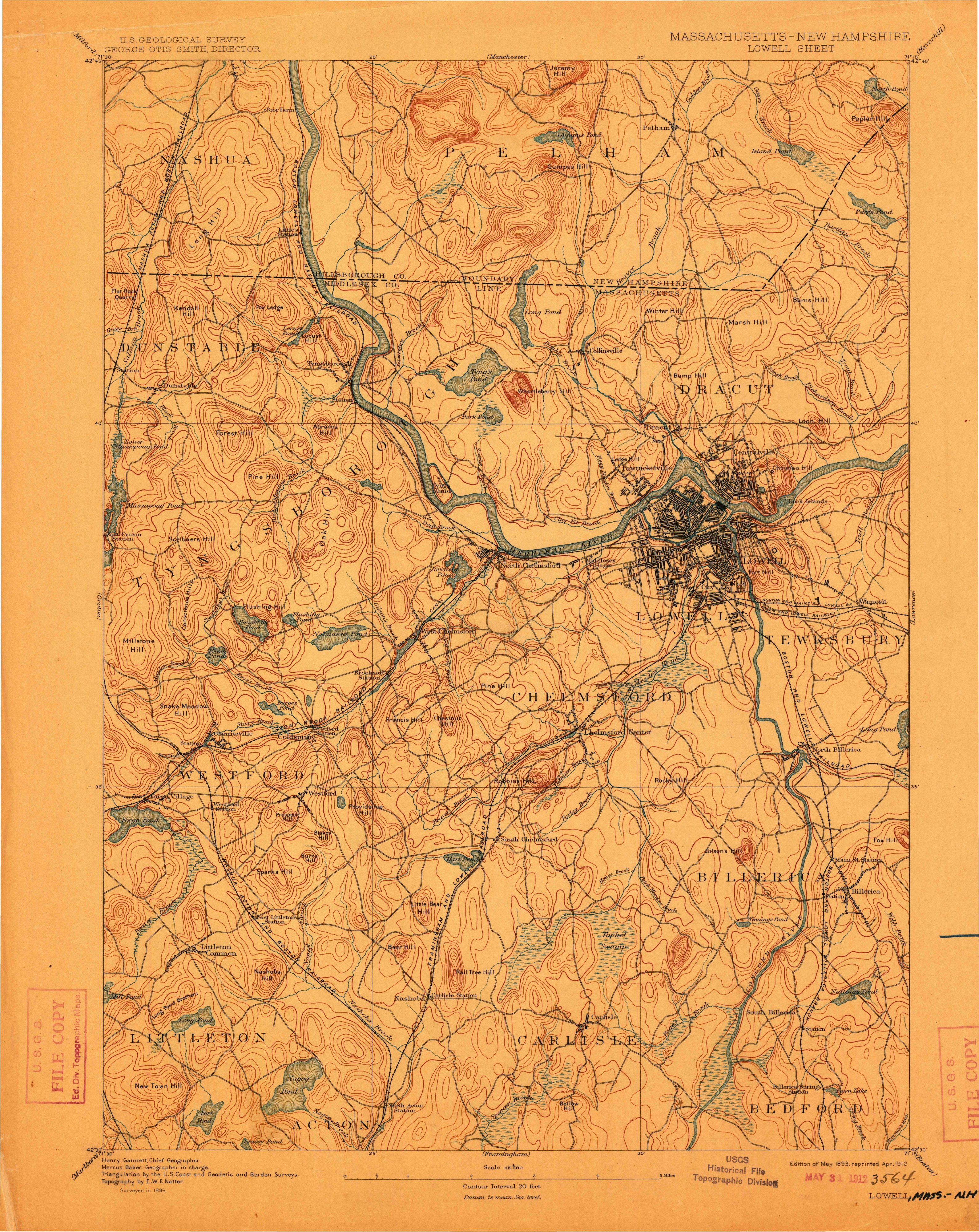
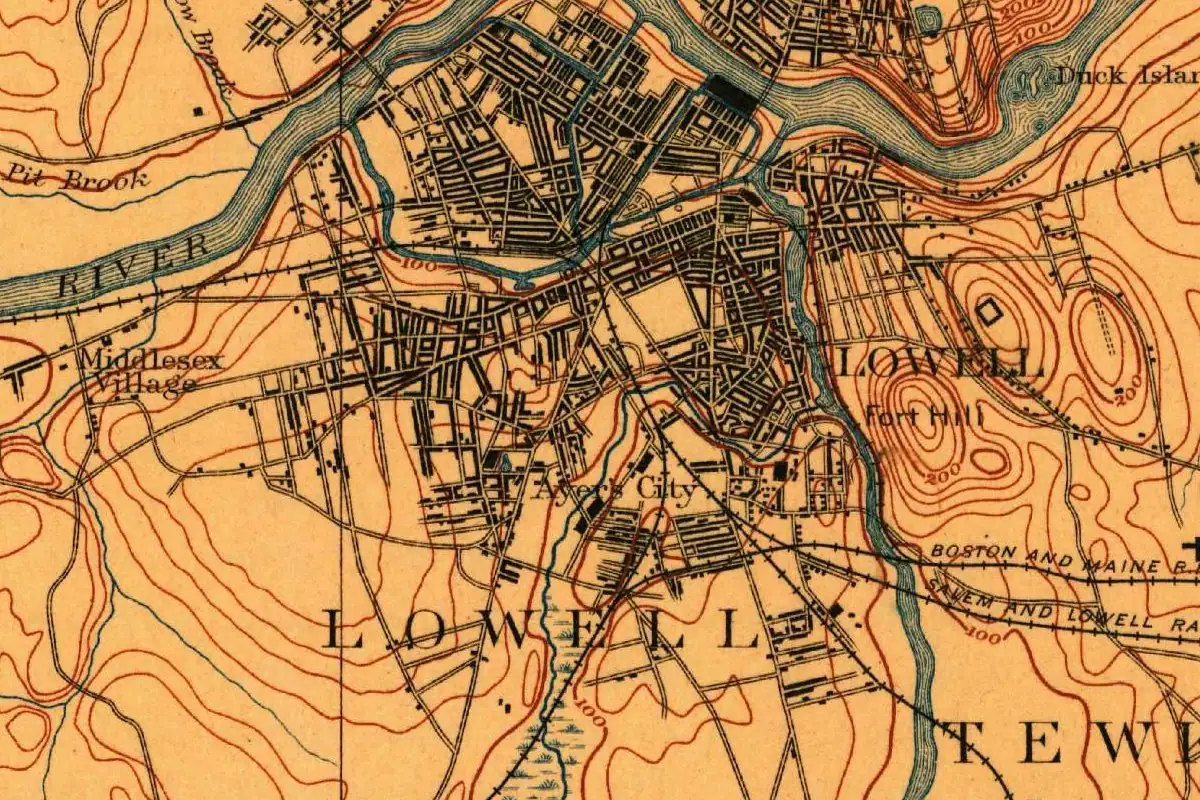
Gannett had already left his mark on Lowell in another way. Look at the bottom margin of the full 1893 sheet the map at the top of this page comes from, and you’ll find the line “Henry Gannett, Chief Geographer.” On that map you can see what Francis Cabot Lowell’s idea turned into: blocks of mills and housing packed between the Merrimack and Concord rivers, threaded with canals.
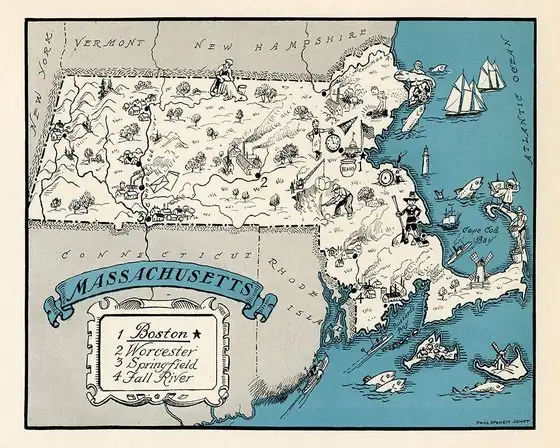
Massachusetts has another city that grew around mills and water power, Fall River, but its name came from the stream itself. Lowell’s came from a man in Boston, the same as the money did. For another Massachusetts city named for a person, try Quincy, or browse the rest on our Massachusetts page.
Quick answers
Who is Lowell, Massachusetts, named after?
Francis Cabot Lowell, the Boston merchant who built the country’s first working power loom and set up the mill at Waltham in 1814. Both Nathan Appleton (1858) and Henry Gannett (1905) say so.
What was Lowell almost called?
Derby. Appleton wrote that Kirk Boott had narrowed the choice to Lowell or Derby, and that Boott had probably suggested Derby because of family ties to a place by that name.
Did Francis Cabot Lowell ever see Lowell?
Not as a town. He died in 1817, and Appleton dates the first visit to the site to November 1821 and the town’s incorporation to 1826.
What was Lowell called before it was Lowell?
It was part of Chelmsford. The National Park Service calls the site East Chelmsford, and Appleton says the town was set off from Chelmsford by the Legislature.
Key dates
- 1814Francis Cabot Lowell, Patrick Tracy Jackson and Nathan Appleton set up the Boston Manufacturing Company at Waltham.
- 1817Francis Cabot Lowell dies at 42.
- 1821In November, Appleton, Jackson, Kirk Boott and others first walk the ground at East Chelmsford.
- 1826The town of Lowell is incorporated, after Boott and Appleton settle on Lowell over Derby.
- 1836Lowell becomes a city.
Things to do in Lowell, Massachusetts
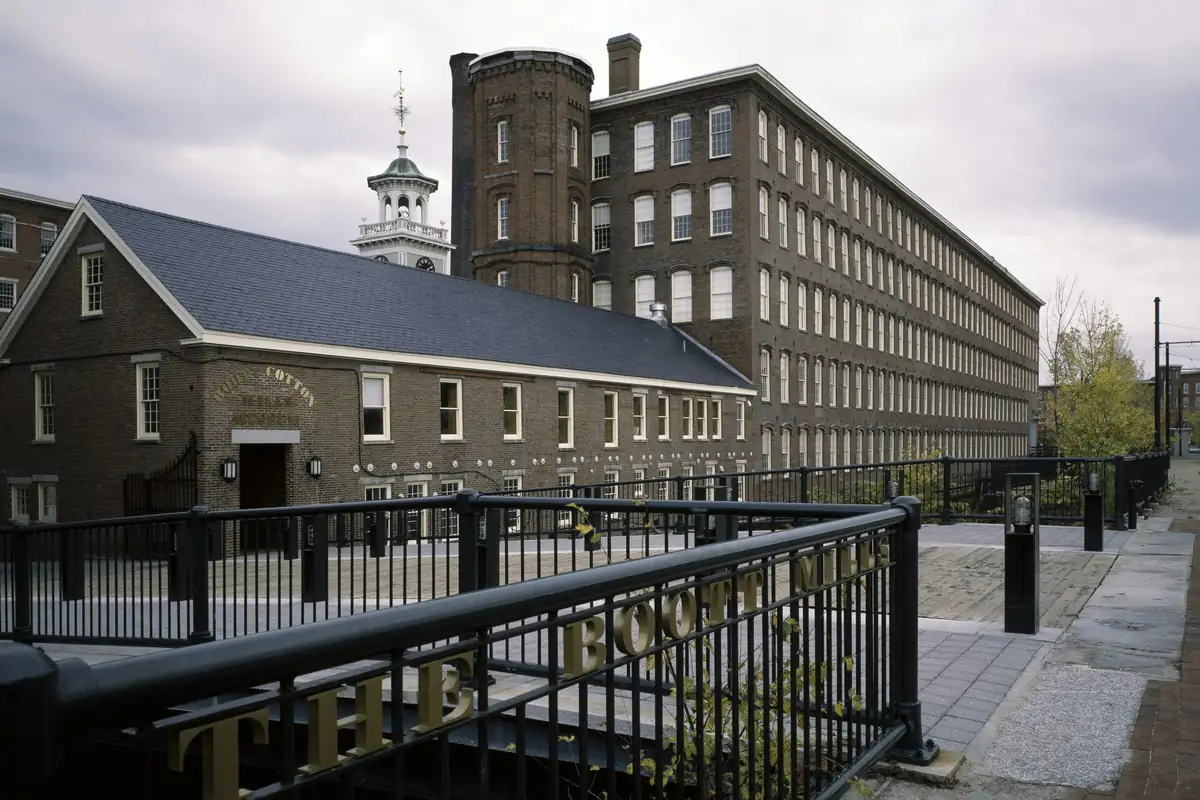
Boott Cotton Mills Museum
The national park's museum in the Boott Mills, where you can learn about the workers, engineers, inventors and investors who made Lowell the first successful planned industrial city in the United States.
Mogan Cultural Center
A park site in a historic boarding house, with exhibits on Lowell's cultural history and a reconstructed corporation boarding house furnished in the style of the 1840s, where the city's mill girls lived.
Suffolk Mill Turbine Exhibit
An exhibit in the Wannalancit building on Suffolk Street that shows how water from the Merrimack River, carried through the canals, powered the mills, and what Lowell's engineers did with turbines.
Pawtucket Canal Tour
A ranger-led boat ride along the historic Pawtucket Canal about the workers who built and ran Lowell's waterpower system, with a stop at the historic Francis Gate when water levels allow.
Getting there
Open Lowell in Google Maps
Opens in a new tab. The pin is the center of Lowell in the USGS place-name record.
The closest airports, Amtrak stations and intercity bus stops, measured in a straight line from the center of Lowell.
Airports
- Manchester Boston Regional (MHT) 22 mi 35 km
- General Edward Lawrence Logan International (BOS) Boston 24 mi 39 km
Amtrak trains
- Woburn station (WOB) 12 mi 19 km
- Haverhill station (HHL) 15 mi 24 km
Intercity buses
- Greyhound Lowell Bus Station under 1 mi 0.3 km
- Boston Express Bus Tyngsboro MA (Exit 90) 7 mi 11 km
- OurBus Methuen - Lawrence, MA (Methuen Park and Ride at 144 Pelham St, Methuen, MA. Free overnight parking is available, at owner's own risk.) 9 mi 14 km
Distances are as the crow flies, not by road. We don't list schedules or fares because they change; check with the airline, Amtrak or the bus company before you go. Official data (FAA commercial service airports (2025), FAA airport locations, Amtrak stations and Intercity Bus Atlas) from the FAA and the U.S. Bureau of Transportation Statistics, checked Nov 14, 2026.
Sponsored
Staying in Lowell?
Compare hotels in Lowell, Massachusetts, on Expedia.
See hotels in LowellWe may earn a commission if you buy through this link. It never changes what we write. Read our affiliate disclosure
Historical Sources & References
- Nathan Appleton, Introduction of the Power Loom, and Origin of Lowell (1858), p. 15. Francis C. Lowell “died in 1817, at the early age of 42”; “the informing soul, which gave direction and form to the whole proceeding.”
- Appleton (1858), p. 19. The first visit in November 1821 in light snow, who went, the “twenty thousand inhabitants” remark and the dozen houses.
- Appleton (1858), p. 32. The November 1824 vote to set off part of Chelmsford, incorporation in 1826 and “a matter of some difficulty to fix upon a name for it.”
- Appleton (1858), p. 33. The quoted exchange with Kirk Boott, “Lowell or Derby”; why the name fit; the son and nephew in the companies; Derby “suggested by Mr. Boott, probably, from his family associations with that place”; the city government of 1836.
- Henry Gannett, The Origin of Certain Place Names in the United States (1905), p. 191. The city in Middlesex County and three other Lowells “named for Francis Cabot Lowell, of Boston.”
- National Park Service, “The Waltham-Lowell System”. Lowell’s merchant family, the first working power loom, the Boston Manufacturing Company at Waltham in 1814, “East Chelmsford (renamed Lowell),” and the caption saying no portrait of him is known to survive.
- National Park Service, “The Boarding Houses”. The corporation boarding houses and the reconstructed 1840s boarding house exhibit.
- GNIS feature 611832 (U.S. Geological Survey). The gazetteer record for Lowell, Middlesex County, with its coordinates.
- U.S. Geological Survey, Lowell sheet (1893). The 1:62,500 map, surveyed in 1886, that the image at the top of this page was cropped from; its margin names Henry Gannett as chief geographer.
Sponsored
Put this 1893 map on your wall
The 1893 USGS Lowell sheet, in a 1912 reprint, is in the public domain. Download the full-size scan for free, then have it printed on canvas with CanvasOnTheCheap.
Print a map on canvasDownload the full-size mapWe may earn a commission if you buy through this link. It never changes what we write. Read our affiliate disclosure
Spot something wrong, or know more? Tell us here. You can also email us or use our contact page. Corrections are noted here with their date, never made silently.