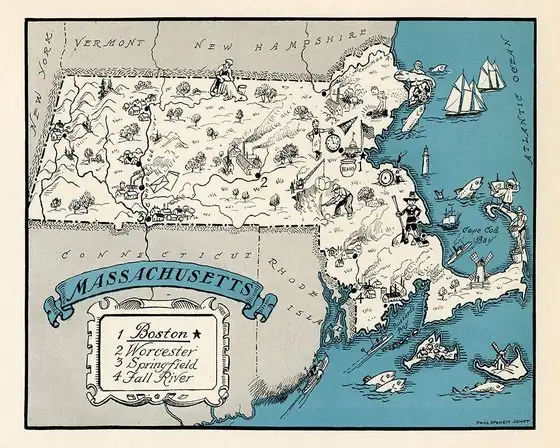
Why Is It Called Provincetown, MA? It Was Almost Herringtown
Provincetown is named for the Province Lands, the land at the tip of Cape Cod owned by the Province of Massachusetts Bay. A 1727 act made 'all the lands on the said Cape, being province lands' into 'a township by the name of Provincetown.' The settlers had asked for Herringtown, but an 1890 county history says lawmakers didn't like it.
The name that didn’t pass
When the fishing settlement at the tip of Cape Cod asked to become a town in 1727, it picked Herringtown, and the lawmakers in Boston made it Provincetown. James H. Hopkins, who wrote the Provincetown chapter of the 1890 History of Barnstable County, tells it in two sentences: the inhabitants petitioned the General Court to make their precinct a separate town, and “the name selected—Herringtown, found little favor with the general court.”
What the court passed instead is still in print. The act’s title reads “An Act for erecting the precinct of Cape Cod into a township by the name of Provincetown.” Hopkins says it was passed July 14, 1727. The state’s own 1869 edition of the province laws prints a different note at the bottom: “Passed June 14; published July 11.” Either way, it was the summer of 1727, and either way it wasn’t Herringtown.
Land that belonged to the province
The new name wasn’t random. It came straight from the land itself. The act opens with “the province lands of Cape Cod” and then makes “all the lands on the said Cape, being province lands,” into “a township by the name of Provincetown.”
Hopkins explains how the land got that label. The Plymouth colony had held the tip of the Cape, and when the Province of Massachusetts Bay took over the colony’s rights in 1692, the land became province property. Since then, he writes, it had been “known as the ‘Province Lands.’” Before 1714 those lands seem to have been treated as part of Truro, Hopkins says. That year the General Court made them a precinct, “The Precinct of Cape Cod.”
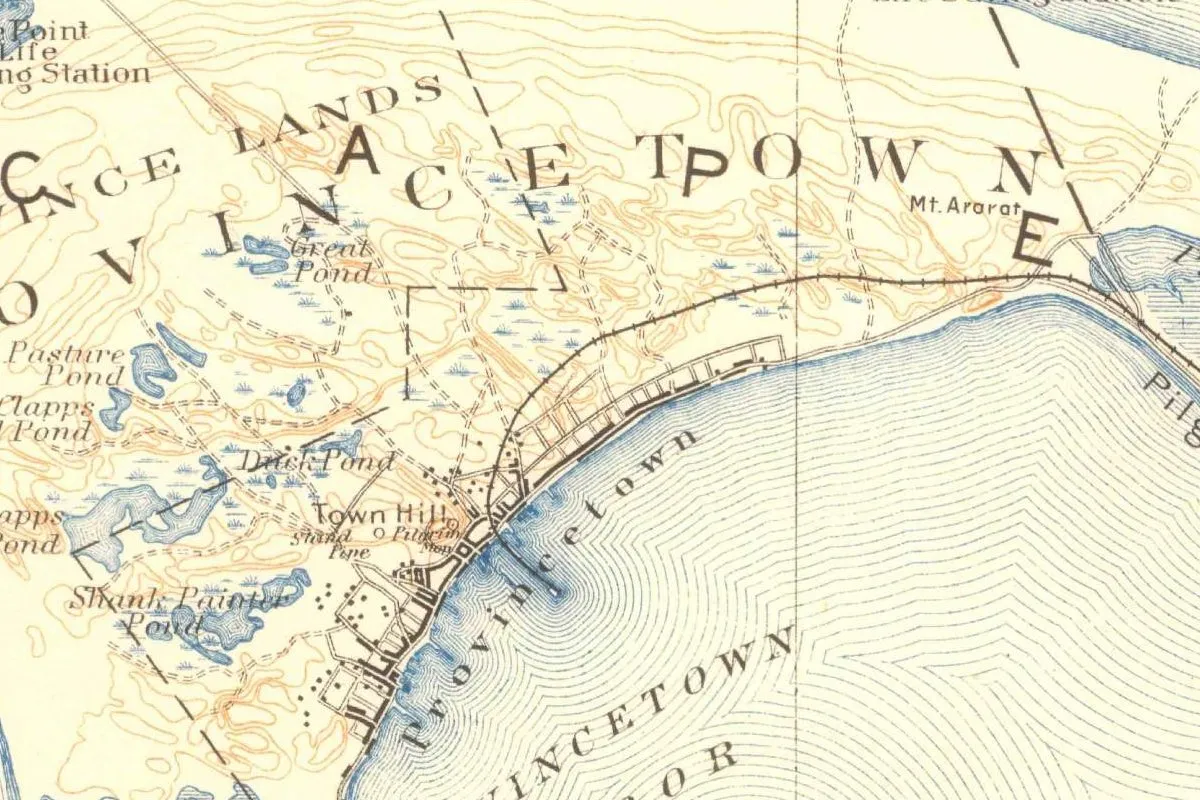
There was a catch in the 1727 act. The town got a name, but not the land under it: the act saved “the right and title of this province to the said lands, which is to be in no wise prejudiced.” The Town of Provincetown’s own page on its old shoreline says the 1727 charter “did not provide the new town with authority to grant land to its settlers.” It also says the part of town east of Howland Street used to be Truro, while the part to the west “was known as the Province Lands.” You can see part of that label printed across the dunes on the 1887 map at the top of this page.
The tax story
You’ll sometimes read a different reason. Henry Gannett, who collected name origins for the U.S. Geological Survey in 1905, says Provincetown was “incorporated as the Province Town, because the inhabitants were exempt from taxation.” Gannett doesn’t give a source, and the act doesn’t say anything about taxes. What it does say is that the land was the province’s, and the town was named for it.
Before it was anything
Long before the precinct, the harbor had its moment. Hopkins writes that the Mayflower was “about to anchor in the harbor of Provincetown” on November 11, 1620, when the passengers signed their compact, weeks before they settled at Plymouth.
The Cape itself nearly had another name, too. John Smith’s 1616 Description of New England includes a table of names changed by Prince Charles, and on it Cape Cod becomes “Cape James.” That’s the same table that turned the harbor called Accomack into Plimouth. Plymouth kept the prince’s name. Cape Cod didn’t.
Quick answers
Why is Provincetown called Provincetown?
Because the town was made out of the Province Lands, land that belonged to the Province of Massachusetts Bay. The 1727 act that created it says so in nearly those words.
What did Provincetown want to be called?
Herringtown. The settlers chose it in their 1727 petition, but it “found little favor with the general court,” according to the 1890 county history.
Was Provincetown part of Truro?
Partly. Hopkins says the Province Lands seem to have been treated as part of Truro before 1714, and the town says the area east of Howland Street was once Truro.
Key dates
- 1616John Smith's schedule of new names lists Cape Cod as renamed Cape James. The new name doesn't stick.
- 1620November 11: the Mayflower anchors in the harbor of today's Provincetown, and the passengers sign their compact.
- 1692The Province of Massachusetts Bay takes over the Plymouth colony's rights, and the land becomes the Province Lands.
- 1714The General Court makes the Province Lands a precinct, the Precinct of Cape Cod.
- 1727The precinct asks to become a town called Herringtown. The General Court makes it Provincetown instead.
- 1905Henry Gannett's guide says the name came from the inhabitants being exempt from taxation, with no source.
Getting there
Open Provincetown in Google Maps
Opens in a new tab. The pin is the center of Provincetown in the USGS place-name record.
The closest airports, Amtrak stations and intercity bus stops, measured in a straight line from the center of Provincetown.
Airports
- Cape Cod Gateway (HYA) Hyannis 27 mi 44 km
- General Edward Lawrence Logan International (BOS) Boston 47 mi 76 km
Amtrak trains
- Boston station (BOS) 49 mi 79 km
- Boston station (BON) 50 mi 80 km
Intercity buses
- Peter Pan (BZ) Peter Pan Bus Lines · Provincetown under 1 mi 1 km
- OurBus Quincy, MA (Quincy Center Station MBTA Bus Stop (bus shelter on Burgin Parkway between Saville & Dimmock St.) bus will not load at the station, follow signs to Burgin Parkway bus stop.) 44 mi 72 km
- CandJ Bus Lines Logan International Airport (Terminal B2) 48 mi 77 km
Distances are as the crow flies, not by road. We don't list schedules or fares because they change; check with the airline, Amtrak or the bus company before you go. Official data (FAA commercial service airports (2025), FAA airport locations, Amtrak stations and Intercity Bus Atlas) from the FAA and the U.S. Bureau of Transportation Statistics, checked Nov 13, 2026.
Sponsored
Staying in Provincetown?
Compare hotels in Provincetown, Massachusetts, on Expedia.
See hotels in ProvincetownWe may earn a commission if you buy through this link. It never changes what we write. Read our affiliate disclosure
Sponsored
Want the spooky side of Provincetown?
The name has its story above. For the ghost stories, US Ghost Adventures runs walking ghost tours in Provincetown.
See ghost tours in ProvincetownWe may earn a commission if you book through this link. It never changes what we write. Read our affiliate disclosure
Historical Sources & References
- Acts and Resolves of the Province of the Massachusetts Bay, vol. 2 (1869), Province Laws 1727, chapter 11, pp. 426-427. The full act: its title, the “province lands of Cape Cod,” the township “by the name of Provincetown,” the province’s title to the land, and “Passed June 14; published July 11.”
- Simeon L. Deyo, ed., History of Barnstable County (1890), pp. 956, 961-965. James H. Hopkins on the Mayflower’s anchoring (p. 956), the Province Lands after 1692 (p. 961), Truro and the 1714 precinct (pp. 962-963), and Herringtown (p. 965).
- Town of Provincetown, “Historic Mean High Water”. The Truro line at Howland Street, the Province Lands to the west, and the 1727 charter’s lack of power to grant land.
- John Smith, A Description of New England (1616; 1865 reprint). The schedule renaming Cape Cod as Cape James and Accomack as Plimouth.
- Henry Gannett, The Origin of Certain Place Names in the United States (USGS, 1905), p. 255. The tax-exemption explanation, with no source.
- GNIS feature 616639 (U.S. Geological Survey). Gives Provincetown’s coordinates and places it in Barnstable County.
- U.S. Geological Survey, Provincetown sheet (1887). The source of the map at the top of this page.
Spot something wrong, or know more? Tell us here. You can also email us or use our contact page. Corrections are noted here with their date, never made silently.