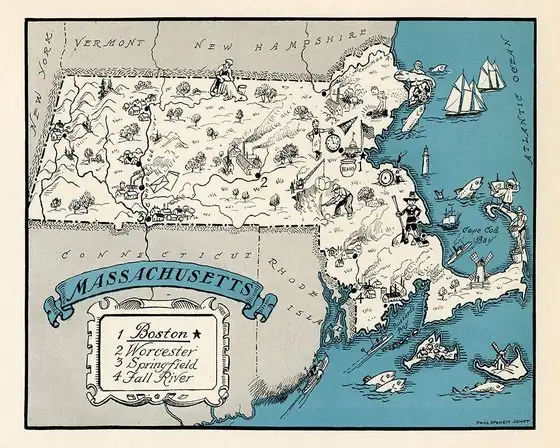
Why Is Plymouth, MA, Called Plymouth? A Prince Picked It
Plymouth, Massachusetts, is named after Plymouth in England, but the Pilgrims didn't pick it. John Smith's 1616 book on New England lists the harbor he'd called Accomack as renamed Plimouth by Prince Charles. A 1620 letter quoted by William Bradford calls it the place 'in Cap: Smiths mape' named Plimoth. No record we found says why the Pilgrims kept it.
A name chosen in England
Plymouth, Massachusetts, had its English name four years before the Mayflower showed up, and the man who chose it was a prince in England. You can see it happen in the front pages of John Smith’s A Description of New England, printed in 1616.
Smith had sailed this coast and mapped it. William T. Davis’s 1885 History of the Town of Plymouth dates his visit to 1614 and says that once he was back in England, Prince Charles put names on various places on the map, “of which only Charles River, Cape Ann, and Plymouth survive.”
The trouble was that Smith’s book had already gone to press with the old names. So he added a table and a note to the reader:
“Because the Booke was printed ere the Prince his Highnesse had altered the names, I intreate the Reader, peruse this schedule; which will plainely shew him the correspondence of the old names to the new.”
In the left column of that schedule there’s Accomack. In the right, Plimouth.
What Smith called it first
Accomack was Smith’s name for the harbor in the body of the book, and he liked it: “an excellent good harbor, good land; and no want of any thing, but industrious people,” he wrote on page 45 of the 1865 reprint. The people living there were the Patuxet. Davis says they were “in full occupation of Plymouth lands” when Smith came by, and that in 1616 an extraordinary plague swept them away.
Squanto was one of them, Davis says, and he’d been taken away from that harbor. In a letter dated June 30, 1620, quoted by William Bradford in his history of the colony, the explorer Thomas Dermer wrote about “that place from whence Squanto, or Tisquantem, was taken away; wch in Cap: Smiths mape is called Plimoth.” Dermer went further: “I would that the first plantation might hear be seated.”
So by the time the Pilgrims sailed, the harbor already had the name on paper, and at least one man who’d been there was recommending it.
The Pilgrims’ own Plymouth
There’s a second Plymouth in this story, the one in England. Bradford writes that on the way out in 1620, the Pilgrims’ two ships “resolved both ships to bear up backe againe & put into Plimoth.” That stop is where a popular explanation comes from.
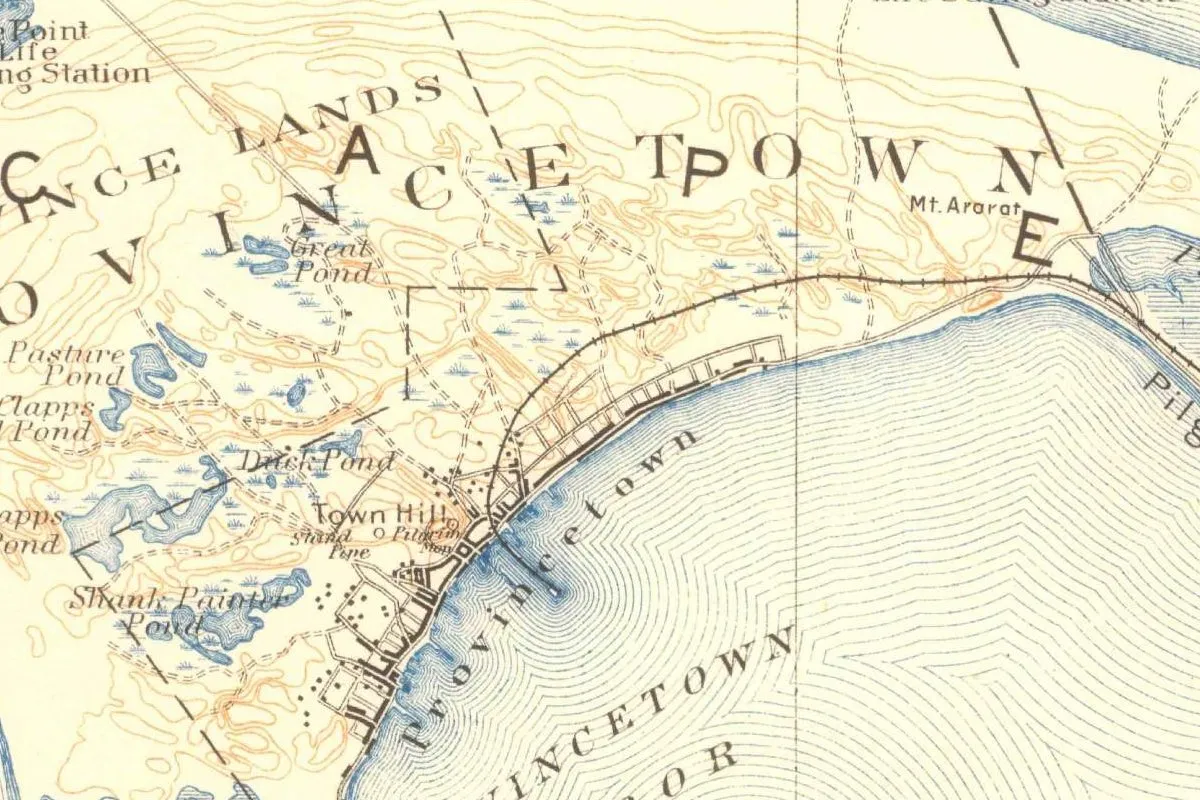
The Mayflower didn’t come straight here, either. It first anchored on November 11, 1620, in the harbor of what’s now Provincetown, at the tip of Cape Cod, according to the 1890 History of Barnstable County. And the same Smith schedule that turned Accomack into Plimouth tried to turn Cape Cod into “Cape James.” That one didn’t stick.
A reason nobody wrote down
Here’s where the legend comes in. An earlier historian, Baylies, wrote in his memoir of the colony that the settlers named the place Plymouth on a Sunday, December 31, 1620 (by the old calendar), “because this place had been so called by Capt. Smith” and because “they remembered the kindness which they had experienced from the people of Plymouth in England.”
It’s a nice story. Henry Martyn Dexter, editing Mourt’s Relation in 1865, quoted it in a footnote and then added: “But he gives no authority for this statement.” He also noted that Palfrey, in his History of New England, had looked at the date of the naming and felt it was “wholly a matter of conjecture.” Still, the hospitality version was printed again in 1905 by Henry Gannett, the Geological Survey’s place-name compiler, with no source attached.
What you can say for sure is the order of events: Smith mapped the harbor, a prince renamed it Plimouth in 1616, Dermer used that name in 1620, and the Pilgrims settled under it. Why they didn’t swap it for something of their own isn’t in any record we found.
Quick answers
Who named Plymouth, Massachusetts?
Prince Charles, on John Smith’s map. Smith’s 1616 book includes a table showing that the prince changed the harbor’s name from Accomack to Plimouth.
Did the Pilgrims name Plymouth after Plymouth, England?
Not exactly. The name was already on Smith’s map before they sailed. A later story says they kept it out of gratitude to the town in England, but the 1865 editor of Mourt’s Relation says no authority backs it.
What was Plymouth called before it was Plymouth?
John Smith called the harbor Accomack in his 1616 book. The Patuxet people lived there before a plague killed most of them, Davis’s 1885 town history says.
Key dates
- 1614John Smith visits the coast and maps it, Davis's town history says.
- 1616Smith's Description of New England lists Accomack as renamed Plimouth by Prince Charles.
- 1616A plague wipes out the Patuxet, who lived on the Plymouth lands, according to Davis.
- 1620June 30: Thomas Dermer writes that the place Squanto was taken from is called Plimoth on Smith's map.
- 1620November 11: the Mayflower anchors in the harbor of today's Provincetown before reaching Plymouth.
- 1865Henry Martyn Dexter notes that the story of why the Pilgrims chose the name has no authority behind it.
Getting there
Open Plymouth in Google Maps
Opens in a new tab. The pin is the center of Plymouth in the USGS place-name record.
The closest airports, Amtrak stations and intercity bus stops, measured in a straight line from the center of Plymouth.
Airports
- Cape Cod Gateway (HYA) Hyannis 28 mi 45 km
- General Edward Lawrence Logan International (BOS) Boston 33 mi 53 km
Amtrak trains
- Route 128 station (RTE) 30 mi 49 km
- Boston station (BOS) 34 mi 54 km
Intercity buses
- Peter Pan (BZ) Peter Pan Bus Lines · Sagamore Circle 14 mi 22 km
- OurBus Quincy, MA (Quincy Center Station MBTA Bus Stop (bus shelter on Burgin Parkway between Saville & Dimmock St.) bus will not load at the station, follow signs to Burgin Parkway bus stop.) 27 mi 43 km
- Peter Pan Bus Lines Logan International Airport (Terminal B1) 33 mi 53 km
Distances are as the crow flies, not by road. We don't list schedules or fares because they change; check with the airline, Amtrak or the bus company before you go. Official data (FAA commercial service airports (2025), FAA airport locations, Amtrak stations and Intercity Bus Atlas) from the FAA and the U.S. Bureau of Transportation Statistics, checked Nov 13, 2026.
Sponsored
Staying in Plymouth?
Compare hotels in Plymouth, Massachusetts, on Expedia.
See hotels in PlymouthWe may earn a commission if you buy through this link. It never changes what we write. Read our affiliate disclosure
Sponsored
Want the spooky side of Plymouth?
The name has its story above. For the ghost stories, US Ghost Adventures runs walking ghost tours in Plymouth.
See ghost tours in PlymouthWe may earn a commission if you book through this link. It never changes what we write. Read our affiliate disclosure
Historical Sources & References
- John Smith, A Description of New England (1616; 1865 reprint). The note to the reader and the schedule of old and new names, Accomack to Plimouth and Cape Cod to Cape James, plus Smith’s description of Accomack (p. 45).
- William Bradford, History of Plimoth Plantation (1899 edition), pp. 84, 117. The ships putting back into Plymouth, England (p. 84) and Thomas Dermer’s letter of June 30, 1620, on the place “in Cap: Smiths mape” called Plimoth (p. 117).
- Henry Martyn Dexter, ed., Mourt’s Relation (1865), p. 69, note 250. Baylies’s story of the naming, with Dexter’s verdict that “he gives no authority for this statement” and Palfrey’s “wholly a matter of conjecture.”
- William T. Davis, History of the Town of Plymouth (1885), p. 21. Smith’s 1614 visit, Prince Charles’s names, Dermer’s visit and the Patuxet plague of 1616.
- Henry Gannett, The Origin of Certain Place Names in the United States (USGS, 1905), p. 248. The hospitality explanation, given without a source.
- Simeon L. Deyo, ed., History of Barnstable County (1890), p. 956. The Mayflower anchoring in Provincetown’s harbor on November 11, 1620.
- GNIS feature 615295 (U.S. Geological Survey). Plymouth’s populated-place record in Plymouth County, with its coordinates.
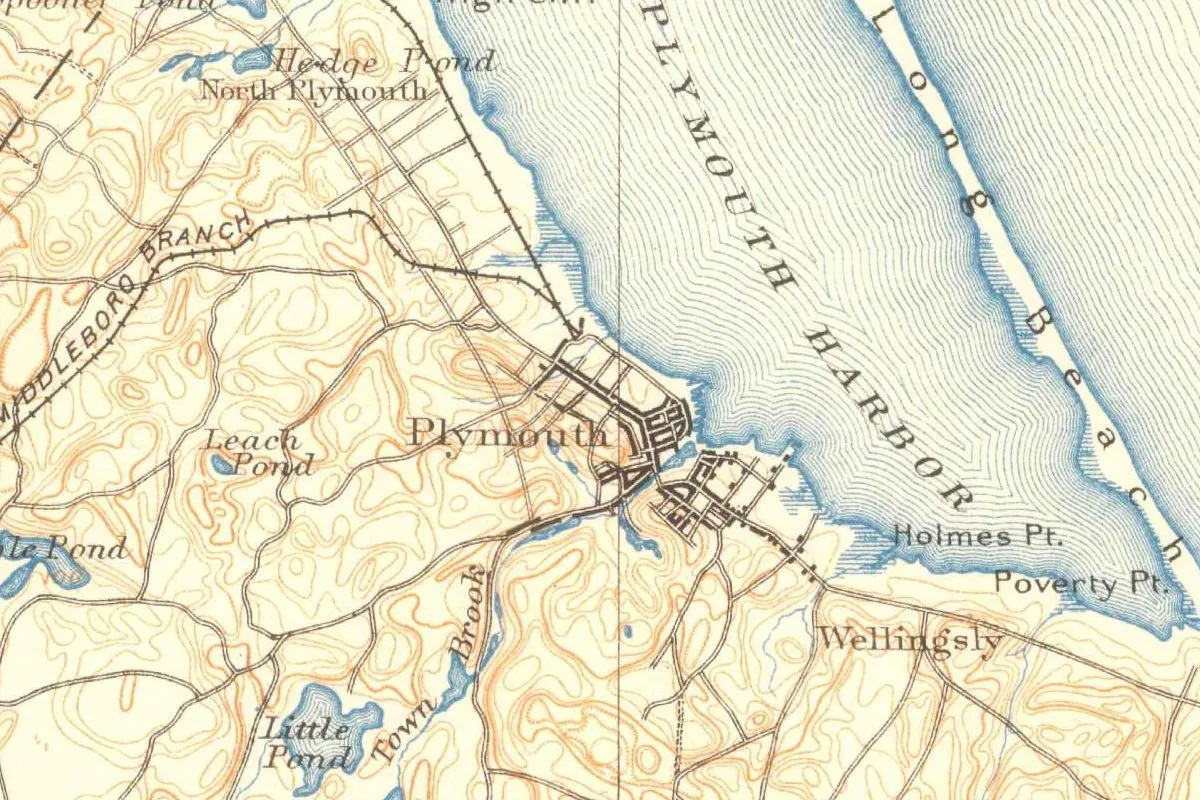
- U.S. Geological Survey, Plymouth sheet (1886). The source of the map at the top of this page.
Spot something wrong, or know more? Tell us here. You can also email us or use our contact page. Corrections are noted here with their date, never made silently.