New Bedford, Massachusetts, and the Farmer Known as the Duke
New Bedford goes back to Joseph Russell, who owned much of the land the city stands on. Daniel Ricketson wrote in 1858 that Joseph Rotch suggested the name Bedford in Russell's honor, because Russell shared the family name of the Dukes of Bedford. When the town was incorporated in 1787, Massachusetts already had a Bedford, so it became New Bedford.
New Bedford, Massachusetts, got its name from a farmer who came to be known as “the Duke,” and it only added the “New” because Bedford was taken. The farmer was Joseph Russell, and the man who thought of the name was a whaling merchant from Nantucket.
The farmer and the whaleman
The land had a long history before the name. The National Park Service says the site of today’s New Bedford was bought from the Wampanoag people in 1652, and Quakers built a meetinghouse there in 1699.
Daniel Ricketson told the naming story in his History of New Bedford, published in 1858. Russell, he wrote, was “a substantial farmer” whose land took in a large part of what became the city. In 1765 Joseph Rotch moved over from Nantucket to the place, “then known as Dartmouth,” to go into the whale fishery, and the two men got acquainted.
A little village had begun to appear by then, Ricketson says, and it needed a name of its own to set it apart from the rest of the old township. Here’s how Ricketson tells it:
“upon a public occasion Joseph Rotch suggested that the name should be “Bedford,” in honor of Joseph Russell, who bore the family name of the Duke of Bedford, which was readily adopted by the rest of the inhabitants, and the old gentleman was afterwards known as “the Duke.””
So the name was a compliment, sent the long way around. Russell was a Russell, the Dukes of Bedford were Russells too, and the village took the duke’s title instead of the farmer’s surname. Ricketson was writing nearly a century later, though, and he doesn’t say when that public occasion was, only that it was back in “the Old Colony days, when we lived under the King.”
What the Park Service says
The National Park Service, which runs New Bedford Whaling National Historical Park, tells a shorter version with Rotch at the center. Rotch, a Quaker, brought his whaling know-how and his money from Nantucket around 1765, it says. He “purchased 10 acres from the area’s first resident, Joseph Russell, and named the area Bedford.”
That’s the same pair of men and the same name. What the Park Service leaves out is the honor. In Ricketson’s telling, the name was a tribute to Russell. In the Park Service’s, it’s simply what Rotch called his new waterfront.
Either way, the place grew fast. By 1775, the Park Service says, Bedford Village had about 1,000 seamen and 75 vessels. The Rotch, Russell and Rodman families dominated that business, investing in whaling ships, gear and the factories that turned whales into products.
Why it needed the “New”
The extra word came later. In Ricketson’s words, “It being afterwards ascertained that the same name had been previously given to a town in the state, it was called New Bedford.” The Park Service dates the change to 1787, when Bedford Village “became New Bedford to set it apart from another Massachusetts town with the same name.”
Ricketson printed the law that did it. It’s “An Act for incorporating the easterly part of the Town of Dartmouth, in the County of Bristol, into a seperate Town by the name of New Bedford,” spelling and all. It passed the House on February 22, 1787, and the Senate the next day. The act also takes in all the islands “heretofore known to be a part of Acquishnet village,” an older name that turns up in the law itself.
Ricketson doesn’t say which Bedford got there first, and neither does the Park Service. When Henry Gannett lined up the country’s place names and where they came from, in a Geological Survey bulletin of 1905, he did list a Bedford in Middlesex County, Massachusetts, and its namesake might sound familiar: “Wriothesley Russell, Duke of Bedford.”
Two sentences from Gannett
Gannett gave New Bedford two sentences of its own: “The name of the owner of the town site was Russell, the family name of the Duke of Bedford.” That’s Ricketson’s story without the nickname, and it puts the weight where Ricketson did, on Russell’s land and Russell’s name.
New Bedford stayed a town for 60 years after it got its “New.” The Park Service says it was incorporated as a city in 1847.
Another New Bedford name change
The city has a second naming story, and it turns on the same problem. In September 1838, a young man who’d escaped slavery in Maryland arrived in New Bedford with his wife, Anna, the Park Service says. They were traveling as Frederick and Anna Johnson, and they stayed with Nathan and Polly Johnson on Seventh Street.
In his 1845 Narrative, Frederick Douglass explained that he’d already changed his name twice since leaving Maryland, and Johnson didn’t work in New Bedford either. He wrote that “there were so many Johnsons in New Bedford, it was already quite difficult to distinguish between them.” He let his host choose. Nathan Johnson “had just been reading the “Lady of the Lake,” and at once suggested that my name be “Douglass.””
So the town added a word in 1787 because the name Bedford was already taken, and a man changed his name there in 1838 because there were too many Johnsons. That second name became known around the world.
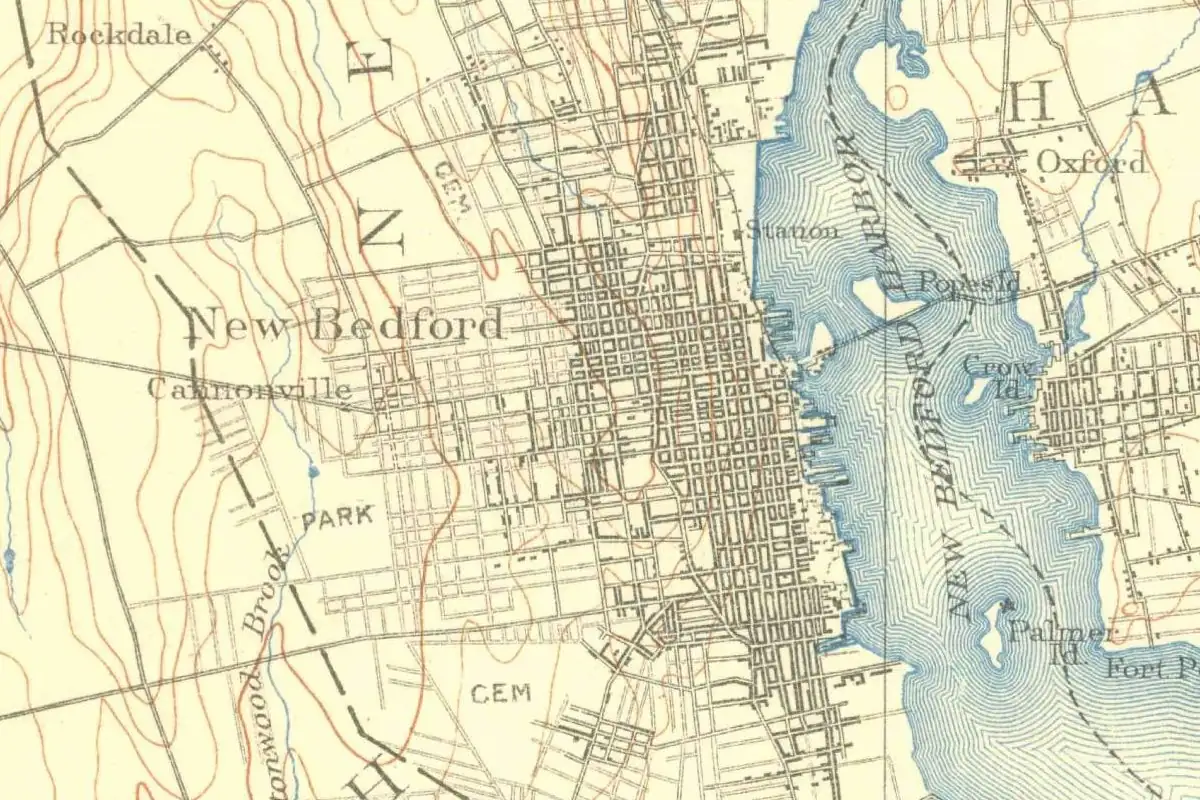
On the 1885 map
The map at the top of this page shows New Bedford as the Geological Survey found it in 1885: a tight grid of streets running down to the harbor, with Popes, Crow and Palmer islands out in the water. Across the harbor, in Fairhaven, you’ll spot a village called Oxford. It was part of New Bedford once: under the 1787 act, Ricketson says, New Bedford took in present-day Fairhaven, and the two didn’t split until 1812.
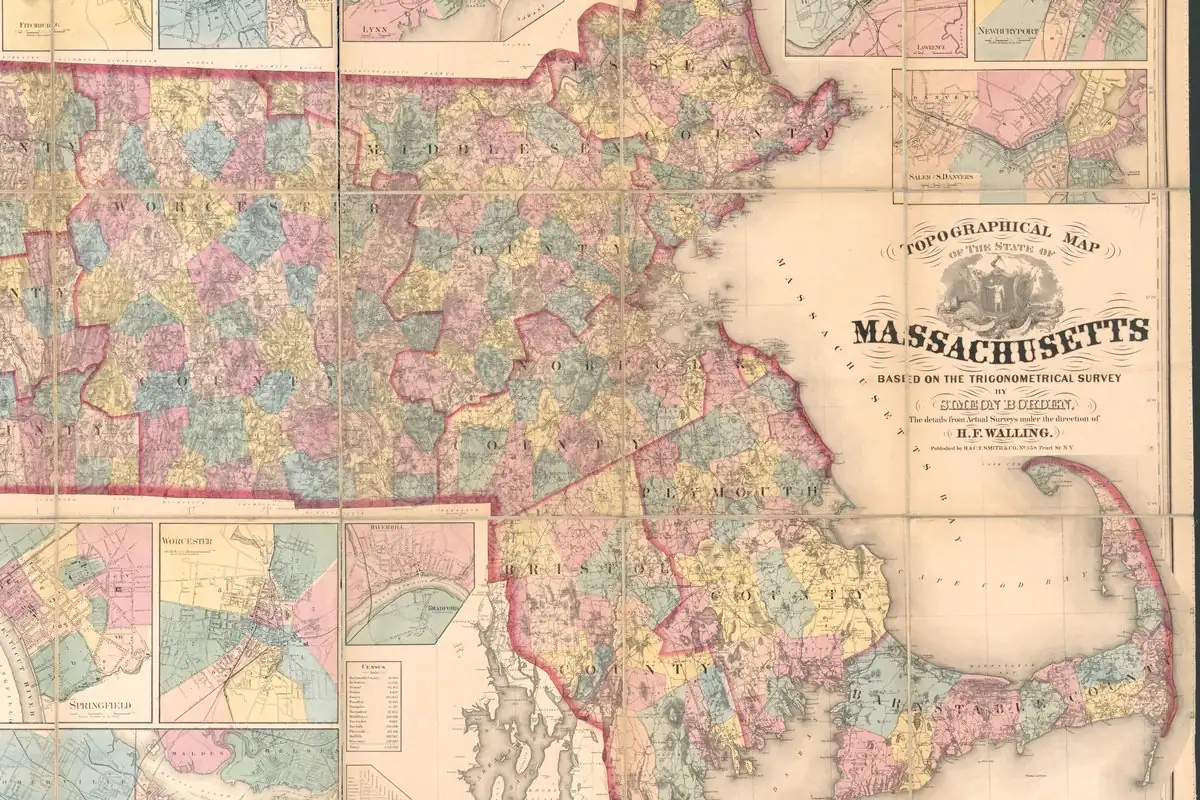
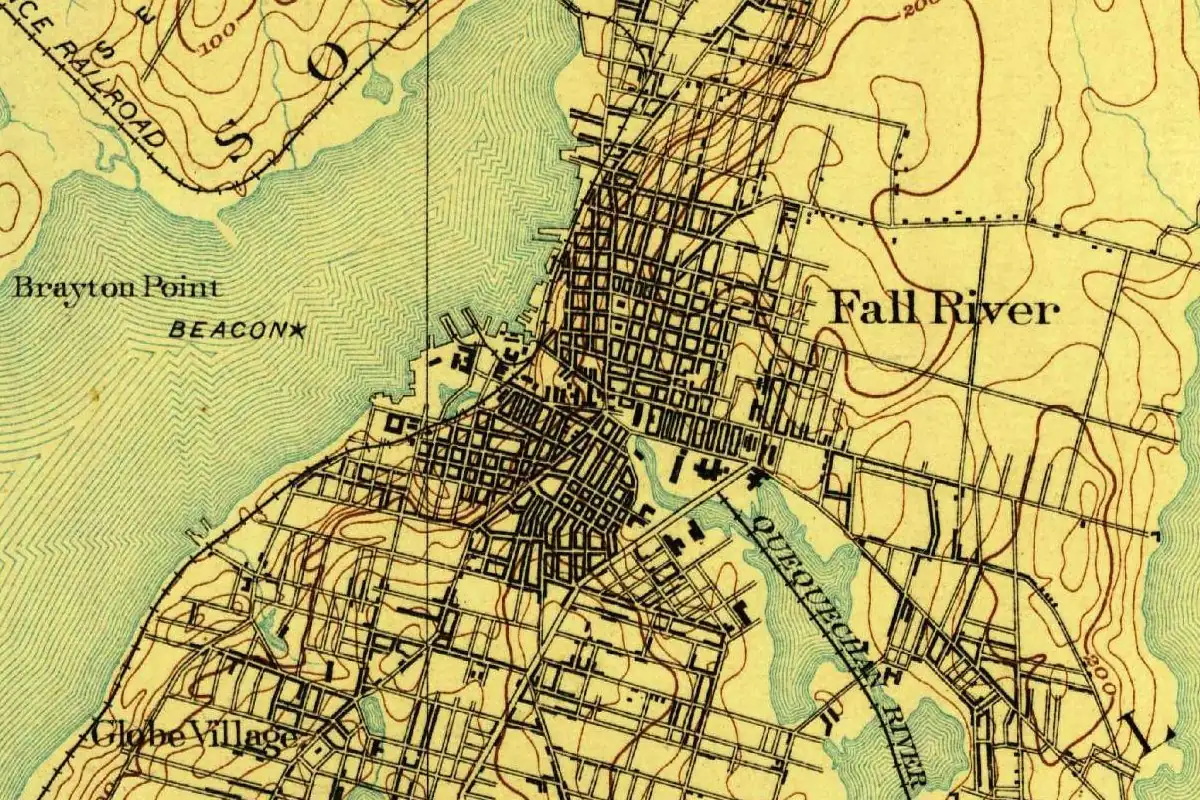
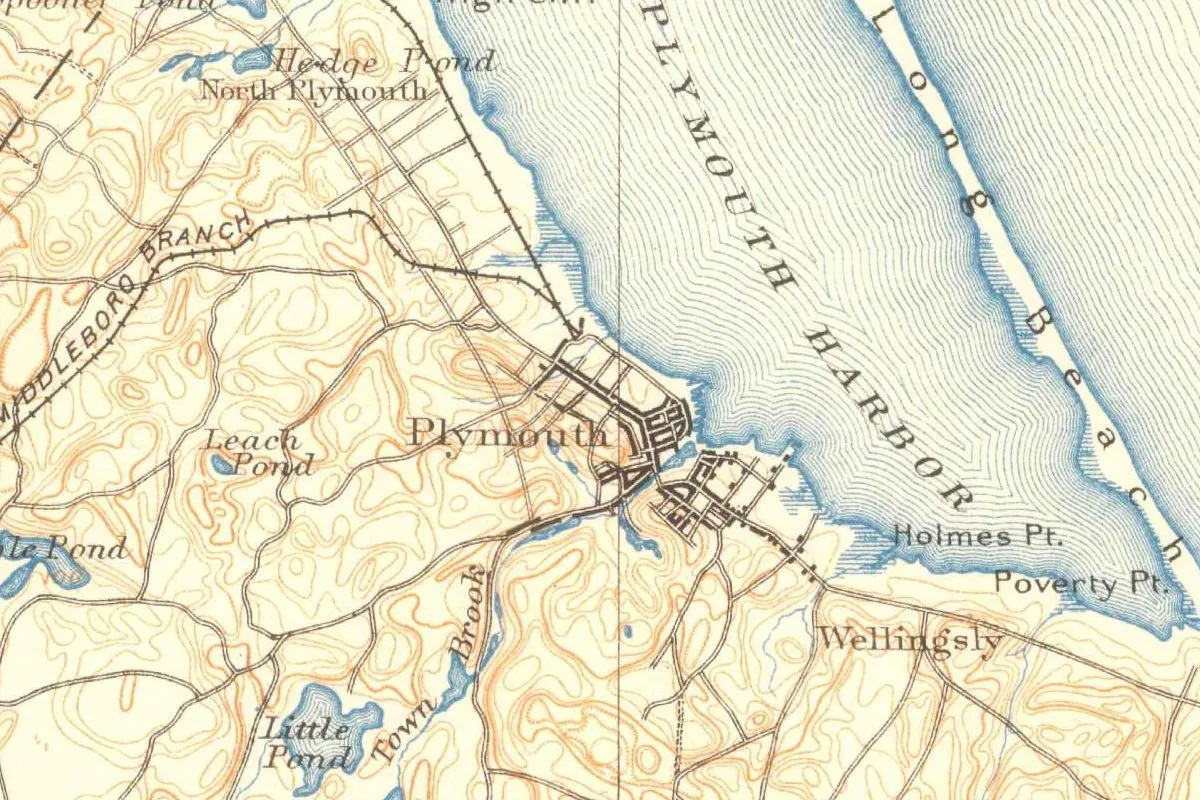
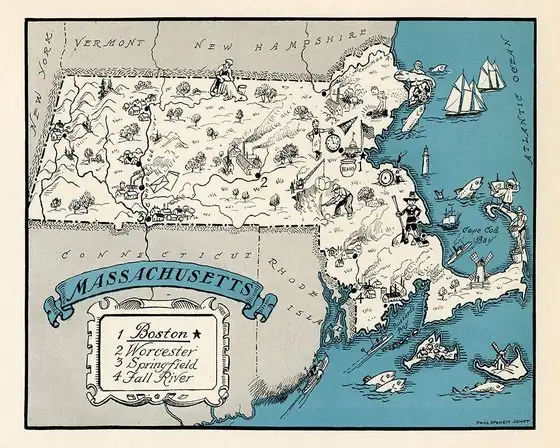
If you’re following the name around Massachusetts, Nantucket is where Rotch came from, and it has its own story about trading an English name for an older one. Fall River shares Bristol County with New Bedford, and Lowell is another Massachusetts city named for a man. There’s more on our Massachusetts page.
Quick answers
Who is New Bedford, Massachusetts, named after?
Joseph Russell, according to Daniel Ricketson’s 1858 history. He wrote that Joseph Rotch suggested “Bedford” in Russell’s honor because Russell shared the family name of the Dukes of Bedford. Gannett (1905) also ties the name to Russell.
Why is it called New Bedford and not just Bedford?
Because another Massachusetts town already had the name. The National Park Service dates the change to 1787, and the act that incorporated the town that year uses “New Bedford.”
Why was Joseph Russell called “the Duke”?
Ricketson says the nickname came after the village took the name Bedford, since Russell “bore the family name of the Duke of Bedford.”
Is New Bedford where Frederick Douglass got his name?
Yes. Douglass wrote that there were too many Johnsons in New Bedford, so he let his host, Nathan Johnson, pick a new surname, and Johnson suggested Douglass.
Key dates
- 1652The site of today's New Bedford is bought from the Wampanoag people.
- 1765Joseph Rotch moves from Nantucket to the Acushnet River to pursue the whale fishery.
- 1787The easterly part of Dartmouth is incorporated as a separate town by the name of New Bedford.
- 1838Frederick Douglass arrives in New Bedford and takes the surname Douglass at Nathan Johnson's suggestion.
- 1847New Bedford is incorporated as a city.
Things to do in New Bedford, Massachusetts
New Bedford Whaling National Historical Park Visitor Center
The national park's visitor center in the historic Third District Courthouse, with interactive exhibits, short films, park rangers, and maps and materials on the park and the city's attractions.
New Bedford Whaling Museum
A museum founded in 1903 as part of the Old Dartmouth Historical Society by a group of citizens who set out "to create and foster an interest in the history" of the area.
Seamen's Bethel
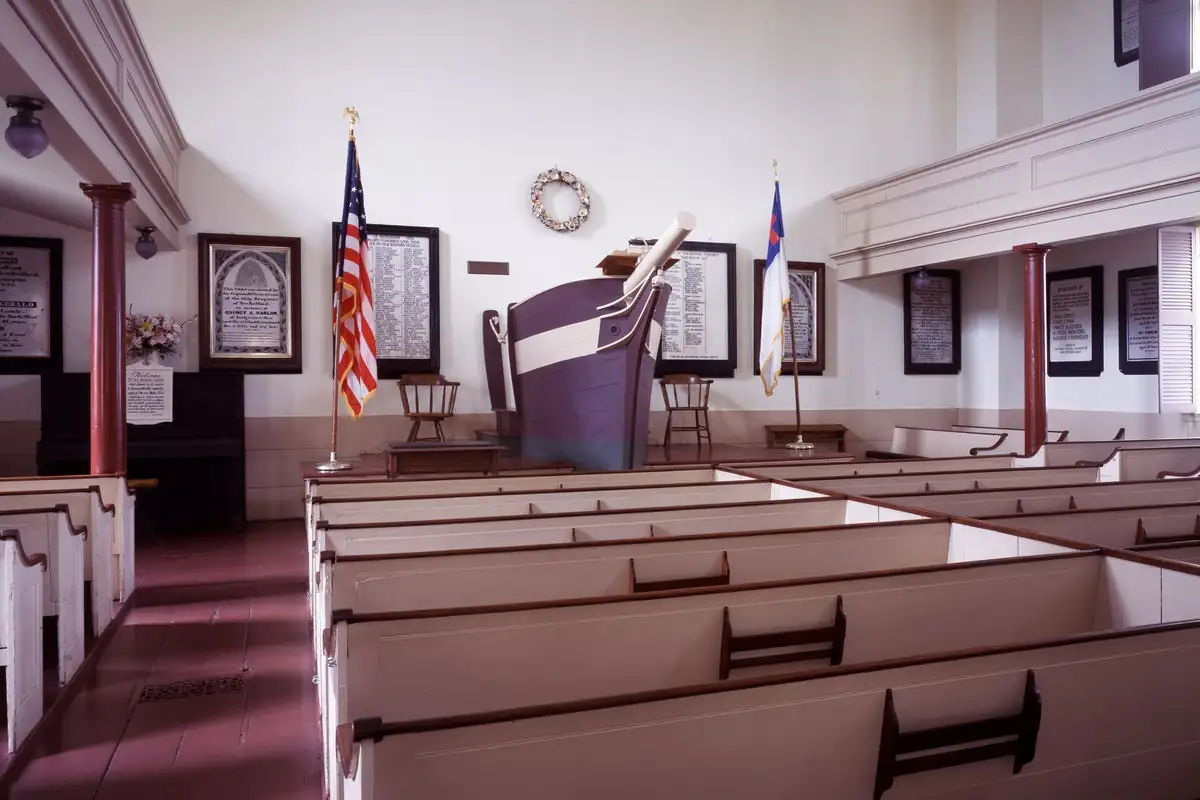
A still-active, nondenominational church on Johnny Cake Hill. Herman Melville attended services here before he sailed on January 3, 1841, and the pew he sat in is marked for visitors.
Rotch-Jones-Duff House & Garden Museum
A National Historic Landmark built in 1834 for whaling merchant William Rotch Jr., with period rooms and formal gardens that tell of New Bedford as a global seaport and a destination for freedom seekers.
Guided walking tours of downtown
Ranger-led walks through historic downtown New Bedford, each on a different chapter of the city's past, from escapes on the Underground Railroad to the global reach of the whaling industry.
Getting there
Open New Bedford in Google Maps
Opens in a new tab. The pin is the center of New Bedford in the USGS place-name record.
The closest airports, Amtrak stations and intercity bus stops, measured in a straight line from the center of New Bedford.
Airports
- Martha's Vineyard (MVY) Vineyard Haven 24 mi 38 km
- Rhode Island Tf Green International (PVD) Warwick 26 mi 42 km
- General Edward Lawrence Logan International (BOS) Boston 50 mi 81 km
Amtrak trains
- Providence station (PVD) 28 mi 45 km
- Kingston station (KIN) 34 mi 55 km
Intercity buses
- Peter Pan (BZ) Peter Pan Bus Lines · Woods Hole 16 mi 25 km
- FlixBus Providence Canal St 28 mi 45 km
- OurBus Providence, RI (On the street below the convention center: 99 W. Exchange St., Providence, RI 02903) 28 mi 45 km
Distances are as the crow flies, not by road. We don't list schedules or fares because they change; check with the airline, Amtrak or the bus company before you go. Official data (FAA commercial service airports (2025), FAA airport locations, Amtrak stations and Intercity Bus Atlas) from the FAA and the U.S. Bureau of Transportation Statistics, checked Nov 14, 2026.
Sponsored
Staying in New Bedford?
Compare hotels in New Bedford, Massachusetts, on Expedia.
See hotels in New BedfordWe may earn a commission if you buy through this link. It never changes what we write. Read our affiliate disclosure
Historical Sources & References
- Daniel Ricketson, The History of New Bedford (1858), p. 22. Joseph Russell, “a substantial farmer,” and Joseph Rotch’s move from Nantucket in 1765 “for the purpose of pursuing the business of the whale-fishery.”
- Ricketson (1858), p. 23. The quoted passage: Rotch suggests “Bedford” in honor of Joseph Russell, and Russell becomes known as “the Duke.”
- Ricketson (1858), p. 24. “The Old Colony days, when we lived under the King,” and why the name became New Bedford.
- Ricketson (1858), pp. 360-362. The text of the 1787 act incorporating New Bedford out of Dartmouth, with “Acquishnet village” and the dates it passed; New Bedford and Fairhaven split in 1812.
- Henry Gannett, The Origin of Certain Place Names in the United States (1905), p. 222. New Bedford: “The name of the owner of the town site was Russell, the family name of the Duke of Bedford.”
- Gannett (1905), p. 41. Bedford in Middlesex County, Massachusetts, “named for Wriothesley Russell, Duke of Bedford.”
- National Park Service, “Quaker Influence”. Rotch’s arrival around 1765, his purchase from Joseph Russell, the name Bedford, the figures for 1775, the change to New Bedford in 1787 and city status in 1847.
- National Park Service, “Places”. The purchase of the site from the Wampanoag people in 1652 and the Quaker meetinghouse of 1699.
- National Park Service, “Frederick Douglass”. The arrival in September 1838, the name Johnson, and Nathan and Polly Johnson’s home on Seventh Street.
- Frederick Douglass, Narrative of the Life of Frederick Douglass (1845), chapter XI. “So many Johnsons in New Bedford” and Nathan Johnson’s choice of “Douglass” after reading The Lady of the Lake.
- GNIS feature 613714 (U.S. Geological Survey). The national gazetteer entry for New Bedford in Bristol County, with its coordinates.
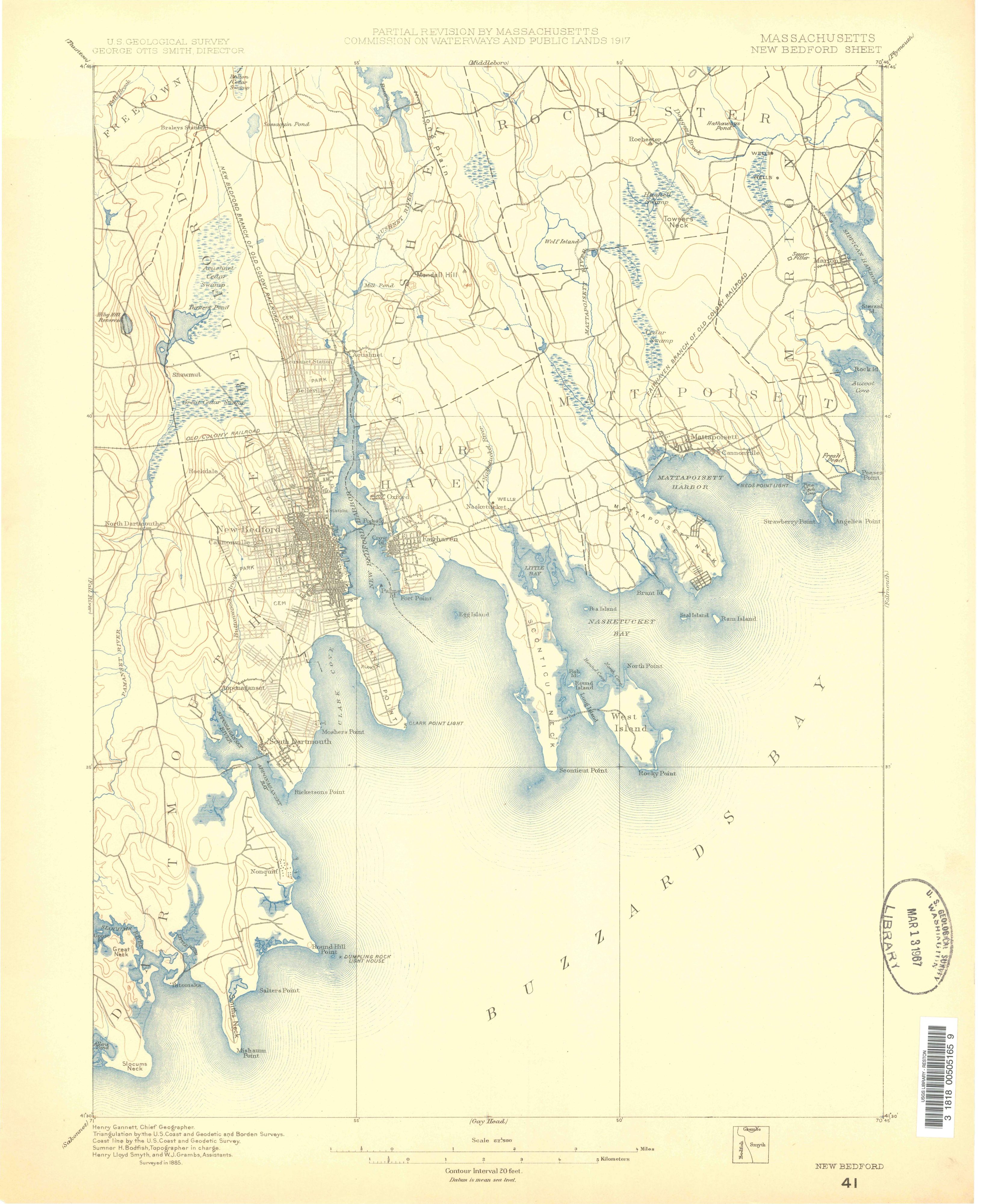
- U.S. Geological Survey, New Bedford sheet (1885). The 1:62,500 map, surveyed in 1885 and partly revised in 1917, that the image at the top of this page was cropped from.
Sponsored
Put this old USGS map on your wall
The USGS New Bedford sheet, surveyed in 1885 and printed with a partial revision from 1917, is in the public domain. Download the full-size scan for free, then have it printed on canvas with CanvasOnTheCheap.
Print a map on canvasDownload the full-size mapWe may earn a commission if you buy through this link. It never changes what we write. Read our affiliate disclosure
Spot something wrong, or know more? Tell us here. You can also email us or use our contact page. Corrections are noted here with their date, never made silently.