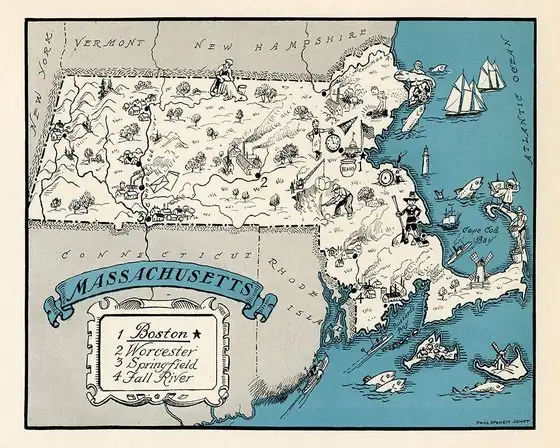
Fall River, Massachusetts: The Name, Troy and Lizzie Borden
Fall River, Massachusetts, is named for its stream, which drops about 140 feet (43 m) in its last half mile (800 m). The town was incorporated as Fall River in 1803, renamed Troy in 1804 and given its old name back in 1831. Nason's 1874 gazetteer gives the stream's Native name, Quequechan, as "quick-running water."
Fall River, Massachusetts, is named for a short stream that drops about 140 feet (43 m) on its way to the Taunton River. From 1804 to 1831, it was Troy. The stream is only about 2 miles (3 km) long, and it makes that whole drop in its last half mile (800 m). That drop is the whole story of the name.
A river that falls
Henry Gannett needed just one line for it in the place-name book he wrote for the U.S. Geological Survey in 1905. The Fall River in Massachusetts was “so named because it is only about 2 miles in length and falls about 140 feet in a half mile.” The city, he added, is “situated on the Fall River.”
Elias Nason’s 1874 gazetteer of the state’s towns gives you the details. The stream is the outlet of Watuppa, a long lake east of town whose name, he says, means “place of boats.” From there it runs over a rocky bed, between high banks, down to the Taunton River. Nason wrote:
“Fall River, from which the city derives its name, is the outlet of this pond, and furnishes a most important motive-power.”
That “motive-power” is the key. The falls ran the mills. Nason says the city’s “vast manufacturing establishments” were built right on that 140-foot (43 m) descent, and the first cotton mill started up in 1813. When his gazetteer came out in 1874, he counted 33 mill companies in what he called “a city of spindles.” So the same drop that named the place also built it.
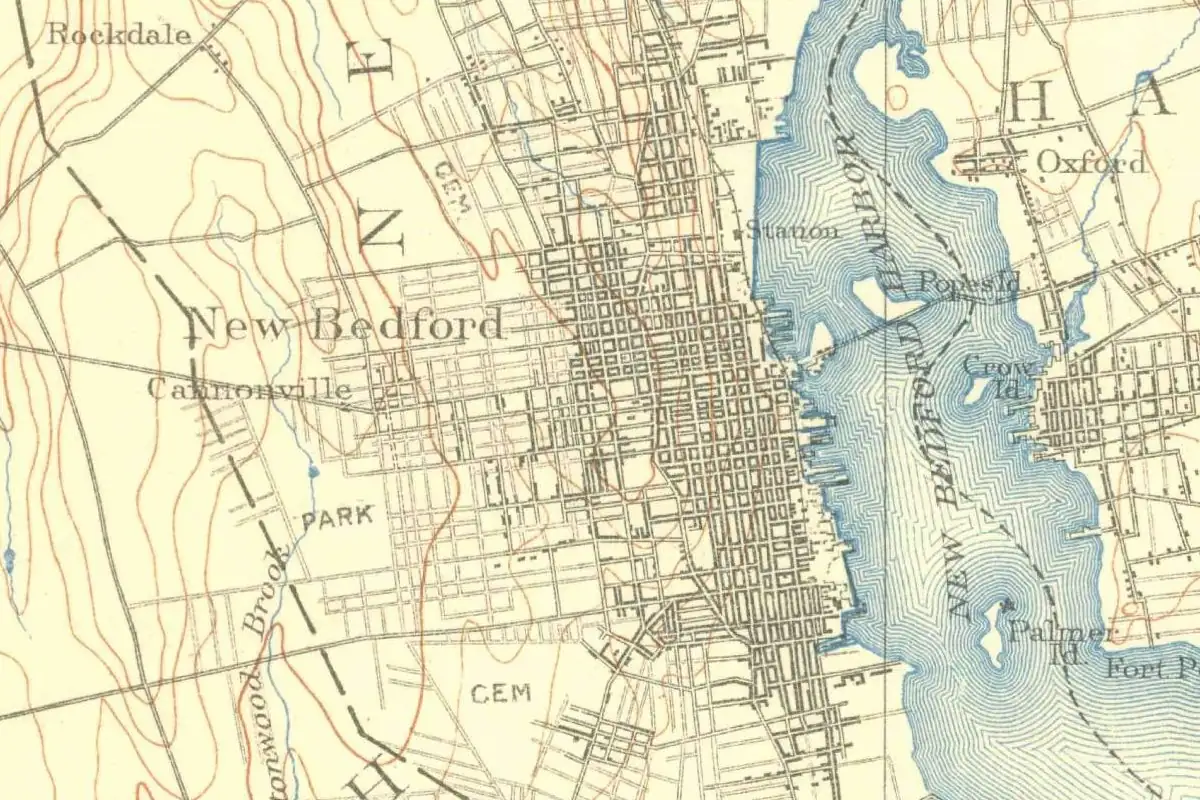
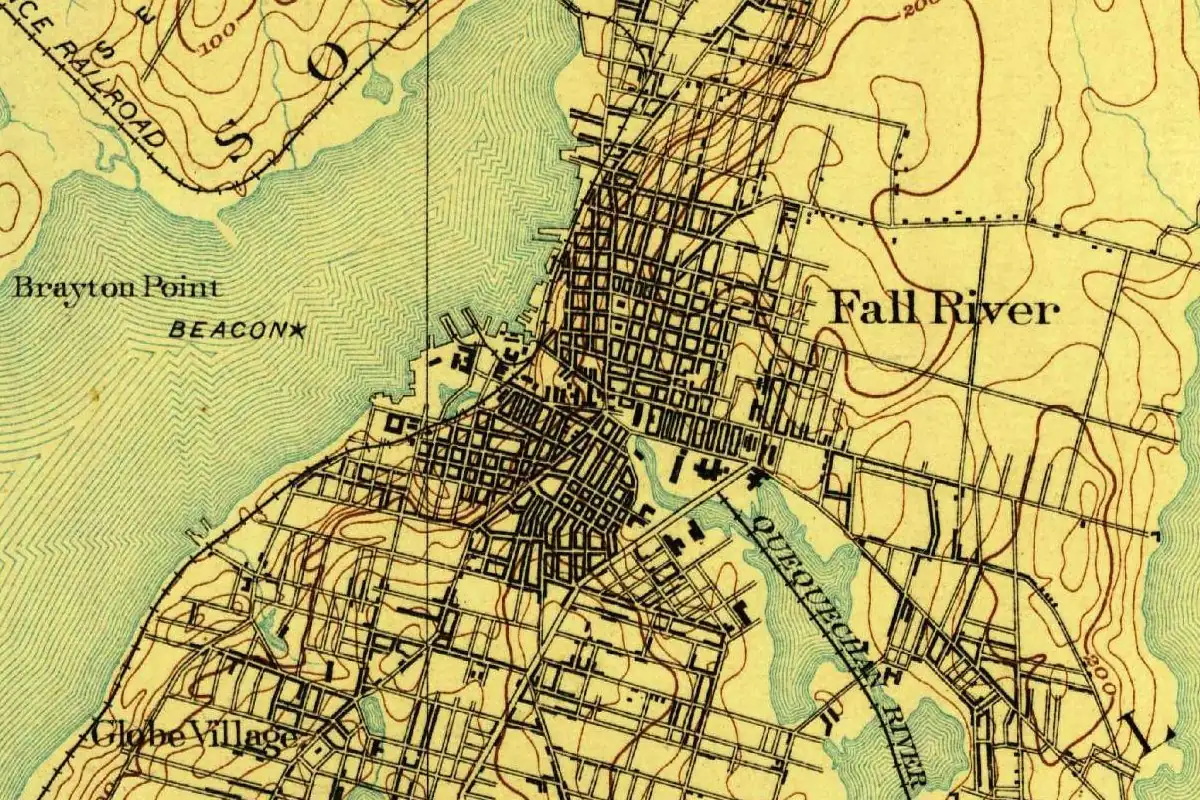
You can find the stream on the map at the top of this page. The 1888 Survey sheet labels it the Quequechan River, and that’s its name on federal maps today.
Quick-running water
The stream’s Native name describes it too. Nason writes that the Indian name of the place was Quequeteant, and “of the stream, Quequechan, which signifies ‘quick-running water.’” R. A. Douglas-Lithgow’s 1909 dictionary of New England’s Native place names lists Quequechan at Fall River with the same meaning, “Quick running water.” English or Native, both names describe a stream in a hurry.
When Fall River was Troy
The name didn’t stick the first time. Until 1803, the land belonged to Freetown. On February 26 of that year, Nason says, it was set off and incorporated as a town “under its present name.” Then, on June 18, 1804, the name was changed to Troy. The town carried that name until February 12, 1831, “when the old name, Fall River, was resumed.” Nason doesn’t say why it changed either time.
The state line has moved too. Because the city sat on the Rhode Island line, Nason says, it was sometimes called “The Border City.” The line used to run through the south of its territory, until a trade of land in 1862 moved it about 2 miles (3 km) south and put the whole city in Massachusetts. It became a city on April 12, 1854.
The Borden house on Second Street
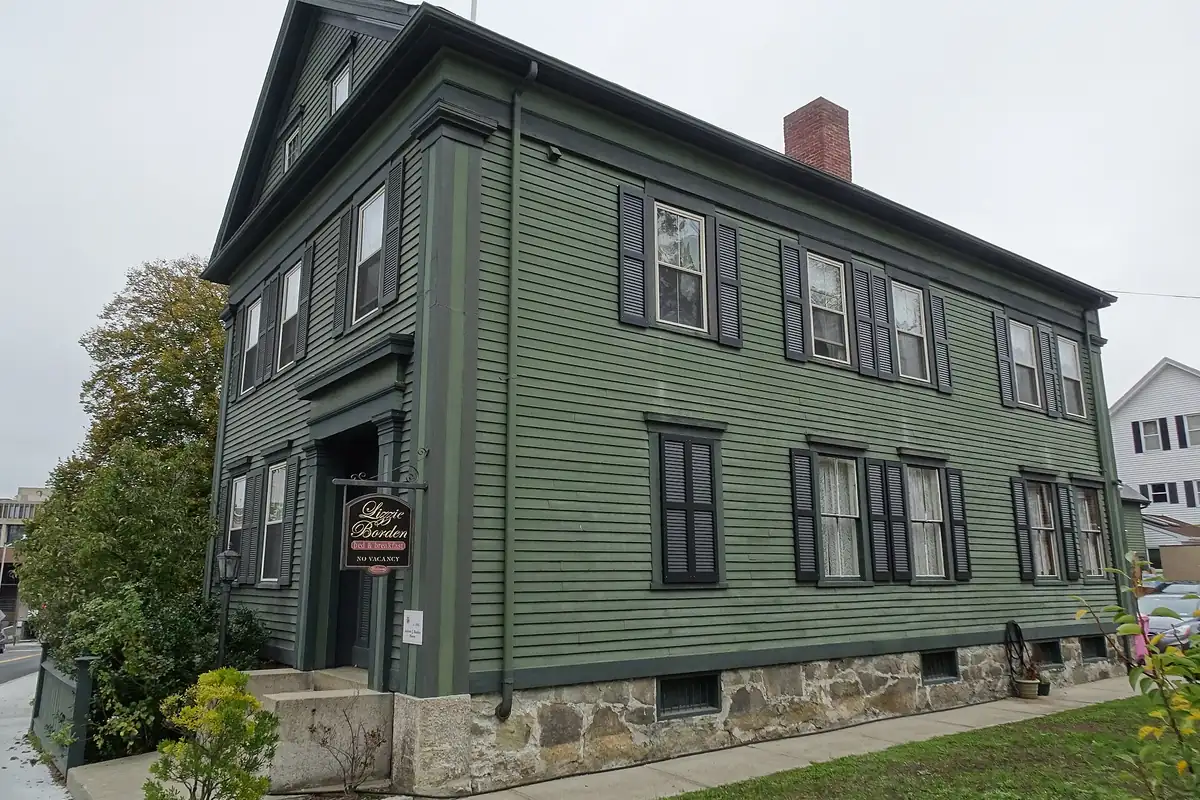
Fall River is also where the Borden murders happened. On the morning of August 4, 1892, Andrew J. Borden and his wife were killed in their own house. The Portland Daily Press reported the next day that the couple, “two of the oldest, wealthiest and most highly respected persons in this city,” had been “brutally murdered with an axe at 11 o’clock this morning at their home on Second street within a few minutes walk of the City Hall.” The Washington Evening Star added that a $5,000 reward had been posted and that four policemen were guarding the house.
Andrew’s daughter Lizzie, accused of “the murder of her stepmother and father,” was tried in New Bedford in June 1893. Asked if she had anything to say to the jury, she answered, as the Portland Daily Press printed it: “I am innocent, but I will leave my counsel to speak for me.” On June 20, the Portland Daily Press reported, the jury got the case at 3:15 in the afternoon and was back at 4:30 with a verdict of not guilty, and in the paper’s words, “a cheer went up which might have been heard a half a mile away through the open windows.”
The house is still standing. Today you can tour it or book a room there, and its own website calls it “America’s Most Haunted House” and says it “has a haunted reputation for a reason.” You can’t check a ghost in an 1893 newspaper, so that part is the house’s word, not ours. The name, though, you can check, and it comes from the falls that ran the mills.
Another Massachusetts name with a long paper trail is Salem, from a Hebrew word for peace. It’s one of our ghost tour towns.
Quick answers
Why is it called Fall River?
Because of its stream. Gannett’s 1905 book says the Fall River was so named because it’s only about 2 miles (3 km) long and falls about 140 feet (43 m) in a half mile (800 m), and the city sits on it.
Was Fall River, Massachusetts, ever called Troy?
Yes. Nason’s 1874 gazetteer says the name was changed to Troy on June 18, 1804, and the old name, Fall River, came back on February 12, 1831.
What does Quequechan mean?
“Quick-running water.” That’s the meaning given by both Nason in 1874 and Douglas-Lithgow in 1909 for the Native name of the stream.
Was Lizzie Borden found guilty?
No. A jury in New Bedford found her not guilty on June 20, 1893, as Maine newspapers reported the next day.
Key dates
- 1803February 26: the town is set off from Freetown and incorporated as Fall River.
- 1804June 18: the name is changed to Troy.
- 1831February 12: the old name, Fall River, comes back.
- 1854April 12: Fall River is incorporated as a city.
- 1862An exchange of land with Rhode Island moves the state line south, putting the whole city in Massachusetts.
- 1892August 4: Andrew J. Borden and his wife are killed in their house on Second Street.
- 1893June 20: in New Bedford, a jury finds Lizzie Borden not guilty.
Getting there
Open Fall River in Google Maps
Opens in a new tab. The pin is the center of Fall River in the USGS place-name record.
The closest airports, Amtrak stations and intercity bus stops, measured in a straight line from the center of Fall River.
Airports
- Rhode Island Tf Green International (PVD) Warwick 14 mi 23 km
- Martha's Vineyard (MVY) Vineyard Haven 35 mi 57 km
- General Edward Lawrence Logan International (BOS) Boston 46 mi 75 km
Amtrak trains
- Providence station (PVD) 16 mi 26 km
- Kingston station (KIN) 26 mi 42 km
Intercity buses
- FlixBus Providence Canal St 16 mi 26 km
- Peter Pan (BZ) Peter Pan Bus Lines · Providence (Downtown) 16 mi 26 km
- OurBus Providence, RI (On the street below the convention center: 99 W. Exchange St., Providence, RI 02903) 16 mi 26 km
Distances are as the crow flies, not by road. We don't list schedules or fares because they change; check with the airline, Amtrak or the bus company before you go. Official data (FAA commercial service airports (2025), FAA airport locations, Amtrak stations and Intercity Bus Atlas) from the FAA and the U.S. Bureau of Transportation Statistics, checked Nov 7, 2026.
Sponsored
Staying in Fall River?
Compare hotels in Fall River, Massachusetts, on Expedia.
See hotels in Fall RiverWe may earn a commission if you buy through this link. It never changes what we write. Read our affiliate disclosure
Sponsored
Want the spooky side of the Borden house?
The name has its story above. For the ghost stories, US Ghost Adventures offers tours of the Lizzie Borden House and nights in its rooms.
See the Lizzie Borden HouseWe may earn a commission if you book through this link. It never changes what we write. Read our affiliate disclosure
Historical Sources & References
- Elias Nason, A Gazetteer of the State of Massachusetts (Boston, 1874), pp. 203-204. Fall River “from which the city derives its name” as the outlet of Watuppa (“place of boats”), its descent of about 140 feet (43 m), the mills, “The Border City,” incorporation on February 26, 1803, Troy from June 18, 1804, to February 12, 1831, Quequeteant and Quequechan (“quick-running water”), the 1862 line change and the city charter of April 12, 1854.
- Henry Gannett, The Origin of Certain Place Names in the United States (USGS, 1905), p. 123. “Fall; river in Massachusetts, so named because it is only about 2 miles in length and falls about 140 feet in a half mile,” and the city “situated on the Fall River.”
- R. A. Douglas-Lithgow, Dictionary of American-Indian Place and Proper Names in New England (Salem, 1909), p. 152. “Quequechan, Fall River, Bristol Co. ‘Quick running water.’”
- Portland Daily Press, August 5, 1892, p. 1. “Murder and Mystery,” dated Fall River, August 4: the Bordens killed at their home on Second Street.
- Evening Star (Washington, D.C.), August 5, 1892, p. 5. “Fall River’s Murder Mystery”: the police guard at the house and the $5,000 reward.
- Portland Daily Press, June 21, 1893, p. 1. The verdict in New Bedford, Lizzie Borden’s words to the jury and the cheer in the courtroom.
- Daily Kennebec Journal (Augusta, Maine), June 21, 1893, p. 1. “Not Guilty! Lizzie Borden Acquitted,” dated New Bedford, June 20, 1893.
- Lizzie Borden House, official website. How the house presents itself today: tours, rooms, “America’s Most Haunted House” and “a haunted reputation for a reason.”
- GNIS feature 612595 (U.S. Geological Survey). The national place-name database lists Fall River as a populated place in Bristol County, and the stream as the Quequechan River (feature 607052).
Spot something wrong, or know more? Tell us here. You can also email us or use our contact page. Corrections are noted here with their date, never made silently.