Gloucester, Massachusetts: Named by Settlers or for a Duke?
Gloucester was named in 1642, when the Massachusetts Bay court made the Cape Ann settlement a plantation. Historian John J. Babson wrote in 1860 that the name probably came from settlers said to be from Gloucester, England. A 2012 report for the city's Historical Commission suggested it may instead have honored a newborn Duke of Gloucester.
Two answers for one English name
Gloucester, Massachusetts, got its English name at a colonial court in 1642, and why is still debated: the settlers’ hometown or a new Duke of Gloucester. Both versions point across the Atlantic. What’s argued is whether the colonists had a city in mind or a baby.
The older and better-known answer is the hometown. The newer one comes from a 2012 report written for the city’s own Historical Commission. You’ll meet both below, along with the date every source here agrees on.
Fishermen on the cape before the town
People were working this rocky cape long before it had a town name. The 2012 survey report, prepared by Wendy Frontiero for the Gloucester Historical Commission, says a fishing colony set up by the Dorchester Company at Stage Fort lasted only from 1623 to 1626, and that it wasn’t until the late 1630s that Cape Ann drew enough permanent settlers to become a town.
John J. Babson, whose History of the Town of Gloucester, Cape Ann came out in 1860, found the same thin trail. He quotes Thomas Lechford, who lived in Boston in 1639 and soon went back to England: “At Cape Ann, where fishing is set forward, and some stages builded, there one master Rashley is chaplain.” In October 1641, Babson says, the General Court sent commissioners to settle the bounds, and the town records date the first handing out of lots to “2d month, 1642,” by Mr. Endicott and Mr. Downing of Salem.
Then came the name. Babson writes that about this time the Rev. Richard Blynman arrived with several families from Plymouth Colony, and that “at a court in May in that year,” the settlement was “established as a plantation, and called Gloucester.”
Babson’s version: the settlers’ hometown
Right after that, on page 51, Babson gives his explanation, and he’s careful about it. “This name was probably given by desire of some of the principal settlers, who are said to have come from the city of the same name in England,” he wrote. His footnote points to a sermon by the Rev. E. Forbes.
Blynman’s group didn’t stay for good. Babson says Blynman was said to have come to New England with “several Welsh gentlemen of good note,” and that after a few years he and several early settlers moved on to New London, in Connecticut. Their lots there were laid out on a new street long known as Cape-Ann Lane, now Ann Street.
Notice the two hedges in Babson’s sentence about the name: “probably” and “are said to have.” Babson didn’t claim to have a record of anyone asking for the name. He then spent a paragraph on old Gloucester itself, which he described as sitting above the Severn, about 30 miles (48 km) from the Bristol Channel, a place the Britons called Caer Gloew.
Later writers dropped the hedges. Henry Gannett, whose 1905 book of name origins for the U.S. Geological Survey covered the whole country, listed the Massachusetts city with counties in New Jersey and Virginia and wrote simply: “Named from Gloucester-shire, England.” The city’s fire department history, on the official Gloucester website, says the town “was named after Gloucester, England, whence many of the settlers of that year came.”
The duke version
The 2012 survey report tells it differently. In its overview of Central Gloucester, on page 9-1, in a section the report says is largely quoted from a 1990 preservation plan for the city by Leslie Donovan and Kim Withers Brengle, it says: “The name of the new town may have come from the recent birth of a new Duke of Gloucester.”
That’s a “may,” not a claim, and the report doesn’t say which duke it means or point to a document. It’s still worth taking seriously, because it comes from a study prepared for the city’s Historical Commission. The word would still be English. What would change is the reason someone picked it.
Which version carries more weight
The hometown version is older in print and has more backing: Babson in 1860, Gannett in 1905 and the city’s own history page today. But Babson himself only called it probable. The duke version has a modern, official-sounding source and no evidence shown for it.
So the fair call is “disputed,” with the settlers’ hometown ahead. If a 1642 record ever turns up saying why the court chose the name, it would settle this. The sources on this page don’t include one.
“Glocester,” without the u
The colony’s own records didn’t spell it the way the city does now. Babson copied an order from the General Court of September 8, 1642, a few months after the naming:
“that Glocester is to have ten muskets of the country’s lent them”
So within months of getting its name, the new town was already in the colony’s books as “Glocester,” with no “u.” Babson also notes that in the colony tax of that first year, Gloucester’s share was £6 10s, against £82 for Ipswich.
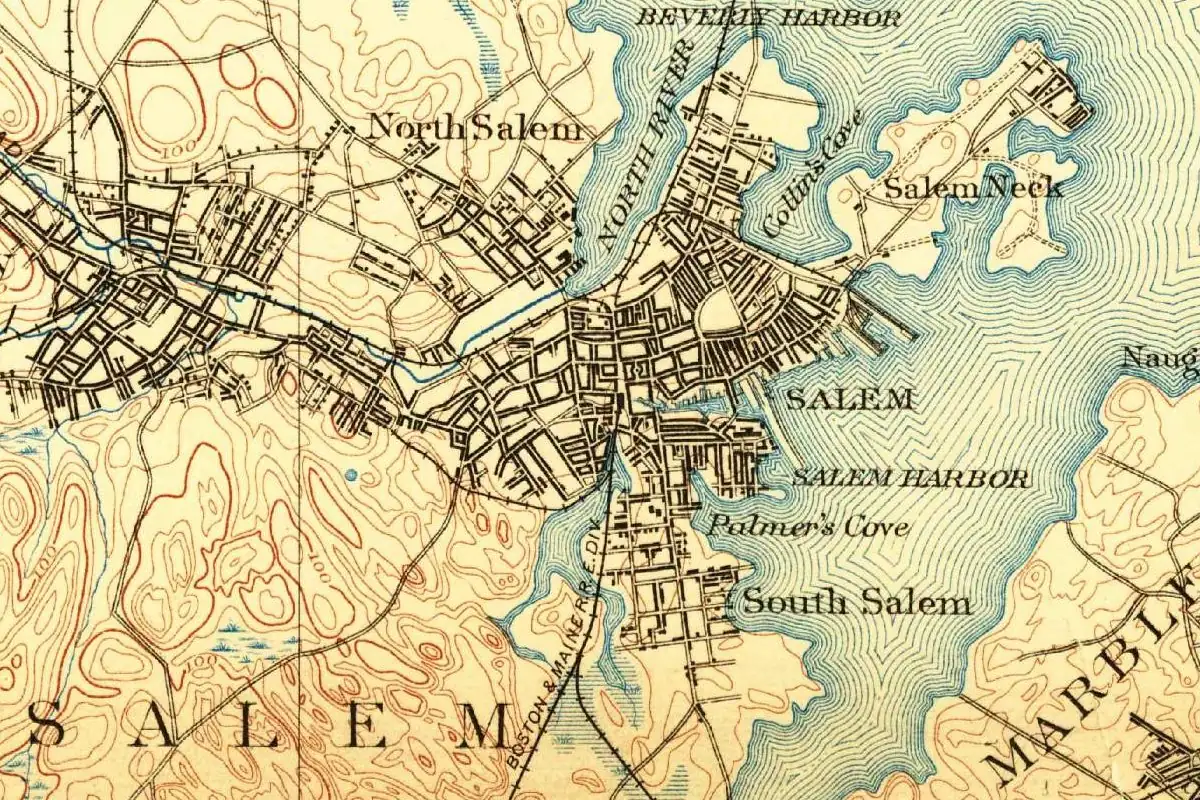
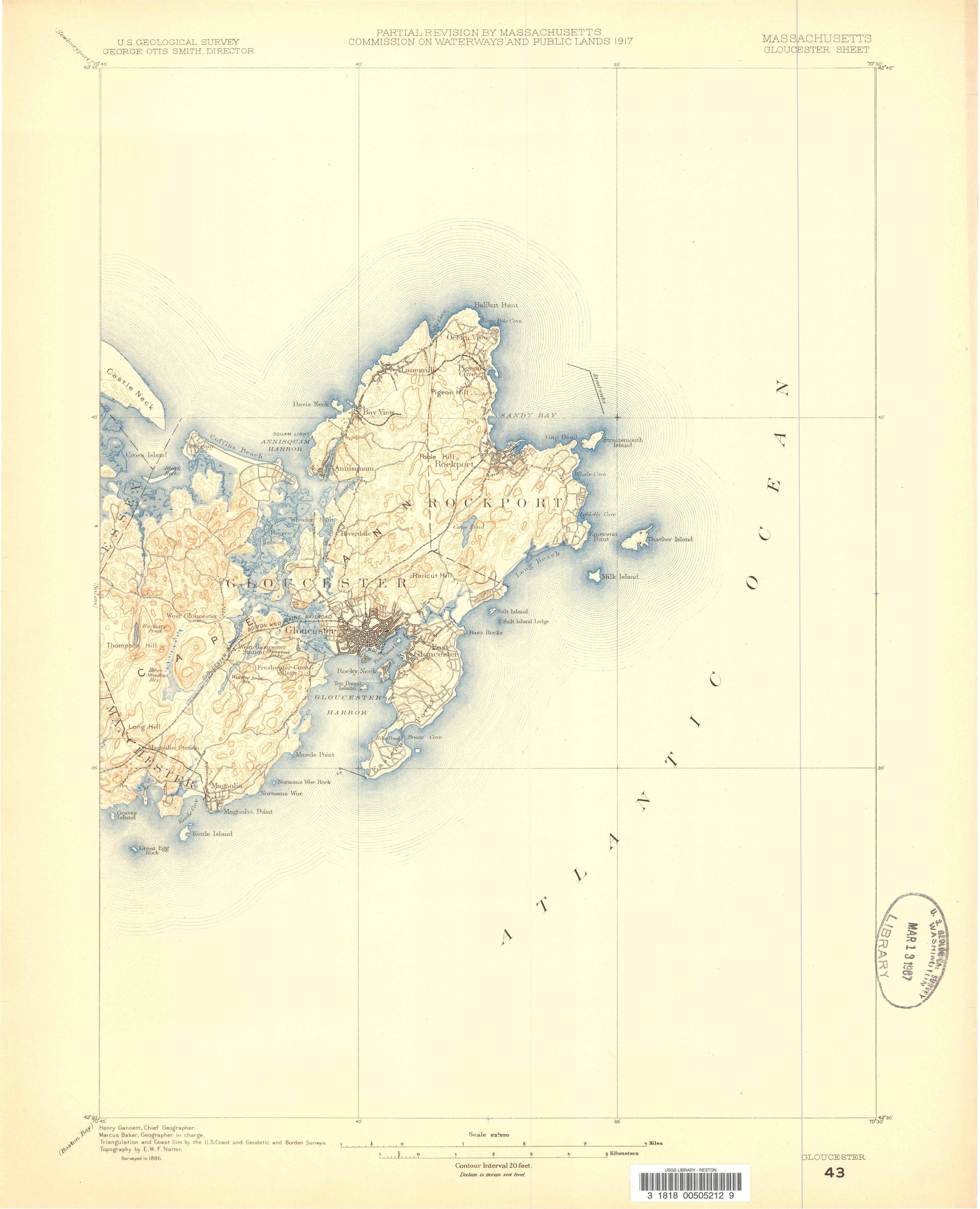
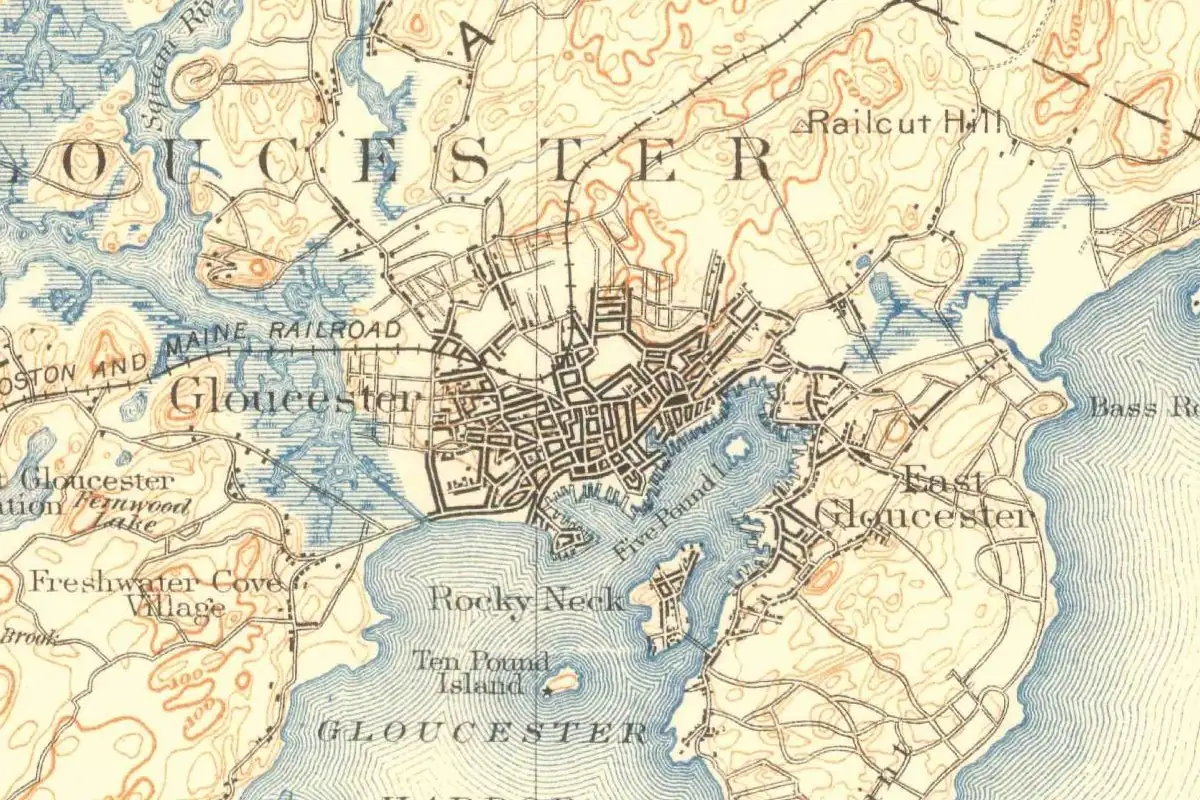
The map at the top of this page, surveyed in 1886 and partly revised in 1917, shows the town some two and a half centuries later, packed around its inner harbor, with East Gloucester and Rocky Neck across the water and the Boston and Maine Railroad coming in from the west.
English names around the bay
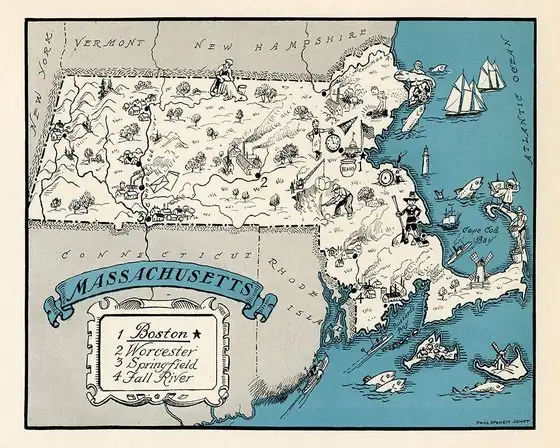
Gloucester wasn’t the only Massachusetts town to borrow a name from England, and its neighbors give you a sense of how differently those borrowings played out. Boston took the name of a Lincolnshire town in 1630, and Plymouth, the colony Blynman’s families came from, had its English name before the Mayflower arrived. More are on our Massachusetts page.
Quick answers
Is Gloucester, Massachusetts, named after Gloucester, England?
Probably, but not everyone agrees. Babson wrote in 1860 that the name was “probably” chosen by settlers “said to have come from” Gloucester, England; a 2012 city survey report says it “may have come” from the birth of a new Duke of Gloucester.
When did Gloucester get its name?
In 1642. Babson says a court in May of that year established the Cape Ann settlement as a plantation “and called Gloucester.”
Who named Gloucester, Massachusetts?
No one is named in these sources. Babson says the name was “probably given by desire of some of the principal settlers,” and that a court in May 1642 made it official.
Was Gloucester settled in 1623?
Fishermen came first. The 2012 survey report says a Dorchester Company fishing colony at Stage Fort lasted from 1623 to 1626; the permanent town came in 1642.
Key dates
- 1623-1626A Dorchester Company fishing colony operates at Stage Fort, according to the 2012 survey report.
- 1639Thomas Lechford writes of fishing stages and a chaplain at Cape Ann.
- 1642A court in May establishes the Cape Ann settlement as a plantation called Gloucester.
- 1642On September 8 the General Court orders that "Glocester" be lent ten muskets.
Things to do in Gloucester, Massachusetts
Cape Ann Museum
A Gloucester museum of the art and cultural history of maritime New England, spread over two locations with four historic structures, including a sea captain's house.
Maritime Gloucester
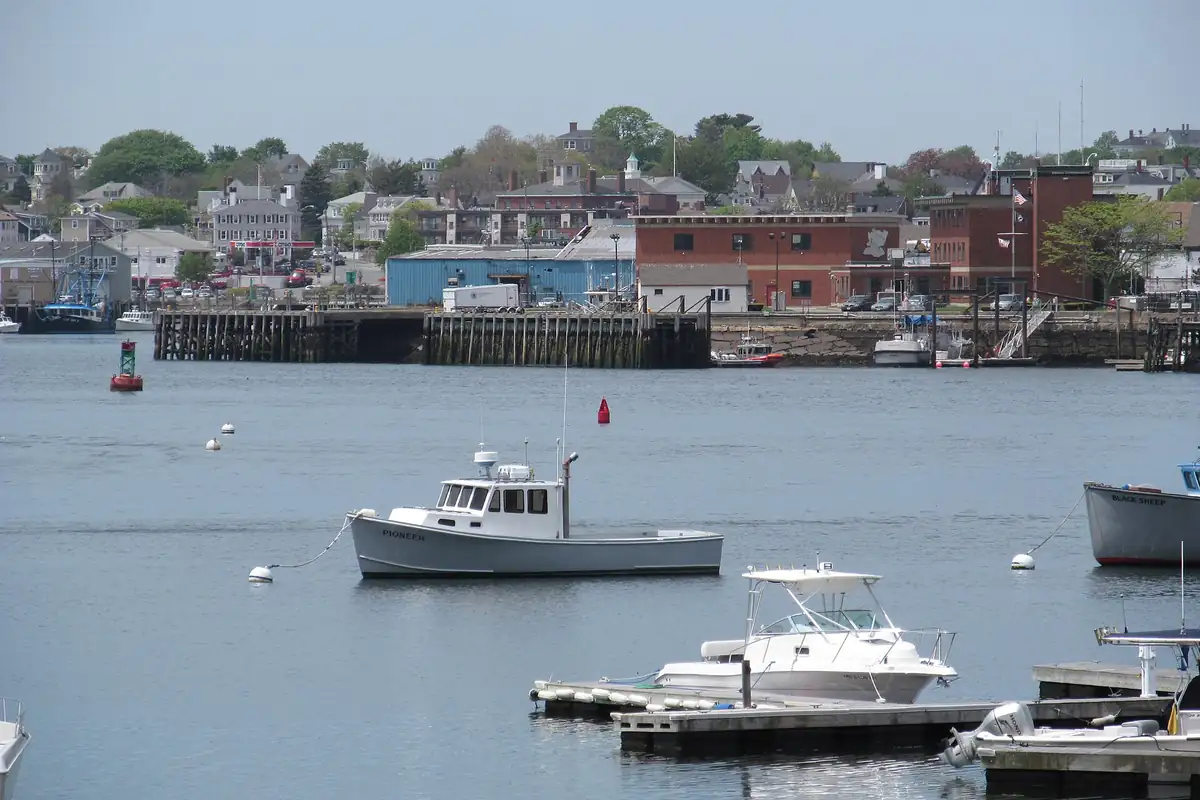
A working waterfront, maritime museum, marine science education center and Sea-Pocket Aquarium on the harbor, with workshops and schooner sailing.
Hammond Castle Museum
The seaside castle home of inventor John Hays Hammond Jr., who always meant it to be a museum and filled it with a large collection of medieval artifacts.
Sargent House Museum
One of Gloucester's historic houses, telling the story of Judith Sargent Murray, an 18th-century advocate of women's education and equality, with artwork by John Singer Sargent and his sister Emily.
Getting there
Open Gloucester in Google Maps
Opens in a new tab. The pin is the center of Gloucester in the USGS place-name record.
The closest airports, Amtrak stations and intercity bus stops, measured in a straight line from the center of Gloucester.
Airports
- General Edward Lawrence Logan International (BOS) Boston 25 mi 40 km
- Portsmouth International at Pease (PSM) 33 mi 53 km
Amtrak trains
- Haverhill station (HHL) 24 mi 39 km
- Woburn station (WOB) 25 mi 41 km
Intercity buses
- CandJ Bus Lines Seabrook 22 mi 36 km
- Peter Pan Bus Lines Logan International Airport (Terminal E) 25 mi 40 km
- Peter Pan (BZ) Peter Pan Bus Lines · Logan International Airport (Terminal E) 25 mi 40 km
Distances are as the crow flies, not by road. We don't list schedules or fares because they change; check with the airline, Amtrak or the bus company before you go. Official data (FAA commercial service airports (2025), FAA airport locations, Amtrak stations and Intercity Bus Atlas) from the FAA and the U.S. Bureau of Transportation Statistics, checked Nov 14, 2026.
Sponsored
Staying in Gloucester?
Compare hotels in Gloucester, Massachusetts, on Expedia.
See hotels in GloucesterWe may earn a commission if you buy through this link. It never changes what we write. Read our affiliate disclosure
Historical Sources & References
- John J. Babson, History of the Town of Gloucester, Cape Ann (1860), pp. 50-52. The commissioners of 1641 and the first lots of “2d month, 1642”; Blynman’s families from Plymouth Colony; the May 1642 court and “called Gloucester”; “probably given by desire of some of the principal settlers, who are said to have come from the city of the same name in England,” with a footnote to Forbes’s sermon; old Gloucester on the Severn and Caer Gloew; Blynman’s “Welsh gentlemen.” On p. 50, Lechford’s line about Cape Ann in 1639; on p. 52, the move to New London and Cape-Ann Lane.
- John J. Babson, History of the Town of Gloucester, Cape Ann (1860), p. 192. The General Court order of September 8, 1642, “that Glocester is to have ten muskets”; the first colony rate, £6 10s for Gloucester and £82 for Ipswich.
- Henry Gannett, The Origin of Certain Place Names in the United States (1905), p. 138. “Named from Gloucester-shire, England.”
- City of Gloucester Fire Department, “History of Gloucester Firefighters”. Settlement in 1623, incorporation in 1642 including Sandy Bay, and the name “after Gloucester, England, whence many of the settlers of that year came.”
- Wendy Frontiero, City of Gloucester Survey Update Plan: Final Report (2012), p. 9-1. The Dorchester Company colony at Stage Fort, 1623-1626; incorporation in 1642; “may have come from the recent birth of a new Duke of Gloucester,” in a section the report says is largely quoted from Donovan and Brengle’s 1990 preservation plan.
- GNIS feature 615084 (U.S. Geological Survey). Gloucester’s entry as a populated place in Essex County.
- U.S. Geological Survey, Gloucester sheet (surveyed 1886, partial revision 1917). The 1:62,500 quadrangle the map at the top of this page was cropped from; the sheet says “Surveyed in 1886” and carries a partial revision by the Massachusetts Commission on Waterways and Public Lands, 1917.
Sponsored
Put this old Gloucester map on your wall
The USGS Gloucester, Massachusetts, sheet, surveyed in 1886 with a partial revision in 1917, is in the public domain. Download the full-size scan for free, then have it printed on canvas with CanvasOnTheCheap.
Print a map on canvasDownload the full-size mapWe may earn a commission if you buy through this link. It never changes what we write. Read our affiliate disclosure
Spot something wrong, or know more? Tell us here. You can also email us or use our contact page. Corrections are noted here with their date, never made silently.