Why Is Fresno Called Fresno? The Spanish Word for Ash
Fresno means ash tree in Spanish. The name was first given to a river, for the ash trees in the mountains, then to Fresno County. When the Central Pacific Railroad founded a town on the dry plain in 1872, the new town adopted the name. An older river port called Fresno City faded soon after.
A river named for ash trees
Fresno is the Spanish word for ash tree, and the city was the last in line to get it. Paul Vandor’s History of Fresno County (1919) explains the order:
“The name ‘Fresno,’ from the Spanish meaning ‘ash tree,’ was applied because of the abundance of the tree in the mountains of the county. It was first given to identify the river tributary to the San Joaquin and once embraced within the county, but now in Madera.”
So the river came first. The county took the river’s name when it was organized in 1856, and Henry Gannett’s federal guide of 1902 grouped them together: “Fresno; county, river, and city in California, so named from a species of ash.” Nellie Van de Grift Sanchez said the same in 1922, adding that the name was given “in reference to the abundance of those trees in that region.”
Fresno City, the first town with the name
Before the railroad, there was already a Fresno City, and it wasn’t where you’d look for it today. California Historical Landmark No. 488 says Fresno City grew up at the head of navigation on Fresno Slough and lasted from about 1855 to 1875. Nothing of it is left. A 2008 survey of downtown Fresno, prepared for the city by the firm Page & Turnbull, places it 35 miles (56 km) southwest of the present city, at what is now Tranquillity; the state landmark says about 30 miles (48 km). The survey says Fresno City was doomed when freight moved from the rivers to the railroad.
The ground under today’s downtown had a less inviting name. The same survey says it was known as the “Sinks of Dry Creek.”
The railroad’s town
The Central Pacific Railroad founded the present Fresno in 1872, as its line came down the San Joaquin Valley. The city’s historic preservation office describes the site as “uninviting at best, with barren sand plains in all directions,” and credits railroad director Leland Stanford with picking it. On a scouting trip in 1871, he saw A. Y. Easterby’s wheat field, green in the middle of the dry plain, and said: “Wonderful! Here we must build the town!”
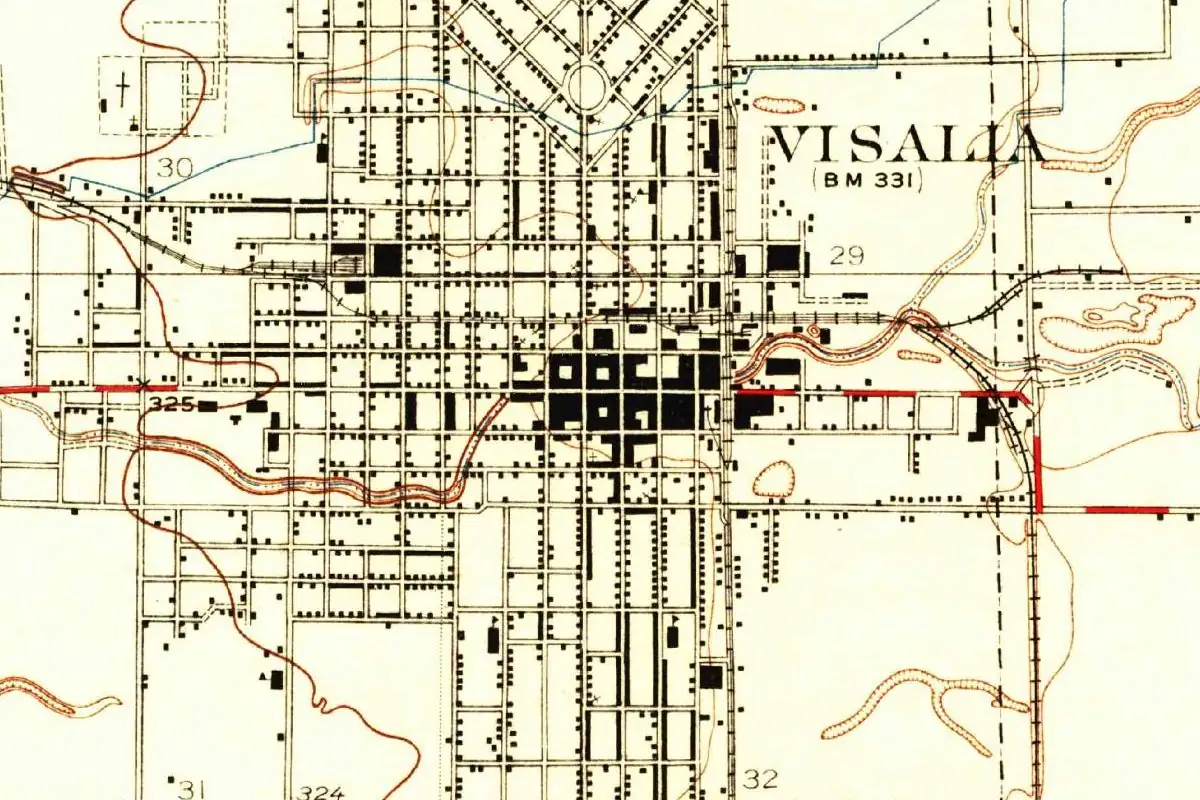
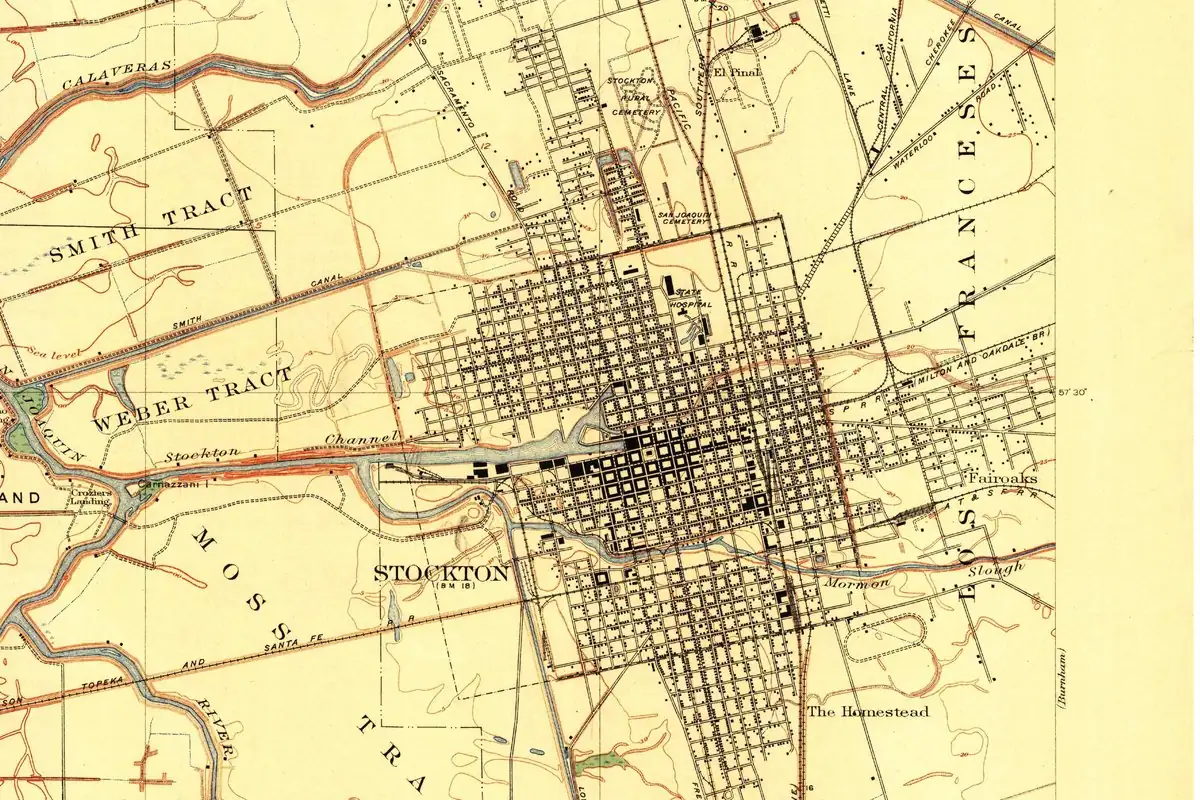
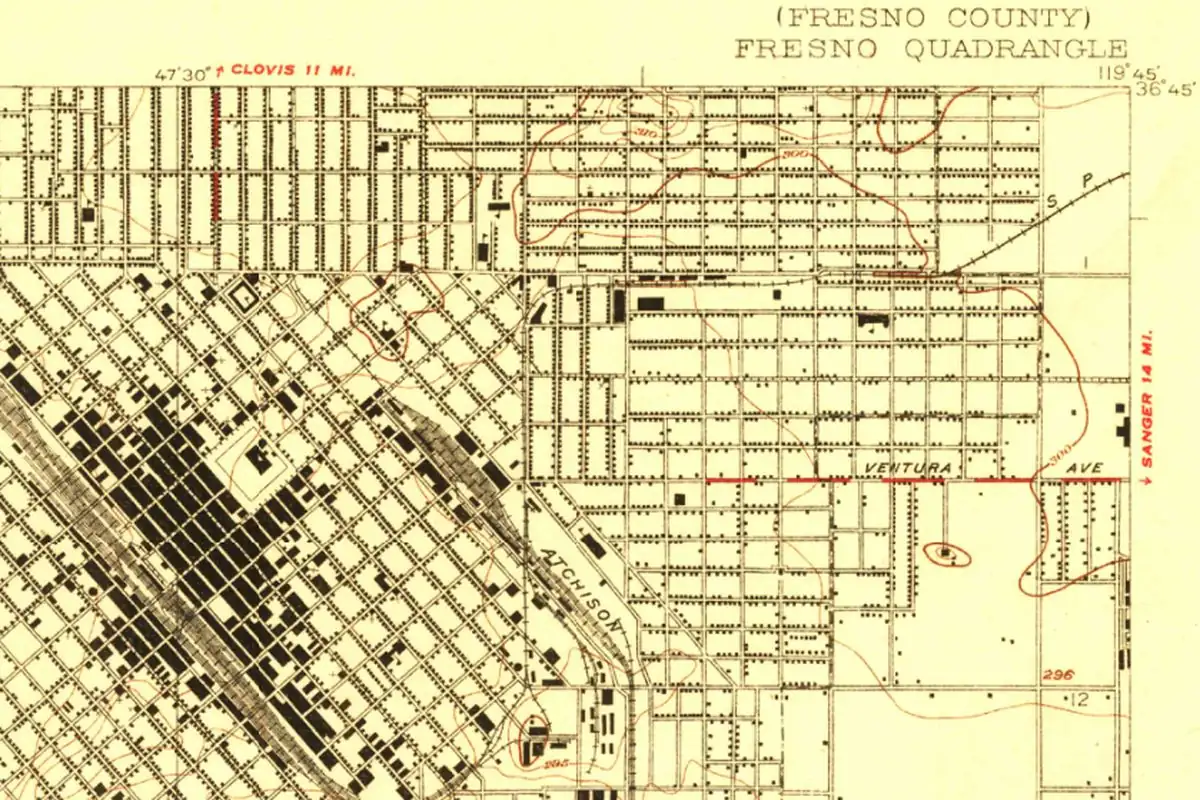
On the 1923 survey map above, you can see how the town had filled in by then: a dense downtown set at an angle, with newer neighborhoods on a square grid around it.
The new town adopted the name, and the river port lost its reason to exist. Fresno became the county seat in 1874, taking the title from Millerton, and it incorporated in 1885. By 1890 it had more than 10,000 people. None of the sources records who picked the name. A name first given to a river for its ash trees ended up on a railroad town, on a plain the city calls “barren sand.”
Quick answers
Why is Fresno called Fresno?
Fresno is Spanish for ash tree. The name was given to a river for the ash trees in the mountains, then to the county, and the railroad’s new town took it in 1872.
What does Fresno mean in Spanish?
Ash tree. Vandor’s 1919 county history, Gannett’s federal guide and Sanchez’s book on California place names all give that meaning.
Was there an older Fresno?
Yes. Fresno City stood on Fresno Slough from about 1855 to 1875, about 30 to 35 miles (48 to 56 km) southwest of today’s city. It faded once the railroad town took over.
When was Fresno founded?
The Central Pacific Railroad founded it in 1872. It became the county seat in 1874 and a city in 1885.
Key dates
- 1855Around this year Fresno City begins at the head of navigation on Fresno Slough, according to its state landmark.
- 1871On a scouting trip, Leland Stanford sees A. Y. Easterby's green wheat field: "Wonderful! Here we must build the town!"
- 1872The Central Pacific Railroad founds the town of Fresno on its new line.
- 1874Fresno replaces Millerton as the county seat.
- 1885Fresno incorporates as a city.
Getting there
Open Fresno in Google Maps
Opens in a new tab. The pin is the center of Fresno in the USGS place-name record.
The closest airports, Amtrak stations and intercity bus stops, measured in a straight line from the center of Fresno.
Airports
- Fresno Yosemite International (FAT) 4 mi 6 km
- Meadows Field (BFL) Bakersfield 99 mi 160 km
- San José Mineta International Airport (SJC) 126 mi 203 km
Amtrak trains
- Fresno station (FNO) under 1 mi 1 km
- Madera station (MDR) 25 mi 41 km
Intercity buses
- FlixBus Fresno Bus Station under 1 mi 1 km
- Amtrak Chartered Vehicle Amtrak Connecting Service · Fresno under 1 mi 1 km
- Gold Runner Fresno under 1 mi 1 km
Distances are as the crow flies, not by road. We don't list schedules or fares because they change; check with the airline, Amtrak or the bus company before you go. Official data (FAA commercial service airports (2025/2026 cached FAA categories from existing site), FAA airport locations, Amtrak stations and Intercity Bus Atlas) from the FAA and the U.S. Bureau of Transportation Statistics, checked Nov 10, 2026.
Sponsored
Staying in Fresno?
Compare hotels in Fresno, California, on Expedia.
See hotels in FresnoWe may earn a commission if you buy through this link. It never changes what we write. Read our affiliate disclosure
Sponsored
Want the spooky side of Fresno?
The name has its story above. For the ghost stories, US Ghost Adventures runs walking ghost tours in Fresno.
See ghost tours in FresnoWe may earn a commission if you book through this link. It never changes what we write. Read our affiliate disclosure
Historical Sources & References
- Paul E. Vandor, History of Fresno County, California, vol. 1 (1919), p. 34. The passage quoted above: the ash trees in the county’s mountains and the river that got the name first, plus the county’s organization in 1856.
- Henry Gannett, The Origin of Certain Place Names in the United States (USGS, 1902), p. 115. The first edition of the federal guide: “so named from a species of ash.”
- Nellie Van de Grift Sanchez, Spanish and Indian Place Names of California (1922 edition), p. 284. Her Fresno County entry: “Fresno (ash-tree),” named for the abundance of those trees.
- Page & Turnbull, Historic Properties Survey Report, Downtown - South Stadium Area (2008), pp. 5-6. The places that share the name, Fresno City at Tranquillity “thirty-five miles southwest,” the “adopted the name” wording, the “Sinks of Dry Creek,” and Millerton as county seat until 1874.
- City of Fresno, Historic Preservation. The Central Pacific founding of 1872, Stanford and the Easterby wheat field, the county seat in 1874, incorporation in 1885 and the 1890 population.
- California Historical Landmark No. 488, Fresno City. The old river town on Fresno Slough, about 1855 to 1875.
- GNIS feature 277606 (U.S. Geological Survey). The national gazetteer record for Fresno as a populated place in Fresno County, with its coordinates.
- U.S. Geological Survey, Fresno sheet (1923). The source of the map at the top of this page.
Spot something wrong, or know more? Tell us here. You can also email us or use our contact page. Corrections are noted here with their date, never made silently.