Redding, California: The Railroad Man, Not the Pioneer
Redding is named for Benjamin B. Redding, the railroad's land agent; the railroad named the town for him in 1872. It isn't named for Major Pierson B. Reading, whose land grant took in the site. A state law of 1874 respelled the town Reading to honor the Major, but the railroad ignored it, and by 1880 it was Redding again.
Two men, almost one name
Redding, California, honors a railroad land agent, Benjamin B. Redding, not the pioneer Pierson B. Reading, though lawmakers tried to switch them in 1874. The Shasta Historical Society opens its account of the county with that exact problem: “There’s a lot of confusion surrounding how the city of Redding got its name.”
The land had people long before either man. The city’s history page says the area was settled by the Wintu, whose settlements stretched from the northwestern part of the Sacramento River down to present-day Chico.
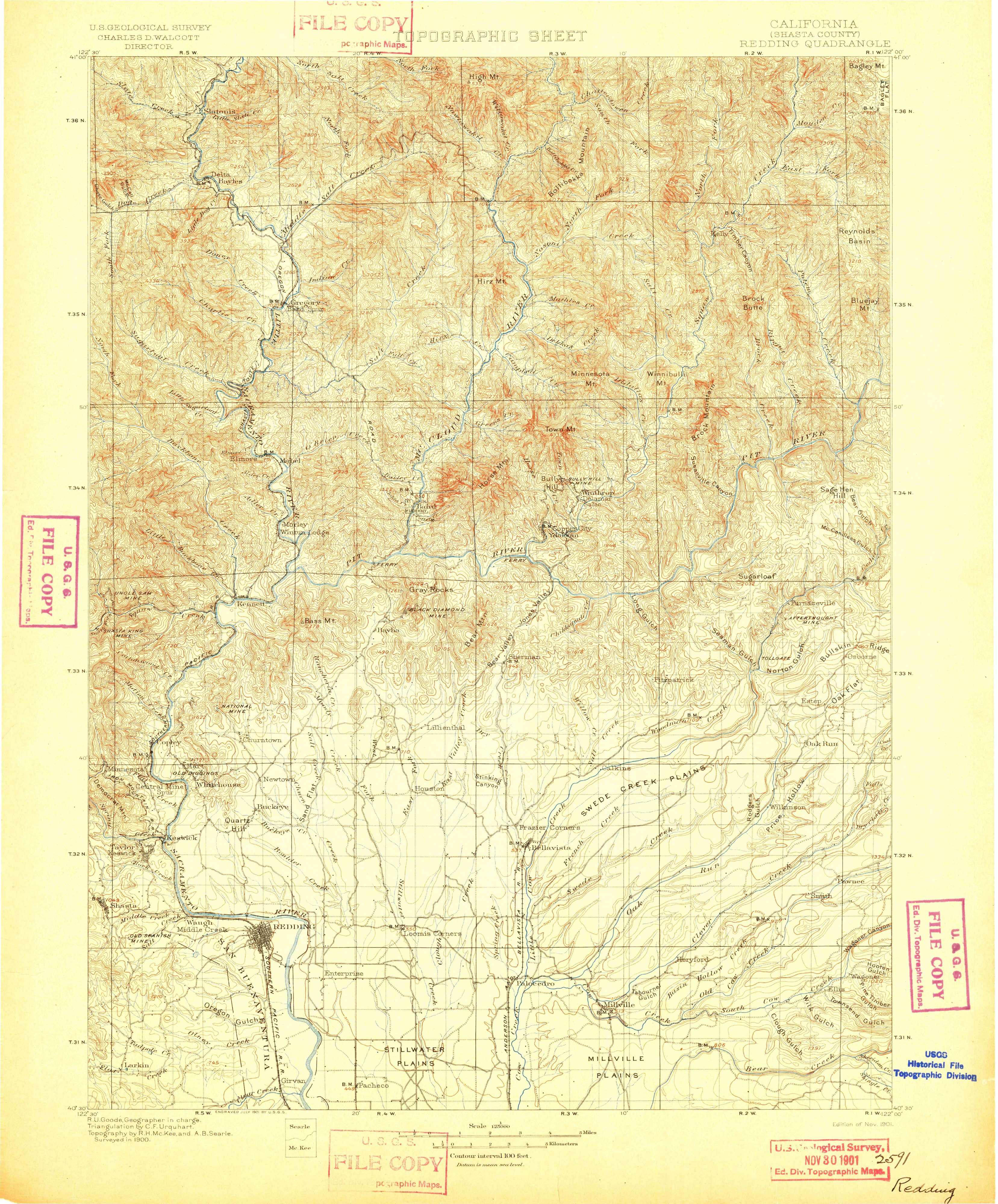
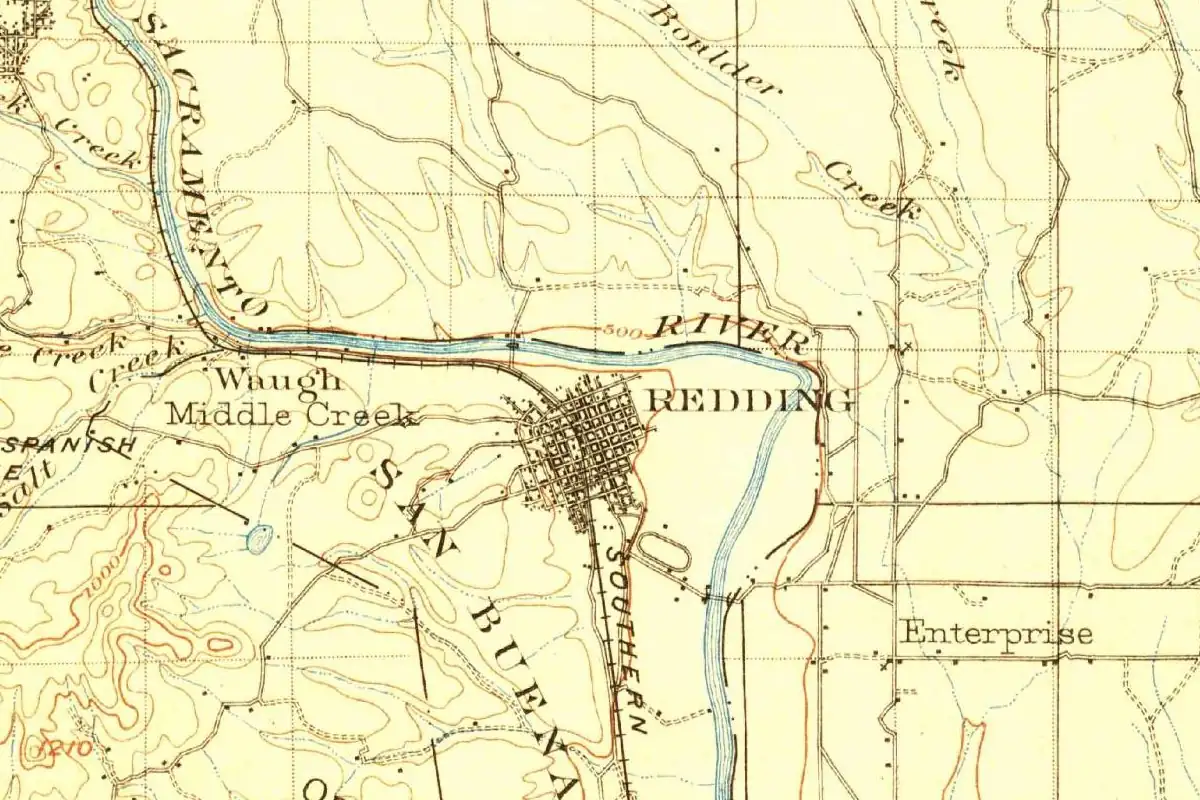
Of the two newcomers, Reading came first. The society says Major Pierson Barton Reading named an area Reading Springs, and that by 1849 it had become a permanent site for miners, the camp that grew into the boomtown of Shasta. The City of Redding adds that in 1844 Governor Manuel Micheltorena granted Reading the Rancho Buena Ventura, which takes in today’s Anderson, Cottonwood and Redding. On the 1901 map at the top of this page you can still read the old grant’s name, SAN BUENA, spaced out in big letters across the land south of town.
So the town sits on Reading’s old grant. Then the city’s history page says it plainly: “The city, however, was not named after the grant recipient.”
A railroad town on Poverty Flats
The other man arrived with the tracks. According to the historical society, Benjamin Bernard Redding was born in Canada in 1824 and became the Central Pacific Railroad’s first land agent in 1868. (The city calls him a land agent of the Southern Pacific.)
In 1872, the society says, an area known as Poverty Flats, 6 miles (10 km) east of Shasta, was selected for the railroad, and “In honor of their land agent, they named the town Redding.” The city’s version gives Redding himself a bigger role, saying he “decided to route the tracks through the area.”
That’s the whole naming, as far as these accounts go. The railroad named its town for its own man, and the result looked a lot like the pioneer’s name.
The legislature tries a new spelling
Less than two years later, the state stepped in. On January 23, 1874, a short law was approved under the title “An Act to change the orthography of the name of a town in Shasta County.” Here’s the heart of it, from the state’s printed statutes:
“That the name of the Town of Redding, in Shasta County, shall hereafter be known and spelled Reading, in honor of the late Major Pearson B. Reading, the pioneer of Shasta County.”
Notice two things. The law didn’t give the town a new name; it changed only the spelling, which is what the title’s “orthography” means. And it spells the Major’s first name “Pearson,” where the city and the historical society both write Pierson.
The legislature had just used the old spelling itself. Three days earlier, on January 20, 1874, the same session adopted a resolution asking California’s members of Congress to work for a daily mail again “from the Town of Redding, via Shasta City” north to Yreka. It’s printed in the same volume of statutes, with the old spelling.
The new spelling didn’t stick. The historical society says the railroad “refused to recognize the name change,” and that “by 1880 the name was officially returned to Redding.” The 1901 map agrees: it prints REDDING, with a railroad lettered SOUTHERN running south out of town.
The town kept the railroad’s spelling as it grew. The city says Redding had 600 settlers when it incorporated on October 4, 1887, and that by 1910, supported mainly by copper and iron mining, it had 3,572 people. When the U.S. Geological Survey mapped the area in 1900, the sheet it printed the next year was simply called the Redding quadrangle, and the name on the town was the land agent’s.
Even the experts blended them
The two names kept tangling long after 1880. In 1905 the Geological Survey’s name man, Henry Gannett, printed this entry: “Redding; city in Shasta County, California, named for Major Redding, one of the earliest American pioneers.”
You can see what happened there. The spelling is the railroad man’s. The rank and the pioneer part fit Reading, whom the 1874 law called “the pioneer of Shasta County.” Gannett’s line mixes the two men together.
So if you’re in Redding and someone tells you the city is named for the Major, you can see where that idea comes from. For a few years the state itself spelled the town for him, and a 1905 Geological Survey bulletin printed the blend.
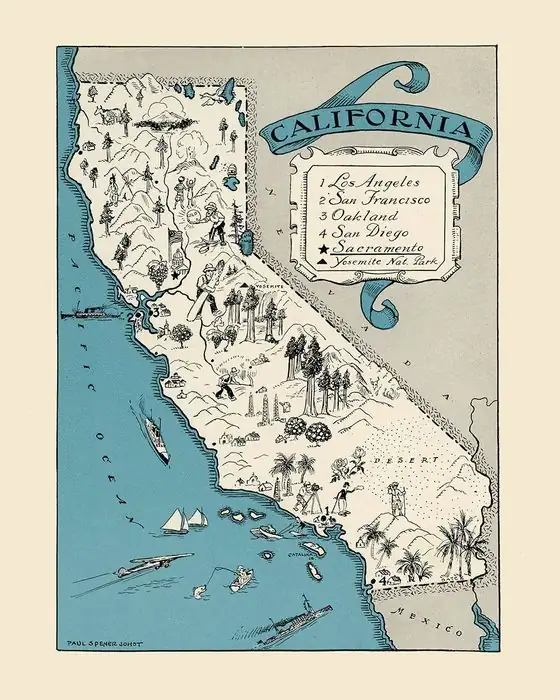
Farther north, up the Sacramento River canyon toward Oregon, Dunsmuir started out as a railroad camp called Pusher. There’s more from around the state on our California page.
Quick answers
Is Redding named after Pierson B. Reading?
No. The city and the Shasta Historical Society both say Redding was named for Benjamin B. Redding, the railroad’s land agent. Reading held the land grant that takes in the site.
Why was Redding spelled Reading?
Because a state law approved on January 23, 1874, ordered the town “known and spelled Reading, in honor of the late Major Pearson B. Reading.” The railroad didn’t go along, and the society says the name was officially Redding again by 1880.
When was Redding, California, named?
In 1872, when the railroad chose the site on Poverty Flats and named the town for its land agent. The city incorporated on October 4, 1887.
What was Redding called before?
The society says the area was known as Poverty Flats. For a few years after 1874 its legal spelling was Reading.
Key dates
- 1844Governor Manuel Micheltorena grants Rancho Buena Ventura, which takes in the future site of Redding, to Pierson B. Reading.
- 1872Poverty Flats, six miles east of Shasta, is selected, and the railroad names the town for its land agent, Benjamin B. Redding.
- 1874January 23: A state law orders the town to be "known and spelled Reading" in honor of Major Reading.
- 1880By this year, the Shasta Historical Society says, the name is officially Redding again.
- 1887October 4: Redding incorporates as a city.
Things to do in Redding, California
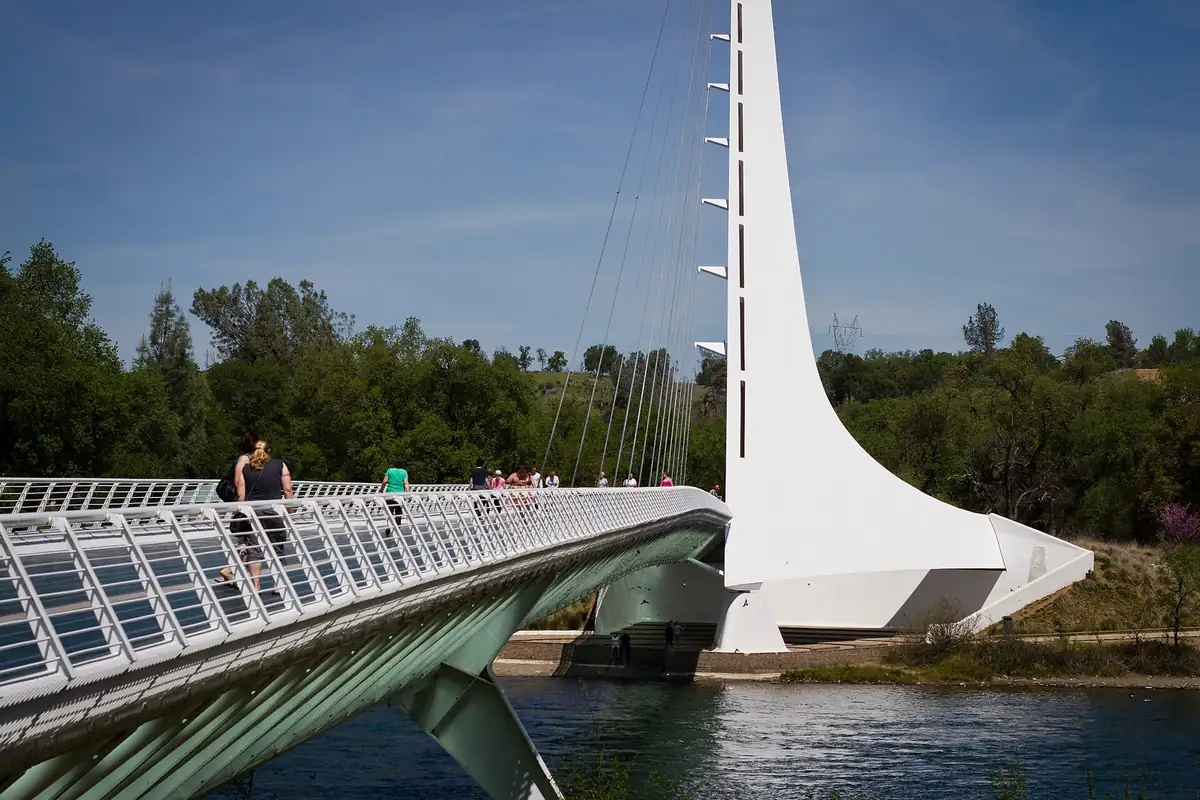
Sundial Bridge
A glass-decked footbridge over the Sacramento River, designed by Santiago Calatrava and opened on July 4, 2004. It's also a working sundial, with a pylon 217 feet (66 m) tall.
Turtle Bay Exploration Park
A 300-acre nonprofit park on the river with a museum, a forestry and wildlife center, an arboretum and botanical gardens, at the gateway to the Sacramento River Trails.
Shasta State Historic Park
The brick ruins and streets of old Shasta, once the center of mining and trade in Northern California, 6 miles (10 km) west of Redding. Its old county courthouse is filled with history exhibits and California art.
Whiskeytown National Recreation Area
A 42,000-acre national recreation area with Whiskeytown Lake, waterfalls, dozens of miles of trails, Gold Rush history and the Tower House Historic District.
Getting there
Open Redding in Google Maps
Opens in a new tab. The pin is the center of Redding in the USGS place-name record.
The closest airports, Amtrak stations and intercity bus stops, measured in a straight line from the center of Redding.
Airports
- Redding Regional (RDD) 7 mi 12 km
- California Redwood Coast-Humboldt County (ACV) Arcata 94 mi 151 km
- Sacramento International (SMF) 137 mi 221 km
Amtrak trains
- Redding station (RDD) under 1 mi 0.4 km
- Dunsmuir station (DUN) 44 mi 70 km
Intercity buses
- Greyhound Redding CA - Downtown RABA Transit Center (RDR) under 1 mi 0.4 km
- Amtrak Chartered Vehicle Amtrak Connecting Service · Redding Amtrak under 1 mi 0.4 km
- Gold Runner Redding under 1 mi 0.4 km
Distances are as the crow flies, not by road. We don't list schedules or fares because they change; check with the airline, Amtrak or the bus company before you go. Official data (FAA commercial service airports (2025), FAA airport locations, Amtrak stations and Intercity Bus Atlas) from the FAA and the U.S. Bureau of Transportation Statistics, checked Nov 14, 2026.
Sponsored
Staying in Redding?
Compare hotels in Redding, California, on Expedia.
See hotels in ReddingWe may earn a commission if you buy through this link. It never changes what we write. Read our affiliate disclosure
Historical Sources & References
- The Statutes of California … Twentieth Session, 1873-74, chap. XXXVII, p. 32. “An Act to change the orthography of the name of a town in Shasta County,” approved January 23, 1874, with the quoted section 1 respelling Redding as Reading for “Major Pearson B. Reading.”
- The Statutes of California … 1873-74, p. 967. Resolution No. XI, adopted January 20, 1874, asking for a daily mail “from the Town of Redding, via Shasta City” to Yreka.
- Shasta Historical Society, “Shasta County History – Pre 1900”. The “confusion” over the name; Reading Springs and Shasta; Benjamin Bernard Redding’s birth in 1824 and his post as Central Pacific land agent in 1868; Poverty Flats in 1872 and “In honor of their land agent, they named the town Redding”; the 1874 change, the railroad’s refusal and the return to Redding by 1880.
- City of Redding, “History of Redding”. The Wintu; Rancho Buena Ventura granted to Pierson B. Reading in 1844; “not named after the grant recipient”; Benjamin B. Redding as a Southern Pacific land agent in 1872; incorporation on October 4, 1887.
- Henry Gannett, The Origin of Certain Place Names in the United States, 2nd ed. (1905), p. 260. Redding “named for Major Redding, one of the earliest American pioneers.”
- GNIS feature 277582 (U.S. Geological Survey). Redding as recorded in the national place-name database, in Shasta County.
- U.S. Geological Survey, Redding sheet (November 1901). The 1:125,000 quadrangle, surveyed in 1900, that the map at the top of this page was cropped from.
Sponsored
Put this 1901 map on your wall
The 1901 USGS Redding sheet is in the public domain. Download the full-size scan for free, then have it printed on canvas with CanvasOnTheCheap.
Print a map on canvasDownload the full-size mapWe may earn a commission if you buy through this link. It never changes what we write. Read our affiliate disclosure
Spot something wrong, or know more? Tell us here. You can also email us or use our contact page. Corrections are noted here with their date, never made silently.