Mendocino, California: A Cape's Name and Two Viceroys
The name was first given to Cape Mendocino, a 1922 place-names book says. Most sources say the cape honors Antonio de Mendoza, the first viceroy of New Spain. A county page from California's agricultural commissioners says it may instead honor Lorenzo Suárez de Mendoza, viceroy from 1580 to 1583. The town was earlier called Meiggsville and Big River.
Mendocino, California, carries the name of a cape that honors a Spanish viceroy of the Mendoza family, but sources differ on which viceroy it was. The village didn’t start out with that name, either. It went through at least three others, the Kelley House Museum says, and the last of them, Mendocino City, carried a “City” to tell the town apart from the county.
Meiggsville, Big River, Mendocino City
The town began with a shipwreck and a sawmill. In their 1914 county history, Aurelius Carpenter and Percy Millberry say a ship bound from China to San Francisco was wrecked at Point Cabrillo in 1851 or 1852, and the salvage party came back with reports of huge stands of redwood. That news reached Harry Meiggs in San Francisco, who sent a complete sawmill north by ship. Meiggs arrived on July 19, 1852, and J. B. Ford had come ten days before him.
The Kelley House Museum in Mendocino picks up the story of the name. “At first, the area (not exactly a town yet) was called Meiggsville, after the financier of the mill, Henry Meiggs, but the name didn’t stick.” Then, for a while, it was Big River Township, which “appeared on early directories and documents usually as just Big River.”
After that came Mendocino City, and here the museum is honest about the gap: “When and why it was changed to Mendocino City is not known exactly.” The “City” was there to tell the town apart from the county, the museum says, and it was dropped when the post office decided the name was too long for a rubber stamp. California State Parks adds that Ford, the superintendent of that first mill, “is credited by many as being the founder of the city.”
The Advisory Council on Historic Preservation says the village grew up around that mill of 1852 and puts it about 150 miles (241 km) north of San Francisco on the California coast. The Mendocino and Headlands Historic District went on the National Register of Historic Places in 1971, the council adds.
The cape that gave the name
In her 1922 book on California’s Spanish and Indian place names, Nellie Van de Grift Sanchez says, in her entry on the village, that the name “was first applied to the cape.” The county took its name from Cape Mendocino, which lies to the north, in Humboldt County, according to Lyman Palmer’s History of Mendocino County, published in 1880. Palmer says Juan Rodríguez Cabrillo discovered the cape in 1542 and named it in honor of the “illustrious Señor Antonio de Mendoza,” the viceroy of Mexico, “and the patron of the voyageur.”
Not everyone gives Cabrillo the credit. Sanchez says the cape “was discovered and named in honor of Don Antonio de Mendoza, first Viceroy of New Spain, by certain ships returning from the Philippines.” The Columbia Encyclopedia credits Bartolomé Ferrelo with discovering and naming it in 1543. All three agree on Antonio de Mendoza. In 1905, the Geological Survey’s Henry Gannett gave the county and cape a single line, “named for Don Antonia de Mendoza, the viceroy of Mexico,” with the first name spelled that way on the page.
Which Mendoza?
Here’s where the agreement breaks. The California Agricultural Commissioners and Sealers Association, in its page on the county, says Cape Mendocino “was probably named in honor of either Antonio de Mendoza, Viceroy of New Spain, 1535–1542 (who sent the Juan Rodríguez Cabrillo Expedition to this coast in 1542), or Lorenzo Suárez de Mendoza, Viceroy from 1580 to 1583.” That “probably” and that “either” are theirs. None of the other sources we checked mentions Lorenzo Suárez de Mendoza.
The same page explains the shape of the word: “Mendocino is the adjectival form of the family name of Mendoza.” So whichever viceroy it was, the name points back to the Mendoza family.
If you’ve followed other viceroys across the map, you’ll see a pattern. Monterey got its name from the Count of Monterey, viceroy of New Spain, when Vizcaíno’s ships anchored there in 1602. San Diego is where Cabrillo’s ships put in during 1542, the year Palmer gives for the cape. Outside California, Galveston, Texas, carries the name of the viceroy Bernardo de Gálvez by way of a bay, much as Mendocino carries its Mendoza by way of a cape, and Albuquerque, New Mexico, was named in 1706 for the Duke of Alburquerque, viceroy of New Spain.
The town on a 1920 Army map
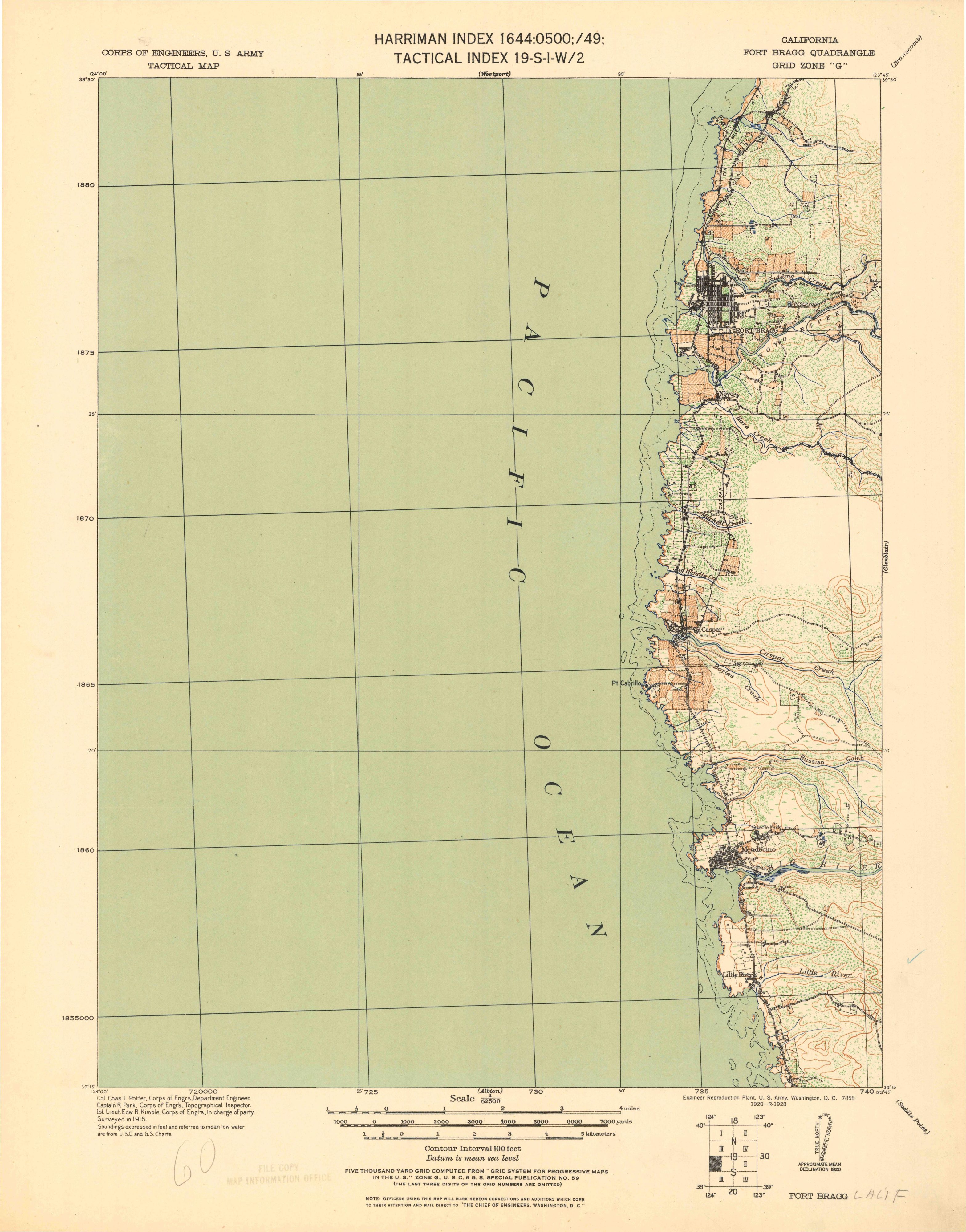
The map at the top of this page isn’t a Geological Survey sheet. It’s a tactical map of the Fort Bragg quadrangle made by the U.S. Army Corps of Engineers, surveyed in 1916 under 1st Lt. Edw. R. Kimble, printed in 1920, and reprinted in 1928, as its print line shows. The Geological Survey keeps it in its historical map collection.
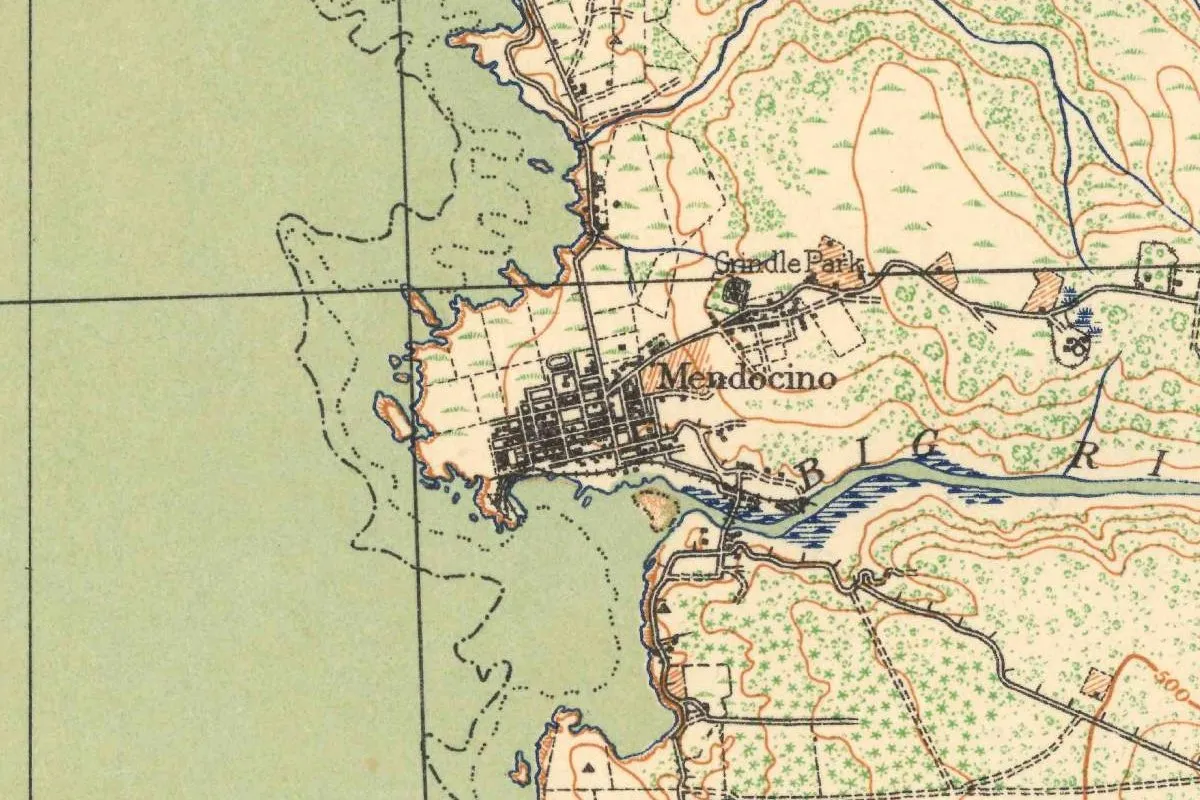
On it, “Mendocino” sits on its headland with a tight grid of streets, and the spaced letters of “Big River” run along the water just south of town. To the east is Grindle Park, and inland the map is covered in woodland and orchard symbols.
Quick answers
What does Mendocino mean?
It comes from the Mendoza family name. The California Agricultural Commissioners and Sealers Association calls Mendocino “the adjectival form of the family name of Mendoza,” for the viceroy the cape was named after.
Who is Mendocino, California, named after?
Indirectly, a viceroy of New Spain. The name was first applied to Cape Mendocino, Sanchez wrote in 1922. Most sources say the cape honors Antonio de Mendoza; one says it may honor Lorenzo Suárez de Mendoza instead.
What was Mendocino, California, called before?
Meiggsville, then Big River, then Mendocino City, according to the Kelley House Museum. It says nobody knows exactly when or why the name became Mendocino City.
Key dates
- 1542Cabrillo discovers the cape and names it for Antonio de Mendoza, according to Palmer's 1880 county history. Other sources credit a different voyage.
- 1852Harry Meiggs arrives at Mendocino Bay on July 19 to set up a sawmill, with J. B. Ford ten days ahead of him, per Carpenter's 1914 history.
- 1971The Mendocino and Headlands Historic District is listed on the National Register of Historic Places.
Things to do in Mendocino, California
Mendocino Headlands State Park
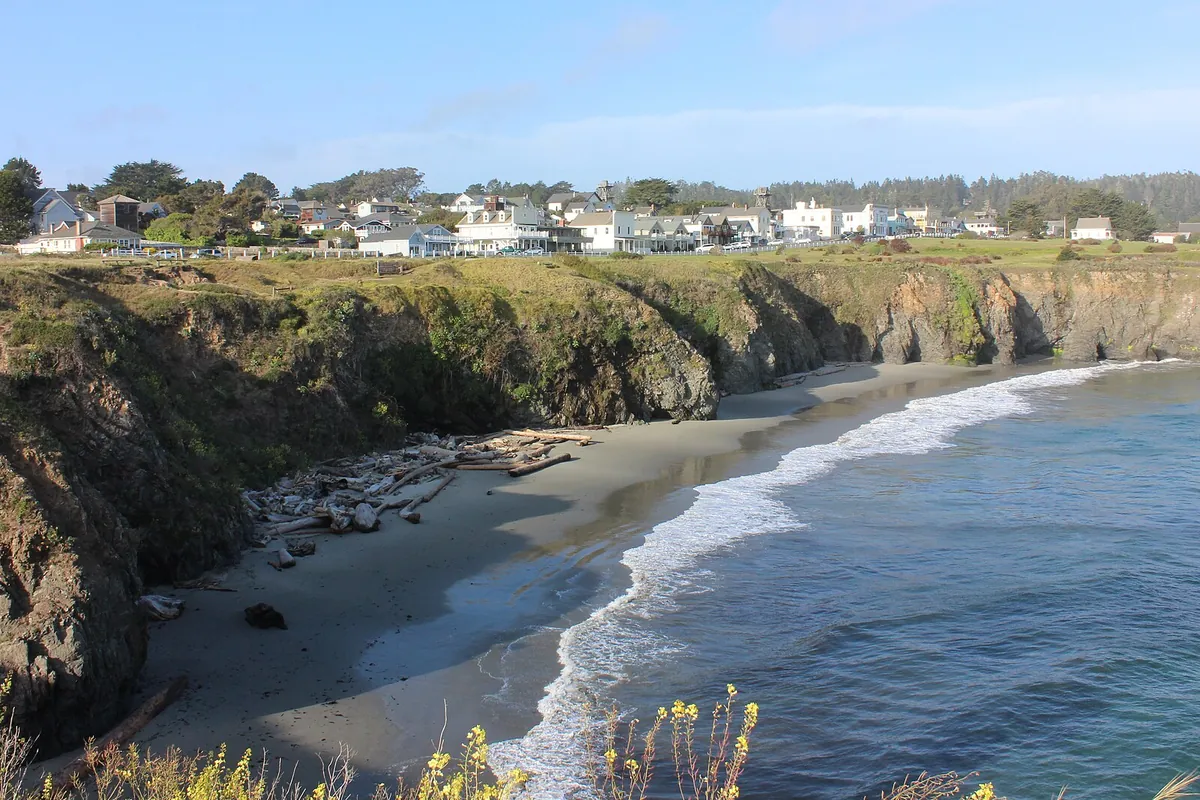
The state park that surrounds the village on three sides, with cliffside trails that look out on what the park calls 'sea arches and hidden grottos,' and Big River Beach on the south side of town, according to California State Parks.
Ford House Visitor Center
The house Jerome B. Ford built in 1854 for his bride, Martha, now a museum on Main Street and the park's visitor center, with a scale model of Mendocino as it was in 1890, built by Len Peterson, whom the park calls a 'local craftsman,' and photos and tools from the logging days.
Kelley House Museum
A house museum in an 1861 Mendocino home, with displays on the town's logging history and its Victorian and New England style architecture, according to the Advisory Council on Historic Preservation.
Point Cabrillo Light Station
A state historic park on a headland, where a half-mile (0.8 km) walk leads down to a working lighthouse with its original third-order Fresnel lens and a lightkeeper's house furnished as it was in the 1930s.
Getting there
Open Mendocino in Google Maps
Opens in a new tab. The pin is the center of Mendocino in the USGS place-name record.
The closest airports, Amtrak stations and intercity bus stops, measured in a straight line from the center of Mendocino.
Airports
- Charles M Schulz/Sonoma County (STS) Santa Rosa 77 mi 123 km
- Redding Regional (RDD) 115 mi 185 km
- Sacramento International (SMF) 126 mi 203 km
Amtrak trains
- Williams station (WMD) 89 mi 143 km
- Orland station (OLD) 90 mi 145 km
Intercity buses
- Gold Runner Willits - Skunk Train Depot 25 mi 40 km
- Amtrak Chartered Vehicle Amtrak Connecting Service · Willits Calif Western Railroad Depot Amtrak 25 mi 40 km
Distances are as the crow flies, not by road. We don't list schedules or fares because they change; check with the airline, Amtrak or the bus company before you go. Official data (FAA commercial service airports (2025), FAA airport locations, Amtrak stations and Intercity Bus Atlas) from the FAA and the U.S. Bureau of Transportation Statistics, checked Nov 17, 2026.
Sponsored
Staying in Mendocino?
Compare hotels in Mendocino, California, on Expedia.
See hotels in MendocinoWe may earn a commission if you buy through this link. It never changes what we write. Read our affiliate disclosure
Historical Sources & References
- Kelley House Museum, “Mendocino: First There Was a Shipwreck”. Meiggsville, Big River Township, Mendocino City and the dropped “City.”
- Lyman L. Palmer, History of Mendocino County (1880). Cabrillo, 1542, and the “illustrious Señor Antonio de Mendoza,” on the first page of the county history. Checked against the page image.
- Nellie Van de Grift Sanchez, Spanish and Indian Place Names of California (1922), p. 253. The cape named for Antonio de Mendoza “by certain ships returning from the Philippines.” Checked against the page image.
- Henry Gannett, The Origin of Certain Place Names in the United States (1905), p. 205. “Named for Don Antonia de Mendoza, the viceroy of Mexico.”
- California Agricultural Commissioners and Sealers Association, “Mendocino County”. Antonio de Mendoza or Lorenzo Suárez de Mendoza, and Mendocino as “the adjectival form” of Mendoza.
- The Columbia Encyclopedia, “Mendocino, Cape”. Ferrelo, 1543.
- Aurelius O. Carpenter and Percy H. Millberry, History of Mendocino and Lake Counties (1914), pp. 50-51. The wreck at Point Cabrillo, Meiggs’s sawmill and his arrival on July 19, 1852. Page 51 checked against the image.
- Advisory Council on Historic Preservation, “Mendocino, California”. The mill of 1852, the National Register listing of 1971 and the Kelley House Museum.
- California State Parks, Mendocino Headlands State Park; Point Cabrillo Light Station. The details in the things-to-do list, including the half-mile (0.8 km) walk to the lighthouse.
- GNIS feature 1659106 (U.S. Geological Survey). Mendocino’s listing as a populated place in Mendocino County, with its coordinates.
- U.S. Army Corps of Engineers, Fort Bragg quadrangle (1920, reprinted 1928). The 1:62,500 tactical map the map at the top was cropped from.
Sponsored
Put this 1920 map on your wall
The Army Corps of Engineers' 1920 tactical map of the Fort Bragg quadrangle (this copy is a 1928 reprint), with Mendocino above the Big River, is in the public domain. Download the full-size scan for free, then have it printed on canvas with CanvasOnTheCheap.
Print a map on canvasDownload the full-size mapWe may earn a commission if you buy through this link. It never changes what we write. Read our affiliate disclosure
Spot something wrong, or know more? Tell us here. You can also email us or use our contact page. Corrections are noted here with their date, never made silently.