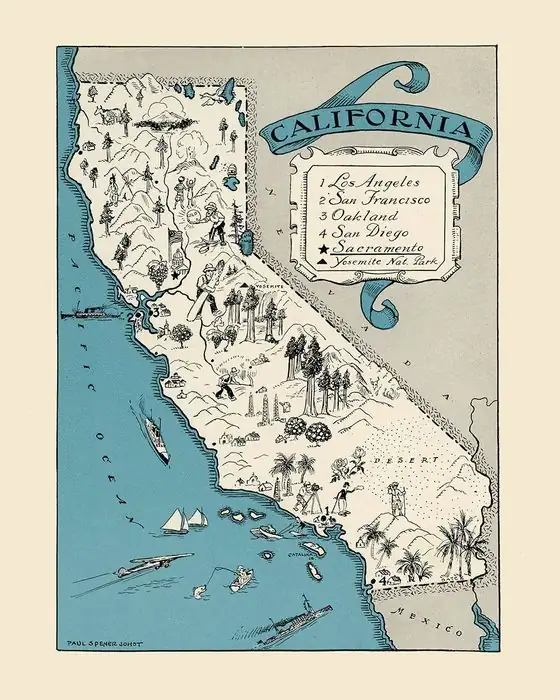
Santa Rosa, California: A Creek, a Baptism and a Saint
Santa Rosa, California, is named for St. Rose of Lima. Sonoma County histories from 1877 on say Friar Juan Amoroso baptized a Native girl in the creek in 1829, on the saint's feast day, and named her Santa Rosa. The creek and valley took the name, and postmaster Alonzo Meacham gave it to the post office in 1852.
A girl named Santa Rosa, and a creek that kept the name
Santa Rosa, California, is named for a creek where, Sonoma County’s early histories say, a missionary baptized a girl on the feast of St. Rose of Lima. The saint was a young woman from Lima, Peru, and the name traveled from that baptism to the stream, then to the valley, and finally to the town.
The oldest telling we found is Robert A. Thompson’s 1877 history of the county. He says the man who “had the honor of giving the beautiful name of Santa Rosa to the stream” was Friar Juan Amoroso, a missionary based at San Rafael. In 1829, Thompson writes, Amoroso rode north with a man named Jose Cantua into the country of the people he calls the Cainemeros, who lived on a stream they called Chocoalomi, “the Indian name of what is now Santa Rosa creek.”
What happened next isn’t a gentle story, and Thompson doesn’t pretend it is:
“…he captured an Indian girl, baptised her in the stream and gave her the name Santa Rosa, from the fact that, on that very day the Church was celebrating the feast of Santa Rosa de Lima.”
The people there attacked him, and he fled back to his mission. “Fortunately the stream and the valley took its name from this beautiful incident,” Thompson adds. You may read that last word differently than he did.
Two dates for the first Santa Rosa
The 1880 History of Sonoma County repeated Thompson’s account almost word for word and credited him by name, so it’s the same source, not a second witness. Tom Gregory’s 1911 history retold it again with more color, and he’s the one who pins down the day: August 30, 1829, the date the Church had set for St. Rose’s feast. In Gregory’s version the priest ends the ceremony in a hurry and gallops off on a mustang, with a crowd trying to stick him full of arrows. That’s Gregory’s flourish; Thompson just says he was attacked and got away.
The Museum of Sonoma County tells it differently. Its gallery text says the name Santa Rosa “first appeared in 1824,” given by a Mexican priest for the feast day of St. Rose of Lima “to describe a particular settlement site,” and only then passed to the creek and the area around it. The museum doesn’t name the priest or mention a baptism.
So if you’re keeping score, everyone agrees on the saint. They don’t agree on the year, and the museum’s version doesn’t include the story the county histories tell.
Meacham’s post office, and a town that followed
In 1838 and 1839 the Carrillo family built an adobe house on the creek, on land granted to a sister of the wife of General Vallejo. That’s the “old adobe” Thompson uses as a landmark: Amoroso’s baptism, he says, happened on the rocky point opposite it.
The name became a town’s name through the mail. In June of 1852 Alonzo Meacham came up from San Francisco, bought the little store at the adobe and asked for a post office. He was made postmaster, Thompson writes, “and gave the office the name of Santa Rosa, to which the town of Santa Rosa succeeded.” Thompson approved. Meacham, he says, “is entitled to the gratitude of posterity that he did not call the post-office Mallaghsville, Buchanansburg or some other stupid name of like derivation.” (David Mallagh had run the store at the adobe before him, and Thompson says James Buchanan signed Meacham’s commission.)
The town itself was laid out on 70 acres that Meacham’s partners, Hoen & Co., bought from him in August 1853, plus land offered by Julio Carrillo, and it wasn’t the only town on the creek. A rival called Franklin Town had a store, a tavern and a church. Then Santa Rosa won the 1854 vote to become the county seat, helped along by a Fourth of July barbecue for at least 500 people, and within a year Franklin’s houses had been moved into Santa Rosa, church and all. The museum dates the city’s incorporation to 1868.
Older than the saint’s name
The museum’s gallery is careful to say the Santa Rosa Valley was the traditional home of the Coast Miwok and Southern Pomo people, “whose presence in the area is measured in millennia.” The creek already had a name when the friar got there. Thompson wrote it down as Chocoalomi, and nobody in these sources says what it meant, so we won’t guess.
Quick answers
Who is Santa Rosa, California, named after?
St. Rose of Lima, the Peruvian saint. The 1877, 1880 and 1911 county histories say the name came from a baptism on her feast day, and the Museum of Sonoma County also ties it to her feast.
Was Santa Rosa named after the creek?
Yes, by way of it. Thompson’s 1877 history says the name was given to the stream first and that the valley, the township and the town were named after it.
When was the name Santa Rosa first used?
Sources disagree. The county histories put it in 1829, and Gregory gives August 30, 1829; the Museum of Sonoma County says the name first appeared in 1824.
Who named the town of Santa Rosa?
Postmaster Alonzo Meacham named the post office Santa Rosa in 1852, and Thompson says the town took the name from it.
Key dates
- 1824The Museum of Sonoma County dates the first appearance of the name Santa Rosa to this year.
- 1829Friar Juan Amoroso baptizes a girl in the creek and names her Santa Rosa, according to the county histories; Gregory gives the day as August 30.
- 1838-1839The Carrillo family's adobe goes up on Santa Rosa Creek.
- 1852Alonzo Meacham becomes postmaster and names the post office Santa Rosa.
- 1853In August, Hoen & Co. buy Meacham's 70 acres to lay out a new town, and Julio Carrillo offers land beside it.
- 1854Santa Rosa wins the vote to become the county seat, and Franklin Town's houses are moved there within the year.
- 1868Santa Rosa is incorporated, according to the Museum of Sonoma County.
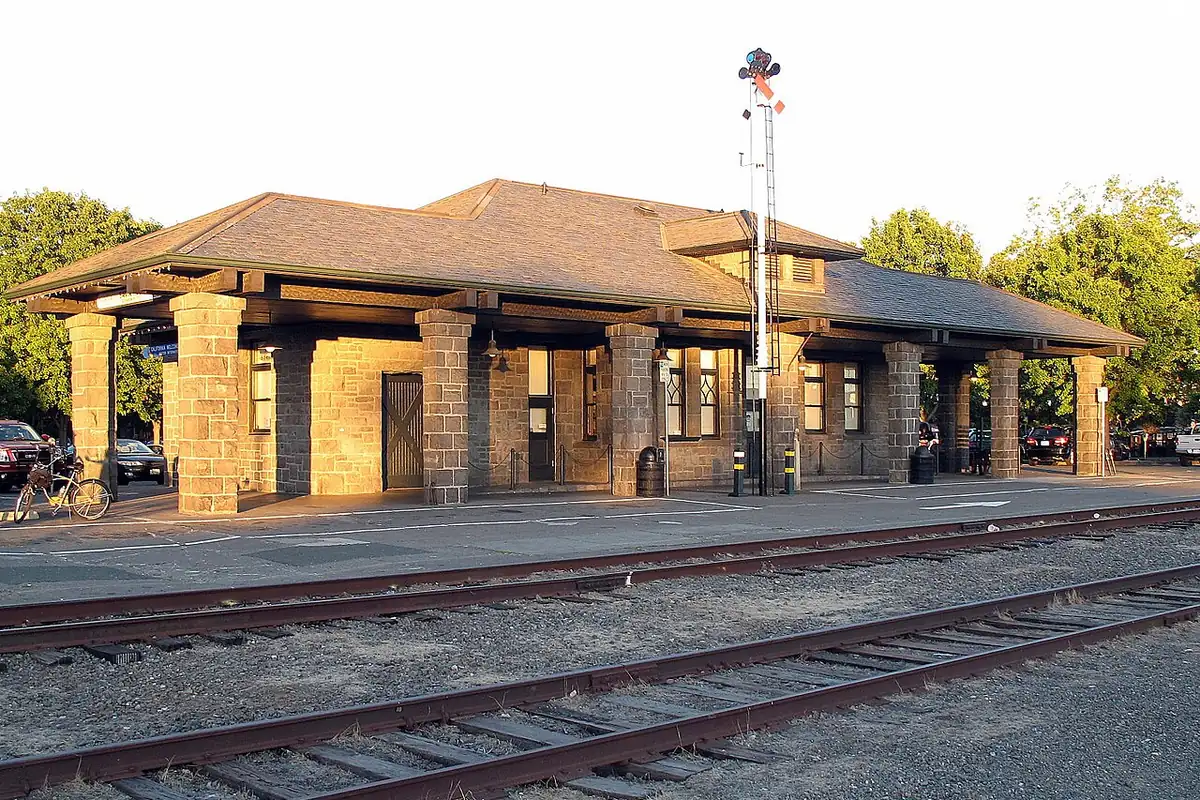
Getting there
Open Santa Rosa in Google Maps
Opens in a new tab. The pin is the center of Santa Rosa in the USGS place-name record.
The closest airports, Amtrak stations and intercity bus stops, measured in a straight line from the center of Santa Rosa.
Airports
- Charles M Schulz/Sonoma County (STS) Santa Rosa 7 mi 12 km
- Oakland San Francisco Bay (OAK) 56 mi 91 km
Amtrak trains
- Suisun-Fairfield station (SUI) 39 mi 63 km
- Richmond station (RIC) 40 mi 64 km
Intercity buses
- Amtrak Chartered Vehicle Amtrak Connecting Service · Santa Rosa Amtrak Bus Stop 1 mi 2 km
- Gold Runner Santa Rosa - Dicks Sporting Goods 1 mi 2 km
- Greyhound Vallejo CA - Curtola Park & Ride (VAL) 34 mi 55 km
Distances are as the crow flies, not by road. We don't list schedules or fares because they change; check with the airline, Amtrak or the bus company before you go. Official data (FAA commercial service airports (2025), FAA airport locations, Amtrak stations and Intercity Bus Atlas) from the FAA and the U.S. Bureau of Transportation Statistics, checked Nov 13, 2026.
Sponsored
Staying in Santa Rosa?
Compare hotels in Santa Rosa, California, on Expedia.
See hotels in Santa RosaWe may earn a commission if you buy through this link. It never changes what we write. Read our affiliate disclosure
Historical Sources & References
- Robert A. Thompson, Historical and Descriptive Sketch of Sonoma County, California (1877), pp. 70-74. Friar Juan Amoroso, the 1829 trip with Jose Cantua, the Cainemeros and the Chocoalomi, the baptism “on that very day the Church was celebrating the feast of Santa Rosa de Lima” (p. 70); the Carrillo adobe of 1838-39, Meacham’s post office of 1852 and the “Mallaghsville, Buchanansburg” line (p. 71); the August 1853 land purchase and the first survey of the town (p. 72); the barbecue, Franklin Town and the county seat in 1854 (pp. 73-74).
- History of Sonoma County (Alley, Bowen & Co., 1880), p. 382. Repeats Thompson’s account of the baptism and credits him as its source.
- Tom Gregory, History of Sonoma County, California (1911), pp. 153-156. St. Rose’s feast set for August 30, the baptism dated August 30, 1829, the priest’s hurried escape, and the Carrillo adobe at the same spot.
- Museum of Sonoma County, “Santa Rosa History”. The name “first appeared in 1824,” given by a Mexican priest for the feast day of St. Rose of Lima; the Coast Miwok and Southern Pomo homeland; the town formed in 1854 and incorporation in 1868.
- GNIS feature 1659601 (U.S. Geological Survey). Coordinates and county for Santa Rosa as the place-name database lists them.
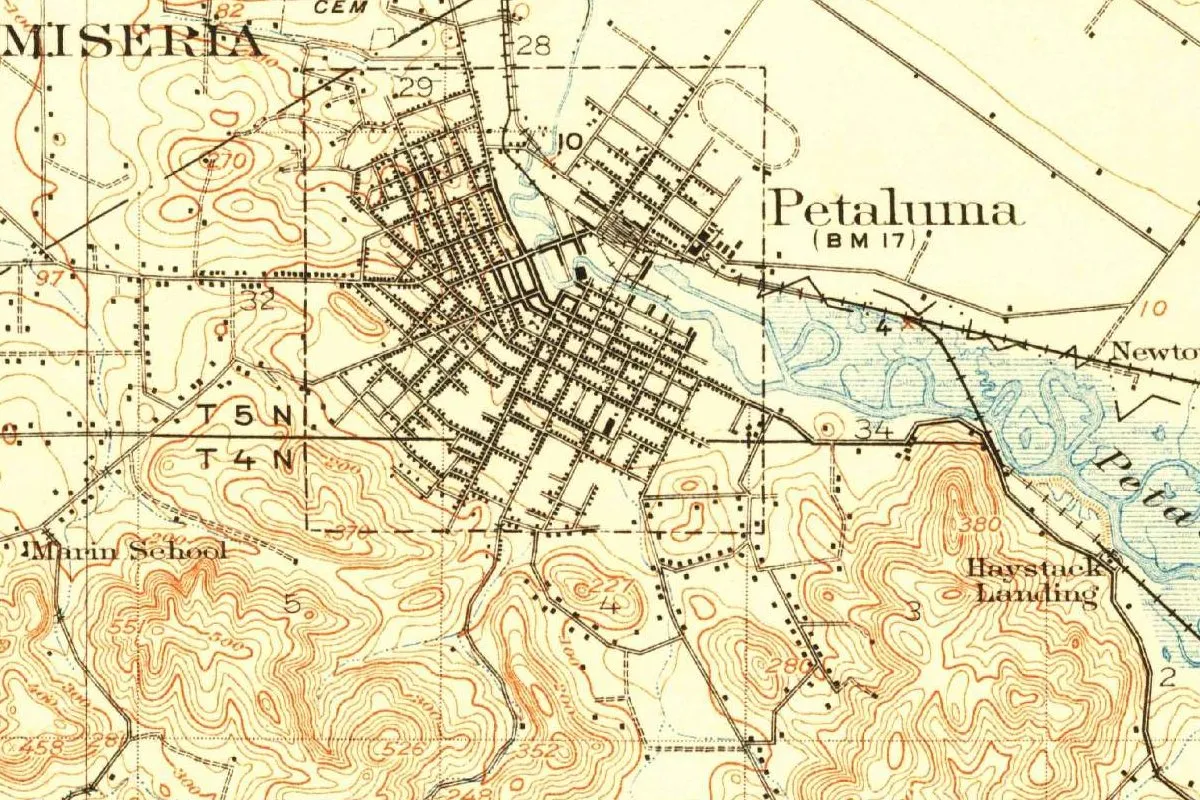
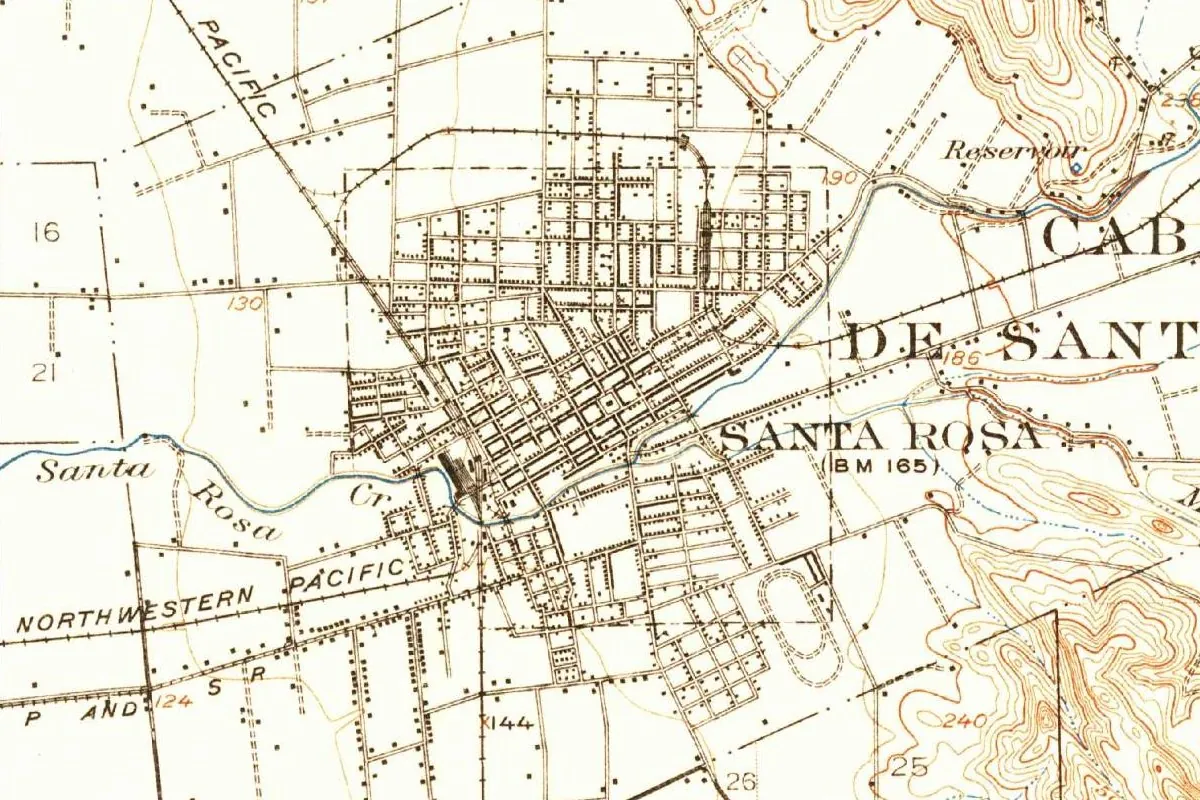
- U.S. Geological Survey, Santa Rosa sheet (1916). The source of the map at the top of this page.
Spot something wrong, or know more? Tell us here. You can also email us or use our contact page. Corrections are noted here with their date, never made silently.