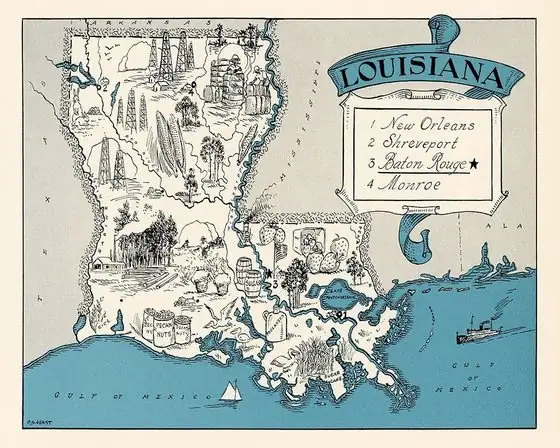
Opelousas, Louisiana: Named for a Tribe, Meaning Unsettled
The name comes from the Opelousa, a small tribe that lived in southwestern Louisiana. What the word meant is disputed. An 1805 report said black head or black skull, Gannett in 1905 black head or black moccasins, Swanton in 1911 black hair or black head, and William Read in 1927 black hair, black leggings or perhaps black legs.
The Opelousa, a small tribe in southwestern Louisiana, gave Opelousas its name, but writers since 1805 have split on its meaning: black head, hair or legs. Every version agrees on the second half, “black.” It’s the first half nobody has pinned down.
A small tribe, a big district
The Opelousa were a small band that lived in southwestern Louisiana, probably a branch of the Atakapa, William A. Read wrote in his 1927 book Louisiana Place-Names of Indian Origin. John R. Swanton of the Bureau of American Ethnology found what appears to be the first mention of them, in an unpublished letter by Bienville dated May 15, 1733, where they appear as the “Loupelousas.”
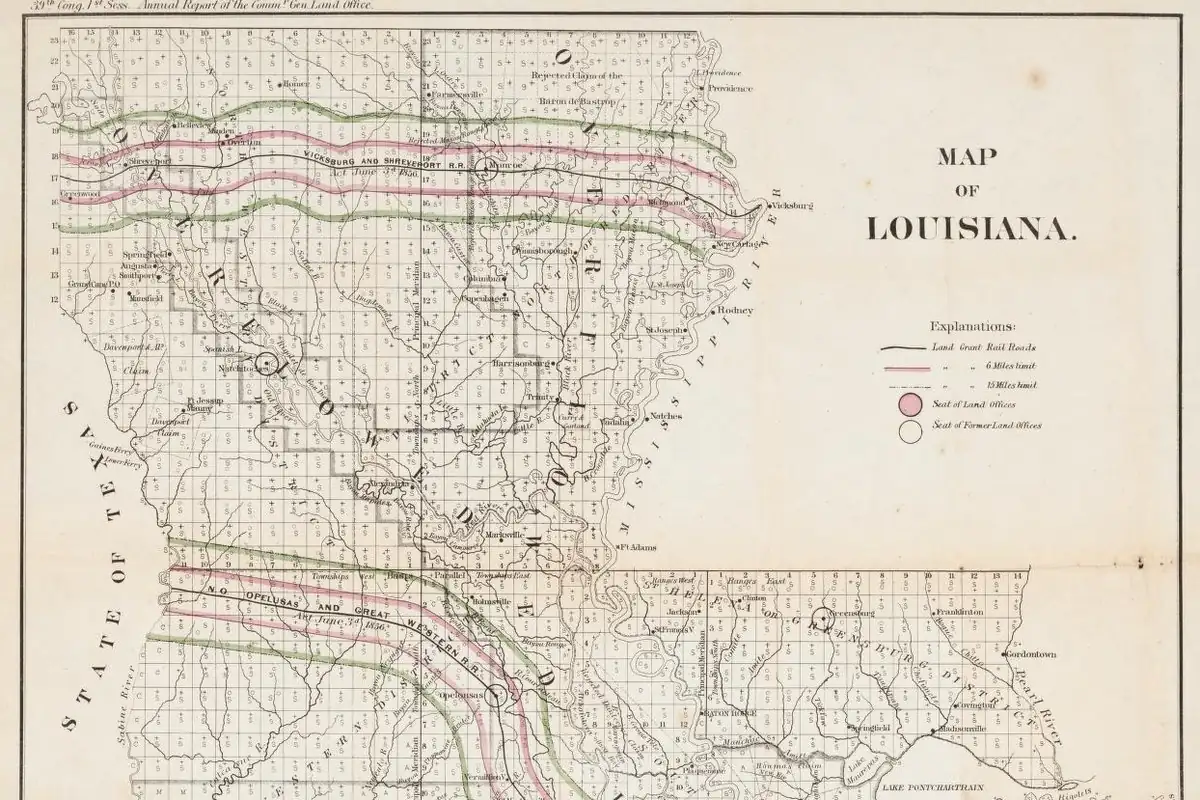
The tribe got “scant attention,” Swanton said, but the district named for it did. It once took in what are now the parishes of St. Landry, Calcasieu and Cameron, and a French and later Spanish post sat in the middle of it. Read dates the town’s history “virtually from 1765,” when it became a Spanish trading and military post. The City of Opelousas reaches further back, to a post it calls Le Poste des Opelousas, established in 1720. Either way, the people were there first, and the post was named for them.
What Sibley wrote down in 1805
One of the earliest attempts to translate the name comes from John Sibley, who signed his “Historical Sketches of the Several Indian Tribes in Louisiana” at Natchitoches on April 5, 1805. The president laid it before the Senate in February 1806, and a London edition printed it the next year:
“APPALOUSAS. It is said the word Appalousa, in the Indian language, means black head, or black skull. They are aborigines of the district called by their name.”
Notice the “it is said.” Sibley wasn’t claiming to know. He also counted about 40 men in their village, “about 15 miles west from the Appelousa church,” and noted that their own language “differs from all other.” That last detail matters, because the word Opelousa may not come from that language at all.
A name borrowed from the trade language
Swanton argued in 1911 that a few tribes in the region, the Opelousa among them, were known by names in the Muskogean family of languages even though they didn’t speak one. The French picked up those names from the Mobilian trade language before they’d met the tribes, he wrote, and by the time settlers arrived the tribes were used to them. Read agreed that the word was “obviously transmitted through the medium of Choctaw.”
So the guessing is about Choctaw words, and that’s where the versions pile up:
- Black head or black skull. Sibley, 1805, as hearsay.
- Black head or black moccasins. Henry Gannett’s 1905 dictionary of U.S. place names.
- Black hair or black head. Swanton, from Choctaw aba, “above,” and lusa, “black.”
- Black hair, black leggings or perhaps black legs. Read, who said “the origin of this name is not altogether clear.” The second part is “certainly” lusa, he wrote, but the first could be aba, “above,” or api, “trunk,” “body,” “leg.”
Read also shot down one translation outright. Because the word came through Choctaw, he said, it “cannot mean ‘salt water.’” The city’s walking-tour page lists “black hair” and “black water” and calls “black leg” the most commonly accepted, tied to a legend that the tribe painted their legs black. You’ll want to treat that legend as just that.
How to say it
Read wrote the pronunciation in phonetic symbols as roughly op-uh-LOO-suhs, and Dictionary.com gives the same thing for American English today. The stress lands on “LOO.”
The name outlasted the people it described. Read wrote that the Opelousa died out or joined other tribes during the second half of the 1800s. By then the town had been incorporated on February 21, 1821, and the district’s name had gone to the County of Opelousas, which became St. Landry Parish in 1807, with Opelousas as its seat, the city’s history says. So when you drive into one of the older towns in Louisiana, the sign still carries the name of a tribe, and nobody has translated it for sure.
Quick answers
What does Opelousas mean?
Nobody’s sure. Sibley’s 1805 report said “black head, or black skull”; Gannett gave “black head” or “black moccasins”; Swanton “black hair” or “black head”; and Read “black hair,” “black leggings” or perhaps “black legs.” All of them read the second part as “black.”
Does Opelousas mean salt water?
No. William Read wrote in 1927 that because the name came through Choctaw, it “cannot mean ‘salt water.’”
How do you pronounce Opelousas?
op-uh-LOO-suhs, with the stress on “LOO.” That’s how Read transcribed it in 1927 and how Dictionary.com gives it today.
Is Opelousas named after a person?
No. It’s named for the Opelousa, a small tribe that lived in southwestern Louisiana, probably a branch of the Atakapa.
Key dates
- 1733May 15: Bienville writes the tribe's name as "Loupelousas" in a letter, the first mention Swanton found.
- 1765The place becomes a Spanish trading and military post, the date William Read gives for the start of the town's history.
- 1805April 5: John Sibley signs his sketches of Louisiana's tribes, saying Appalousa is said to mean black head, or black skull.
- 1821February 21: Opelousas is incorporated, according to Read.
- 1927Read's book on Louisiana's Indian place names calls the origin of the name not altogether clear.
Getting there
Open Opelousas in Google Maps
Opens in a new tab. The pin is the center of Opelousas in the USGS place-name record.
The closest airports, Amtrak stations and intercity bus stops, measured in a straight line from the center of Opelousas.
Airports
- Lafayette Regional/Paul Fournet Field (LFT) 23 mi 38 km
- Baton Rouge Metro, Ryan Field (BTR) 55 mi 89 km
- Louis Armstrong New Orleans International (MSY) Kenner 115 mi 185 km
Amtrak trains
- Lafayette station (LFT) 22 mi 35 km
- New Iberia station (NIB) 39 mi 63 km
Intercity buses
- Greyhound Opelousas Texaco 4 mi 6 km
- FlixBus Lafayette La 20 mi 32 km
- Delta Bus Lines Inc. Saint Francisville 45 mi 73 km
Distances are as the crow flies, not by road. We don't list schedules or fares because they change; check with the airline, Amtrak or the bus company before you go. Official data (FAA commercial service airports (2025), FAA airport locations, Amtrak stations and Intercity Bus Atlas) from the FAA and the U.S. Bureau of Transportation Statistics, checked Nov 13, 2026.
Sponsored
Staying in Opelousas?
Compare hotels in Opelousas, Louisiana, on Expedia.
See hotels in OpelousasWe may earn a commission if you buy through this link. It never changes what we write. Read our affiliate disclosure
Historical Sources & References
- John Sibley, “Historical Sketches of the Several Indian Tribes in Louisiana,” in Travels in the Interior Parts of America (London, 1807), pp. 52-53. Sibley’s entry on the “APPALOUSAS”: “It is said the word Appalousa… means black head, or black skull,” about 40 men in a village 15 miles west of the Appelousa church, a language that “differs from all other,” and his signature, Natchitoches, April 5, 1805.
- Henry Gannett, The Origin of Certain Place Names in the United States (1905), p. 232. Opelousas “named from a tribe of Indians,” the name signifying “black head,” or “black moccasins.”
- John R. Swanton, Indian Tribes of the Lower Mississippi Valley (1911), pp. 38, 363-364. Non-Muskogean tribes with Muskogean names taken from the Mobilian trade language (p. 38); aba and lusa, “black hair” or “black head,” Bienville’s “Loupelousas” of May 15, 1733, and the size of the old district (pp. 363-364). Also online: page 38.
- William A. Read, Louisiana Place-Names of Indian Origin (1927), pp. 44-45. The pronunciation, “the origin of this name is not altogether clear,” the aba and api readings, why it “cannot mean ‘salt water,’” the 1765 post, the end of the tribe and the incorporation of February 21, 1821. Also online: page 45.
- Alcée Fortier, ed., Louisiana, vol. 2 (1914), p. 276. The trading post where Indians brought their peltries, the military post and the incorporation in 1821.
- City of Opelousas, Historic Walking Tour. Le Poste des Opelousas in 1720, the County of Opelousas and St. Landry Parish in 1807, the translations “black hair,” “black water” and “black leg,” and the legend about painted legs.
- Dictionary.com, Opelousas. The American-English pronunciation, op-uh-loo-suhs.
- GNIS feature 1629991 (U.S. Geological Survey). Opelousas’s permanent place-name ID and its parish, St. Landry.
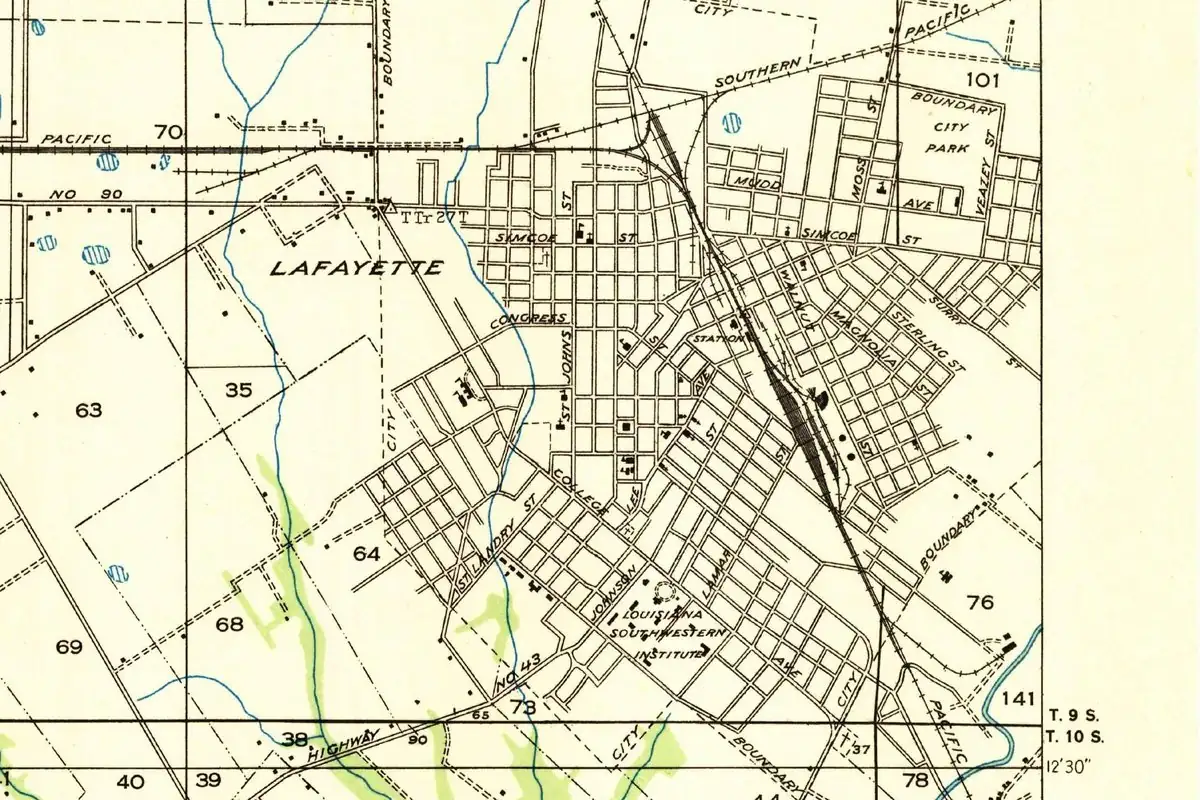
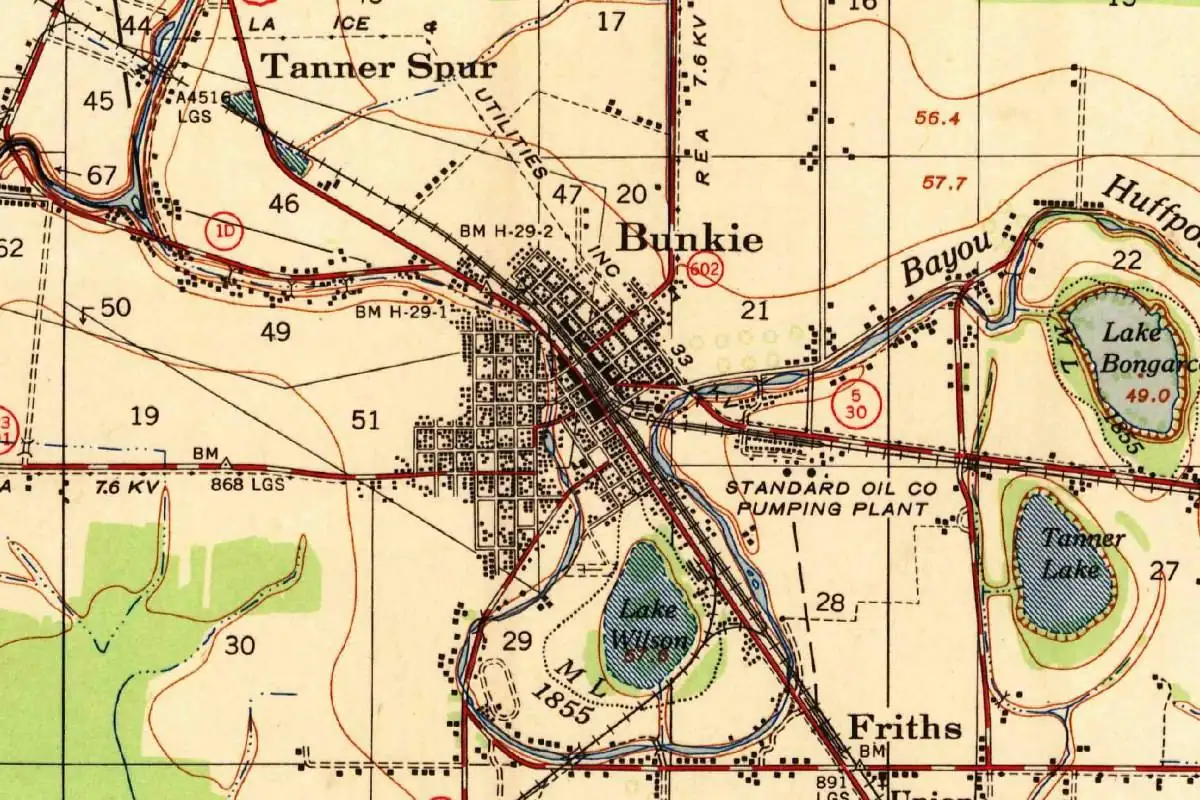
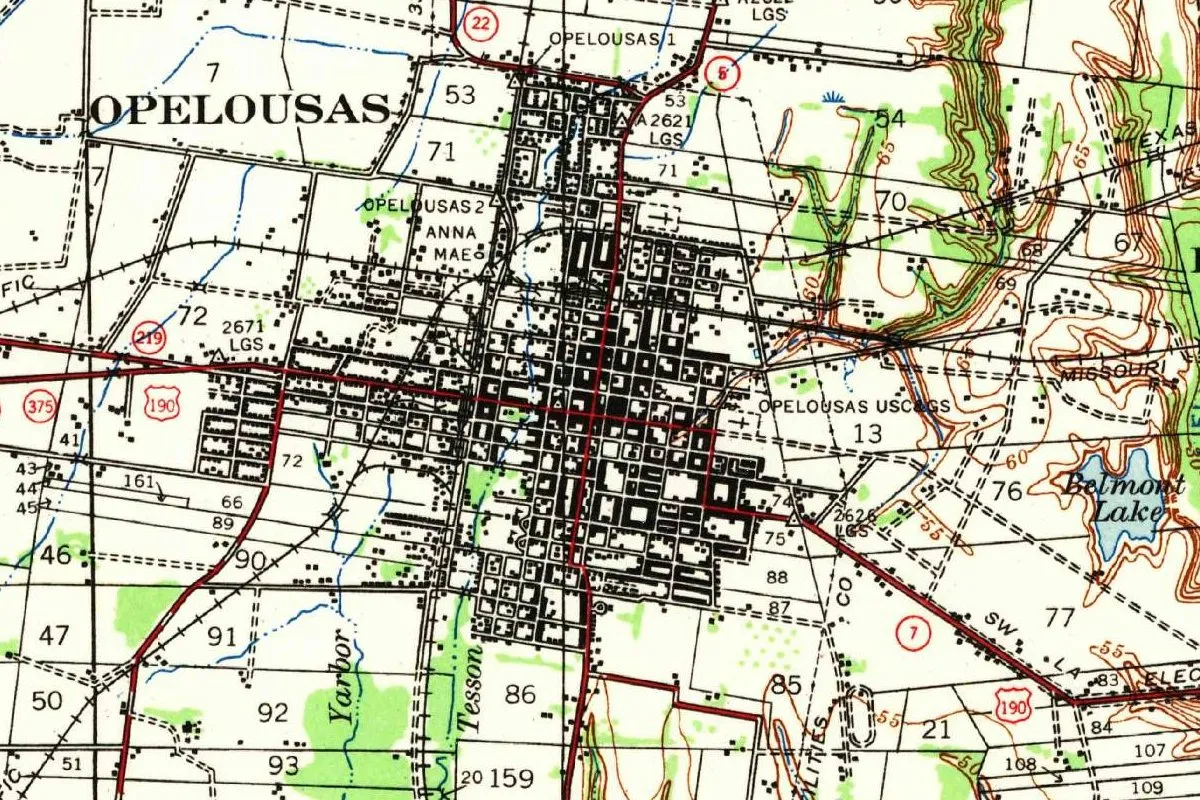
- U.S. Geological Survey, Opelousas sheet (1939). Downtown Opelousas, its rail lines and Belmont Lake as surveyed in the late 1930s.
Spot something wrong, or know more? Tell us here. You can also email us or use our contact page. Corrections are noted here with their date, never made silently.