Omaha, Nebraska: The Ferry Town That Took a Tribe's Name
The city took its name from the Omaha people, the tribe living nearest the site. A Council Bluffs ferry company laid out the town in 1854, and an 1876 history says the name was probably picked because it was pretty and belonged to that tribe. The Omaha word is usually given as "upstream" or "against the current."
A ferry company needs a town
Omaha took its name in 1854 from the Omaha people, the tribe living nearest the spot where a Council Bluffs ferry company laid out a town on the Missouri. The people who picked it weren’t trying to say anything deep, at least according to an 1876 history of the city.
That history is Alfred Sorenson’s Early History of Omaha, published in 1876, just 22 years after the survey. On July 23, 1853, a group of men in Council Bluffs, with Dr. Enos Lowe as president, organized the Council Bluffs and Nebraska Ferry Company. They wanted a steady crossing, and a town on the far bank to cross to. Council Bluffs sits about 4 miles (6.4 km) east of Omaha’s center, so the ferry had a short run between its two landings.
“Omaha City” before there was a city
The name showed up on paper before the town did. A. D. Jones, who’d crossed the river in November 1853, had applied for a post office. Sorenson prints two letters Bernhart Henn wrote in Washington City on May 6, 1854. One, to Dr. J. D. Test of Council Bluffs, says he’d “got the office established to-day” and had Jones appointed postmaster. The other, about a mail route, was addressed to “A. D. Jones, Omaha City, Nebraska Ter.” Sorenson thought that one “must have been the very first letter directed to Omaha City,” and it came “before the town was surveyed.”
That survey happened in June and early July of 1854, with Jones doing the work for the ferry company. The tract ran between two creeks. Sorenson says the Omahas had lived along the northern one, first called simply Omaha Creek, and the Otoes along the southern one, called Otoe Creek. The company’s map was lithographed in St. Louis and dated September 1, 1854. The longer name didn’t disappear, though. The Omaha Arrow, a paper printed in Council Bluffs, ran a piece on “Omaha City” that same September 1, and Sorenson himself calls Jones’s work “the survey of Omaha City.”
Why that name
So why the tribe’s name? Sorenson leaned on a man he calls Gen. Estabrook and passed on his answer on pages 32 and 33:
“Gen. Estabrook is our authority for saying that it was probably adopted by the Ferry Company simply because it was pretty and was borne by the nearest tribe of Indians in the vicinity, the Mahas.”
Notice the “probably.” Even in 1876, Sorenson couldn’t point to a document explaining the choice. He also couldn’t settle who said it first. He wrote that “some” gave the credit for suggesting the name to Jesse Lowe, who had died by then, while “others” credited J. E. Johnson, then living in Kanesville. By 1925, Lilian Fitzpatrick’s Nebraska Place-Names simply said Jesse Lowe suggested it, “partly because it was attractive.”
Upstream, against the current
In 1868, A. D. Jones wrote to the missionary William Hamilton at the Omaha Mission, and Sorenson prints the reply. Hamilton said the Omahas had once camped above on a stream called “E-ro-ma-ha, contracted into O-ma-ha, which means ‘above’ with reference to a stream, or, ‘above on a stream.’” Sorenson then stretched that into “above all others upon a stream,” which is his own reading, not Hamilton’s words.
Henry Gannett’s 1905 bulletin on place names kept it short: an Indian word meaning “upstream,” and the name of a tribe described as “upstream people.”
The most careful version comes from inside the tribe. The Omaha Tribe, published in 1911 by Alice Fletcher and Francis La Flesche, son of Joseph La Flesche, a former principal chief of the tribe, gives the name as umoⁿ’hoⁿ, “against the current” or “upstream.” They say it had been fixed on the people before 1541, and that it pairs with the name of the Quapaw, which means “with the current” or “downstream.” According to the book, both tribes say the two names recall when they parted company, one going up the river and the other going down. Today the Omaha Tribe of Nebraska still calls its newsletter Against the Current.
Fitzpatrick’s 1925 book also repeats a legend about a drowning warrior and an account of “those who went against the current,” with white men adding the “O.” Then she adds a blunt note: “The foregoing Omaha legend is the usual white man’s invention.” She says the city’s name is the white man’s approximation of O-maⁿ’-ha, an old name the Omaha used for themselves, with the accent on the second syllable.
So you’ll see “upstream,” “against the current” and “above on a stream” all attached to the word. The first two come from the tribe’s own account in 1911, which is why they’re the ones worth trusting most.
A grid on the west bank
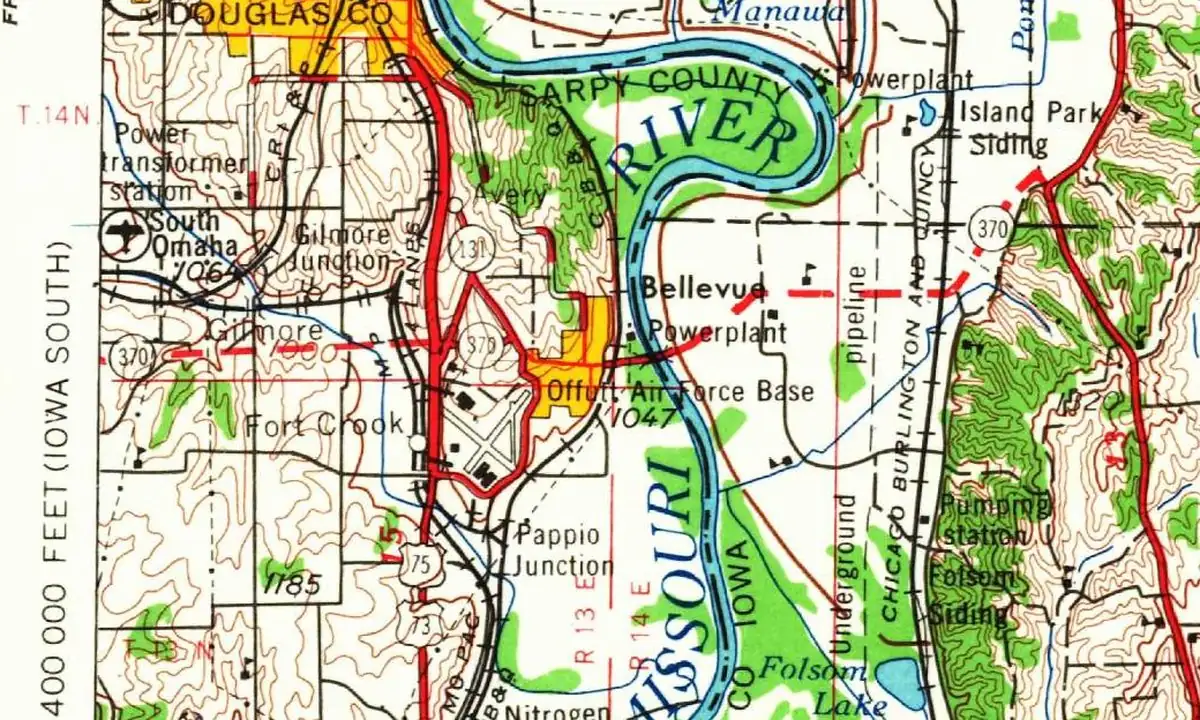
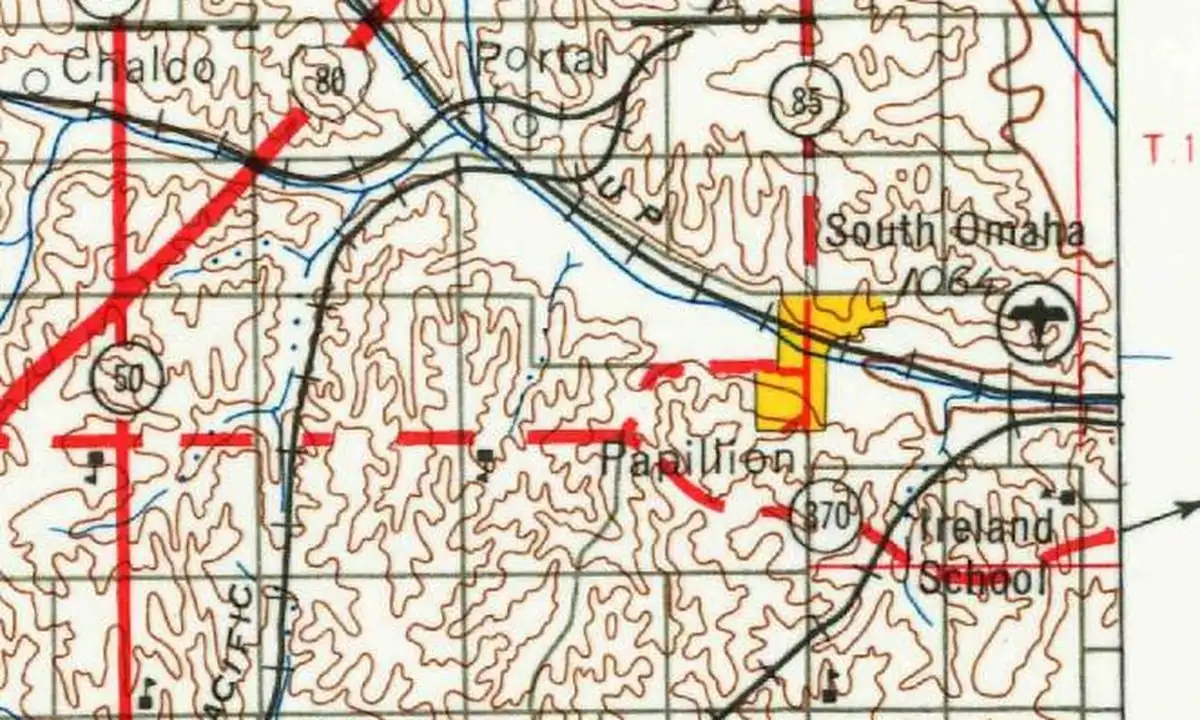
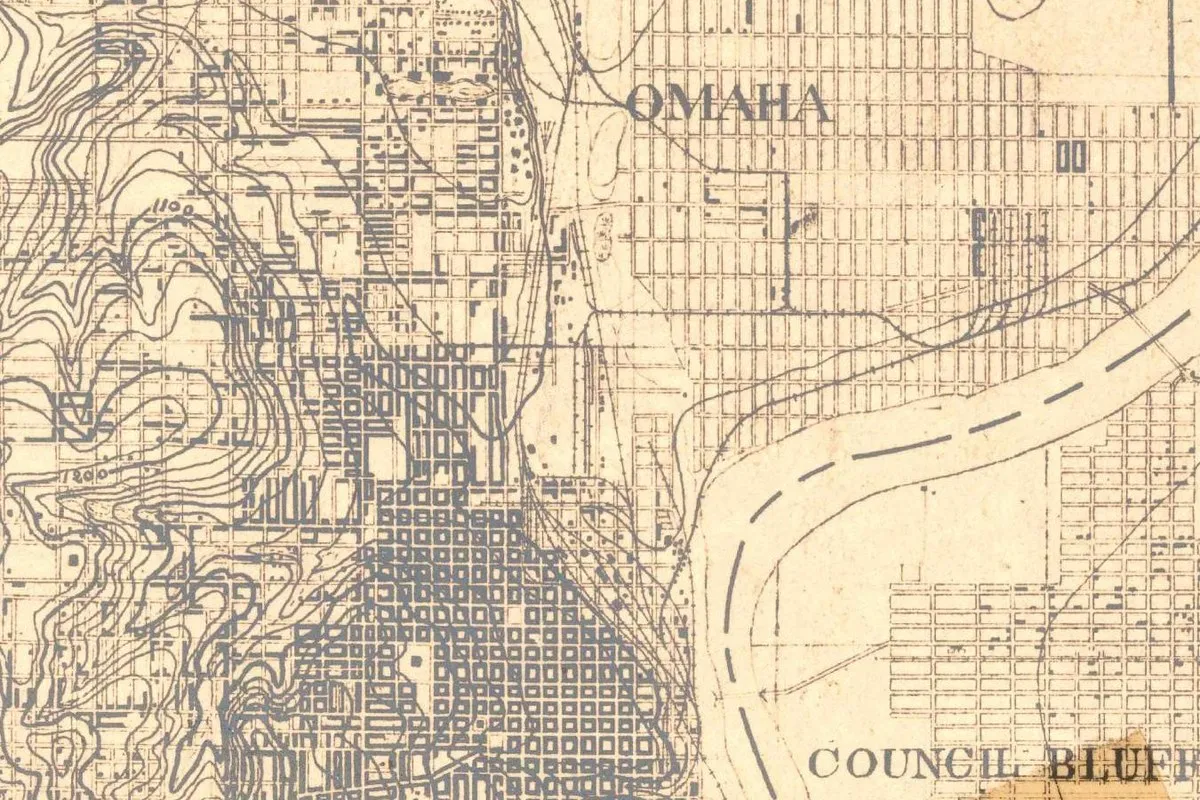
The town grew fast after the survey. Fitzpatrick, whose book surveys place names across Nebraska, says an act incorporating Omaha was approved on February 2, 1857, and that it became the county seat of Douglas County. The 1893 survey sheet you see above already shows a dense grid of streets and rail lines on the west bank, with Council Bluffs across the water.
The name a ferry company borrowed for its town site in 1854 stuck, and it still points back to a people who went upstream.
Quick answers
Who is Omaha, Nebraska, named after?
The Omaha people. Sorenson’s 1876 history says the ferry company probably chose the name because it was pretty and belonged to the nearest tribe, which he calls the Mahas.
Was Omaha first called Omaha City?
Yes, on paper. The post office set up on May 6, 1854, was Omaha City, and the Omaha Arrow still used that name in September 1854, according to Sorenson’s 1876 history.
What does the word Omaha mean?
Usually “upstream” or “against the current.” That’s how Fletcher and La Flesche gave it in 1911; an 1868 letter from missionary William Hamilton read it as “above on a stream.”
Key dates
- 1853July 23: the Council Bluffs and Nebraska Ferry Company is organized, with Dr. Enos Lowe as president.
- 1854May 6: a letter from Washington says the Omaha City post office has been established, with A. D. Jones as postmaster.
- 1854June and early July: A. D. Jones surveys the town site for the ferry company. The lithographed map is dated September 1.
- 1857February 2: an act incorporating Omaha is approved, according to Fitzpatrick's 1925 Nebraska Place-Names.
- 1868March 4: missionary William Hamilton writes that the tribe's name comes from O-ma-ha, meaning "above on a stream."
- 1911Fletcher and La Flesche give the tribe's name as umoⁿ'hoⁿ, "against the current" or "upstream."
Getting there
Open Omaha in Google Maps
Opens in a new tab. The pin is the center of Omaha in the USGS place-name record.
The closest airports, Amtrak stations and intercity bus stops, measured in a straight line from the center of Omaha.
Airports
- Eppley Airfield (OMA) Omaha 4 mi 6 km
- Lincoln (LNK) 51 mi 82 km
Amtrak trains
- Omaha station (OMA) under 1 mi 1 km
- Lincoln station (LNK) 51 mi 82 km
Intercity buses
- Greyhound Omaha Burlington Trailways under 1 mi 0.5 km
- Jefferson Lines Omaha under 1 mi 0.5 km
- Express Arrow Omaha under 1 mi 0.5 km
Distances are as the crow flies, not by road. We don't list schedules or fares because they change; check with the airline, Amtrak or the bus company before you go. Official data (FAA commercial service airports (2025), FAA airport locations, Amtrak stations and Intercity Bus Atlas) from the FAA and the U.S. Bureau of Transportation Statistics, checked Nov 13, 2026.
Sponsored
Staying in Omaha?
Compare hotels in Omaha, Nebraska, on Expedia.
See hotels in OmahaWe may earn a commission if you buy through this link. It never changes what we write. Read our affiliate disclosure
Sponsored
Want the spooky side of Omaha?
The name has its story above. For the ghost stories, US Ghost Adventures runs walking ghost tours in Omaha.
See ghost tours in OmahaWe may earn a commission if you book through this link. It never changes what we write. Read our affiliate disclosure
Historical Sources & References
- Alfred Sorenson, Early History of Omaha (1876), pp. 20-23, 31-33 and 50-51. The ferry company organized July 23, 1853, A. D. Jones’s crossing and Bernhart Henn’s two letters of May 6, 1854, one to Dr. J. D. Test on the Omaha City post office and one addressed to Jones at Omaha City (pp. 20-23); Jones’s survey between the Omaha and Otoe creeks, the map dated September 1, 1854, Estabrook’s explanation of the name, the Jesse Lowe and J. E. Johnson claims and William Hamilton’s 1868 letter on O-ma-ha (pp. 31-33); the Omaha Arrow of September 1, 1854 on “Omaha City” and “the survey of Omaha City” (p. 50).
- Alice C. Fletcher and Francis La Flesche, The Omaha Tribe (1911), pp. 30 and 36. Francis La Flesche as son of Joseph La Flesche, former principal chief (p. 30); the name umoⁿ’hoⁿ, “against the current” or “upstream,” fixed before 1541, and its pairing with the Quapaw name.
- Henry Gannett, The Origin of Certain Place Names in the United States (USGS, 1905), p. 231. Omaha as an Indian word meaning “upstream,” also the name of the “upstream people.”
- Lilian L. Fitzpatrick, Nebraska Place-Names (1925), pp. 56-57. Jesse Lowe as the one who suggested the name, the legends she calls “the usual white man’s invention,” the form O-maⁿ’-ha, the 1857 incorporation and the county seat.
- Omaha Tribe of Nebraska, official website. The tribe’s newsletter title, Against the Current.
- GNIS feature 835483 (U.S. Geological Survey). Omaha’s official naming record, filed under Douglas County.
- U.S. Geological Survey, Omaha sheet (1893). The 1893 survey sheet behind the map above, with Omaha’s grid along the Missouri.
Spot something wrong, or know more? Tell us here. You can also email us or use our contact page. Corrections are noted here with their date, never made silently.