Why Is It Called Canandaigua, NY? The Chosen Spot
Canandaigua comes from the name of a Seneca town on the site. J. H. French's 1860 gazetteer spelled it Gan-a-dar-que and translated it 'a chosen spot,' and the city uses the same meaning. Older readings differ: 'place selected for a settlement,' 'a chosen town,' 'a town set off' and, on one old campaign map, 'the Chosen or Beautiful Lake.'
Canandaigua, New York, carries the name of a Seneca town that once stood there; the word is usually read as “chosen spot,” though old sources differ. The town gave its name to the lake, not the other way around.
Why is it called Canandaigua, New York?
The city’s answer is short. Its 2020 comprehensive plan traces the name to the Native word “Kanandarque,” meaning “chosen spot,” and calls the place the site of the Senecas’ principal village and the legendary birthplace of the “People of the Hills.” J. H. French’s Gazetteer of the State of New York said much the same in 1860: the name came out of Gan-a-dar-que, the Seneca village built where the village of Canandaigua now stands, and “it signifies a chosen spot.”
French didn’t call it the main Seneca town, though. A few pages earlier he puts the Senecas’ chief village at Kanadesaga, near what’s now Geneva, at the foot of Seneca Lake.
William M. Beauchamp, who compiled Aboriginal Place Names of New York for the State Museum in 1907, gathered the readings he could find, and they don’t all agree:
- “Place selected for a settlement.” Morgan’s version, written Ga’-nun-da-gwa.
- “A chosen town.” Marshall’s version, Ga’-noon-daa-gwah’, which he built from gan-on-da, “town,” and gaa-gwah, “it was selected.”
- “A town set off.” Spafford’s version.
- “The Chosen or Beautiful Lake.” The label on Lodge’s map from Sullivan’s campaign, which Beauchamp quotes. Shute’s journal of the same campaign calls it “Chosen Town.”
Beauchamp also lists the spellings the name went through: Canaderagey in 1763, when it was mentioned as a friendly Seneca town, and Kennendanque, Kanondaqua and Kanadalaugua in the campaign journals. And he settles the order of things: “The lake had its name from the town.”
Canandaigua isn’t the only town whose Native name has “town” at its heart. In Ohio, Chillicothe carries the name of the Shawnee villages that served as the tribe’s chief town, and the Park Service translates it “principal town.” In Pennsylvania, the borough of Punxsutawney translates its Lenape name as “town of the sandflies.”
Canandaigua, NY history: the land office, the treaty and the city of 1913
The English town grew from a land sale. In 1788, the city’s plan says, Oliver Phelps and Nathaniel Gorham came into six million acres between Seneca Lake and the Genesee River, and they opened their first land office at Canandaigua, run by William Walker, who built the first house. French dates the settlement to 1788 as well. On January 27, 1789, the state formed Ontario County and the town of Canandaigua, and the place became the county seat. The village was incorporated on April 18, 1815, French says, and the plan adds that the legislature made it a city in 1913. Today the city sits where Canandaigua Lake ends to the north, about 25 miles (40 km) south of Rochester, surrounded on three sides by the separate town of Canandaigua.
The name also belongs to a treaty. In 1794, Timothy Pickering, acting for President George Washington, and sachems of the Six Nations signed the Canandaigua Treaty, which recognized each side as a nation. The Friends of Ganondagan hold a commemoration of it each year outside the Ontario County Courthouse, at 27 North Main Street. The treaty “continues to be valid and in effect,” Peter Jemison (Seneca), the founding manager of the Ganondagan State Historic Site, says on the group’s page.
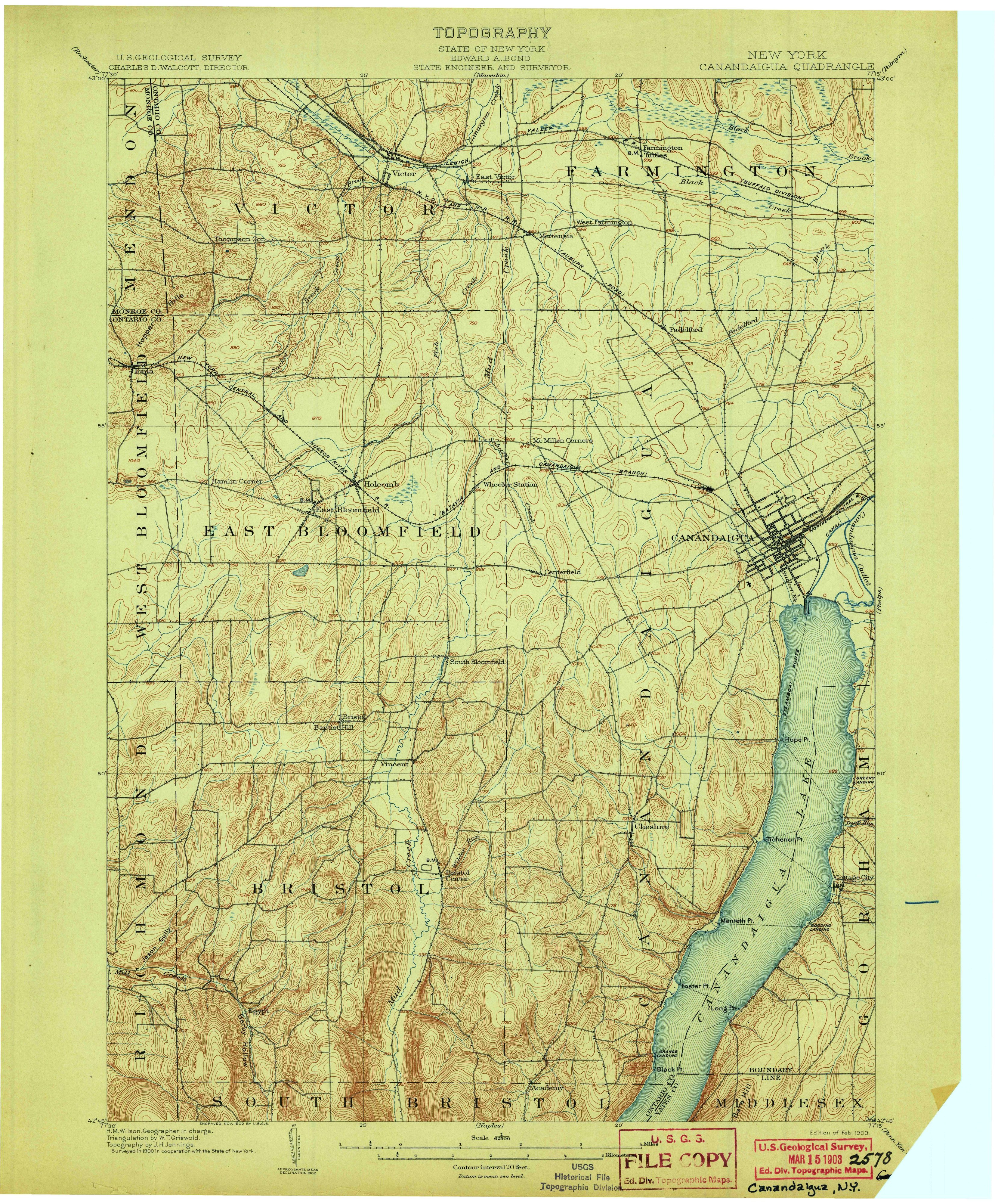
Canandaigua on the 1903 map
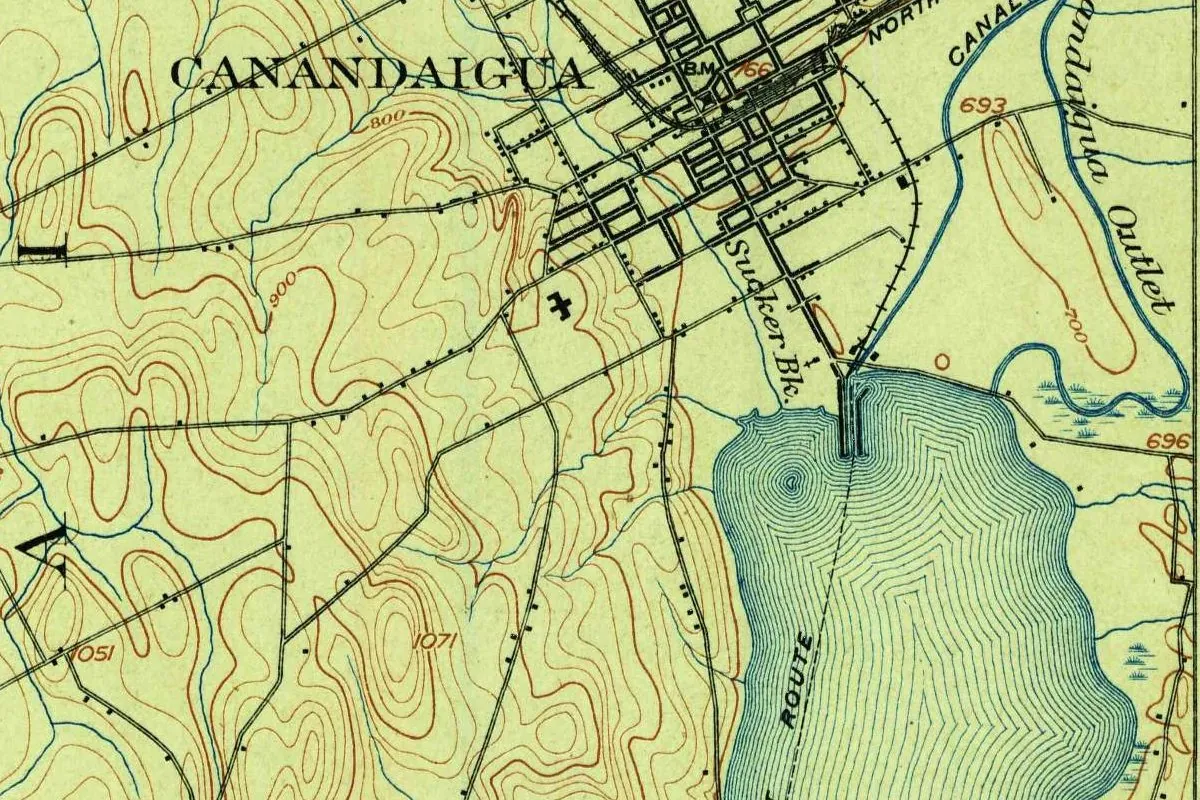
The Canandaigua quadrangle, a 1:62,500 Geological Survey sheet, supplied the crop above. H. M. Wilson was its geographer, W. T. Griswold ran the triangulation and J. H. Jennings mapped the topography. The margin reads “Surveyed in 1900 in cooperation with the State of New York.” It was engraved in November 1902, in an “Edition of Feb. 1903.”
You’ll see Canandaigua’s streets where the lake ends, with Sucker Brook and the Canandaigua Outlet running out of town. The lake that borrowed the town’s name fills the lower right of the crop, with a dashed line marked “Route” running down it.
Quick answers
What does the name Canandaigua, New York, mean?
It’s usually translated “chosen spot,” the meaning French gave in 1860 and the city uses today. Beauchamp also recorded “place selected for a settlement,” “a chosen town” and “a town set off.”
Is Canandaigua, New York, named after the lake?
No, it’s the other way around. Beauchamp wrote in 1907 that “the lake had its name from the town,” a Seneca town on the site.
When did Canandaigua, New York, become a city?
In 1913, when the state legislature passed an act making it one, according to the city. The village had been incorporated on April 18, 1815.
Key dates
- 1763Canaderagey is mentioned as a friendly Seneca town, an early form of the name that Beauchamp records.
- 1788Oliver Phelps and Nathaniel Gorham, owners of six million acres, open their land office at Canandaigua and begin settlement.
- 1789January 27: Ontario County and the town of Canandaigua are formed, with Canandaigua as the county seat.
- 1794Timothy Pickering, for President Washington, and sachems of the Six Nations sign the Canandaigua Treaty.
- 1815April 18: the village of Canandaigua is incorporated.
- 1903The Geological Survey's Canandaigua quadrangle, surveyed in 1900, is issued in an edition of February 1903.
- 1913The state legislature makes Canandaigua a city.
Things to do in Canandaigua, New York
Sonnenberg Gardens & Mansion State Historic Park
A 50-acre (20 ha) Victorian estate with views of Canandaigua Lake: the Queen Anne summer house Frederick Ferris and Mary Clark Thompson built in 1887, gardens laid out from 1902 to 1920 in Italian, Japanese and other styles, and a Lord & Burnham greenhouse complex.
Granger Homestead and Carriage Museum
Gideon Granger, postmaster general under Jefferson and Madison, built this Federal-style house on Main Street to retire in. Guided tours take you through the house, the law office of Walter Hubbell, whose students included Stephen A. Douglas, and three barns of carriages, wagons and sleighs.
Kershaw Park
Nine acres (3.6 ha) of city park on the north shore of Canandaigua Lake, with lakefront walkways, a public beach, a public dock, launch areas for small boats, pavilions and picnic tables.
Ontario County Historical Society
At 55 North Main Street, the society runs a museum with exhibits on the county's history and a research room for genealogy and local history, open by appointment.
Getting there
Open Canandaigua in Google Maps
Opens in a new tab. The pin is the center of Canandaigua in the USGS place-name record.
The closest airports, Amtrak stations and intercity bus stops, measured in a straight line from the center of Canandaigua.
Airports
- Frederick Douglass/Greater Rochester International (ROC) 26 mi 41 km
- Ithaca Tompkins International (ITH) 50 mi 80 km
- Buffalo Niagara International (BUF) 73 mi 118 km
Amtrak trains
- Rochester station (ROC) 26 mi 41 km
Intercity buses
- OurBus Geneva (Hobart and William Smith Colleges) 15 mi 25 km
- Adirondack Trailways Trailways · Geneva 16 mi 25 km
- FlixBus Rochester Bus Stop 25 mi 41 km
Distances are as the crow flies, not by road. We don't list schedules or fares because they change; check with the airline, Amtrak or the bus company before you go. Official data (FAA commercial service airports (2025), FAA airport locations, Amtrak stations and Intercity Bus Atlas) from the FAA and the U.S. Bureau of Transportation Statistics, checked Nov 22, 2026.
Sponsored
Staying in Canandaigua?
Compare hotels in Canandaigua, New York, on Expedia.
See hotels in CanandaiguaWe may earn a commission if you buy through this link. It never changes what we write. Read our affiliate disclosure
Historical Sources & References
- William M. Beauchamp, Aboriginal Place Names of New York (1907), pp. 155-157. The readings of Morgan, Marshall, Spafford, Lodge’s map and Shute’s journal, the old spellings and the lake named from the town.
- J. H. French, Gazetteer of the State of New York (1860), pp. 493 and 495. Gan-a-dar-que as “a chosen spot,” the Seneca chief village at Kanadesaga, the town of 1789, the village of 1815 and the settlement of 1788.
- City of Canandaigua, Comprehensive Plan 2020 Update, pp. 6-7. “Kanandarque,” Phelps and Gorham’s land office, the county seat and the city of 1913.
- Friends of Ganondagan, Canandaigua Treaty Commemoration. The treaty of 1794 and its yearly commemoration.
- Sonnenberg Gardens, the Granger Homestead, Kershaw Park and the Ontario County Historical Society. The details in the things-to-do list.
- U.S. Geological Survey, GNIS feature 945739. Canandaigua’s federal record.
- Canandaigua quadrangle, edition of February 1903. The sheet the map at the top was cropped from.
Sponsored
Put this 1903 map on your wall
The Geological Survey's Canandaigua quadrangle, surveyed in 1900 and issued in February 1903: the village's street grid at the head of the lake that took its name from the town. It is in the public domain: download the full-size scan for free, then have it printed on canvas with CanvasOnTheCheap.
Print a map on canvasDownload the full-size mapWe may earn a commission if you buy through this link. It never changes what we write. Read our affiliate disclosure
Spot something wrong, or know more? Tell us here. You can also email us or use our contact page. Corrections are noted here with their date, never made silently.