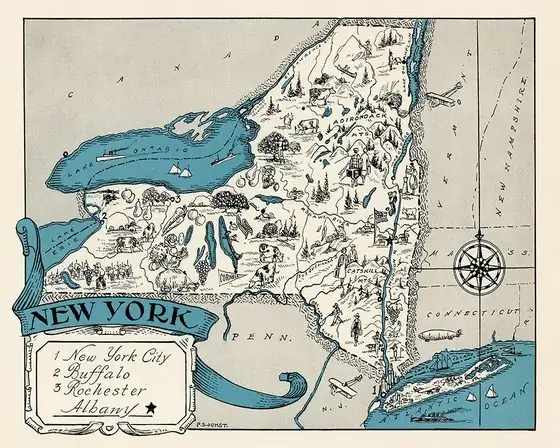
Ithaca, NY: An Island From Homer in the Town of Ulysses
Ithaca is named for the Greek island of Ithaca, which Henry Gannett's 1905 name-origin bulletin calls the kingdom of Ulysses in the Homeric poems. The name was on surveyor general Simeon DeWitt's map by 1803, says the Tompkins County historian. Whether DeWitt chose it, and why, is less clear: a 1968 biography calls that part possibly legendary.
An island from Homer
Ithaca, New York, carries the name of the Greek island Ulysses ruled in Homer, and until 1821 it sat inside a New York town that was named Ulysses. The Greek part is the easy bit. Henry Gannett, writing up the nation’s place names for the government in 1905, said the city was “named for one of the Ionian Islands, supposed to be the one celebrated in the Homeric poems as the Kingdom of Ulysses.”
The Ulysses part comes from the Tompkins County historian, who notes that in 1821 the state made Ithaca a village “separated from the Town of Ulysses.” So for its first years, the kingdom of Ulysses sat inside Ulysses. It’s a neat fit. Whether anybody planned it that way is another question, and none of the sources here says so.
A map full of Romans
To see how a Greek island landed at the south end of Cayuga Lake, you have to start with the land itself. After the Revolution, New York set aside a huge block of land east of Seneca Lake to pay its soldiers, the Military Tract. Simeon DeWitt, the state’s surveyor general, organized the survey and drew up the townships with numbers.
Then somebody gave them names, and what names. William Heidt’s 1968 biography of DeWitt, published by the local historical society, lists all 28: Lysander, Hannibal, Cato, Brutus, Cicero, Romulus, Scipio, Homer, Virgil, Ovid, Hector and, as No. 22, Ulysses, among others. Heidt says DeWitt’s maps went to the state’s land commissioners, who assigned the names.
DeWitt got the blame anyway. Heidt says DeWitt “maintained that he had had no part in the choice of names,” but he was long charged with them. John Vanderlyn wrote in 1802, as Heidt quotes him, that DeWitt “had already passed over the country with his Lempriere in hand, erasing the Indian nomenclature.” In 1819 a New York City paper, the Evening Post, ran an ode hailing DeWitt as “GODFATHER OF THE CHRISTEN’D WEST.”
Did DeWitt name Ithaca?
Here’s where Ithaca itself comes in. DeWitt bought land at the head of Cayuga Lake and laid out a settlement there. The county historian calls him “the man who developed Ithaca” and says: “His map of 1803 had placed the name Ithaca on the land, as did his 1807 sketch of streets.”
The story you’ll usually hear is that DeWitt picked the name because the hills and lake looked like the Greek island. Heidt reported that version too, and then poked holes in it:
“DeWitt was said to have named the area about 1806 after a fancied resemblance of the hills and lake in the Greek island of Ithake.”
DeWitt had never been to Greece, Heidt pointed out, and the real island is “but a craggy islet set in the Ionian Sea.” He wondered whether a practical man really went for “such a romantic flight of fancy.” His own guess was plainer: the name may have been chosen, like many others of the day, “to lend dignity to an area known locally as Sodom or simply as The City.”
Heidt went further. “That DeWitt applied the name Ithaca to his settlement may be legendary,” he wrote. “There seems to be no direct statement of his that would clear up the puzzle.” He even described an old map in which the word “Ithaca” had been added later, in different lettering.
To be fair to the old story, Heidt left the door open. DeWitt had been prepared for Queen’s College by the Rev. Mr. Romeyn, a man with a classical education, and had to qualify in Greek to get in, so he could well have seen engravings of Greek scenery. Heidt even mentions a photograph of the modern island, brought back by John Floros, that showed “a marked similarity” to Ithaca’s setting.
So you get two dates and two views. The county puts the name on DeWitt’s map in 1803. Heidt mentions a state map of about 1806 and isn’t sure DeWitt chose the name at all. What nobody disputes is where the word comes from.
Before the surveyors
The valley had other names and other people first. Heidt writes that an Indian village stood along Six Mile Creek, and that another, called Coreorgonel, stood about two miles (3 km) up the Cayuga Inlet from about 1753 until soldiers from Sullivan’s army burned it in September 1779. The county historian says Coreorgonel was built by Saponi and Tutelo people who had moved up from the Carolinas, and that the site is now Tutelo Park in the town of Ithaca.
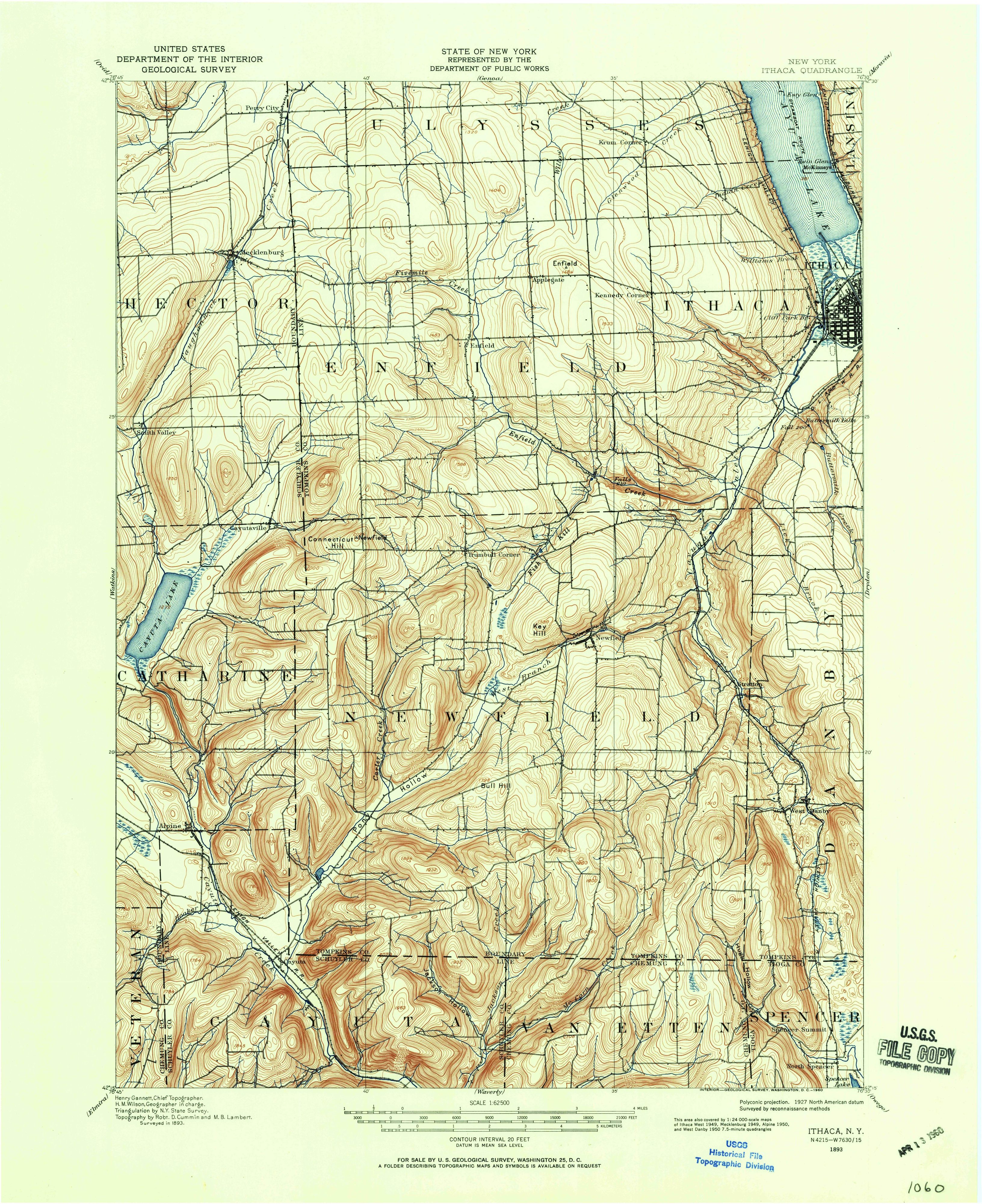
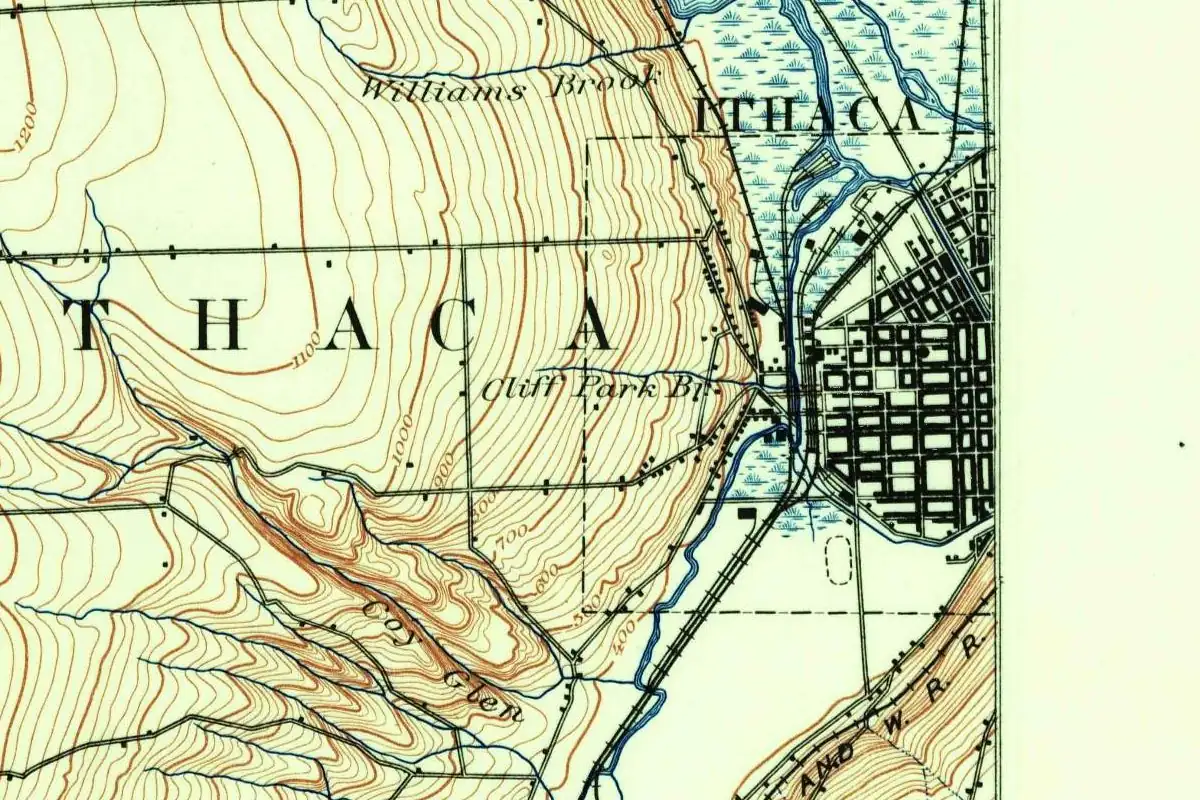
On the 1893 map at the top of this page, you can see what the surveyors inherited: a small grid of streets pressed against marshland where the streams come down to the lake, with steep hills rising to the west.
A name that stuck
Ithaca became the county seat when Tompkins County was created in 1817, and the county historian credits the founding of Cornell University in 1865 with steadying the local economy. Through all of it, the island name held.
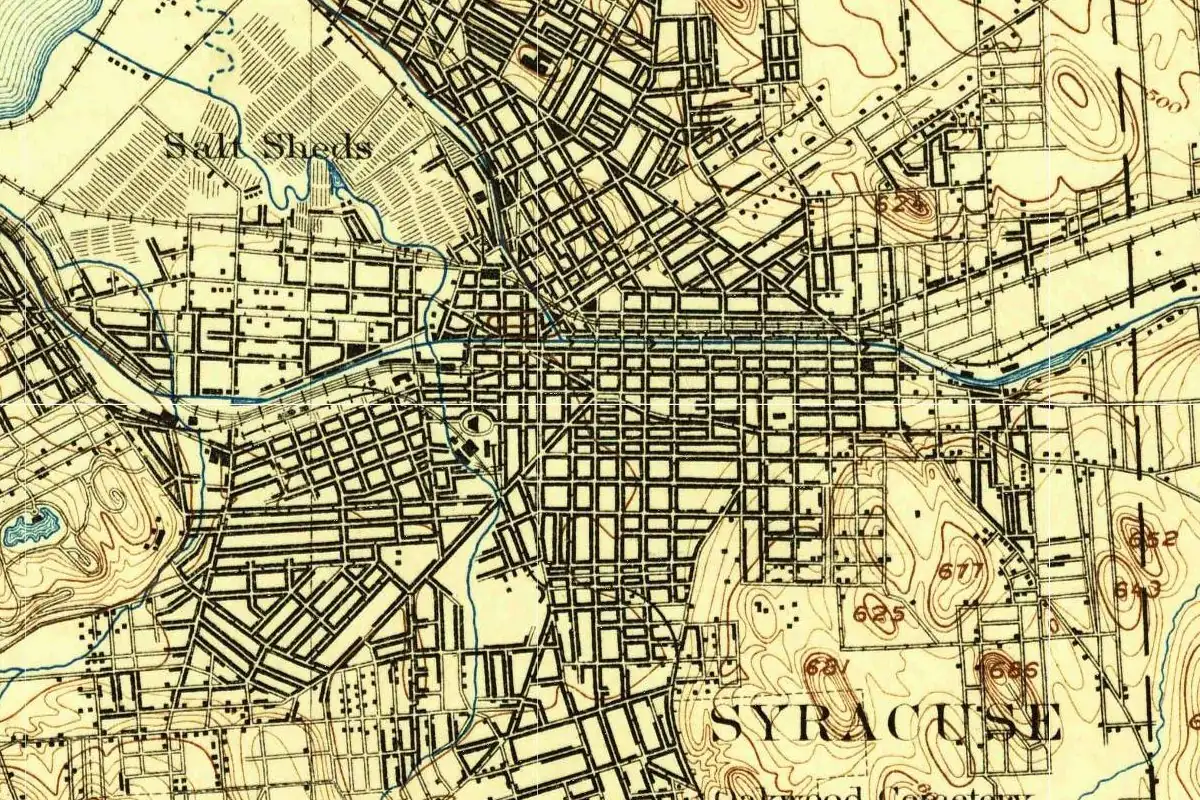
It also had company. The same Military Tract list includes a Hannibal, and a Hannibal in Missouri tells a similar story about a craze for classical names; see Hannibal, Missouri. Elsewhere in central New York, Syracuse borrowed a Greek city in Sicily. More of the Empire State’s place names are waiting on our New York page.
Quick answers
What is Ithaca, New York, named after?
The Greek island of Ithaca. Gannett wrote in 1905 that the city was named for the Ionian island “supposed to be the one celebrated in the Homeric poems as the Kingdom of Ulysses.”
Did Simeon DeWitt name Ithaca?
Possibly, but it isn’t proven. The county historian says his 1803 map put the name on the land, while William Heidt wrote in 1968 that DeWitt’s role “may be legendary” and that no direct statement of his explains it.
Was Ithaca named because it looks like the Greek island?
That’s the popular story, not a documented fact. Heidt doubted it, noting that DeWitt never visited Greece, and suggested the name may have been picked to lend dignity to a place locals called Sodom or The City.
Why are there so many classical names around Ithaca?
Because the Military Tract townships got them: Ulysses, Homer, Ovid, Hector and more. Heidt says the land commissioners assigned those names, though DeWitt was long blamed for them.
Key dates
- 1779Soldiers of Sullivan's campaign burn Coreorgonel, a village up the Cayuga Inlet.
- 1802John Vanderlyn accuses Simeon DeWitt of naming the region's townships from a classical dictionary.
- 1803Simeon DeWitt's map places the name Ithaca on the land.
- 1817Ithaca becomes the seat of the new Tompkins County.
- 1821Ithaca becomes a village, separated from the town of Ulysses.
- 1865Cornell University is established.
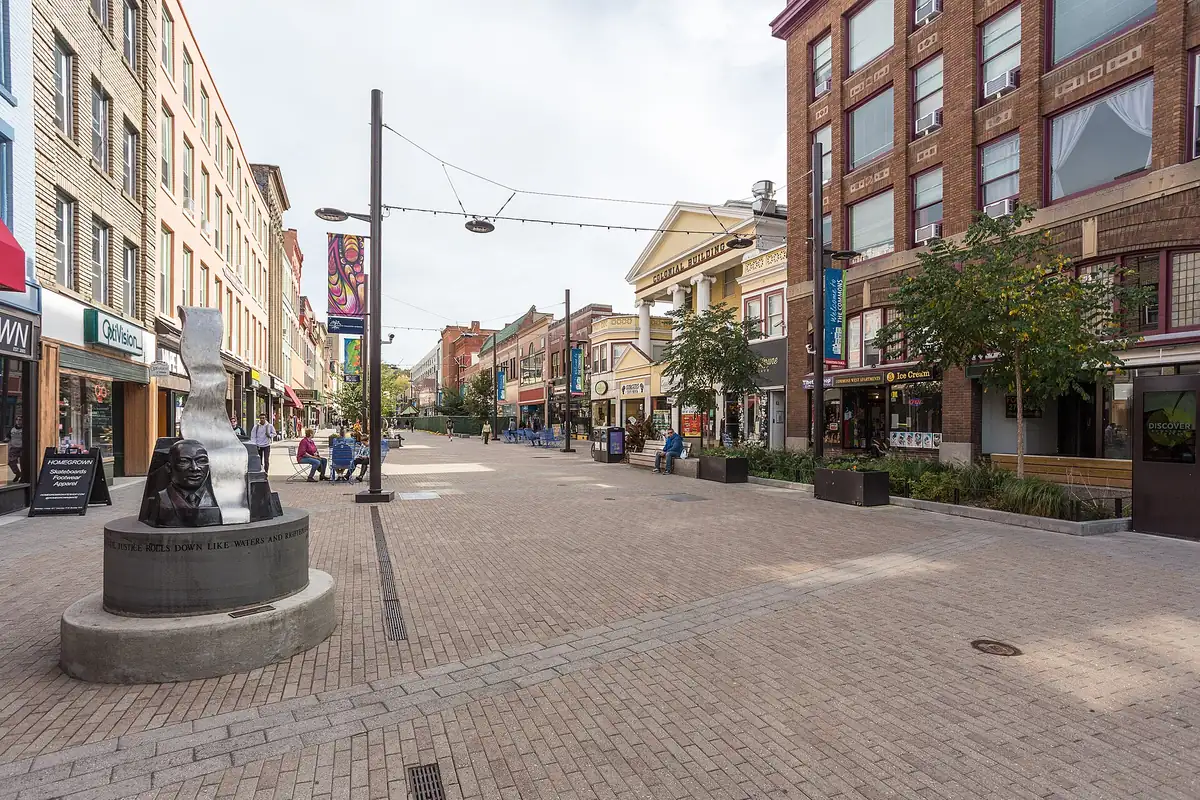
Things to do in Ithaca, New York
Buttermilk Falls State Park
A state park named for the foaming cascade Buttermilk Creek makes as it runs down the steep valley side toward Cayuga Lake, with trails through the woods and along the gorge and rim.
Taughannock Falls State Park
Home of a waterfall that plunges 215 feet (66 m) past cliffs nearly 400 feet (122 m) high, with gorge and rim trails and campsites overlooking Cayuga Lake.
Herbert F. Johnson Museum of Art
Cornell University's art museum, opened in 1973 in a building designed by I. M. Pei & Partners at the top of Libe Slope.
Cornell Botanic Gardens
Cultivated gardens, an arboretum and natural areas that cover about a third of Cornell's campus and, with off-campus lands, 3,600 acres in all.
The History Center in Tompkins County
Tompkins County's history center on North Tioga Street in Ithaca, which cares for the county's historical collections and runs guided tours and programs on local history.
Getting there
Open Ithaca in Google Maps
Opens in a new tab. The pin is the center of Ithaca in the USGS place-name record.
The closest airports, Amtrak stations and intercity bus stops, measured in a straight line from the center of Ithaca.
Airports
- Ithaca Tompkins International (ITH) 4 mi 6 km
- Elmira/Corning Regional (ELM) 28 mi 45 km
- Buffalo Niagara International (BUF) 119 mi 191 km
Amtrak trains
- New York State Fair station (NYF) 46 mi 74 km
- Syracuse station (SYR) 47 mi 76 km
Intercity buses
- OurBus Ithaca, NY (Downtown Ithaca - E. Seneca Street in front of Ithaca Deli (Note if arriving by car, use 118 E. Seneca Street for directions)) under 1 mi 0 km
- Adirondack Trailways Trailways · Ithaca under 1 mi 0.2 km
- FlixBus Ithaca NY (ITH) under 1 mi 0.2 km
Distances are as the crow flies, not by road. We don't list schedules or fares because they change; check with the airline, Amtrak or the bus company before you go. Official data (FAA commercial service airports (2025), FAA airport locations, Amtrak stations and Intercity Bus Atlas) from the FAA and the U.S. Bureau of Transportation Statistics, checked Nov 14, 2026.
Sponsored
Staying in Ithaca?
Compare hotels in Ithaca, New York, on Expedia.
See hotels in IthacaWe may earn a commission if you buy through this link. It never changes what we write. Read our affiliate disclosure
Historical Sources & References
- Henry Gannett, The Origin of Certain Place Names in the United States, 2nd ed. (1905), p. 167. Ithaca, city in Tompkins County, “named for one of the Ionian Islands, supposed to be the one celebrated in the Homeric poems as the Kingdom of Ulysses.”
- William Heidt, Simeon DeWitt: Founder of Ithaca (1968). PDF pages 23-25: the Military Tract, its numbered townships and their names (Hannibal, Ulysses and the rest), DeWitt’s denial, Vanderlyn’s 1802 “Lempriere” remark and the 1819 Evening Post ode. PDF pages 35-36: the quoted “fancied resemblance” version, DeWitt never in Greece, the “Sodom” and “The City” nicknames, “may be legendary,” the map with “Ithaca” added later, DeWitt’s Greek schooling under the Rev. Mr. Romeyn and John Floros’s photograph, the villages on Six Mile Creek and at Coreorgonel, burned in 1779.
- Tompkins County, Historian Division, “Tompkins County History”. DeWitt as “the man who developed Ithaca”; his 1803 map and 1807 street sketch with the name; Coreorgonel, the Saponi and Tutelo, and Tutelo Park; county seat in 1817; village in 1821, separated from the Town of Ulysses; Cornell in 1865.
- GNIS feature 970238 (U.S. Geological Survey). The USGS listing for Ithaca, in Tompkins County.
- U.S. Geological Survey, Ithaca sheet (1893, 1960 reprint). The 1:62,500 quadrangle the map at the top of this page was cropped from.
Sponsored
Put this 1893 map on your wall
The 1893 USGS Ithaca, New York, sheet, in a 1960 reprint, is in the public domain. Download the full-size scan for free, then have it printed on canvas with CanvasOnTheCheap.
Print a map on canvasDownload the full-size mapWe may earn a commission if you buy through this link. It never changes what we write. Read our affiliate disclosure
Spot something wrong, or know more? Tell us here. You can also email us or use our contact page. Corrections are noted here with their date, never made silently.