Corning, New York: The Albany Investor Behind the Name
Corning is named for Erastus Corning of Albany. The Corning Company, formed in Albany in 1835, bought land on the Chemung River, and in 1836 the hamlet was called Corning 'in honorable allusion' to him, says the 1896 Landmarks of Steuben County, edited by Harlo Hakes. The town around it was called Painted Post until 1852.
Corning, New York, took its name in 1836 from Erastus Corning, an Albany businessman whose land company had bought 340 acres on the Chemung River. He was the investor behind the Corning Company, and the settlement that company laid out was named for him. The town around it kept an older, stranger name, Painted Post, for another 16 years.
A canal, then a land company
Landmarks of Steuben County, edited by Harlo Hakes and published in 1896, starts the story with a canal. A bill passed on April 15, 1829, authorized the Chemung Canal from Watkins to Elmira, and it was finished in 1833. Without it and the projects that followed, Hakes wrote, “it is doubtful if the original hamlet would ever have been more than a cross-roads settlement.” Lumber and coal came down the rivers to the canal’s end, and “it is not surprising that Albany capitalists sought investments in so promising a field.”
“The Corning Company was formed in 1835, in Albany,” Hakes says, and its members included Erastus Corning and Thomas W. Olcott. The company first bought land at Painted Post, “but their title failed.” It then got 340 acres on the west side of the Chemung, inside today’s city limits.
A hamlet called Corning
By 1836, Hakes writes, “there was sufficient importance in the settlement to warrant a name for the hamlet. It was called Corning, in honorable allusion to Erastus Corning, founder in fact of the company and one of the chief promoters of the enterprise.” Hakes doesn’t say who chose it.
The company’s next step was a railroad up the Tioga valley to the coal fields around Blossburg, Pennsylvania. “In 1839 the first locomotive traversed the Tioga valley,” Hakes says. The post office came in 1840, when the Painted Post postmaster moved his office to the new settlement, and “In 1841 the name of the office was changed to Corning.”
In 1905, Henry Gannett’s The Origin of Certain Place Names in the United States said the same of three places: Corning in Iowa, Corning in Nebraska and the city in Steuben County, New York, all “named for Erastus Corning.” The Corning Museum of Glass puts it plainly too: “The City of Corning was named after a financier named Erastus Corning.”
Who Erastus Corning was
The University at Albany’s guide to the Albany Rural Cemetery, where he’s buried, says Corning was born in Norwich, Connecticut, on December 14, 1794. He was mayor of Albany from 1834 to 1837, a state senator from 1842 to 1845, and president of the New York Central Railroad from 1854. He served two terms in Congress, 1857 to 1859 and 1861 to 1863, and died on April 8, 1872.
If you’ve read about Astoria, Oregon, the pattern will look familiar. That town was named for John Jacob Astor, a New York merchant whose company built it. Here it was an Albany company, and the man who led it.
Painted Post, the name that came first
The township itself had another name. Hakes says it was part of the town of Painted Post, and “the old name was continued until March 31, 1852, and then changed to Corning, in honorable allusion to the enterprise of the ‘Corning Company,’ the acknowledged leader in which was Erastus Corning, of Albany, N. Y.” The Village of Painted Post gives a slightly different date. “Corning was the last township to bear the name of Painted Post and retained it until 1850,” its history page says.
Painted Post kept the old name as a village next door. The village’s history page speaks of a painted post “which once gave name to the whole area,” and says the village keeps a replica of the post beside a statue of Chief Montour. A painted marker standing behind a place name isn’t unique to New York. Baton Rouge, in Louisiana, means “red stick,” for a pole painted red that French explorers saw on the riverbank in 1699.
Glass came later
The Corning Company was dissolved in 1855, Hakes says. In 1868 “the now celebrated glass works were removed from Brooklyn to Corning,” bringing at least 100 experienced workmen. The Corning Museum of Glass says that when the Brooklyn Flint Glass Works moved, it was renamed the Corning Glass Works. So the company took the town’s name, not the other way around. The act creating the city of Corning was signed on March 20, 1890.
The 1914 map
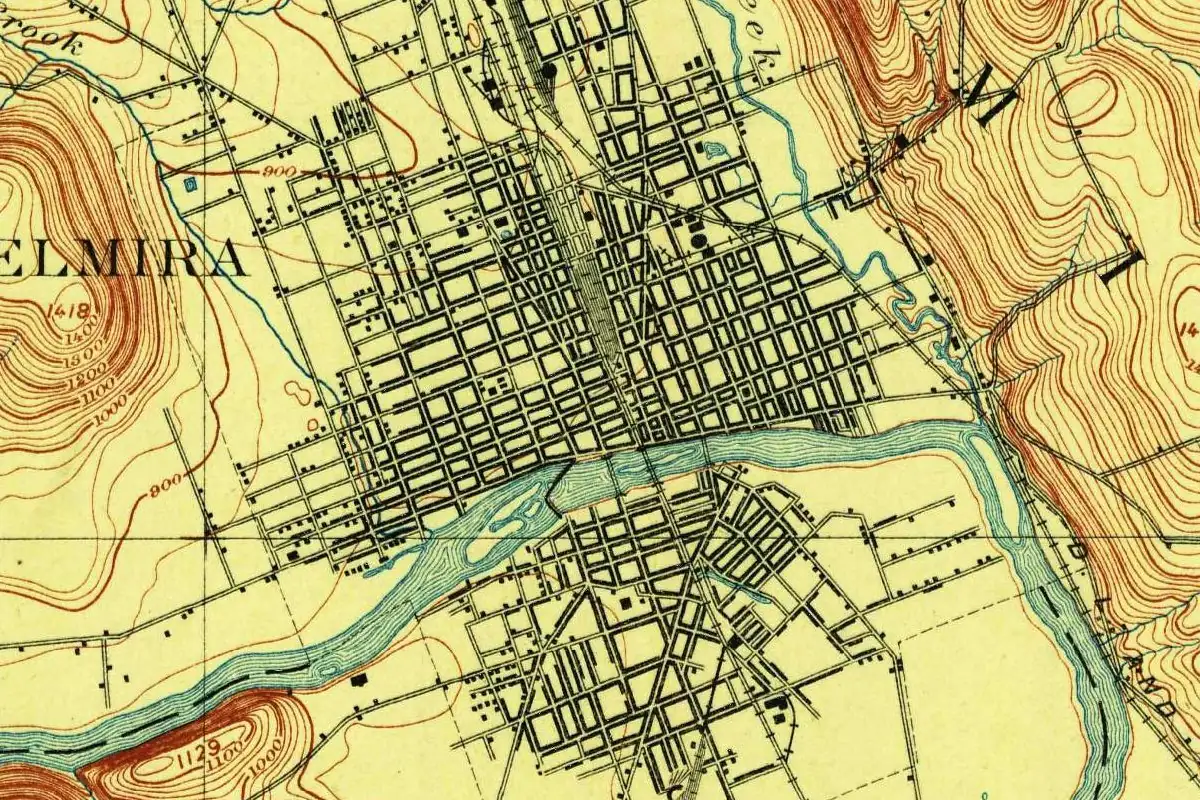
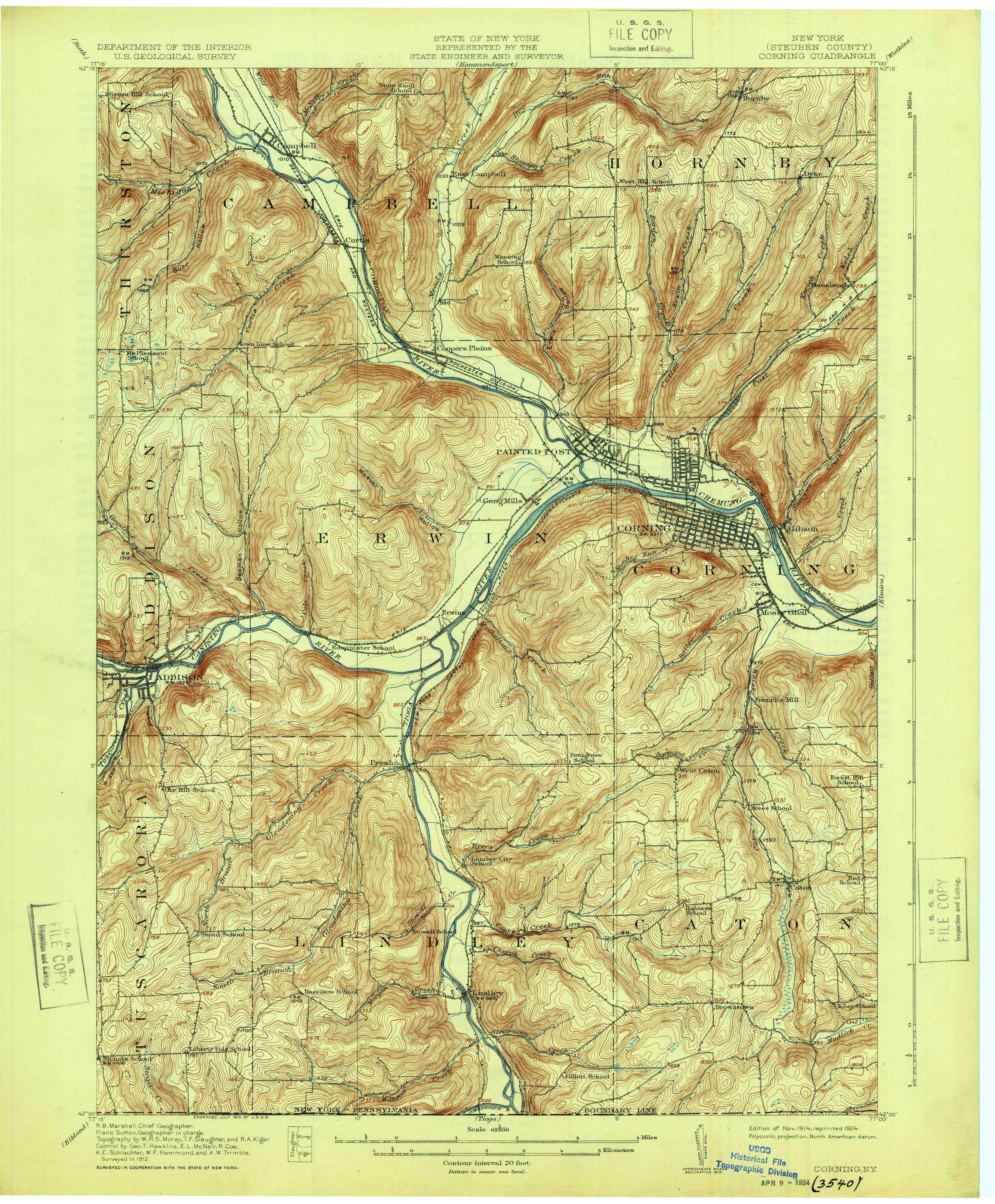
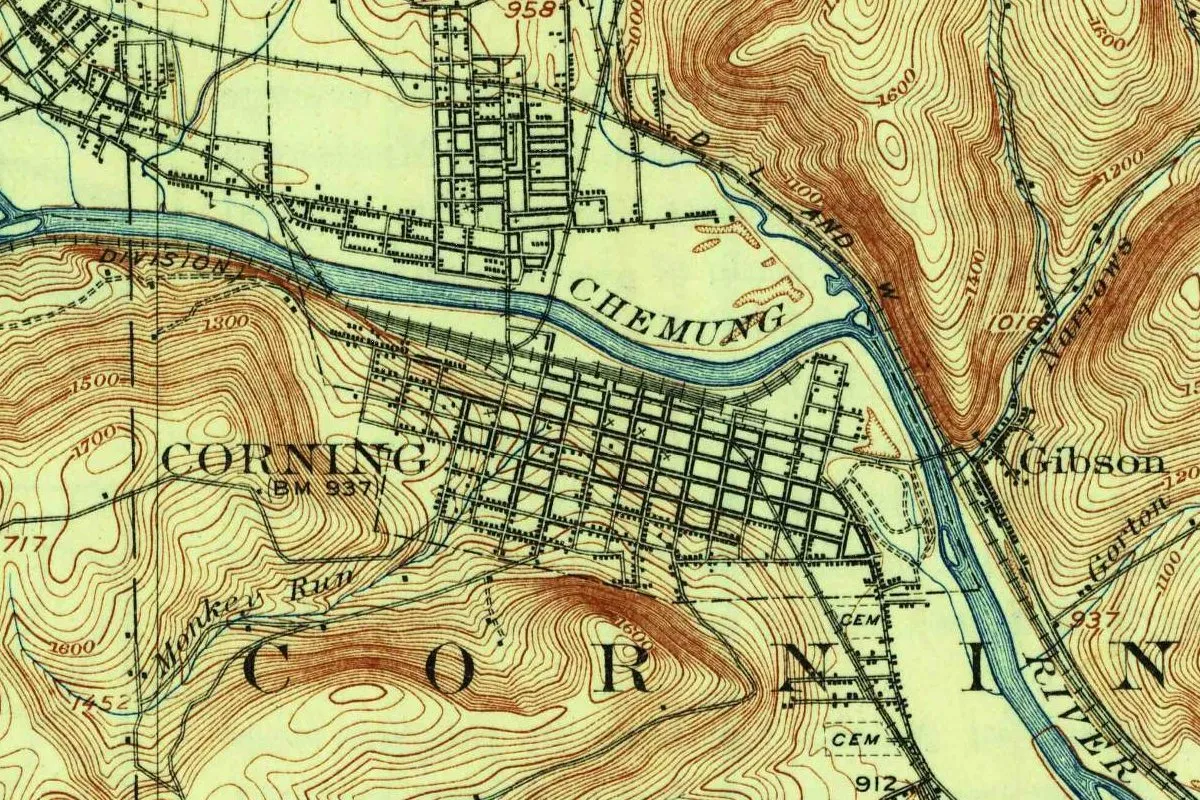
The map at the top of this page is part of the Geological Survey’s Corning sheet, surveyed in 1912 and first issued in November 1914, in a copy reprinted in 1924. The city’s grid sits on the south bank of the Chemung, with the hamlet of Gibson across the river to the east. Look across the bottom and you’ll see big spaced letters spelling Corning again: that’s the town, the old Painted Post township, laid over the hills. The photo below shows the same valley from the air.
Quick answers
Who is Corning, New York, named after?
Erastus Corning of Albany, “founder in fact” of the Corning Company, which bought the land on the Chemung. Hakes says the hamlet was named for him in 1836.
Was Corning, New York, named after Corning Glass?
No. The glass works came from Brooklyn in 1868, and the Corning Museum of Glass says they were renamed the Corning Glass Works after the move. The town already had the name.
What was Corning called before?
The town was Painted Post until March 31, 1852, Hakes writes. The Village of Painted Post says 1850.
Who was Erastus Corning?
An Albany businessman and politician: mayor of Albany from 1834 to 1837, president of the New York Central Railroad from 1854 and a congressman, according to the University at Albany.
Key dates
- 1829A bill passed on April 15 authorizes the Chemung Canal, finished in 1833.
- 1835The Corning Company is formed in Albany.
- 1836The hamlet on the company's land is named Corning.
- 1839The first locomotive runs up the Tioga valley on the company's railroad toward the Pennsylvania coal fields.
- 1841The post office moved from Painted Post the year before takes the name Corning.
- 1852On March 31 the town of Painted Post is renamed Corning, Hakes says; the Village of Painted Post gives 1850.
- 1855The Corning Company is dissolved.
- 1868The glass works move from Brooklyn to Corning.
- 1872Erastus Corning dies on April 8.
- 1890The act creating the city of Corning is signed on March 20.
Things to do in Corning, New York
Corning Museum of Glass
The museum covers 3,500 years of glass and glassmaking, with what it calls the world's most comprehensive collections of glass, live demonstrations by glassblowers and flameworkers, and a studio where you can make your own glass.
The Rockwell Museum
A museum of American art, open since 1976 and a Smithsonian Affiliate, set in Corning's former city hall. Its collection runs from paintings and sculpture to photography.
Heritage Village of the Southern Finger Lakes
The local historical society restored the 1796 building once known as the Painted Post Tavern in 1976. It now anchors a village of old buildings moved to the site, among them the Benjamin Patterson Inn.
The Painted Post monument
The Village of Painted Post says it keeps a replica of the post with a statue of Chief Montour beside it, part of an Indian monument put up in 1950, and that another replica now stands in the Village Square.
Getting there
Open Corning in Google Maps
Opens in a new tab. The pin is the center of Corning in the USGS place-name record.
The closest airports, Amtrak stations and intercity bus stops, measured in a straight line from the center of Corning.
Airports
- Elmira/Corning Regional (ELM) 8 mi 14 km
- Ithaca Tompkins International (ITH) 39 mi 62 km
- Buffalo Niagara International (BUF) 102 mi 163 km
Amtrak trains
- Rochester station (ROC) 76 mi 122 km
- New York State Fair station (NYF) 77 mi 123 km
Intercity buses
- Adirondack Trailways Trailways · Corning under 1 mi 0.3 km
- Greyhound Corning NY (CNY) under 1 mi 0.3 km
- OurBus Ithaca, NY (Bus stop outside IC Terrace Apartments) 34 mi 55 km
Distances are as the crow flies, not by road. We don't list schedules or fares because they change; check with the airline, Amtrak or the bus company before you go. Official data (FAA commercial service airports (2025), FAA airport locations, Amtrak stations and Intercity Bus Atlas) from the FAA and the U.S. Bureau of Transportation Statistics, checked Nov 17, 2026.
Sponsored
Staying in Corning?
Compare hotels in Corning, New York, on Expedia.
See hotels in CorningWe may earn a commission if you buy through this link. It never changes what we write. Read our affiliate disclosure
Historical Sources & References
- Harlo Hakes, ed., Landmarks of Steuben County, New York (1896), p. 90. The town of Painted Post renamed Corning on March 31, 1852, for the Corning Company and Erastus Corning. Checked against the page image.
- Hakes, Landmarks of Steuben County (1896), pp. 260-263, 266-267. The canal of 1829-1833, “Albany capitalists,” the Corning Company of 1835, the 340 acres, the hamlet named in 1836, the railroad of 1839, the post office of 1841, the dissolution of 1855, the glass works of 1868 and the city of 1890. Checked against the page images.
- Henry Gannett, The Origin of Certain Place Names in the United States (1905), p. 92. The three Cornings “named for Erastus Corning.” Checked against the page image.
- University at Albany, “Erastus Corning”. His birth, offices and death.
- Corning Museum of Glass, “Frequently Asked Questions”. “Named after a financier named Erastus Corning,” and the glass works’ move and new name.
- Village of Painted Post, “Village History”. The date of 1850, the Painted Post and the monument.
- Corning Museum of Glass; The Rockwell Museum; Heritage Village of the Southern Finger Lakes. The details in the things-to-do list.
- GNIS feature ID 947476 (U.S. Geological Survey). Corning’s listing in the national names database, in Steuben County, with its coordinates.
- U.S. Geological Survey, Corning sheet (1914, reprinted 1924). The 1:62,500 map that the image at the top of this page was cropped from.
Sponsored
Put this 1914 map on your wall
The 1914 USGS Corning, New York, sheet, in a 1924 reprint, is in the public domain. Download the full-size scan for free, then have it printed on canvas with CanvasOnTheCheap.
Print a map on canvasDownload the full-size mapWe may earn a commission if you buy through this link. It never changes what we write. Read our affiliate disclosure
Spot something wrong, or know more? Tell us here. You can also email us or use our contact page. Corrections are noted here with their date, never made silently.