Astoria, Oregon: Named for a Fur Baron Who Never Saw It
Astoria is named for John Jacob Astor, the New York financier whose Pacific Fur Company sent traders to the mouth of the Columbia River in 1811. Alexander Ross, one of them, wrote that the post was named Astoria in Astor's honor once its first foundation was laid. Astor himself never visited the Pacific Northwest.
The boss who stayed in New York
The men who built Astoria, Oregon, in 1811 named it for their boss, John Jacob Astor, a New York merchant who never set foot in Oregon. He paid for the trip, he dreamed up the business, and he gave the place its name without ever seeing it.
The Oregon Encyclopedia, published by the Oregon Historical Society, puts it in one line: “John Jacob Astor never visited Oregon or the Pacific Northwest.” Everything Astoria knows about its namesake, it knows secondhand.
Two expeditions to the Columbia
Astor’s plan was fur. In 1810, the encyclopedia says, he sent two expeditions for his Pacific Fur Company toward the mouth of the Columbia River, one by sea and one over land. The ship was the Tonquin, and by the spring of 1811 it had anchored in the Columbia’s estuary.
Historian Larry Morris, writing for the same encyclopedia, says the men came ashore at what’s now Astoria and started clearing land for a fort and trading post. The overland party, led by Wilson Price Hunt, didn’t show up until February 1812.
The land wasn’t empty. The City of Astoria’s own history page opens by naming the Chinook Nation and the Clatsop-Nehalem Confederated Tribes. The fur company came to trade with the people already living at the river’s mouth.
Ross’s day: the 18th
One of the men on the ground wrote down when the name arrived. Alexander Ross, who described himself as “one of the adventurers,” published his account in London in 1849. He says the party planted potatoes on the fourth day after landing and laid the foundation of their first building on May 16. Big trees and no cattle made it slow work: eight men were harnessed to drag the timber.
Then came the naming. Ross wrote:
“On the 18th, as soon as the foundation was completed, the establishment was named Astoria, in honour of Astor, the projector of the enterprise.”
“Projector” there means the man with the plan, not a machine. The name was in use right away: two weeks later, Ross writes, the Tonquin “left Astoria on the 1st of June” to trade along the coast, and crossed the bar on the 5th, “when we saw her for the last time.” So the name came with the foundation, before the building was finished, and it went to the one person who wasn’t there to see it.
Named for a man the crew grumbled about
Now for the odd part. The same book that records the honor doesn’t think much of the honoree. A few pages earlier, Ross describes a camp worn down by hard labor, night watches and sickness, and he lays much of the blame on “the conduct of Mr. Astor; first, in not sending out a medical man with the party; and, secondly, in his choice” of Duncan M’Dougall, the man Astor had placed at the head of his affairs.
Ross says some men talked about walking back across the continent, and a few did desert before being brought back. “In this case we surely look in vain for that sagacity and forethought which Mr. Astor was thought to possess,” he wrote. Then, a few pages later, he reports without comment that the post was named for him. You can read that as company manners. Whatever the crew thought of their boss, his name went on the post.
Henry Gannett’s entry for the Oregon city, written in 1905, took a shortcut. It says Astoria was “named for the founder, John Jacob Astor, who established a fur-trading station there in early days.” Founder is fair, in the sense that his money did it. But if you picture Astor swinging an ax at the mouth of the Columbia, you’ve got the wrong man.
Fort George, for a while
The name almost didn’t last, because war followed the traders west. “In the face of war in October 1813,” the Oregon Encyclopedia says, “the Pacific Fur Company sold Astoria to the North West Company,” a rival fur company. Britain ended up with the post, which was renamed Fort George.
So for a stretch, the post named for an American merchant went by another name entirely. Astor’s company was gone, and so, for the moment, was his name.
That mattered, because of what the post had been. The Oregon Encyclopedia calls Fort Astoria “the first American settlement in the Oregon Country,” and now it belonged to Britain.
It came back anyway. The City of Astoria says the city was incorporated in 1856, under the old name, and today it calls itself “the oldest American settlement west of the Rocky Mountains.” Oregon City claims a different first: its own city history calls it “the first incorporated city west of the Rocky Mountains.”
A name on the river
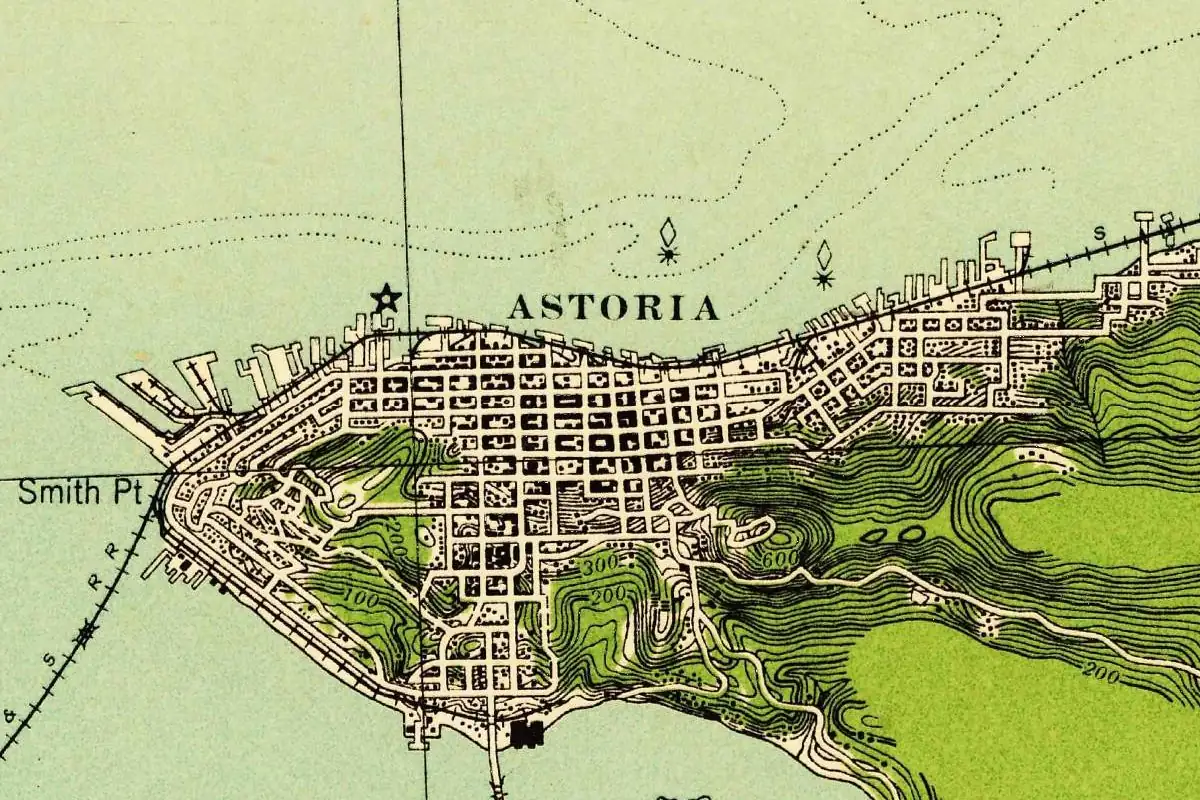
The town grew up on the steep shore where Ross’s crew cleared those trees. On the 1919 U.S. Geological Survey map, you can see what it became: a tight grid of streets squeezed between the hills and the Columbia, with wharves sticking out into the river. Far upstream on the same river are the rapids that French voyageurs called the dalles, which gave The Dalles its name.
Astor never came to look. But the post his employees named for him in May 1811 outlived his company, survived British ownership and a new name, and kept his on the map of Oregon.
Quick answers
Who is Astoria, Oregon, named after?
John Jacob Astor, the New York merchant who founded the Pacific Fur Company. Alexander Ross, who was there, wrote that the post was named Astoria “in honour of Astor, the projector of the enterprise.”
Did John Jacob Astor ever visit Astoria?
No. The Oregon Encyclopedia says Astor never visited Oregon or the Pacific Northwest. He sent his traders by sea and by land.
Was Astoria ever called Fort George?
Yes. After the Pacific Fur Company sold the post to the North West Company in October 1813, it was renamed Fort George. The city was incorporated as Astoria in 1856.
Key dates
- 1810John Jacob Astor sends two Pacific Fur Company expeditions toward the Columbia River, one by sea and one by land.
- 1811The Tonquin's party lands at the mouth of the Columbia. On May 18, Ross says, the new post is named Astoria.
- 1812The overland expedition led by Wilson Price Hunt arrives in February.
- 1813In October, with war on, the Pacific Fur Company sells Astoria to the North West Company. It is renamed Fort George.
- 1856Astoria is incorporated as a city.
Things to do in Astoria, Oregon
Astoria Column
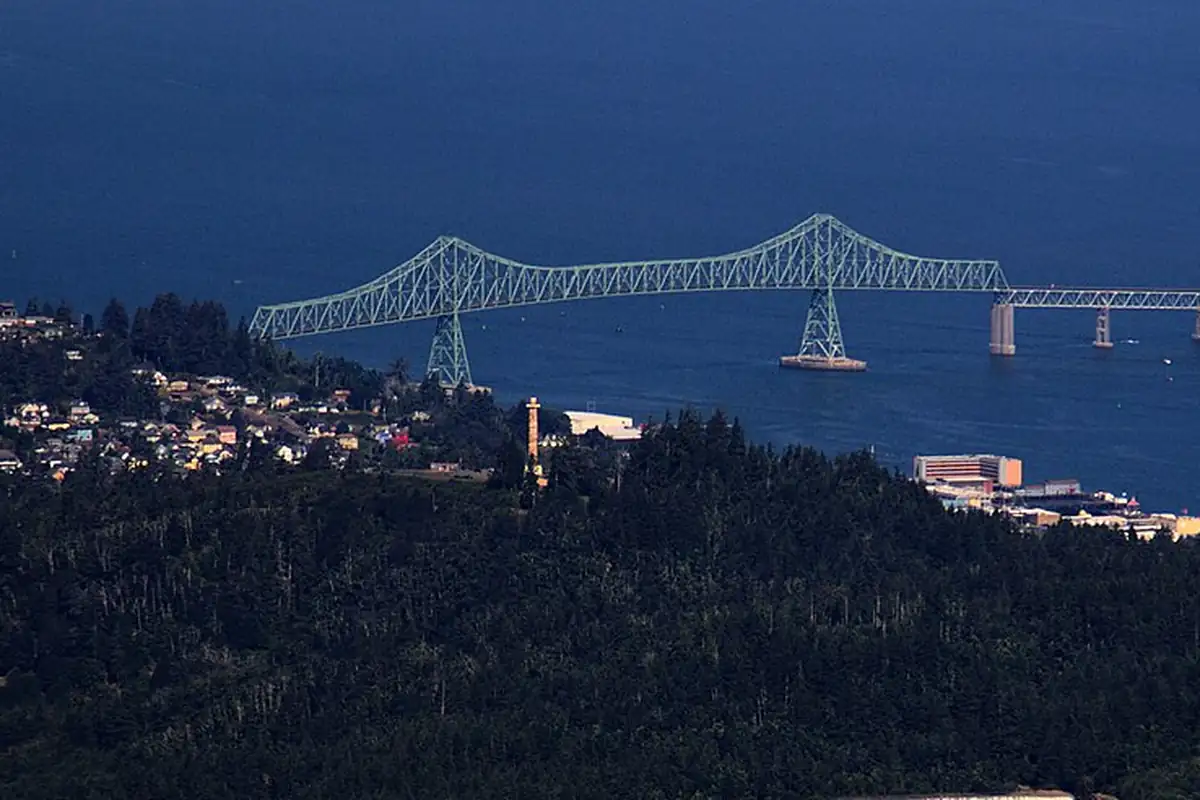
A monument on Coxcomb Hill, dedicated by the Great Northern Railway in 1926, that commemorates the settlement of the West with artwork on its sides, and that you can climb for a wide view from the top.
Columbia River Maritime Museum
The official maritime museum of the State of Oregon, with seafaring vessels, maritime artifacts and art, and the Lightship Columbia moored outside as part of the visit.
Fort Clatsop at Lewis and Clark National Historical Park
The park's main attraction is the second replica of Fort Clatsop, reached by a walk from the visitor center through coastal rainforest.
Fort Stevens State Park
A 4,300-acre state park on the site of a military post that once guarded the mouth of the Columbia, with camping, beaches, trails, a lake, a historic shipwreck and military displays.
Getting there
Open Astoria in Google Maps
Opens in a new tab. The pin is the center of Astoria in the USGS place-name record.
The closest airports, Amtrak stations and intercity bus stops, measured in a straight line from the center of Astoria.
Airports
- Portland International (PDX) 72 mi 116 km
- McNary Field (SLE) Salem 97 mi 156 km
Amtrak trains
- Kelso-Longview station (KEL) 44 mi 71 km
- Centralia station (CTL) 56 mi 89 km
Intercity buses
- Oregon POINT Astoria Transit Center under 1 mi 0.3 km
- Pacific Crest Bus Lines Forest Grove 58 mi 93 km
Distances are as the crow flies, not by road. We don't list schedules or fares because they change; check with the airline, Amtrak or the bus company before you go. Official data (FAA commercial service airports (2025), FAA airport locations, Amtrak stations and Intercity Bus Atlas) from the FAA and the U.S. Bureau of Transportation Statistics, checked Nov 13, 2026.
Sponsored
Staying in Astoria?
Compare hotels in Astoria, Oregon, on Expedia.
See hotels in AstoriaWe may earn a commission if you buy through this link. It never changes what we write. Read our affiliate disclosure
Historical Sources & References
- Alexander Ross, Adventures of the First Settlers on the Oregon or Columbia River (1849), pp. 75-76 and 81. An eyewitness account by “one of the adventurers”: his complaints about Astor’s planning and M’Dougall’s leadership (pp. 75-76), the foundation laid on May 16, the timber hauled by eight men, the post “named Astoria, in honour of Astor” on the 18th, and the Tonquin leaving “Astoria” on June 1 (p. 81).
- “John Jacob Astor (1763-1848),” Oregon Encyclopedia. Astor never visited the Pacific Northwest; the two expeditions of 1810; the Tonquin in the estuary by spring 1811; Hunt’s arrival in February 1812; Fort Astoria as “the first American settlement in the Oregon Country”; the October 1813 sale and the renaming to Fort George.
- Larry Morris, “Astor Expedition (1810-1812),” Oregon Encyclopedia. The men landing at present-day Astoria and clearing ground for a fort and trading post.
- City of Astoria, “History of Astoria”. The Chinook Nation and Clatsop-Nehalem tribes; Astor’s traders in 1811; the “oldest American settlement west of the Rocky Mountains”; incorporation in 1856.
- City of Oregon City, “Brief History of Oregon City”. Oregon City’s claim to be “the first incorporated city west of the Rocky Mountains.”
- Henry Gannett, The Origin of Certain Place Names in the United States (USGS, 1905), p. 31. Astoria “named for the founder, John Jacob Astor.”
- GNIS feature 1117076 (U.S. Geological Survey). The Geographic Names Information System’s page for Astoria, a populated place in Clatsop County.
- U.S. Geological Survey, Astoria sheet (1919). The 1:62,500 map the 1919 view of Astoria’s waterfront was cut from.
Spot something wrong, or know more? Tell us here. You can also email us or use our contact page. Corrections are noted here with their date, never made silently.