Medford, Oregon: A Massachusetts Name or a Middle Ford?
Medford was named in 1883 by David Loring, the Oregon & California Railroad's right-of-way agent, after Medford, Massachusetts, according to Lewis McArthur, compiler of Oregon Geographic Names. In 1927, though, Loring told McArthur he really chose it because the town sat at the middle ford on Bear Creek. Other early accounts credit different people and reasons.
A railroad town with an argument built in
Medford, Oregon, got its name from a railroad agent who knew Medford, Massachusetts, but the man himself later said he was thinking of a middle ford. Both halves of that sentence come from the same researcher, writing a year apart, and Medford has been sorting out the difference ever since.
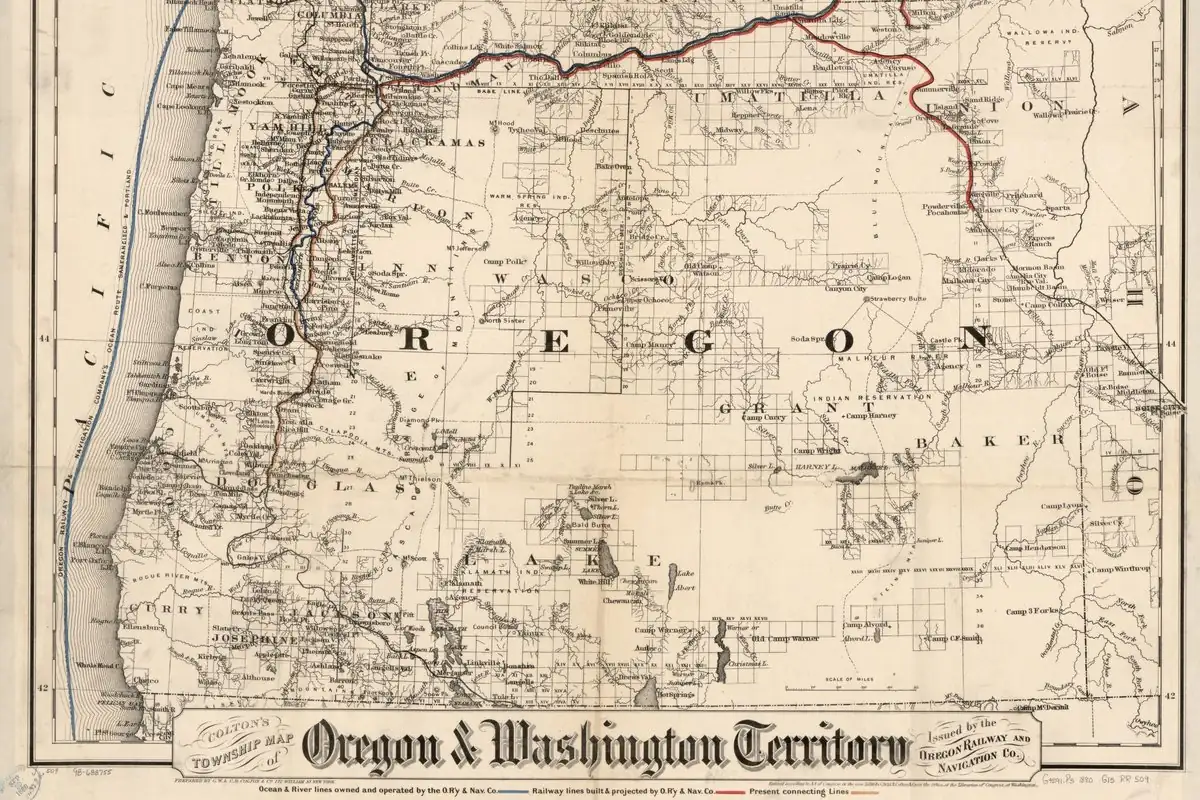
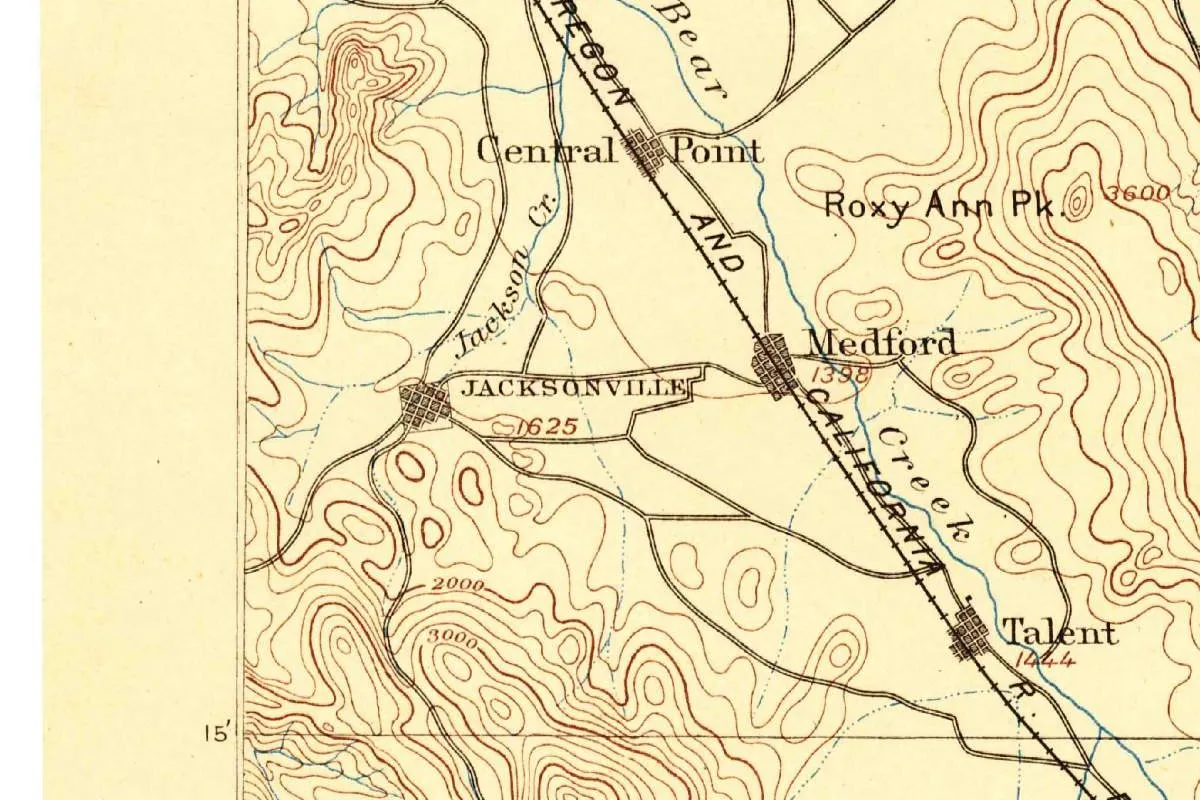
The town itself was a railroad decision. The Oregon Encyclopedia says Medford was laid out ahead of the Oregon & California Railroad, whose right-of-way agent, David Loring, saw the benefits of a direct route through the valley “even though it would bypass the county seat in Jacksonville.” In October 1883, four landowners, C. W. Broback, I. J. Phipps, Conrad Mingus and C. C. Beekman, gave the railroad land along the west bank of Bear Creek, and the company agreed to build its depot there. The first train arrived on January 18, 1884, and the town was incorporated on February 24, 1885. That’s a fast start, and the older town of Jacksonville watched it happen from about four miles (6 km) away.
Five names on the table
Before it was Medford, the new depot had a handful of candidate names. Ben Truwe, a Medford researcher whose Southern Oregon history pages collect every early mention of the name he could find, transcribes the newspapers of late 1883. The Jacksonville Oregon Sentinel called it the “Grand Central railroad depot.” The Ashland Tidings reported that some people wanted “East Jacksonville” while others pushed “Phippstown,” after one of the landowners. Then, on November 30, 1883, the Tidings passed along this:
“A name for the town has not yet been finally adopted, but “Medford” or “Middleford” has been suggested by the railroad people, we are told.”
Note the “we are told.” The paper was reporting secondhand. According to Truwe, the town plat recorded on December 20, 1883, already said Medford, and the Sentinel joked that month that passengers could start undressing at Medford before they reached the next station, which was to be called Bedford. Bedford, Truwe notes, ended up as Gold Hill.
A. G. Walling’s History of Southern Oregon, printed in 1884, caught the town in its first winter:
“Medford, the newest town in Southern Oregon, is an important station of the railway, and is regarded as likely to become a very important shipping point.”
Walling put it about four miles (6 km) east of Jacksonville, in the center of the Bear Creek valley, and counted about forty wooden buildings put up in the winter of 1883-84. He didn’t say a word about the name.
The Massachusetts version
The first published explanation came from Lewis A. McArthur, who was compiling Oregon Geographic Names in installments for the Oregon Historical Quarterly. In September 1926, as transcribed by Truwe, McArthur cited Richard Koehler, the longtime head of Southern Pacific lines in Oregon. Koehler said the town “was named by David Loring,” a civil engineer working on right-of-way for the Oregon & California, and that Loring, “a native of Massachusetts,” selected the name “in honor of Medford, Massachusetts.”
The Oregon Encyclopedia tells it the same basic way today: “The new town was named Medford after a city near Loring’s home in Massachusetts.” Truwe adds a detail you won’t find in the encyclopedia. Loring, he says, was a native of Concord, Massachusetts, about twelve miles (19 km) from Medford.
What Loring said himself
Here’s where it gets complicated. McArthur went back to the source. In September 1927, again as Truwe transcribes it, McArthur reported that Loring, by then living in Portland, told him in August 1927 “that while the form of the name was suggested by Medford, Massachusetts, he really named the new community in Oregon because it was situated at the middle ford on Bear Creek.”
So the man who picked the name gave two reasons at once. The spelling came from back east. The meaning, he said, came from the creek.
Middleford, Midford and other memories
Once the “middle” idea was out there, it grew. The Federal Writers’ Project guide to Oregon, published in 1940, said flatly that “the new town was named Middleford because it was situated at the middle of three fords on Bear Creek,” and that Loring, who it says “had lived in Medford, Massachusetts,” suggested changing it.
Other old-timers remembered it differently again. Truwe collects a 1932 article by Alice Applegate Sargent saying I. J. Phipps suggested the name because the town sat in the middle of the valley, “probably first called Midford.” And in 1933, an Ashland merchant named Emil Peil wrote to the Oregonian that he’d heard railroad officials and Jacksonville people discuss it in the fall of 1883 and that they chose Medford, “meaning ‘the middle ford.’”
Truwe, for his part, doesn’t buy Middleford at all. He argues the town was never called that, that there was no ford at the townsite itself (the nearest was on a county road about half a mile, or 0.8 km, north), and that the “Med” really points to the middle of the valley. That’s his reading of the evidence. You can follow every clipping he relies on and judge for yourself.
Which story wins?
Nobody’s going to settle this with one document, and you’ll see the town’s name explained both ways in print. What the sources agree on is narrower, and still pretty solid. The name came from the railroad side in late 1883, it was on the plat by December 20, and David Loring is the person most often credited with it, by Koehler, by McArthur and, in 1927, by Loring himself.
As for why, the evidence points two ways. McArthur’s first source said Medford, Massachusetts. Loring said that’s where he got the form, but that the middle ford on Bear Creek was the real reason. It’s one of the more tangled name stories in Oregon, and it’s been argued in print for almost a century.
The Oregonian weighed in back in 1933, in an editorial that Truwe also transcribes, after Peil’s letter contradicted the Massachusetts story. Its verdict still works: “it may be that both sides in the discussion are right.”
Quick answers
Is Medford, Oregon, named after Medford, Massachusetts?
Partly. Lewis McArthur’s 1926 source said David Loring named it in honor of Medford, Massachusetts, but Loring told McArthur in 1927 that only the form came from there and that he really named it for the middle ford on Bear Creek.
Who named Medford, Oregon?
David Loring, the Oregon & California Railroad’s right-of-way agent, according to Richard Koehler, Lewis McArthur and Loring himself. One 1932 account credited landowner I. J. Phipps instead.
Was Medford ever called Middleford?
Not on record as the town’s name. “Medford” or “Middleford” was reported as a suggestion in November 1883, and the plat recorded that December said Medford. The 1940 state guide claimed it was first named Middleford; historian Ben Truwe calls that a myth.
Why wasn’t the railroad depot put in Jacksonville?
Because the railroad wanted a direct route through the valley, even though that meant bypassing the county seat, according to the Oregon Encyclopedia.
Key dates
- 1883In October, four landowners give the railroad land on Bear Creek for a depot; on December 20 a town plat is recorded under the name Medford.
- 1884The first train reaches Medford on January 18.
- 1885Medford is incorporated on February 24.
- 1927David Loring tells Lewis McArthur he named the town for the middle ford on Bear Creek, with the form borrowed from Medford, Massachusetts.
Things to do in Medford, Oregon
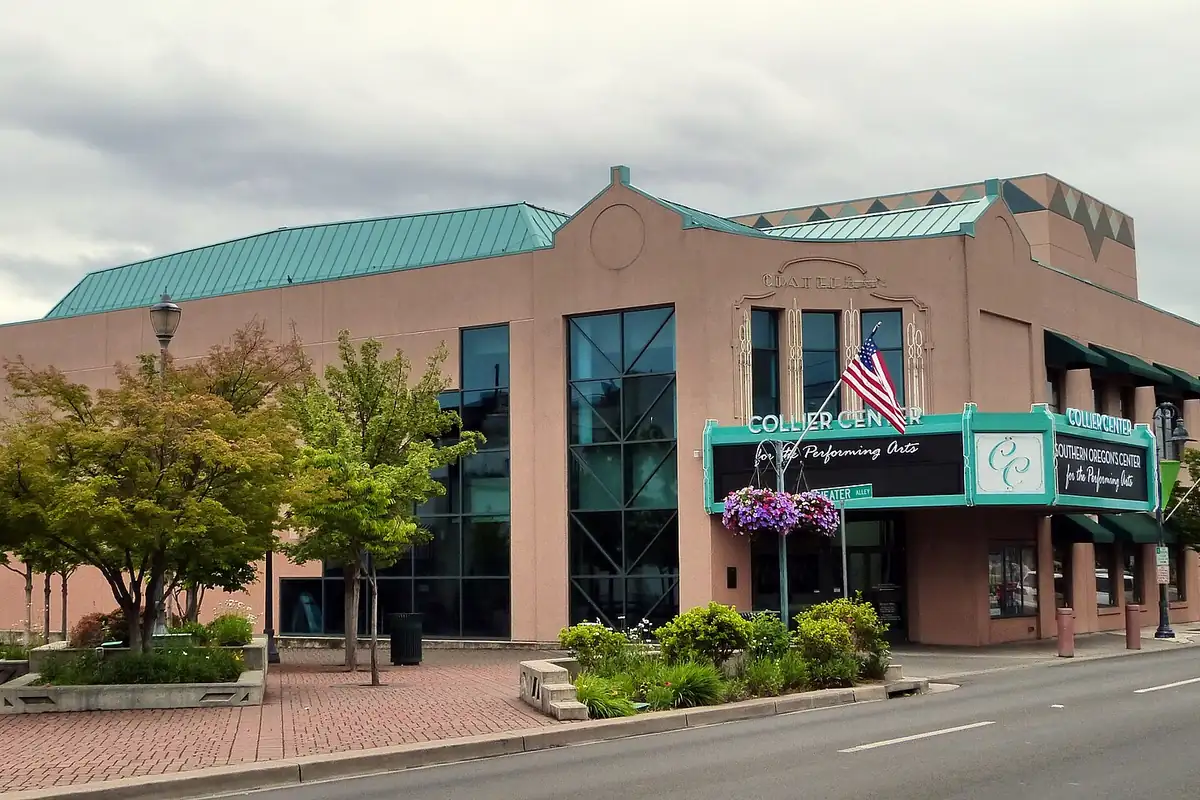
Craterian Theater at the Collier Center
A downtown theater in a 1924 Spanish Colonial building. Its name came from a contest: out of 1,500 entries, George A. Hunt picked Craterian, after Crater Lake and a play on the movie-house name Criterion. Renovated and reopened in 1997.
Railroad Park
A city park run by railroad clubs, with a Willamette locomotive, a caboose and other full-size cars, model trains, a working telegraph, a garden railway and miniature steam trains to ride. Development began under a 1979 agreement.
Table Rocks
Two lava-capped mesas rising above the Rogue Valley, with round-trip trails of 2.5 miles (4 km) and 3.5 miles (5.6 km) to views of the valley and the Cascade and Siskiyou Mountains. The BLM and The Nature Conservancy manage them together.
Bear Creek Greenway
An 18-mile (29 km) paved, multi-use trail through Phoenix, Medford and Central Point, used by cyclists, skaters, runners and walkers, with community parks along the way.
Getting there
Open Medford in Google Maps
Opens in a new tab. The pin is the center of Medford in the USGS place-name record.
The closest airports, Amtrak stations and intercity bus stops, measured in a straight line from the center of Medford.
Airports
- Rogue Valley International/Medford (MFR) 3 mi 5 km
- Southwest Oregon Regional (OTH) North Bend 102 mi 165 km
Amtrak trains
- Klamath Falls station (KFS) 57 mi 91 km
- Chemult station (CMO) 83 mi 133 km
Intercity buses
- Pacific Crest Bus Lines Front Street Station - Medford under 1 mi 0.4 km
- Oregon POINT Front Street Station - Medford under 1 mi 0.4 km
- Greyhound Grants Pass A-1 Market 24 mi 39 km
Distances are as the crow flies, not by road. We don't list schedules or fares because they change; check with the airline, Amtrak or the bus company before you go. Official data (FAA commercial service airports (2025), FAA airport locations, Amtrak stations and Intercity Bus Atlas) from the FAA and the U.S. Bureau of Transportation Statistics, checked Nov 14, 2026.
Sponsored
Staying in Medford?
Compare hotels in Medford, Oregon, on Expedia.
See hotels in MedfordWe may earn a commission if you buy through this link. It never changes what we write. Read our affiliate disclosure
Historical Sources & References
- Ben Truwe, “The Middleford Myth and the Naming of Medford”. Transcriptions of the Oregon Sentinel (November 3 and December 15, 1883), the Ashland Tidings (November 23 and 30, 1883, including the quoted “Medford” or “Middleford” line), the plat of December 20, 1883; Lewis A. McArthur, “Oregon Geographic Names,” Oregon Historical Quarterly 27, no. 3 (September 1926), p. 340, citing Richard Koehler; McArthur, OHQ 28, no. 3 (September 1927), p. 297, with Loring’s own explanation; Alice Applegate Sargent (1932); Emil Peil’s 1933 letter and the Oregonian editorial of January 30, 1933 (“it may be that both sides in the discussion are right”); and Truwe’s own conclusions. We read McArthur and the newspapers in Truwe’s transcriptions, not in the originals.
- Federal Writers’ Project, Oregon: End of the Trail (1940), Medford section, reproduced by Ben Truwe. The “middle of three fords on Bear Creek” version and Loring “who had lived in Medford, Massachusetts.”
- Oregon Encyclopedia, “Medford”. Loring as right-of-way agent; bypassing Jacksonville; the October 1883 land donation by Broback, Phipps, Mingus and Beekman; the first train on January 18, 1884; incorporation on February 24, 1885; named “after a city near Loring’s home in Massachusetts.”
- A. G. Walling, History of Southern Oregon (1884), p. 375. The quoted description of Medford as “the newest town in Southern Oregon”; about four miles east of Jacksonville; about forty wooden buildings in the winter of 1883-84.
- GNIS feature 1124040 (U.S. Geological Survey). GNIS entry for Medford, in Jackson County.
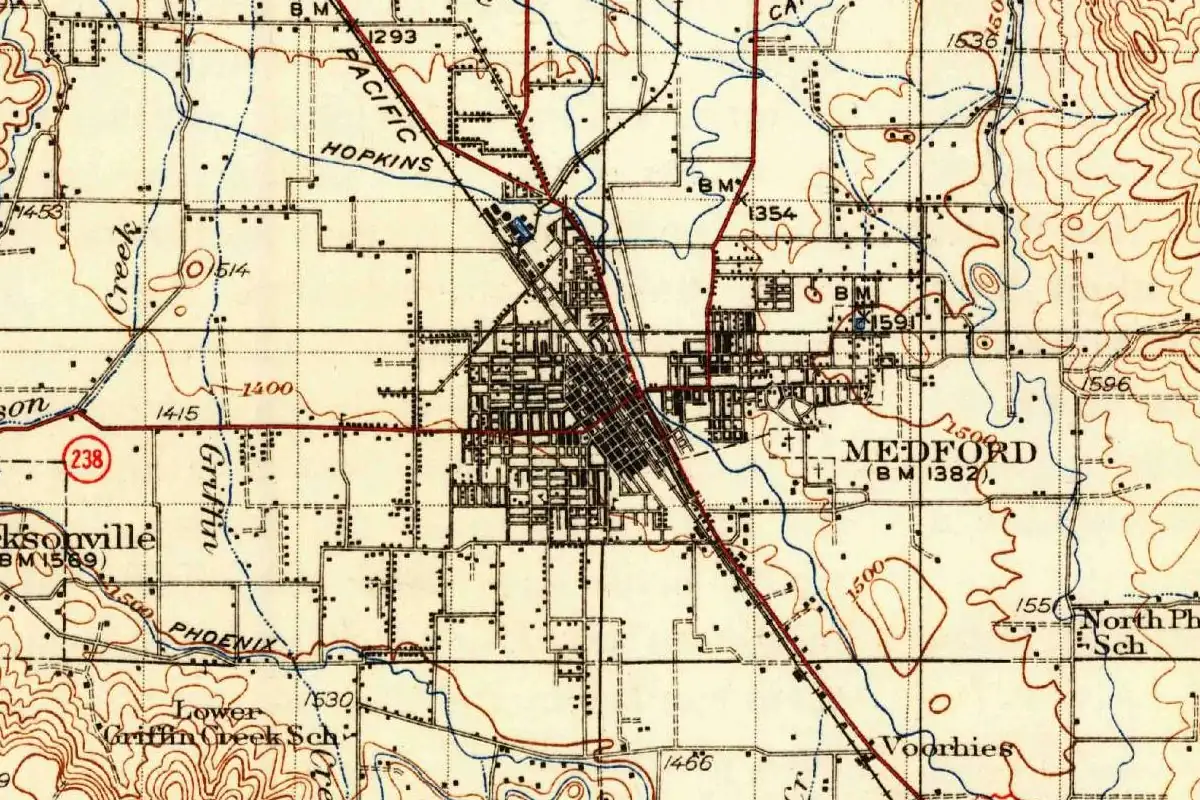
- U.S. Geological Survey, Medford sheet (1938). The 1:125,000 quadrangle the map at the top of this page was cropped from.
Spot something wrong, or know more? Tell us here. You can also email us or use our contact page. Corrections are noted here with their date, never made silently.