How Eugene, Oregon, Got Its Name From Eugene Skinner
Eugene, Oregon, is named for Eugene F. Skinner, who claimed land there in 1846. A post office called Skinner's opened in 1850, and the town was laid out as Eugene City, named after the founder, an 1872 gazetteer says. A 1941 local memoir adds that his wife, Mary Skinner, chose the name.
A last name first, then a first name
Eugene, Oregon, carries the first name of its founder, Eugene F. Skinner, but the earliest post office there carried his last name: Skinner’s. Skinner staked his claim in 1846, and the town that grew around it went from Skinner’s to Eugene City, then City of Eugene, and finally plain Eugene in 1889.
So the name the city kept is the settler’s given name. His family name came first, on the post office, and lost.
Eugene Skinner’s claim
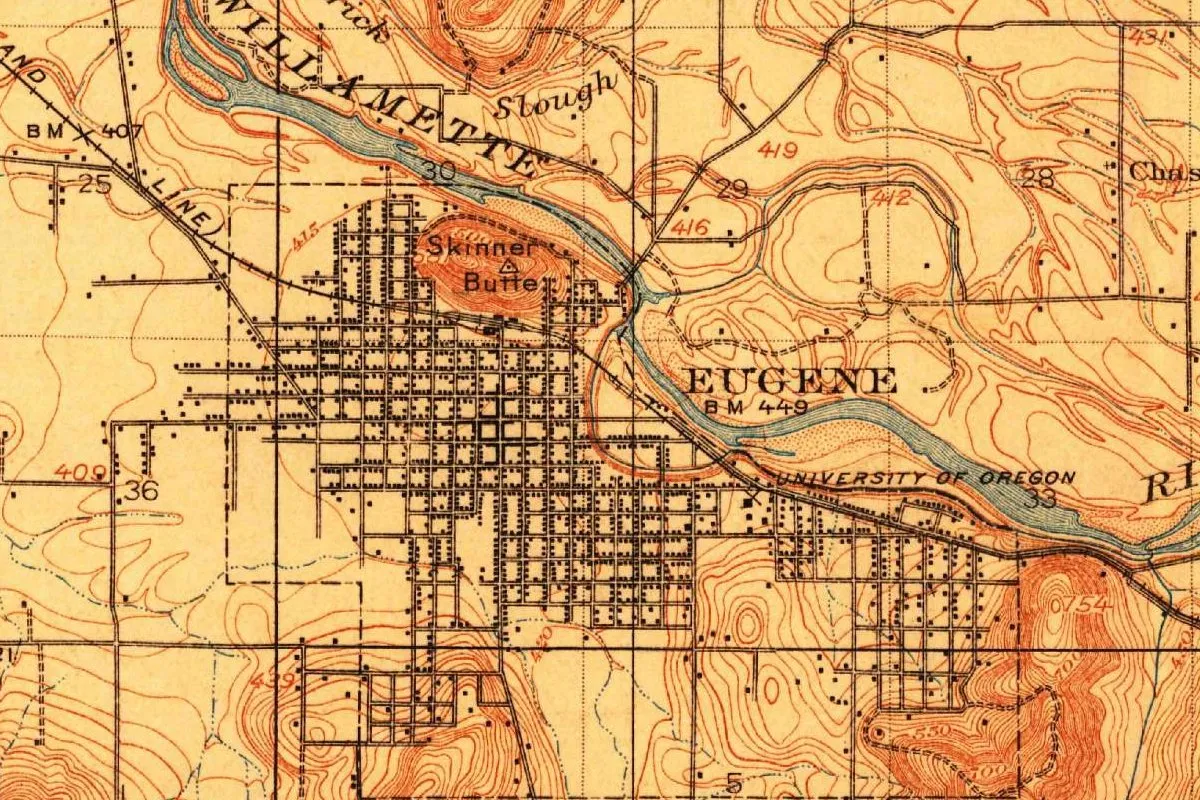
The Oregon Encyclopedia, published by the Oregon Historical Society, says Skinner reached the Willamette Valley in 1846. He filed his land claim that July and came back in October to build a cabin partway up the butte closest to the river. The Kalapuya people knew that butte as Ya-Po-Ah, which the encyclopedia translates as “high place.” Today it’s Skinner Butte, and you can find it on the 1910 survey map at the top of this page, right at the north edge of the town grid.
Skinner wasn’t the first person to live there, of course. The encyclopedia says the area was home to the Chifin band of the Kalapuya for thousands of years, and that diseases such as smallpox and malaria devastated them in the 19th century. Emigrants coming in on the Applegate Trail used Skinner’s cabin that first winter, and his family moved into it in the spring of 1847.
Skinner’s, then Eugene City
A post office named Skinner’s opened in 1850, the encyclopedia says, and a town site was platted in 1852. The town took the other half of his name. A railroad gazetteer printed in 1872 laid it out plainly in its directory of Oregon towns:
“EUGENE CITY, Lane County, an incorporated city and county seat, was first laid out in 1853 and named after the founder, Eugene Skinner.”
Notice the year. The 1872 gazetteer says 1853; the Oregon Encyclopedia says 1852. The gap doesn’t change the namesake. Hubert Howe Bancroft’s History of Oregon agreed in 1888 that Eugene City “was founded by Eugene F. Skinner,” and in 1905 Henry Gannett’s federal guide to American place names gave it one line: “named for Eugene F. Skinner, its first settler.” That “first” leaves out the Kalapuya, who, as the encyclopedia makes clear, were there long before him.
None of these old books says who actually chose “Eugene” over “Skinner,” or why. The first account we’ve found that does came much later. Irena Dunn Williams, a pioneer’s daughter, published her Reminiscences of Early Eugene and Lane County, Oregon in 1941, close to a century after the Skinners arrived. In it she wrote that “Mrs. Skinner was later given the privilege of naming the town, which she named ‘Eugene’ in honor of her husband.”
Williams says her book retells what she heard from her parents, and the earlier books cited here, from the 1872 gazetteer to Gannett in 1905, don’t mention it. So treat it as a local tradition, in print by 1941 at the latest, not as a record from the 1850s. Either way, the name honors the same man. The question is only whose idea it was: his, or Mary Skinner’s.
Dropping the “City”
The town incorporated as Eugene City in 1862. Two years later, the encyclopedia says, the name was changed to City of Eugene, and in 1889 it was shortened to Eugene. So if you’re reading old letters or newspapers, “Eugene City” isn’t a different place. It’s the same town in its first official form, and it stayed in common use: the 1872 gazetteer still listed businesses there as being in “Eugene City.”
The early town had a less flattering name too. Frequent flooding in the rainy season, the encyclopedia says, earned it the nickname Skinner’s Mudhole. That one stayed a nickname.
The settler on the map
Skinner’s two names ended up splitting the job. His first name went to the city, and his last name went to the butte. Lewis A. McArthur’s Oregon Geographic Names says the butte “was named for Eugene F. Skinner, who settled at its foot in 1846.” On the old survey sheet they sit side by side: Skinner Butte at the top of the street grid and EUGENE in capital letters just beside it. So in this corner of Oregon, one settler’s name ended up on the map twice, once for each half.
Quick answers
Who was Eugene, Oregon, named after?
Eugene F. Skinner, who founded the town on his 1846 claim. An 1872 gazetteer says it was “named after the founder, Eugene Skinner,” and Gannett’s 1905 guide calls him “its first settler,” though the Kalapuya lived there long before he came.
Who chose the name Eugene?
The 19th-century sources cited here don’t say. Irena Dunn Williams’s 1941 memoir says Skinner’s wife, Mary, “was later given the privilege of naming the town,” but it gives no source, and no earlier record we’ve found backs it up.
What was Eugene, Oregon, called before?
Its first post office, opened in 1850, was called Skinner’s. The town then went by Eugene City, which became City of Eugene in 1864 and Eugene in 1889, according to the Oregon Encyclopedia.
When was Eugene, Oregon, founded?
Skinner arrived and built his cabin in 1846. The town site was platted in 1852, according to the Oregon Encyclopedia (an 1872 gazetteer says 1853), and Eugene City was incorporated in 1862.
Key dates
- 1846Eugene Skinner arrives, files his land claim in July and builds a cabin in October on the butte now named for him.
- 1847The Skinner family moves into the cabin in the spring.
- 1850A post office named Skinner's is established.
- 1852A town site is platted, according to the Oregon Encyclopedia; an 1872 gazetteer dates the layout of Eugene City to 1853.
- 1862Eugene City is incorporated.
- 1864The name Eugene City is changed to City of Eugene.
- 1889City of Eugene is shortened to Eugene.
Getting there
Open Eugene in Google Maps
Opens in a new tab. The pin is the center of Eugene in the USGS place-name record.
The closest airports, Amtrak stations and intercity bus stops, measured in a straight line from the center of Eugene.
Airports
- Mahlon Sweet Field (EUG) Eugene 8 mi 13 km
- McNary Field (SLE) Salem 59 mi 96 km
- Portland International (PDX) 109 mi 175 km
Amtrak trains
- Eugene station (EUG) under 1 mi 0.6 km
- Albany station (ALY) 40 mi 64 km
Intercity buses
- Oregon POINT Eugene Amtrak Station Bus Platform under 1 mi 0.5 km
- Pacific Crest Bus Lines Eugene Amtrak under 1 mi 0.5 km
- FlixBus Eugene Eugene University of Oregon Jaqua Academic Ctr 1 mi 2 km
Distances are as the crow flies, not by road. We don't list schedules or fares because they change; check with the airline, Amtrak or the bus company before you go. Official data (FAA commercial service airports (2025), FAA airport locations, Amtrak stations and Intercity Bus Atlas) from the FAA and the U.S. Bureau of Transportation Statistics, checked Nov 13, 2026.
Sponsored
Staying in Eugene?
Compare hotels in Eugene, Oregon, on Expedia.
See hotels in EugeneWe may earn a commission if you buy through this link. It never changes what we write. Read our affiliate disclosure
Historical Sources & References
- McKenney’s Gazetteer and Directory of the Central Pacific Railroad (1872), p. 656. Eugene City “was first laid out in 1853 and named after the founder, Eugene Skinner,” and local businesses listed in “Eugene City.”
- Henry Gannett, The Origin of Certain Place Names in the United States, 2nd ed. (USGS, 1905), p. 122. Eugene, “named for Eugene F. Skinner, its first settler.”
- Hubert Howe Bancroft, History of Oregon, vol. 2 (1888), p. 309. Eugene City, “which was founded by Eugene F. Skinner.”
- Lewis A. McArthur, Oregon Geographic Names, 3rd ed. (1952), “Skinner Butte”. The butte, at an elevation of 681 feet between downtown Eugene and the Willamette, “was named for Eugene F. Skinner, who settled at its foot in 1846.”
- Irena Dunn Williams, Reminiscences of Early Eugene and Lane County, Oregon (1941), p. 11. Mary Skinner as the first white woman to make her home in what became Lane County, and the statement that she “was later given the privilege of naming the town, which she named ‘Eugene’ in honor of her husband.”
- Steve McQuiddy, “Eugene,” The Oregon Encyclopedia. The Chifin band of the Kalapuya, Skinner’s arrival in 1846, his claim and cabin, Ya-Po-Ah and Skinner Butte, the family’s move in 1847, the Skinner’s post office in 1850, the 1852 plat, incorporation as Eugene City in 1862, the changes of 1864 and 1889, and the nickname Skinner’s Mudhole.
- GNIS feature 1120527 (U.S. Geological Survey). Lane County location and the federal feature number for the city.
- U.S. Geological Survey, Eugene sheet (1910). The source of the map at the top of this page.
Correction, November 13, 2026: this page used to call Eugene Skinner the town’s first settler without qualification and said only that the old sources don’t name who chose “Eugene.” It now notes the Kalapuya presence in that context and reports Irena Dunn Williams’s 1941 account that Mary Skinner named the town, with how far that account can be trusted.
Spot something wrong, or know more? Tell us here. You can also email us or use our contact page. Corrections are noted here with their date, never made silently.