Coos Bay, Oregon: Why Marshfield Became Coos Bay
Coos Bay was Marshfield until November 7, 1944, when voters adopted a new charter and the name City of Coos Bay, confirmed on December 28. Lewis A. McArthur's Oregon Geographic Names says the name came from the bay, and Coos from a native tribe. He reports 'lake' and 'place of pines' as Indian meanings of Coos.
Coos Bay, Oregon, was Marshfield for some 90 years, until its voters swapped that name in 1944 for the bay’s, which comes from the Coos people. The old name came from Massachusetts. The new one was already on the water, on the county and on the people who lived around it.
Marshfield, by way of Massachusetts
Lewis A. McArthur’s Oregon Geographic Names gives two pioneer accounts of the first name. G. A. Bennett said the land had been part of a claim taken up by Wilkins Warwick in 1855, and that it “was the general understanding of Oregon pioneers that Warwick named part of his claim for Marshfield, Massachusetts.” A deed of March 11, 1856, describes the property as “known and designated as the Marshfield claim at the mouth of Wapello Slough.”
S. B. Cathcart told it another way. He wrote that J. C. Tolman, who’d settled the claim before Warwick, was “a great admirer of Daniel Webster,” and named it after Webster’s home in Massachusetts. McArthur’s conclusion: “While the details of these two stories differ somewhat, it is apparent that Marshfield, Oregon, was named about 1854 for the Massachusetts community.”
The City of Coos Bay goes with Tolman. Its history page says he founded Marshfield in 1853 and “named it after his Massachusetts hometown.” Marshfield was incorporated on October 24, 1874, the city says. McArthur adds that it didn’t amount to much until John Pershbaker started lumber and shipbuilding there in 1867, when the place had two buildings.
Two elections and a new name
The change took more than one try. On November 16, 1943, McArthur writes, voters were asked to merge Marshfield, North Bend and the land between them into one city called Coos Bay. “The proposal carried in Marshfield but lost elsewhere.”
A year later Marshfield went ahead on its own. “At the general election a year later, November 7, 1944, the people of Marshfield adopted a new charter and a new name, City of Coos Bay,” McArthur says. A special election on December 28 confirmed it. “The new name was of course taken from the natural feature, Coos Bay.” The city says residents chose it because the bay was “the community’s most prominent geographic feature,” and it dates the official change to February 15, 1945.
Washington caught up that spring. Executive Order 9533, signed by Franklin D. Roosevelt on March 23, 1945, changed the name of “the customs port of entry of Marshfield, Oregon,” to Coos Bay, effective April 1. The old name hasn’t vanished, though. The city says the historic downtown is still known as the Marshfield District.
Other towns have made the same kind of switch. Roanoke, Virginia, dropped Big Lick for the name of its river and county in 1882, and Pocomoke City, Maryland, went from New Town to the name of its river in 1878.
The Coos people
McArthur calls Coos “an Indian name of a native tribe whose habitat was the vicinity of Coos Bay.” He says Lewis and Clark were the first to write it down, as Cook-koo-oose, and that “The explorers heard the name among the Clatsop Indians.” Later writers spelled it Cahoose, Cowis and Cowes, and then “variously Koo’as, Kowes, Koos, Coose, and finally Coos.”
The Confederated Tribes of Coos, Lower Umpqua and Siuslaw Indians describe two bands of Coos. The Hanis-speaking Coos lived where North Bend is today, and the Miluk-speaking Coos lived on South Slough. “Several Oregon landmarks are named after the tribe,” the tribes say, “the Coos Bay, the city of Coos Bay, and Coos County.” The county was created by Oregon’s territorial legislature on December 22, 1853, the Secretary of State’s history says.
What Coos means
Here the sources split. McArthur reports that “One Indian meaning of Coos is ‘lake,’ another, ‘place of pines,’” citing the Oregonian of August 26, 1902. Henry Gannett, in 1905, had a shorter answer for the bay, the river and the county: “place of pines.” The Handbook of American Indians, in its 1907 entry on the Kusan family, says the name “is said to be taken from one of the Rogue River dialects in which it means ‘lake,’ ‘lagoon,’ or ‘inland bay.’” The Oregon Secretary of State’s county history gives “lake” or “place of the pines.”
The city’s history page offers a different reading, that the name comes from the Miluk and Hanis languages and means “South.” And McArthur passes along one more. Perry B. Marple, who began promoting Coos Bay in 1853, spelled it Coose and “said it was an Indian perversion of the English word coast, meaning a place where ships can land.”
So if you’re asking what Coos means, you’ll get a different answer depending on which source you open.
How to say it
Merriam-Webster gives \ˈküs\ for the first word, so it’s KOOS.
The 1900 map
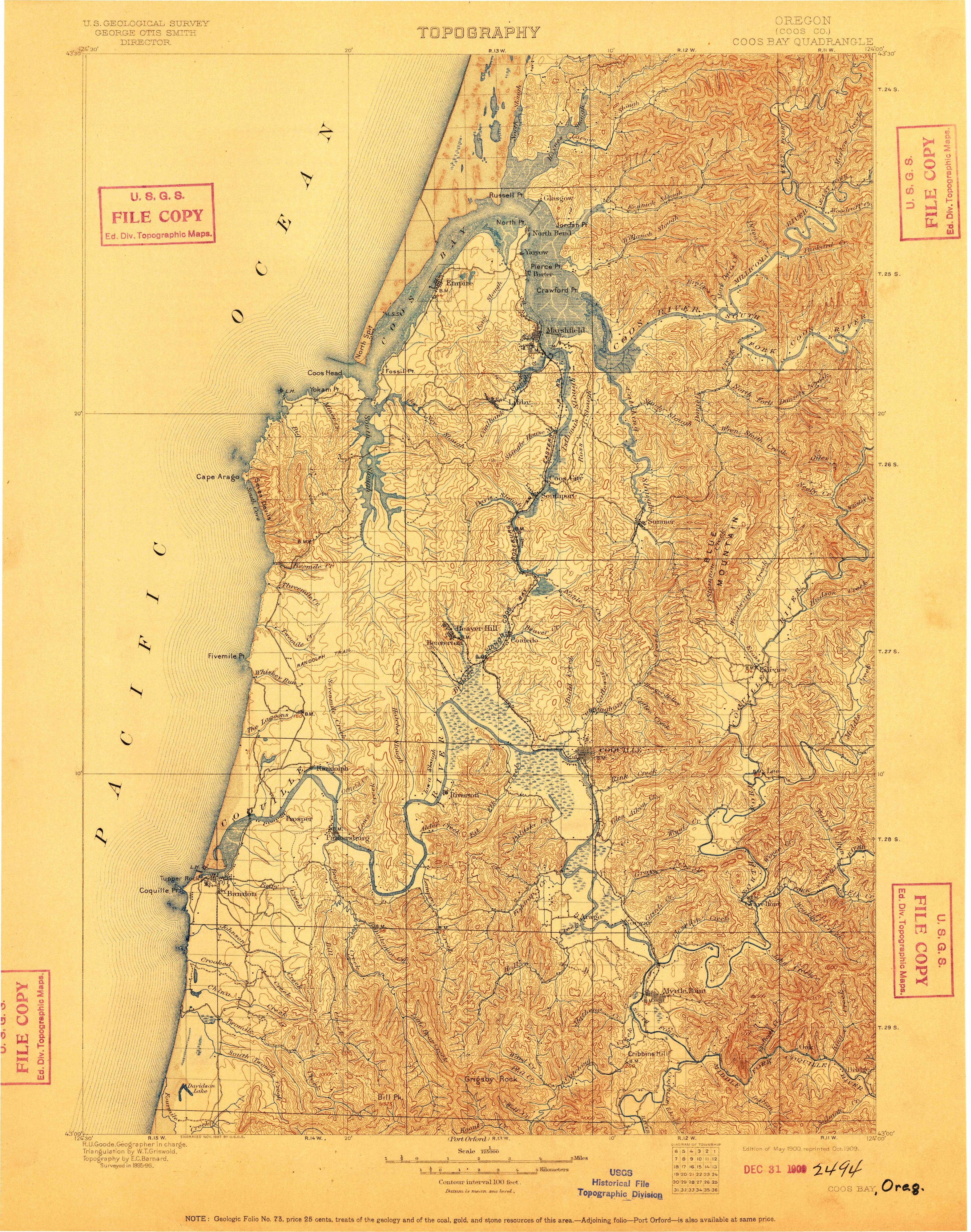
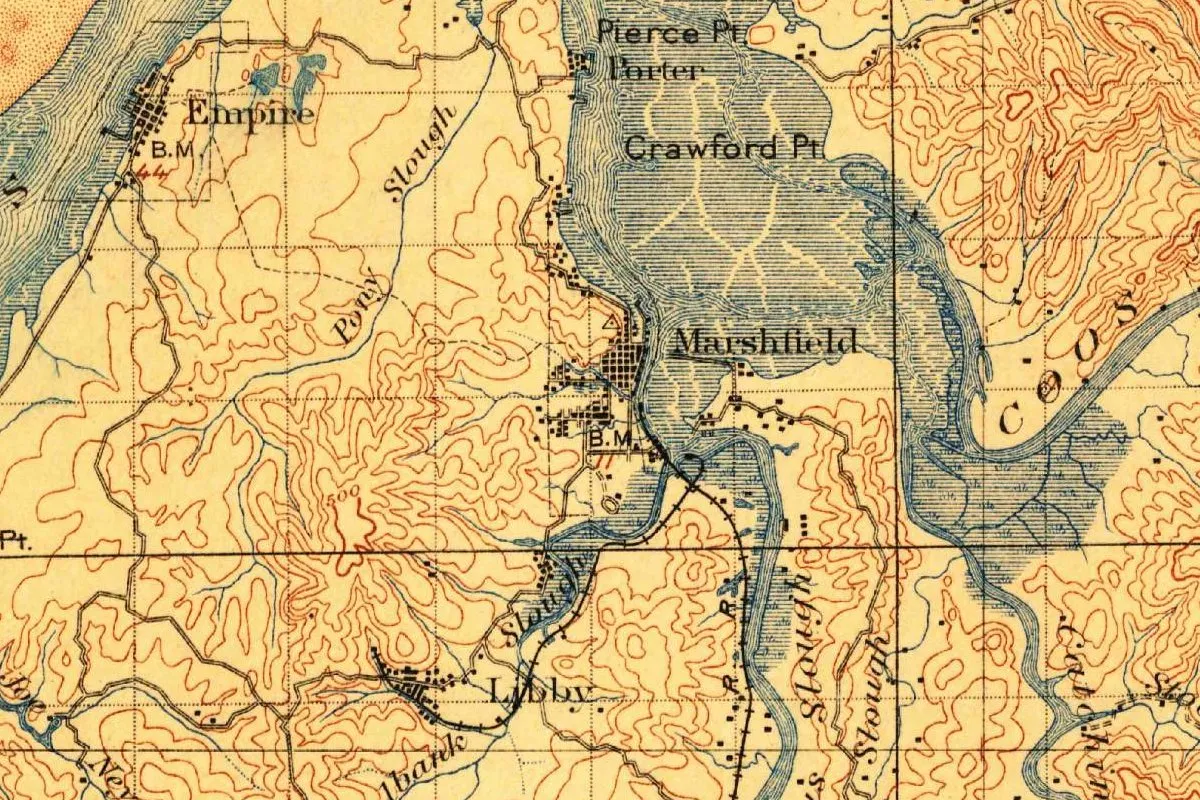
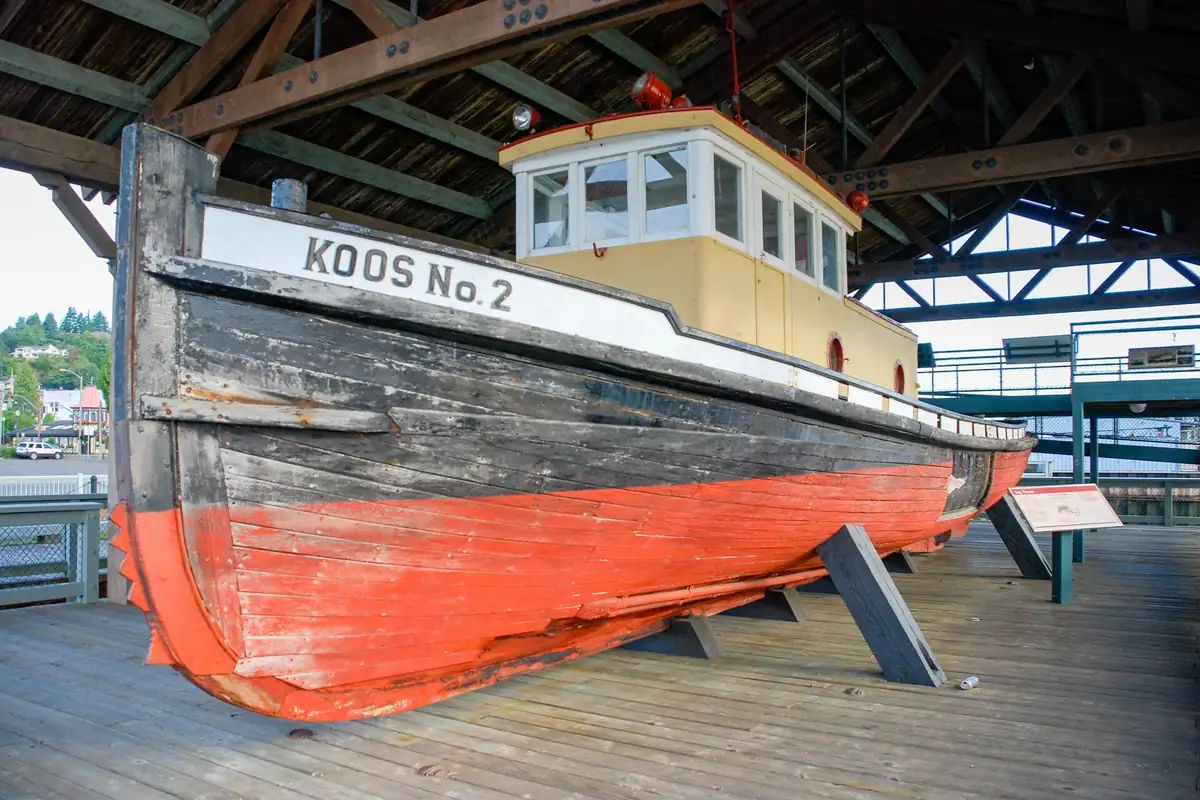
The map at the top of this page comes from the Geological Survey’s Coos Bay sheet, surveyed in 1895 and 1896 and first issued in May 1900. This copy is a reprint from October 1909. The town still carries its first name, Marshfield, a small grid on the edge of a wide tidal flat, with Empire across the hills to the northwest and a railroad heading south. The photo below shows the Koos No. 2, an old tow boat kept on the waterfront, with one of the spellings McArthur lists painted on its bow.
Quick answers
What was Coos Bay called before?
Marshfield. Voters adopted the name City of Coos Bay on November 7, 1944, and confirmed it on December 28, McArthur writes. The city dates the official change to February 15, 1945.
Why did Marshfield change its name to Coos Bay?
The city says residents picked the name of the community’s most prominent geographic feature, the bay. A 1943 plan to merge with North Bend under that name had failed.
What does Coos mean?
Sources differ. McArthur reports “lake” and “place of pines,” the Handbook of American Indians “lake,” “lagoon” or “inland bay,” and the city “South.”
How do you pronounce Coos Bay?
Merriam-Webster gives \ˈküs\ for Coos, said KOOS.
Key dates
- 1853Coos County is created on December 22, and Marshfield's founding is dated to this year by the city.
- 1854Marshfield is named about this year for the Massachusetts town, McArthur concludes.
- 1856A deed of March 11 describes land 'known and designated as the Marshfield claim.'
- 1867John Pershbaker starts lumber and shipbuilding at Marshfield.
- 1874Marshfield is incorporated on October 24.
- 1943A plan to merge Marshfield and North Bend as Coos Bay loses at the polls on November 16.
- 1944Marshfield adopts a new charter and the name City of Coos Bay on November 7, confirmed on December 28.
- 1945The city dates the official change to February 15; on March 23, Roosevelt renames the customs port.
Things to do in Coos Bay, Oregon
Coos History Museum
The museum's collections hold more than 50,000 objects and more than 250,000 images on the Coos region, from prehistory through the 1970s, with a special interest in its maritime history.
Shore Acres State Park
A formal garden on sandstone cliffs above the ocean, with a Japanese-style garden and lily pond and two rose gardens. An enclosed observation building stands where Louis J. Simpson built his mansion, and a trail leads to Simpson Beach.
Cape Arago State Park
A headland about 15 miles (24 km) southwest of Coos Bay, with tidepools in the south cove and views of the seals and sea lions on Shell Island. The north cove trail closes part of the year to protect seal pups.
South Slough National Estuarine Research Reserve
Nearly 7,000 acres (2,800 ha) of channels, wetlands and forest on the Coos estuary, with trails and a visitor center, managed by the Oregon Department of State Lands and NOAA. The Miluk Coos lived on South Slough, the tribes say.
Getting there
Open Coos Bay in Google Maps
Opens in a new tab. The pin is the center of Coos Bay in the USGS place-name record.
The closest airports, Amtrak stations and intercity bus stops, measured in a straight line from the center of Coos Bay.
Airports
- Southwest Oregon Regional (OTH) North Bend 4 mi 6 km
- Mahlon Sweet Field (EUG) Eugene 73 mi 117 km
Amtrak trains
- Eugene station (EUG) 74 mi 119 km
Intercity buses
- Pacific Crest Bus Lines Sutherlin Hospital Way 44 mi 71 km
Distances are as the crow flies, not by road. We don't list schedules or fares because they change; check with the airline, Amtrak or the bus company before you go. Official data (FAA commercial service airports (2025), FAA airport locations, Amtrak stations and Intercity Bus Atlas) from the FAA and the U.S. Bureau of Transportation Statistics, checked Nov 17, 2026.
Sponsored
Staying in Coos Bay?
Compare hotels in Coos Bay, Oregon, on Expedia.
See hotels in Coos BayWe may earn a commission if you buy through this link. It never changes what we write. Read our affiliate disclosure
Historical Sources & References
- Lewis A. McArthur, Oregon Geographic Names, 3rd ed. (1952), p. 146. The elections of 1944, “ninety years” of Marshfield, the name “taken from the natural feature,” the tribe, Lewis and Clark’s spelling, the meanings “lake” and “place of pines,” and Marple’s “coast.” Checked against the page image.
- McArthur, Oregon Geographic Names, 3rd ed. (1952), p. 387. Bennett’s and Cathcart’s accounts of Marshfield, the deed of 1856, Pershbaker in 1867 and the votes of 1943 and 1944. Checked against the page image.
- City of Coos Bay, “History”. Tolman’s hometown, “South,” the reason for the change, February 15, 1945, the Marshfield District and the incorporation of 1874.
- Executive Order 9533, The American Presidency Project. The customs port renamed on March 23, 1945.
- Frederick Webb Hodge, ed., Handbook of American Indians North of Mexico, Part 1 (1907), p. 737. “Lake,” “lagoon” or “inland bay.” Checked against the page image.
- Henry Gannett, The Origin of Certain Place Names in the United States (1905), p. 91. “Place of pines.” Checked against the page image.
- Confederated Tribes of Coos, Lower Umpqua and Siuslaw Indians, “History”. The Hanis and Miluk Coos and the landmarks named for the tribe.
- Oregon Secretary of State, “Coos County History & Records”. “Lake” or “place of the pines,” and the county’s creation in 1853.
- Merriam-Webster, “Coos Bay”. The pronunciation.
- Coos History Museum; Shore Acres State Park; Cape Arago State Park; South Slough Reserve. The details in the things-to-do list.
- GNIS feature ID 1166633 (U.S. Geological Survey). Coos Bay in the national gazetteer, in Coos County, with its coordinates.
- U.S. Geological Survey, Coos Bay sheet (1900, reprinted 1909). The 1:125,000 map that the image at the top of this page was cropped from.
Sponsored
Put this 1900 map on your wall
The 1900 USGS Coos Bay sheet, in a 1909 reprint, shows the town under its old name, Marshfield, and is in the public domain. Download the full-size scan for free, then have it printed on canvas with CanvasOnTheCheap.
Print a map on canvasDownload the full-size mapWe may earn a commission if you buy through this link. It never changes what we write. Read our affiliate disclosure
Spot something wrong, or know more? Tell us here. You can also email us or use our contact page. Corrections are noted here with their date, never made silently.