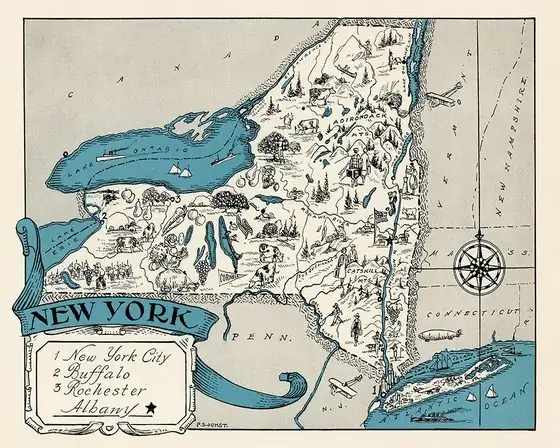
Binghamton, NY: Named for the Landlord of Chenango Point
Binghamton is named for William Bingham, a wealthy Philadelphia merchant who owned the land patent where the Chenango River meets the Susquehanna. The settlement was first called Chenango Point. Bingham gave lots for a courthouse and a school, and the name got its first legal recognition when the village was incorporated in 1834.
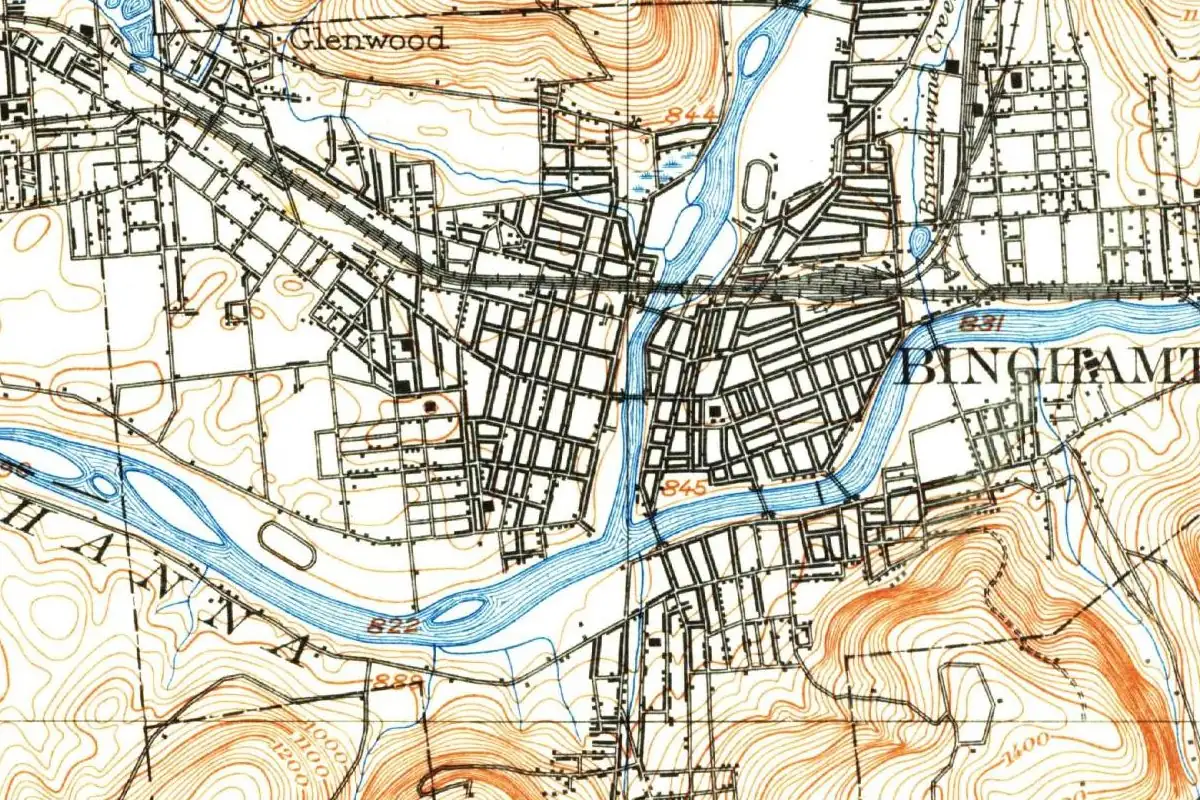
Chenango Point, where two rivers meet
Binghamton, New York, went by Chenango Point for years before it took the name of William Bingham, the Philadelphia merchant who owned the land. The old name was pure geography. The new one belonged to the landlord.
Look at the old map at the top of this page and you’ll see why the first name stuck. The Chenango River comes down from the north and runs into the Susquehanna right in the middle of town. The settlement grew on that point of land between them.
J. B. Wilkinson, who published The Annals of Binghamton in 1840, put it simply. The village “for a series of years was known only by the name of Chenango Point, and received its present name from the name of William Bingham, a gentleman of large estate, formerly residing in Philadelphia.”
There wasn’t much there at first. A history of Broome County edited by H. P. Smith in 1885 says that before 1799, “no village had been thought of” where the city now stands. It reprints a map of Chenango Point as it looked in 1797: a ferry over the Chenango, roads along the valleys, and the old treaty ground where a treaty with the Indians was made in 1786.
A landlord in Philadelphia
Bingham never had to live there to matter. His home and business were in Philadelphia. He held a large patent, a land grant, on both sides of the Susquehanna. The Advisory Council on Historic Preservation, a federal agency, puts it at 10,000 acres granted to “William Bingham, Esq. of Philadelphia.”
The people farming that land knew exactly who owned it. In 1798 most of the settlers on Bingham’s Patent hadn’t gotten title to their farms, so they drew up a petition and sent it to him in Philadelphia. Wilkinson copied it into his book:
“That whereas we, your petitioners, having been to considerable expense in moving on said land and making improvements, we pray your honor would grant us three lives lease, and we will pay an annual rent for the same…”
It’s dated “Chenango, Feb. 15, 1798,” and thirty-seven people signed it. A few others refused, Wilkinson adds, “contending that Bingham had no right to the land.” So you can see the relationship in one page. Before the town was named for him, Bingham was the man the settlers paid rent to, or argued with.
The man in the middle: Joshua Whitney
Bingham ran things from a distance, through an agent. Wilkinson says the first survey of the village was made in 1800, “under the direction of Mr. Bingham,” with the streets laid out at right angles. Bingham told his agent to sell the lots at reasonable prices and on easy terms, to draw settlers in. The village was surveyed again in 1808 by Roswell Marshall and in full in 1835 by William Wentz, whose work F. B. Tower turned into a map in 1836. By then it stretched about 2 miles (3 km) east to west and 1.5 miles (2.4 km) north to south.
That agent was Joshua Whitney, and Wilkinson gives him as much credit as the owner. It’s doubtful, he wrote, that Bingham would have done “the half he actually did” without General Whitney. To Whitney’s “sound policy, liberal views and foresight” he credits the village’s quick growth.
Bingham also gave land outright. When the village was chosen as the county seat, he deeded a lot for the courthouse to the county for free, plus a lot for a public school. Broome County itself was set off from Tioga County in 1806 and named for John Broome, a New York City merchant who was lieutenant governor at the time. Bingham died in 1804, only four years after that first survey.
When “Binghamton” became official
None of these sources gives a day when the new name caught on, or an act that renamed Chenango Point. What Smith’s 1885 history found in the paperwork is a slow switch. The court records call the place “Chenango Point” until 1817, and then the “town of Chenango in the county of Broome” until 1834.
“The first legal recognition of the name,” Smith writes, “occurs in the act incorporating the village, May 3d, 1834.” The federal preservation write-up gives the same year for incorporation. Six years later, Wilkinson’s book used Binghamton throughout and treated Chenango Point as the old name.
Smith calls Bingham “the patentee from whom Binghamton received its name.” Henry Gannett’s 1905 government list of name origins agrees in one line: the city in Broome County is named for William Bingham of Philadelphia, “a benefactor of the town.” Three books across 65 years, and none of them offers anyone else.
From canal town to Parlor City
The village grew fast once the water came. The Chenango Canal, begun in 1834 and finished in 1837, connected with the Erie Canal at Utica and ended at Binghamton, Wilkinson notes. The Erie Railroad arrived in 1848, according to the federal account.
Factories followed, turning out cigars, clothing, furniture and shoes, and the money built opera houses, theaters, libraries and big Victorian homes. That’s where the nickname “The Parlor City” came from, the preservation agency says. Binghamton picked up a second name that described the place, after giving up the first one that did. The point itself never went anywhere. On the 1904 map, and in New York today, the Chenango still runs into the Susquehanna right downtown.
Quick answers
Who is Binghamton, New York, named after?
William Bingham, a wealthy Philadelphia merchant who owned the land patent the town was built on. Wilkinson’s 1840 Annals of Binghamton and Gannett’s 1905 entry both name him.
What was Binghamton called before?
Chenango Point. Wilkinson wrote in 1840 that the village “for a series of years was known only by the name of Chenango Point,” and the county’s court records used that name until 1817.
Did William Bingham live in Binghamton?
No. He lived in Philadelphia and managed his land through his agent, Joshua Whitney. He gave lots for the courthouse and a school, and he died in 1804.
When did Binghamton get its name officially?
In 1834. Smith’s 1885 county history says the first legal recognition of the name came in the act incorporating the village on May 3, 1834.
Key dates
- 1798On February 15, 37 settlers on Bingham's Patent sign a petition to William Bingham in Philadelphia asking for leases.
- 1800The first survey of the village is made under Bingham's direction, with streets laid out at right angles.
- 1806Broome County is set off from Tioga County, named for Lieutenant Governor John Broome.
- 1834The act incorporating the village, passed May 3, is the first legal recognition of the name Binghamton.
- 1837The Chenango Canal, begun in 1834, is finished, ending at Binghamton.
- 1848The Erie Railroad reaches Binghamton.
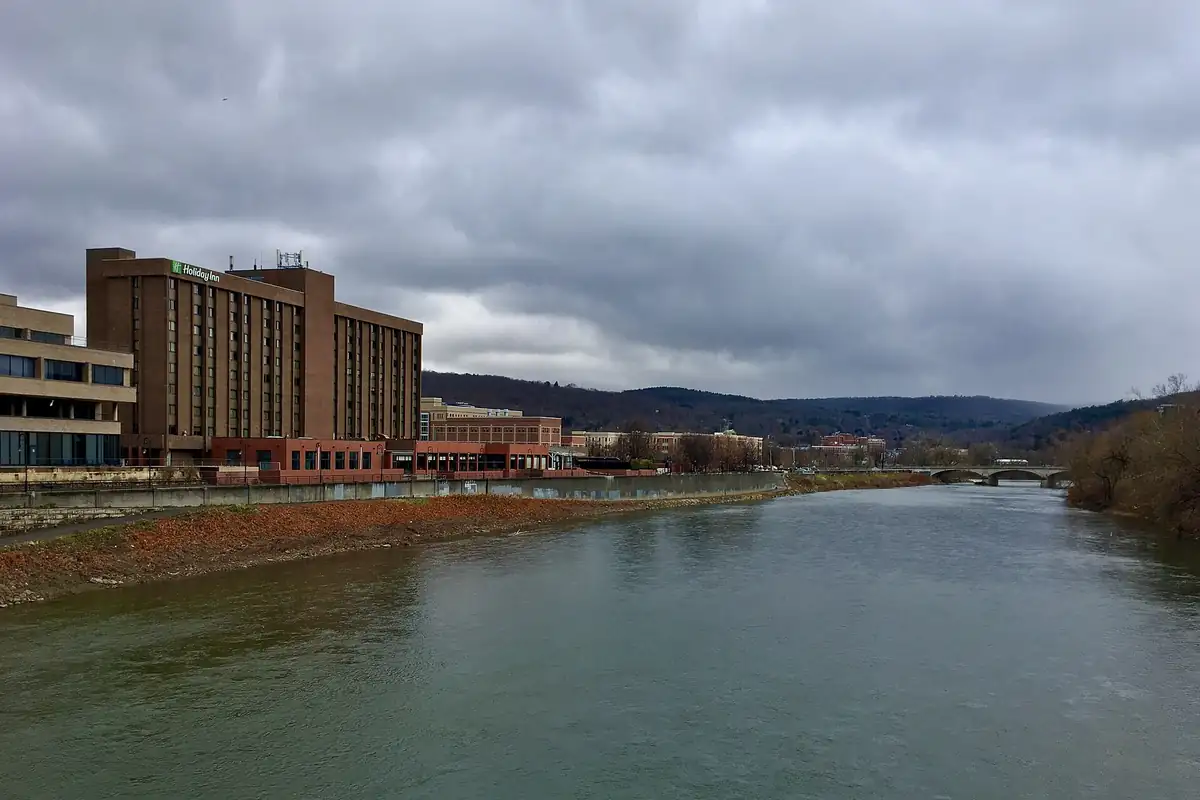
Things to do in Binghamton, New York
Binghamton's antique carousels
Greater Binghamton bills itself as the Carousel Capital of the World, with six antique carousels in its parks. They've been free to ride for more than 80 years, thanks to George F. Johnson of the Endicott Johnson Shoe Co.
Phelps Mansion Museum
Built in 1870 for Sherman David Phelps, a businessman and onetime mayor, this Second Empire house by architect Isaac G. Perry is the last mansion left on Court Street's old Mansion Row.
Roberson Museum
Galleries with rotating historical and contemporary art exhibitions, together with a historic Gilded Age mansion, on Front Street in Binghamton.
Ross Park Zoo
Set on the northern face of Binghamton's South Mountain, the zoo officially opened in 1875 and calls itself the fifth-oldest zoological institution in the country.
Getting there
Open Binghamton in Google Maps
Opens in a new tab. The pin is the center of Binghamton in the USGS place-name record.
The closest airports, Amtrak stations and intercity bus stops, measured in a straight line from the center of Binghamton.
Airports
- Greater Binghamton/Edwin A Link Field (BGM) 8 mi 13 km
- Ithaca Tompkins International (ITH) 39 mi 62 km
- Newark Liberty International (EWR) 133 mi 214 km
Amtrak trains
- Syracuse station (SYR) 69 mi 111 km
- New York State Fair station (NYF) 69 mi 111 km
Intercity buses
- FlixBus Binghamton Bus Station under 1 mi 0.7 km
- ShortLine Hudson Binghamton ShortLine Terminal under 1 mi 0.7 km
- Adirondack Trailways Trailways · Binghamton under 1 mi 0.7 km
Distances are as the crow flies, not by road. We don't list schedules or fares because they change; check with the airline, Amtrak or the bus company before you go. Official data (FAA commercial service airports (2025), FAA airport locations, Amtrak stations and Intercity Bus Atlas) from the FAA and the U.S. Bureau of Transportation Statistics, checked Nov 13, 2026.
Sponsored
Staying in Binghamton?
Compare hotels in Binghamton, New York, on Expedia.
See hotels in BinghamtonWe may earn a commission if you buy through this link. It never changes what we write. Read our affiliate disclosure
Historical Sources & References
- J. B. Wilkinson, The Annals of Binghamton (1840), pp. 12-15 and 89. Chenango Point as the old name and Bingham as the source of the new one, Broome County and John Broome (p. 12); the free lots for the courthouse and school and Joshua Whitney’s role (pp. 12-13); the 1800 survey, Bingham’s death in London in 1804 and the later surveys of 1808 and 1835 (p. 14) and the village’s size (pp. 14-15); the canal of 1834-1837 (p. 12); the settlers’ petition of February 15, 1798, its 37 signers and the objectors (p. 89).
- H. P. Smith (ed.), History of Broome County (1885), pp. 197-198 and 205. No village before 1799 and the 1797 map of Chenango Point (pp. 197-198); Bingham as “the patentee from whom Binghamton received its name,” the court records’ use of Chenango Point until 1817 and the first legal recognition of the name on May 3, 1834 (p. 205).
- Henry Gannett, The Origin of Certain Place Names in the United States (USGS, 1905), p. 47. Binghamton named for William Bingham of Philadelphia, “a benefactor of the town.”
- Advisory Council on Historic Preservation, “Binghamton, New York”. The 10,000 acres granted to William Bingham of Philadelphia, incorporation in 1834, the Chenango Canal of 1837, the Erie Railroad of 1848, the factories and “The Parlor City.”
- GNIS feature 943985 (U.S. Geological Survey). How the national names database lists Binghamton: a populated place in Broome County, record 943985.
- U.S. Geological Survey, Binghamton sheet (1904). The 1:62,500 quadrangle that the old map of the river junction was cut from.
Spot something wrong, or know more? Tell us here. You can also email us or use our contact page. Corrections are noted here with their date, never made silently.