Why Is It Called Sag Harbor, NY? The Harbor of Sagg
Sag Harbor is short for the Harbor of Sagg, the port used by farmers from Sagaponack, to the south. Sagg is a clipped form of Sagaponack, a Native name. In 1883 W. S. Pelletreau, following J. Hammond Trumbull, read it as a place where big ground nuts grow; William Wallace Tooker agreed about the ground nuts.
Sag Harbor, New York, was the Harbor of Sagg, the landing for Sagaponack, and its name keeps a piece of an Algonquian word about ground nuts.
Why is it called Sag Harbor, New York?
The harbor was named for the people who used it. Munsell’s 1882 History of Suffolk County explains that goods for the Town of Southampton used to land at North Sea, but as Sagaponack and Mecox filled up with farmers, they needed a closer port. That port became Sag Harbor, called for years “Sagaponack Harbor” and “The Harbor of Sagg.” The Village of Sag Harbor tells it the same way: Sagaponack, to the south, shipped its goods from this harbor and gave it both names.
Sagg was the everyday short form. William Wallace Tooker’s Indian Place-Names on Long Island (1911) says the Sagaponack area was known for years simply as Sagg, and that Sag Harbor, directly north, took its name from it. In 1889, he adds, the Sagg post office was renamed Sagaponack. French’s 1860 gazetteer still lists Sagg as a hamlet of Southampton.
Munsell found the name Sag Harbor in 1707, in the Southampton trustees’ book, in a clerk’s charge for a trip there. The village says the Southampton records first name it in 1709.
Sagaponack is the Native name, and its meaning comes with names attached. Tooker quotes W. S. Pelletreau, who in 1883 gave it as “a place where big ground nuts grow,” a reading he got from Dr. J. Hammond Trumbull. Tooker adds a note from a writer named Rand that sagabon, Micmac segubun, is “a ground nut or Indian potato.” William Beauchamp’s 1907 state museum bulletin repeats Trumbull: Sag Harbor is shortened from Sagabonack, in Bridgehampton.
Tooker kept the ground nuts but read the first part of the word differently. He thought the first part, sagga, matched a Cree word meaning thick or close together, which suited the plant’s tubers growing in strings. A 1905 Geological Survey bulletin by Henry Gannett kept it simpler: Sagg comes from sagaporack, a place where ground nuts grow.
The village had another Native name, and it isn’t Sagg. The Village of Sag Harbor says the earliest people here called the place Weg-wag-onuch, from words meaning “the land or place at the end of the hill,” and that neighboring villages called it the Great Meadows.
Tooker did the detective work on that one. He traced Wegwagonuck through East Hampton records, starting with a 1698 release that left Joseph Stretton a share of the meadow nearest Hog Neck, and showed that it meant the East Hampton side of Sag Harbor, the part east of Division Street, which was the line between East Hampton and Southampton. He read it as Wequae-adn-auke, “place at the end of the hill,” probably Sleights Hill. At the foot of that hill, he wrote, were the remains of a large shell heap, or village site.
Sag Harbor, NY history
French says a few fishermen made the first settlement in 1730. Munsell says the Russell family was on Hog Neck by 1727, and that Samuel Russell’s house of 1745, on the later site of the railroad depot, was the first in Sag Harbor itself. The village dates its first land subdivisions to 1738 and 1745.
The Revolution reached the harbor in 1777. Col. Return Jonathan Meigs led 130 men in a surprise attack on the British at Sag Harbor on the morning of May 24, French says, and got back across the Sound without losing anyone. The village dates the expedition’s departure to May 21.
Several of the big dates don’t match between sources. French says it became a village on March 12, 1819, after serving as a fire district from 1803. The village’s own history cites Chapter 42 of the Laws of 1846, passed March 26, 1846, which made the Port of Sag Harbor a village. French dates the port of entry to 1784, while the village cites an act of Congress of July 31, 1789. The village says whaling thrived from 1760 to 1850, then faded with the gold rush, the oil strikes in Pennsylvania and fewer whales, and that the Bulova watchcase plant, one of the last factories, left in 1981.
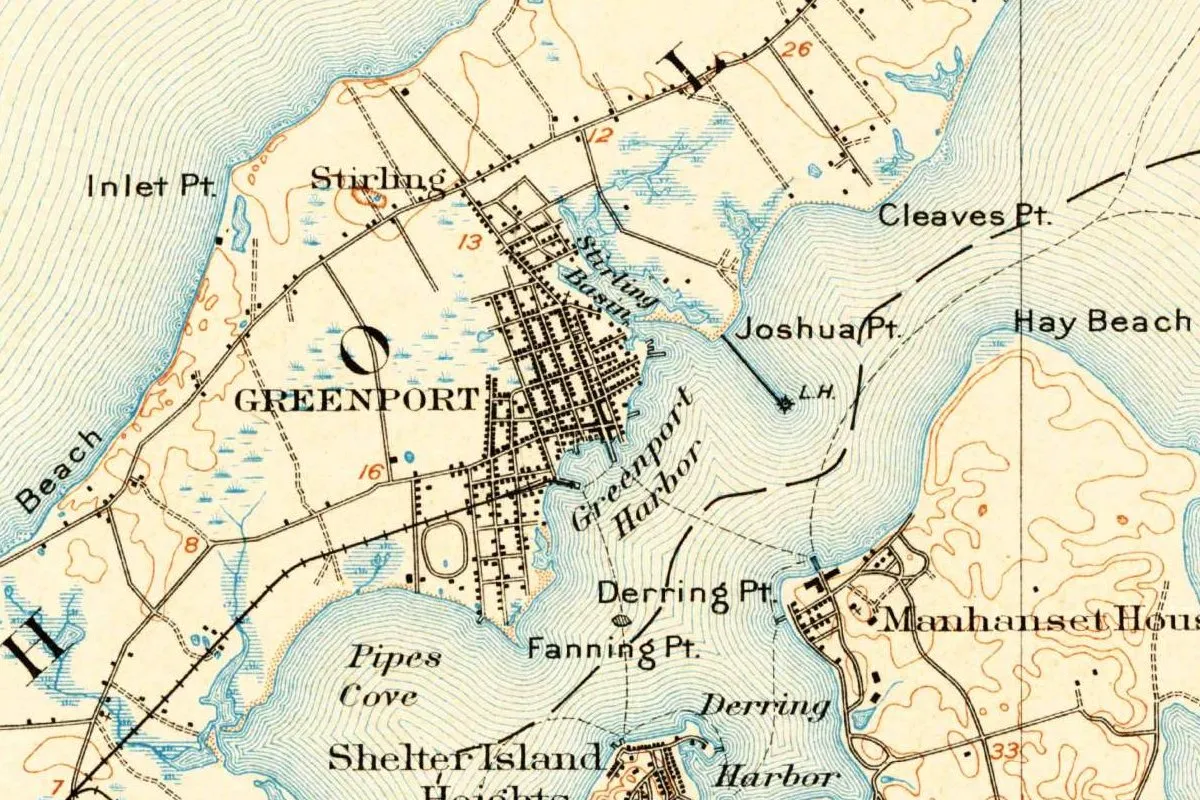
Whaling ties Sag Harbor to the New England coast. Joseph Rotch, a whaling merchant from Nantucket, suggested the Bedford in the name of New Bedford, Massachusetts. And Trumbull, the scholar behind the ground-nut reading, also read the Mohegan name of the river at Mystic, Connecticut, as “great tidal river.” Across the bay on the North Fork, Greenport took its name from Green Hill, a bank by its harbor.
Sag Harbor on the 1904 maps
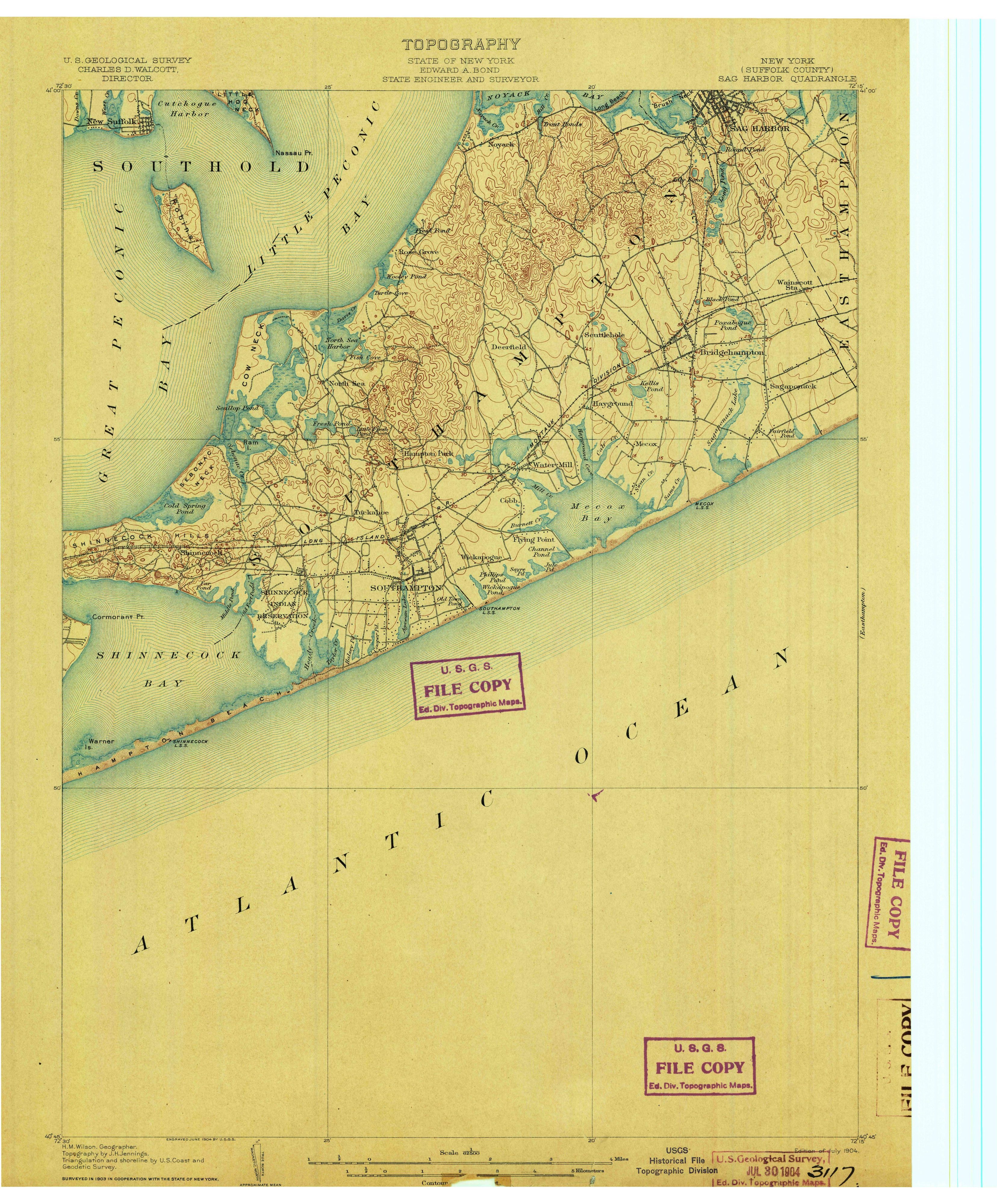
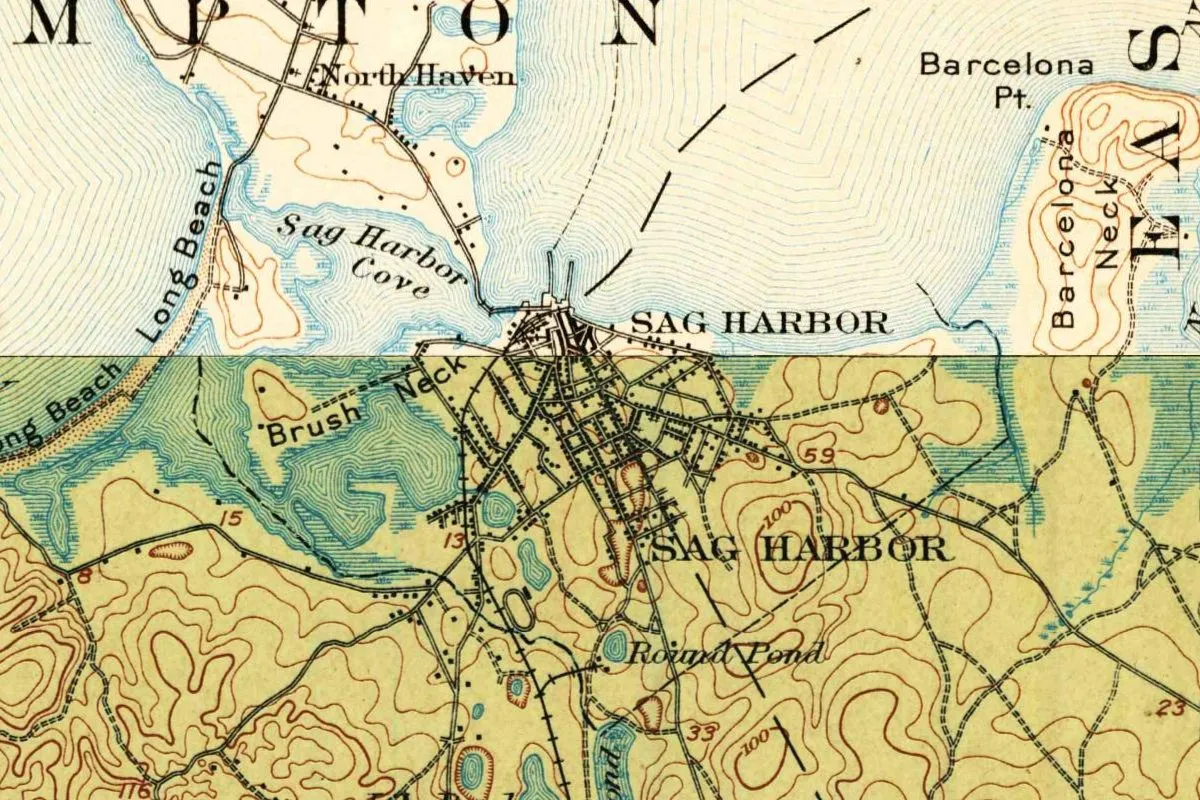
Sag Harbor sits across the seam of two Geological Survey sheets, and the map at the top stitches them together. Its southern half is from the Sag Harbor quadrangle, a 1:62,500 sheet surveyed in 1903, engraved in June 1904 and printed as the “Edition of July 1904”; a stamp on the scanned copy reads July 30, 1904. Its margin credits topography to J. H. Jennings and triangulation and shoreline to the U.S. Coast and Geodetic Survey, and names H. M. Wilson as geographer and Edward A. Bond as state engineer. The northern half is cut from the Shelter Island quadrangle, “Edition of Nov. 1904.”
You can see the seam where the paper color changes, and each sheet prints SAG HARBOR once. Look for Sag Harbor Cove and North Haven to the northwest, Brush Neck and Long Beach to the west, Barcelona Neck to the east and Round Pond south of town. The big partial letters are pieces of the names Southampton and East Hampton, the two towns the village straddles.
Quick answers
What does Sag mean in Sag Harbor, New York?
Sag, or Sagg, is short for Sagaponack, the farming area to the south whose harbor this was. Sagaponack is a Native name read as a place where ground nuts grow.
What was Sag Harbor, New York, called before?
Sagaponack Harbor and the Harbor of Sagg. The East Hampton side was Wegwagonuck, and neighbors called the area the Great Meadows.
Is Sag Harbor, New York, in Southampton or East Hampton?
Both. French counted 2,041 of its people in Southampton and 735 in East Hampton in 1860, and Tooker says Division Street was the line.
Key dates
- 1698Joseph Stretton inherits a share of the meadow nearest Hog Neck, later shown to be Wegwagonuck, on the East Hampton side.
- 1707Southampton's trustees' book charges a fee "for going to Sag Harbor," the first use of the name Munsell found.
- 1745Samuel Russell has a house on the later railroad depot site, the first settlement in Munsell's account.
- 1777May 24: Col. Return Jonathan Meigs's men surprise the British force at Sag Harbor, by French's date; the village says the expedition set off on May 21.
- 1789July 31: Congress makes Sag Harbor a port of entry, the village says; French gives 1784.
- 1803Sag Harbor becomes a fire district, with what the village calls the state's first fire department.
- 1846March 26: Chapter 42 of the Laws of 1846 incorporates the Port of Sag Harbor as a village; French gave an earlier date, 1819.
- 1889The post office called Sagg, to the south, is renamed Sagaponack, Tooker says.
Things to do in Sag Harbor, New York
Sag Harbor Whaling & Historical Museum
A museum since 1936, now in the Benjamin Huntting House at 200 Main Street, built in 1845 for $7,000 as the home of the whaling ship owner Benjamin Huntting II.
Sag Harbor Historical Museum
The Annie Cooper Boyd House at 174 Main Street, on Captain's Row, bought in 1871 by the Cooper family of whaleboat builders and donated in 1998.
Custom House
The house of Henry Packer Dering, one of the port's first U.S. customs collectors, moved in 1948 to save it and owned since 1966 by Preservation Long Island; tours can be booked on request.
Sag Harbor Cinema
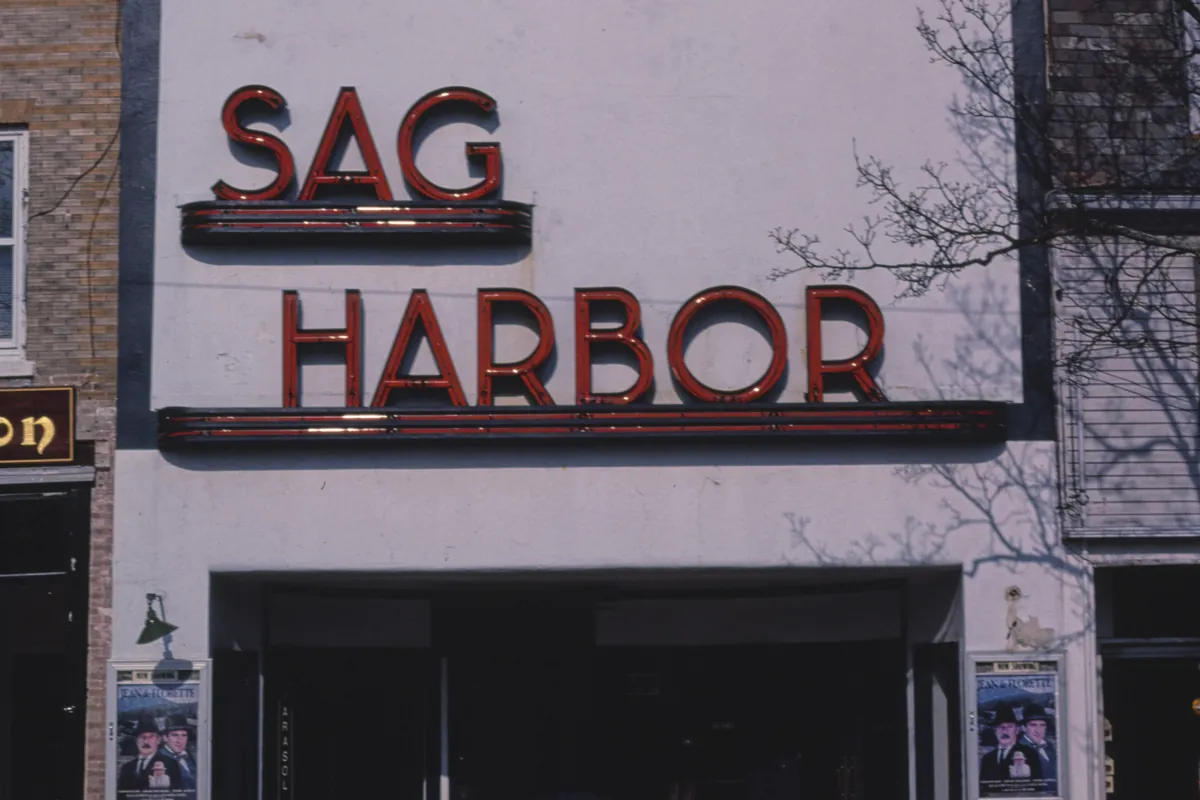
The movie house John Eberson designed, known for its neon sign, burned on December 16, 2016, and was rebuilt with three screens.
Historical Sources & References
- Village of Sag Harbor, History. Weg-wag-onuch, the Great Meadows, Sagaponack Harbor and the Harbor of Sagg, the first mention in 1709, the subdivisions, the act of 1846, the port of 1789, the fire department of 1803, Meigs setting off on May 21, 1777, and the whaling years.
- William Wallace Tooker, The Indian Place-Names on Long Island (1911), pp. 221-223 and 283-285. Sagaponack and Sagg, the post office of 1889, Pelletreau and Trumbull’s reading and Tooker’s own, and Wegwagonuck.
- William M. Beauchamp, Aboriginal Place Names of New York (1907), p. 222. Sag Harbor shortened from Sagabonack, after Trumbull.
- J. H. French, Gazetteer of the State of New York (1860), pp. 638-639. The fire district of 1803, the village of 1819, the port of 1784, the population split, the hamlet of Sagg, the settlement of 1730 and Meigs’s raid.
- History of Suffolk County (Munsell, 1882), Town of Southampton, p. 35. Sagaponack Harbor, the trustees’ entry of 1707 and the Russell house of 1745.
- Henry Gannett, The Origin of Certain Place Names in the United States (1905), p. 269. Sagg from sagaporack.
- Sag Harbor Whaling & Historical Museum, the Sag Harbor Historical Museum, Preservation Long Island’s Custom House and the Sag Harbor Cinema. The details in the things-to-do list.
- U.S. Geological Survey, GNIS feature 963216. The village’s federal record.
- Sag Harbor quadrangle, edition of July 1904 and Shelter Island quadrangle, edition of November 1904. The two sheets the map at the top was joined and cropped from.
Sponsored
Put this 1904 map on your wall
The Geological Survey's Sag Harbor sheet, surveyed in 1903 and printed in July 1904, with the old whaling port split between Southampton and East Hampton. It is in the public domain: download the full-size scan for free, then have it printed on canvas with CanvasOnTheCheap.
Print a map on canvasDownload the full-size mapWe may earn a commission if you buy through this link. It never changes what we write. Read our affiliate disclosure
Spot something wrong, or know more? Tell us here. You can also email us or use our contact page. Corrections are noted here with their date, never made silently.