Yonkers, New York, Is Named for a Dutch Title, Not a Name
Yonkers, New York, comes from the Dutch title Youncker, or jonkheer, roughly a young gentleman or squire. Adriaen van der Donck, who got a huge land grant north of Manhattan in 1646, was known as the Youncker. His land became the Youncker's Land, then simply Yonkers, a name the New York Legislature adopted for the town in 1788.
A title, not a surname
Yonkers, New York, isn’t named for anyone’s last name but for Youncker, a Dutch title for a young gentleman that people gave Adriaen van der Donck. He was the man who held a huge grant of land north of Manhattan in the 1640s, and the title stuck to the land long after he was gone.
The Historical Society of the New York Courts tells his story. Van der Donck, the son of a prosperous burgher of Breda, was studying law at Leiden when he signed on with Kiliaen van Rensselaer’s colony at Rensselaerswyck, and he sailed to New Netherland in 1641. In 1645 he acted as translator and go-between in Director Willem Kieft’s peace talks with the Mohawk, and in return he got a patent for 24,000 acres on the mainland north of Manhattan, running from Spuyten Duyvil Creek to beyond today’s Yonkers. He called his estate Colendonck, which Edward Hagaman Hall’s 1912 history translates as “Donck Colony.” People had another name for the man himself.
“The Youncker” in the Dutch records
Edward Floyd De Lancey, writing the chapter on manors for a big 1886 history of Westchester County, went looking for the first time anyone used the title. He found it in a reference to something that happened in 1645, about four years after Van der Donck arrived in America. Then he spelled out what it meant for the city:
“The term is simply a corruption of “Jonkheer,” son of a gentleman. It is of interest, for, from this title so given to him who became in the succeeding year, 1646, the Patroon of Colen-Donck, is derived the name which that Patroonship, in common parlance, ever afterwards bore…”
In other words, the patroonship carried his title in everyday talk, not the name he’d given it.
Hall’s 1912 book adds the paper trail. A summons from the Director and Council of New Netherland, dated January 2, 1646, calls him “The Youncker.” On April 12, 1646, Dutch records name him “Yoncker Adriaen Verdonck.” Hall says the word is spelled “Jonker” or “Jonkheer” in modern Dutch, comes from roots meaning young and gentleman, and is defined in a Dutch dictionary as “messire, country squire or young nobleman (eldest son to a noble family).” English had the word too: Hall quotes Spenser’s Faerie Queene, “But that same younker soone was overthrowne.”
From the Youncker’s Land to Yonkers
Van der Donck died in 1655, but his title kept working. Hall writes that his property was sometimes called “de Jonkheer’s Landt” and sometimes “the Younckers Land.” A council minute of November 6, 1668, about a land dispute, mentions “the Youncker’s Land” and the land “that was the Youncker Van der Donck’s.” Over time, Hall says, those phrases “became shortened in the course of time to simply Younckers,” and by 1734 the place was “commonly called Yonkers.” In 1788 the Legislature formally adopted the name for the town.
Here’s where the two old histories don’t quite line up. Hall says that while the Philipse family held the land, it was “frequently called by their name.” A footnote in the King’s Bridge chapter of the 1886 county history goes further: it says the name wasn’t applied to any part of present-day Yonkers until the township was created in 1788. Before that, according to the footnote, “the Yonkers” was a precinct covering most of King’s Bridge township, and present-day Yonkers was called Phillipsburgh. Either way, you end up in the same place: the title came first, and the town got it officially in 1788.
What about the manor house?
If you check Henry Gannett’s 1905 federal guide to American place names, you’ll find a slightly different version. Gannett says Yonkers was “named for a manor house built by the Dutch,” with the word meaning “young lord” and first used here for “Adrien Van der Douck, a patentee.” He agrees on the word and the man. The manor house is where he differs: neither De Lancey nor Hall ties the name to a building. They tie it to the way people addressed one young lawyer.
That’s the odd part of the story. The Philipse family later held the land long enough for it to carry their name for a while, and Van der Donck’s own name for his colony faded. What survived was a polite form of address, passed along for a few hundred years until it became the name of a city.
Quick answers
What does Yonkers mean?
It comes from the Dutch title Youncker, spelled jonker or jonkheer in modern Dutch. Hall’s 1912 history defines it as “country squire or young nobleman,” De Lancey as “son of a gentleman,” and Gannett as “young lord.”
Who is Yonkers named after?
Adriaen van der Donck, though not by his name. People called him the Youncker, and his land became the Youncker’s Land.
When did Yonkers get its name?
By 1734 the place was “commonly called Yonkers,” according to Hall. The New York Legislature formally adopted the name for the town in 1788.
Was Yonkers named after a manor house?
Gannett’s 1905 guide says so, but the histories by De Lancey (1886) and Hall (1912) trace the name to Van der Donck’s title, not to a building.
Key dates
- 1641Adriaen van der Donck sails to New Netherland to serve Kiliaen van Rensselaer's colony at Rensselaerswyck.
- 1645Van der Donck helps negotiate Director Kieft's peace with the Mohawk; the earliest known reference to him as the Yoncker concerns this year.
- 1646January 2: a Dutch summons calls him The Youncker. That year he receives the patent for the land he names Colendonck.
- 1655Van der Donck dies.
- 1668November 6: a council minute about a land dispute refers to the Youncker's Land.
- 1734The place is commonly called Yonkers, according to a quotation in Edward Hagaman Hall's 1912 history.
- 1788The New York Legislature formally adopts the name Yonkers for the town.
Getting there
Open Yonkers in Google Maps
Opens in a new tab. The pin is the center of Yonkers in the USGS place-name record.
The closest airports, Amtrak stations and intercity bus stops, measured in a straight line from the center of Yonkers.
Airports
- Laguardia (LGA) New York 11 mi 17 km
- Westchester County (HPN) White Plains 14 mi 22 km
Amtrak trains
- Yonkers station (YNY) under 1 mi 0.6 km
- New Rochelle station (NRO) 6 mi 10 km
Intercity buses
- Rockland Coaches Rte 9W & Closter Dock Rd 2 mi 3 km
- ShortLine Hudson W 179th St & Broadway 6 mi 10 km
- Greyhound New York US-9 6 mi 10 km
Distances are as the crow flies, not by road. We don't list schedules or fares because they change; check with the airline, Amtrak or the bus company before you go. Official data (FAA commercial service airports (2025), FAA airport locations, Amtrak stations and Intercity Bus Atlas) from the FAA and the U.S. Bureau of Transportation Statistics, checked Nov 13, 2026.
Sponsored
Staying in Yonkers?
Compare hotels in Yonkers, New York, on Expedia.
See hotels in YonkersWe may earn a commission if you buy through this link. It never changes what we write. Read our affiliate disclosure
Historical Sources & References
- Edward Floyd De Lancey, “The Origin and History of Manors,” in J. Thomas Scharf, ed., History of Westchester County, vol. 1 (1886). Page 66: the earliest mention of “the Yoncker,” for a matter of 1645, the term as “a corruption of ‘Jonkheer,’ son of a gentleman,” and the name of the patroonship. Page 744 (King’s Bridge chapter, footnote): the name not applied to present-day Yonkers until 1788, and Phillipsburgh before that.
- Edward Hagaman Hall, Philipse Manor Hall at Yonkers, N.Y. (1912), pp. 32-33. Colendonck as “Donck Colony,” the summons of January 2, 1646, “Yoncker Adriaen Verdonck,” the Dutch dictionary definition, Spenser’s “younker,” the council minute of 1668, “commonly called Yonkers” by 1734, the Philipse name and the Legislature’s adoption of Yonkers in 1788.
- Henry Gannett, The Origin of Certain Place Names in the United States (USGS, 1905), p. 333. Yonkers “named for a manor house built by the Dutch,” the word meaning “young lord,” first applied to Van der Donck.
- Historical Society of the New York Courts, “Adriaen van der Donck”. His life (1620-1655), Breda and Leiden, the 1645 Mohawk peace talks, the 24,000-acre patent of 1646 from Spuyten Duyvil Creek to beyond Yonkers, Colendonck, and the title “Jonkheer” as the origin of the city’s name.
- GNIS feature 971828 (U.S. Geological Survey). The Yonkers listing as a populated place in Westchester County, with its coordinates.
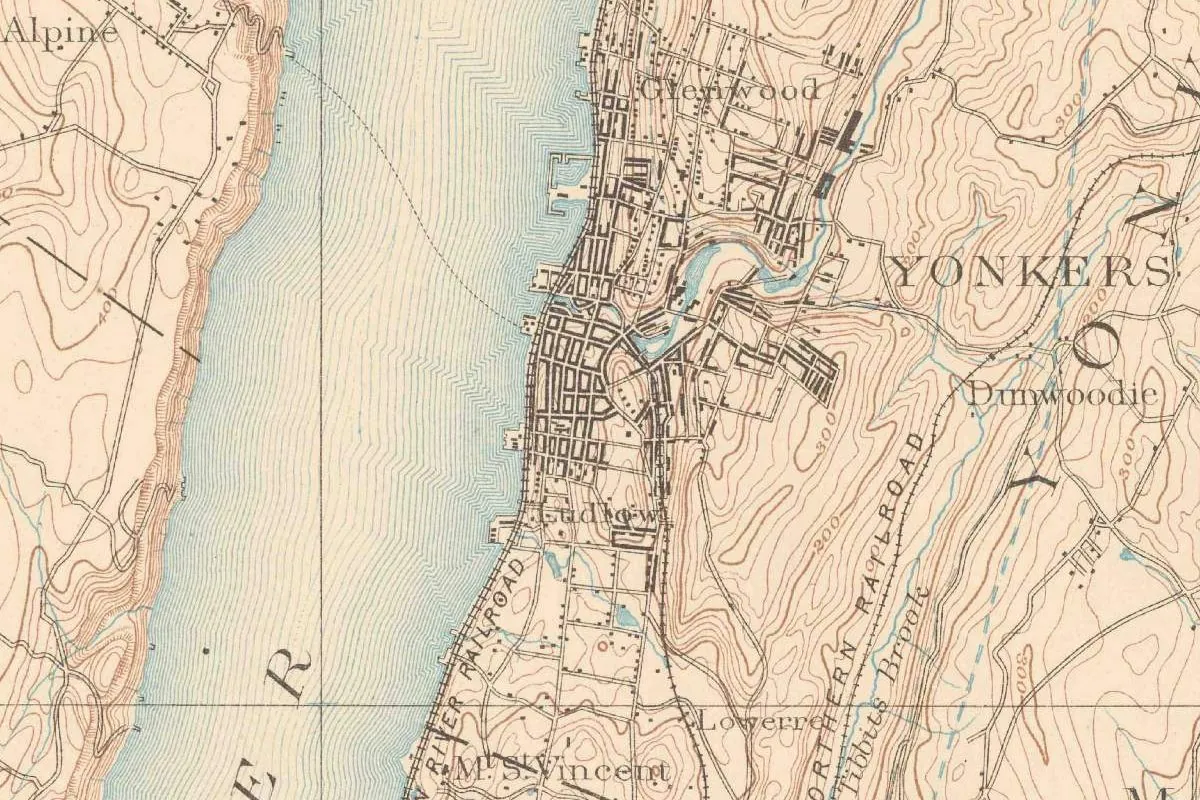
- U.S. Geological Survey, Harlem sheet (1891). The source of the map at the top of this page.
Spot something wrong, or know more? Tell us here. You can also email us or use our contact page. Corrections are noted here with their date, never made silently.