Schenectady, New York: A Name That Started Out as Albany's
Schenectady's name is Iroquois and first belonged to Albany, according to William Beauchamp's 1907 study and the City of Schenectady, which says the Mohawk used it for the settlement at Fort Orange. It's usually translated 'beyond the pines' or 'over the pine plains,' but Beauchamp thought it might just mean 'on the other side.'
A name borrowed from down the road
Schenectady, New York, carries a Mohawk name first used for the Dutch settlement at Fort Orange, today’s Albany, before it moved to the Mohawk River. The City of Schenectady’s own history says it, and so did a New York State Museum study of Indian place names back in 1907.
The city’s version is short. When Dutch settlers reached the Hudson Valley in the middle of the 1600s, it says, the Mohawk called the settlement at Fort Orange “Schau-naugh-ta-da,” meaning “over the pine plains.” The Dutch picked the word up, “but the meaning was reversed,” and the name came to mean the bend in the Mohawk River where the city stands today.
Beauchamp’s “properly the name of Albany”
William M. Beauchamp wrote that study, Aboriginal Place Names of New York, which the museum printed as one of its bulletins. Under Schenectady County he put it plainly: “Schen-ec-ta-dy was properly the name of Albany, but was soon placed here, being equally significant in coming from the east.”
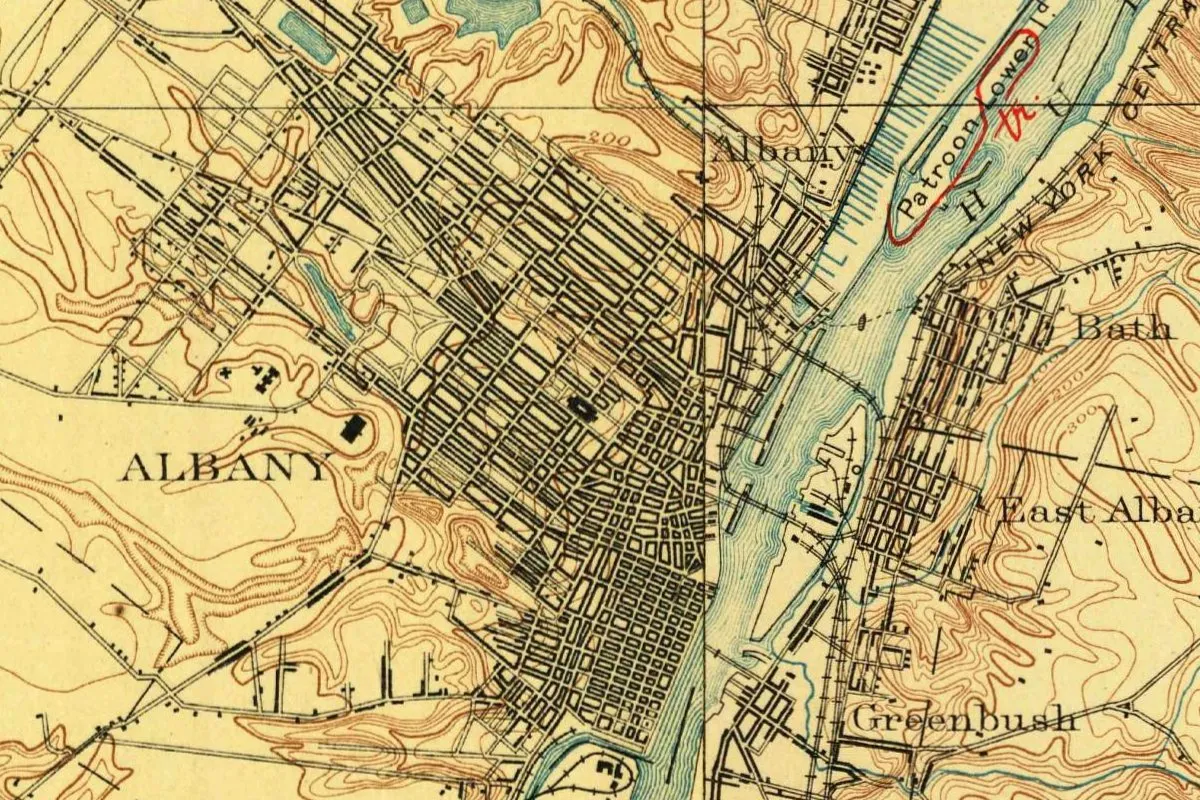
He came back to the same idea in his Albany County section. There he lists Ska’-neh-ta’-de, “beyond the openings,” as Morgan’s Iroquois name for Albany, “afterward transferred to Schenectady, where it was equally appropriate.” So the city and Beauchamp agree on the big point: the name started at Albany and moved west. They just explain the move a little differently.
Pines, plains or “the other side”
Ask what the word means and you’ll get a stack of answers. Beauchamp collected them, and it’s worth seeing who said what.
- Spafford said the name was originally applied to Albany, “pronounced by the Indians Schagh-nack-taa-da,” and meant “beyond the pine plains.” In his 1813 edition he made it “over the pines.”
- Morgan gave “beyond the openings.”
- A Dr. Mitchill said he’d learned that Skenectadea, or Albany, “signifies the place the nations of the Iroquois arrived at by traveling beyond the pine trees.”
- Other writers had Skaghnetade, “beyond the pines,” and Skaneghtada, “end of pine woods.”
- David Cusick called it Shaw-na-taw-ty, “beyond the pineries,” and Beauchamp says the Onondagas gave “essentially the same definition.”
Spafford had an explanation for all those pines. “The country between these two places is a sandy plain, thickly covered with pine trees,” he wrote, according to Beauchamp. That’s the stretch between Albany and Schenectady.
Henry Gannett’s two-line Schenectady entry, printed by the Geological Survey in 1905, keeps both flavors. It gives the name as “over beyond the plains” or “river valley beyond the pine trees.” The city’s “over the pine plains” fits right into that family.
Beauchamp, though, went one step further. Among Mohawk words, he notes, Bruyas gives skannatati, “on the other side,” from askati, “on one side.” His conclusion:
“The name therefore does not necessarily include pines or plains, but merely being on the other side of anything of a notable character.”
So the pines may be a local add-on. “In this particular case,” he wrote, the name “seems to have been popularly associated with local features.”
Schoneistade, Schanhectade and Corlar
Beauchamp warned that the name “varies much in spelling,” and the old records prove it. In 1667, he says, it was written Schoneistade. A land purchase in July 1672 describes ground “Lying Neare The Town of Schanhectade.” On his Albany page he more or less gives up counting: “There are numberless forms of the name.”
The French had their own habits. When De Nonville mentioned the place in 1687, he called it Kan-nes-ta-ly. Usually, though, Beauchamp says, the French called it Corlar, after its founder. That founder was Arent Van Curler, who led the first settlement in 1661, according to the city, while New Netherland was still Dutch.
Beauchamp adds that the land Van Curler bought in 1661 had a name of its own, Scho-no-we, which he says is usually defined “great flat.” It didn’t stick. The borrowed name from Albany did.
Who lived there first
The city’s history adds a point of its own. Contrary to popular belief, it says, the Schenectady area wasn’t actually inhabited by the Mohawk. At most there were lean-tos where travelers and hunting parties rested before heading on to the Mohawk settlements near present-day Fonda. If anyone lived in the immediate area, the city says, it was most likely the Mohican, who had been pushed east of the Hudson by 1634.
The town didn’t have an easy start. On February 8, 1690, the city says, French forces and their Indian allies attacked, burned the town and killed all but 60 of the inhabitants. Schenectady became a borough in 1765 and was chartered as a city in 1798.
From Fort Orange to the Mohawk
Albany ended up with a duke’s Scottish title, as our Albany story explains, and the Iroquois name for it moved up the road to the Mohawk River, where it has stayed for more than three and a half centuries.
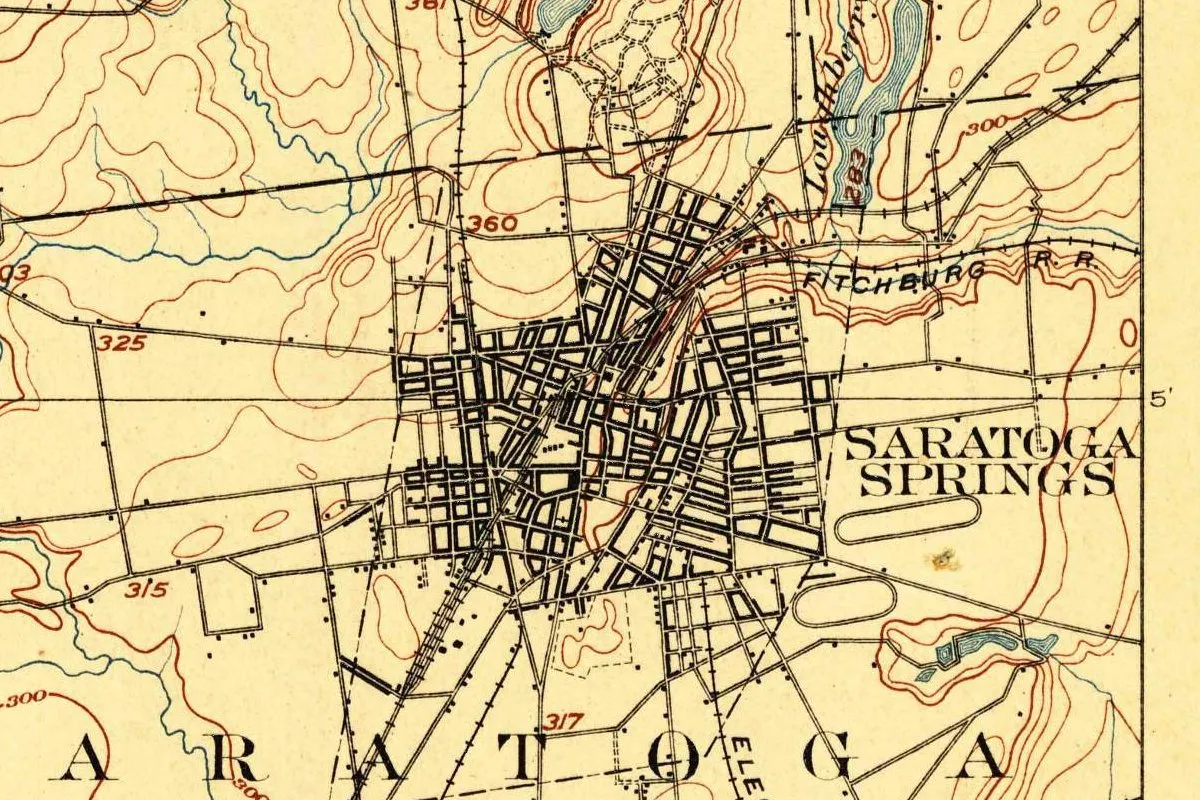
Beauchamp wrestled with plenty of other New York names in the same book, including Saratoga Springs, where he couldn’t settle on any meaning at all. For Schenectady, he could at least say where the name came from.
For more stories from around the state, see our New York page.
Quick answers
What does Schenectady mean?
It depends on who’s translating. The city says “over the pine plains,” Gannett gave “over beyond the plains” or “river valley beyond the pine trees,” and Beauchamp listed “beyond the pines” and “beyond the openings.” Beauchamp thought the root might mean only “on the other side.”
Was Schenectady originally the name of Albany?
Yes, according to both main sources. Beauchamp wrote that the name “was properly the name of Albany, but was soon placed here,” and the city says the Mohawk used it for the settlement at Fort Orange.
What did the French call Schenectady?
Corlar, after its founder Arent Van Curler, Beauchamp says. In 1687 De Nonville also called it Kan-nes-ta-ly.
Was Schenectady a Mohawk village?
No, says the city’s history. The area had at most lean-tos used by travelers and hunters, and any settlement there was more likely Mohican.
Key dates
- 1661Arent Van Curler leads the first settlement at Schenectady, the city says.
- 1667The place is written down as Schoneistade, Beauchamp notes.
- 1672July: A land purchase is described as lying near "The Town of Schanhectade."
- 1687De Nonville calls the place Kan-nes-ta-ly; the French usually call it Corlar.
- 1690February 8: French forces and their Indian allies attack and burn the town.
- 1798Schenectady is chartered as a city.
Things to do in Schenectady, New York
Stockade Historic District
Dozens of Dutch and English colonial houses from the 18th and 19th centuries. Designated in 1965 as New York State's first National Register historic district, it takes its name from the stockade fence that once surrounded the settlement.
Union College and the Nott Memorial
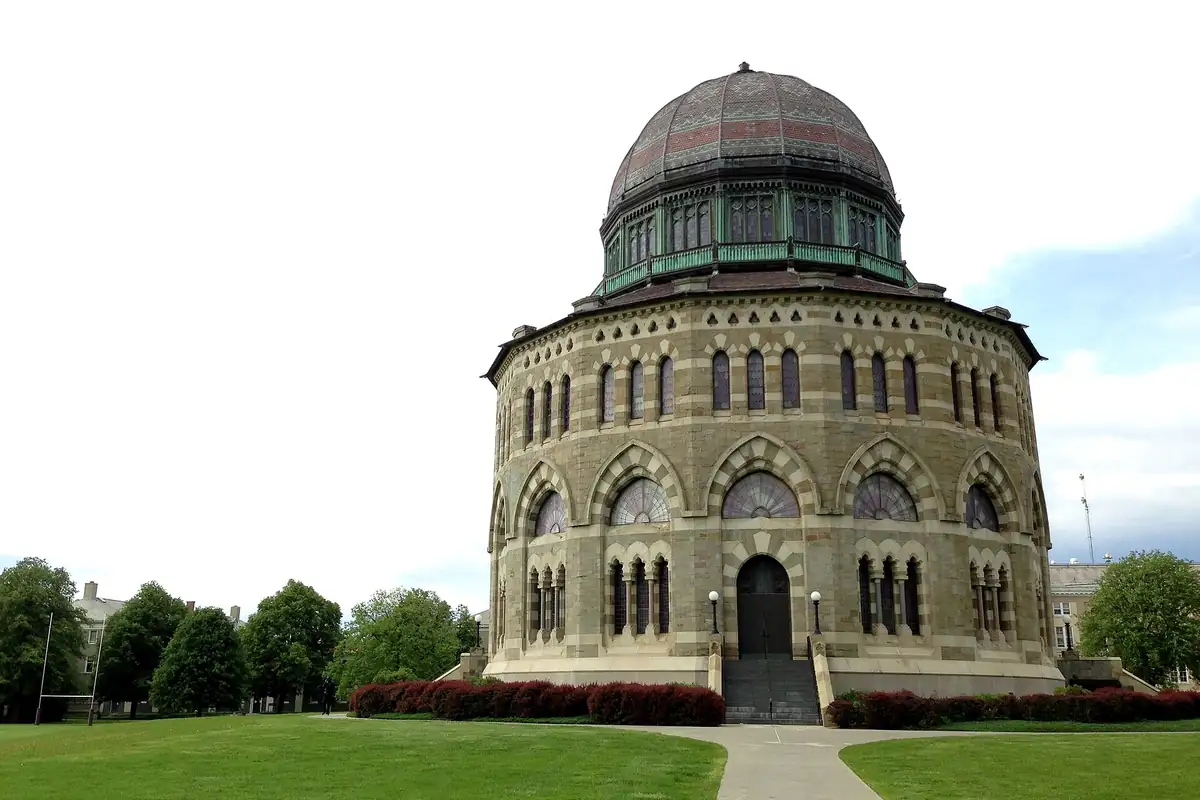
The city calls Union's grounds the oldest planned college campus in the United States. Walk through Jackson's Garden, eight acres (3 ha) of formal gardens and woods, and see the 16-sided Nott Memorial, built in 1875.
miSci (Museum of Innovation and Science)
A science museum founded in 1934 that merged in 1997 with the General Electric Hall of Electrical History. Its collection of more than 15,000 science and technology artifacts traces the history of electricity, and it has the Suits-Beuche Planetarium.
Mabee Farm Historic Site
The Schenectady County Historical Society calls it the oldest farm in the Mohawk Valley, settled in 1705. It has three 18th-century houses and an 18th-century Dutch barn near the Mohawk River.
Central Park
The city calls it the crown of Schenectady's many parks, on the highest point in the city. The Common Council voted to buy the land in 1913, and the park has a rose garden and Iroquois Lake.
Getting there
Open Schenectady in Google Maps
Opens in a new tab. The pin is the center of Schenectady in the USGS place-name record.
The closest airports, Amtrak stations and intercity bus stops, measured in a straight line from the center of Schenectady.
Airports
- Albany International (ALB) 8 mi 13 km
- Bradley International (BDL) Windsor Locks 88 mi 142 km
Amtrak trains
- Schenectady station (SDY) under 1 mi 0.3 km
- Albany-Rensselaer station (ALB) 16 mi 25 km
Intercity buses
- Adirondack Trailways Trailways · Schenectady under 1 mi 0.7 km
- FlixBus Schenectady Gateway Mobility Hub under 1 mi 0.7 km
- OurBus Schenectady, NY (Gateway Plaza Mobility Center - Bus stop at 12 State Street in front of Liberty Park) under 1 mi 0.7 km
Distances are as the crow flies, not by road. We don't list schedules or fares because they change; check with the airline, Amtrak or the bus company before you go. Official data (FAA commercial service airports (2025), FAA airport locations, Amtrak stations and Intercity Bus Atlas) from the FAA and the U.S. Bureau of Transportation Statistics, checked Nov 14, 2026.
Sponsored
Staying in Schenectady?
Compare hotels in Schenectady, New York, on Expedia.
See hotels in SchenectadyWe may earn a commission if you buy through this link. It never changes what we write. Read our affiliate disclosure
Historical Sources & References
- William M. Beauchamp, Aboriginal Place Names of New York, New York State Museum Bulletin 108 (1907), pp. 199-200. “Schen-ec-ta-dy was properly the name of Albany”; “beyond the pines or openings”; Spafford’s Schagh-nack-taa-da, “beyond the pine plains” and “over the pines”; the sandy plain of pines; Schoneistade in 1667; Bruyas’s skannatati and the “other side” quotation; Scho-no-we and Corlar. Page 200 is here.
- William M. Beauchamp, Aboriginal Place Names of New York (1907), p. 23. Morgan’s Ska’-neh-ta’-de for Albany, “afterward transferred to Schenectady”; Mitchill, Skaghnetade, Skaneghtada and Cusick’s Shaw-na-taw-ty.
- William M. Beauchamp, Aboriginal Place Names of New York (1907), p. 198. De Nonville’s Kan-nes-ta-ly (1687), the French name Corlar, and the 1672 purchase near “The Town of Schanhectade.”
- City of Schenectady, General History: Settlement to 1960. “Schau-naugh-ta-da,” “over the pine plains,” Fort Orange and the reversed meaning; lean-tos and the Mohican; Van Curler and 1661; the attack of February 8, 1690; the borough of 1765 and the city charter of 1798.
- Henry Gannett, The Origin of Certain Place Names in the United States, 2nd ed. (1905), p. 276. “Over beyond the plains,” or “river valley beyond the pine trees.”
- GNIS feature 964570 (U.S. Geological Survey). The city’s official entry in the national names system, in Schenectady County.
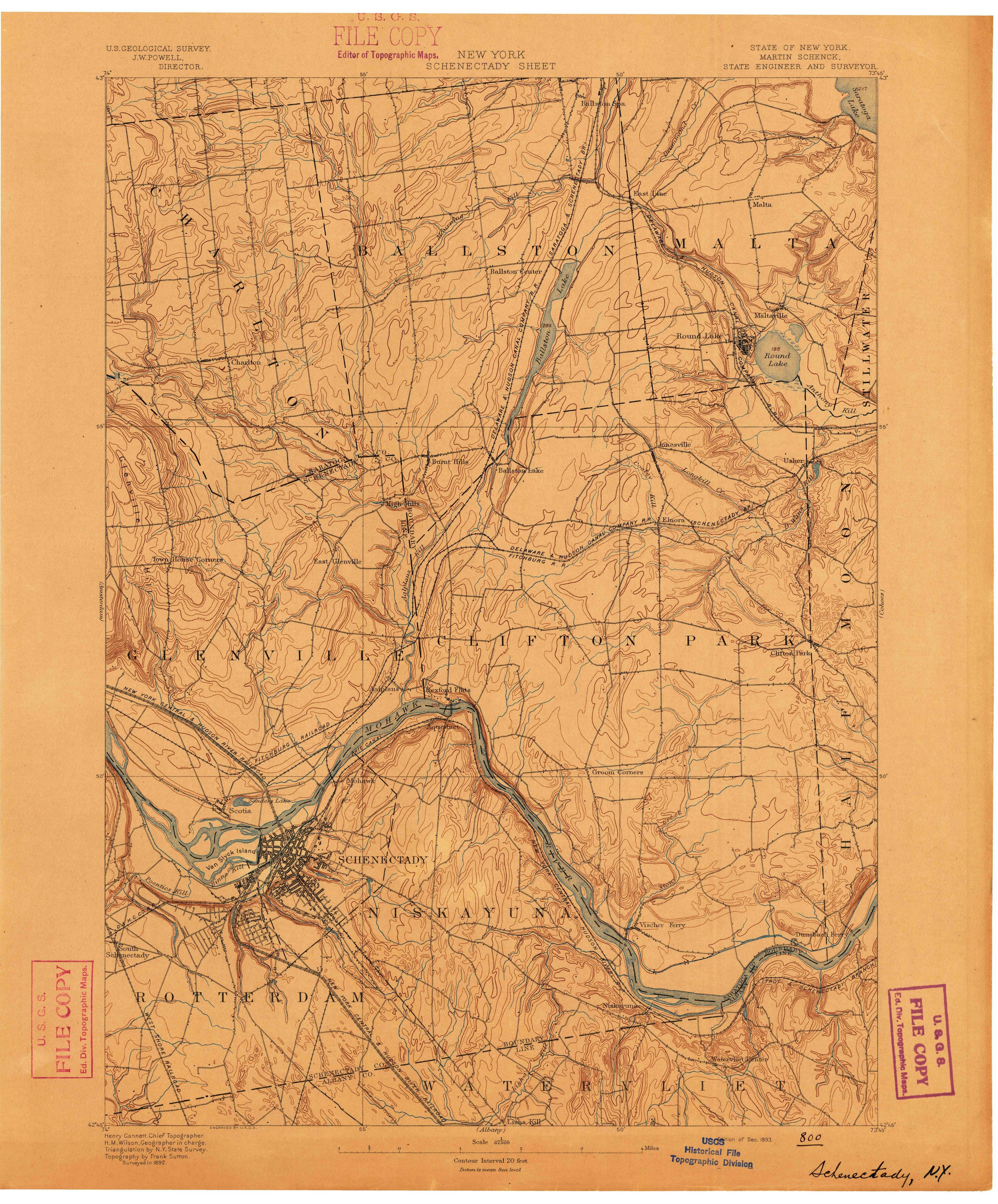
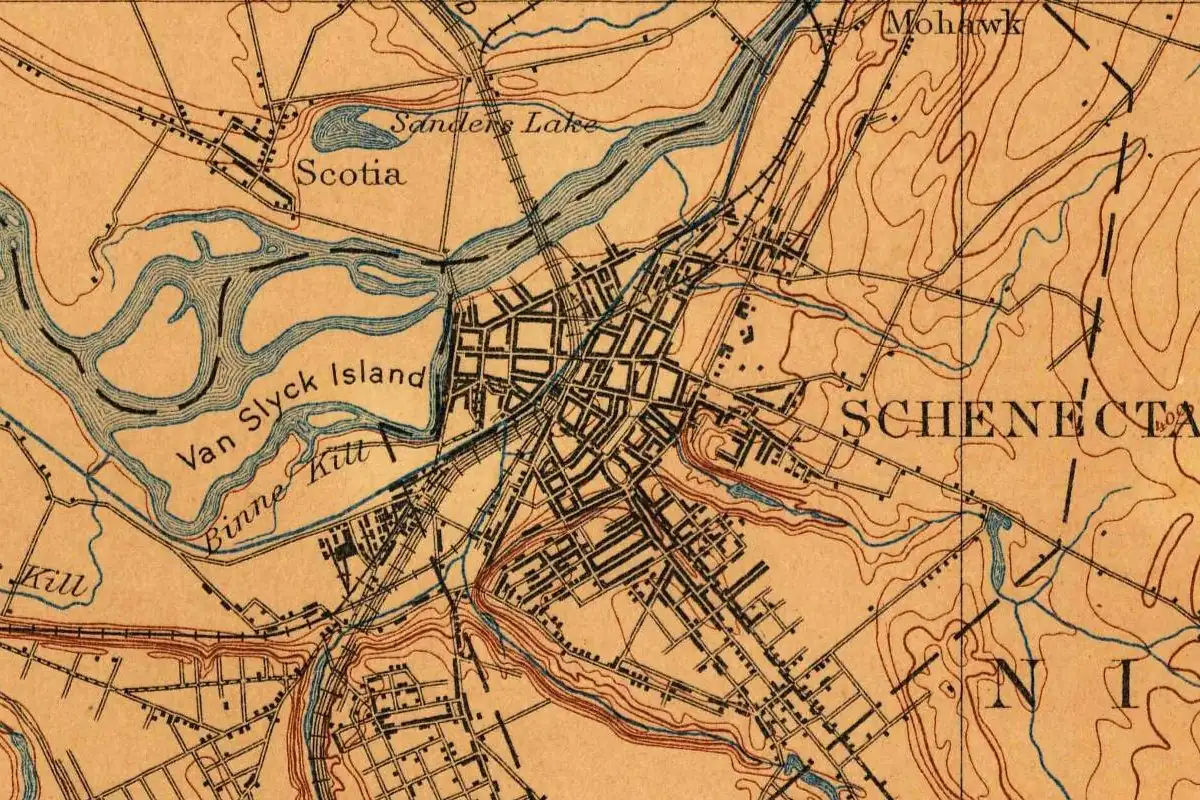
- U.S. Geological Survey, Schenectady sheet (1893). The 1:62,500 sheet, surveyed in 1892, that the map at the top of this page was cropped from.
Sponsored
Put this 1893 map on your wall
The 1893 USGS Schenectady sheet is in the public domain. Download the full-size scan for free, then have it printed on canvas with CanvasOnTheCheap.
Print a map on canvasDownload the full-size mapWe may earn a commission if you buy through this link. It never changes what we write. Read our affiliate disclosure
Spot something wrong, or know more? Tell us here. You can also email us or use our contact page. Corrections are noted here with their date, never made silently.