Why Is It Called Mystic, CT? The River Had the Name First
Mystic, Connecticut, is named after the Mystic River, the tidal river that separates the towns of Groton and Stonington. The name is Native. The 19th-century linguist J. Hammond Trumbull listed it as Mohegan 'Mistick' and read it as missi-tuk, 'great tidal-river.' Mystic itself is a village in both towns, not a town of its own.
A village without a town
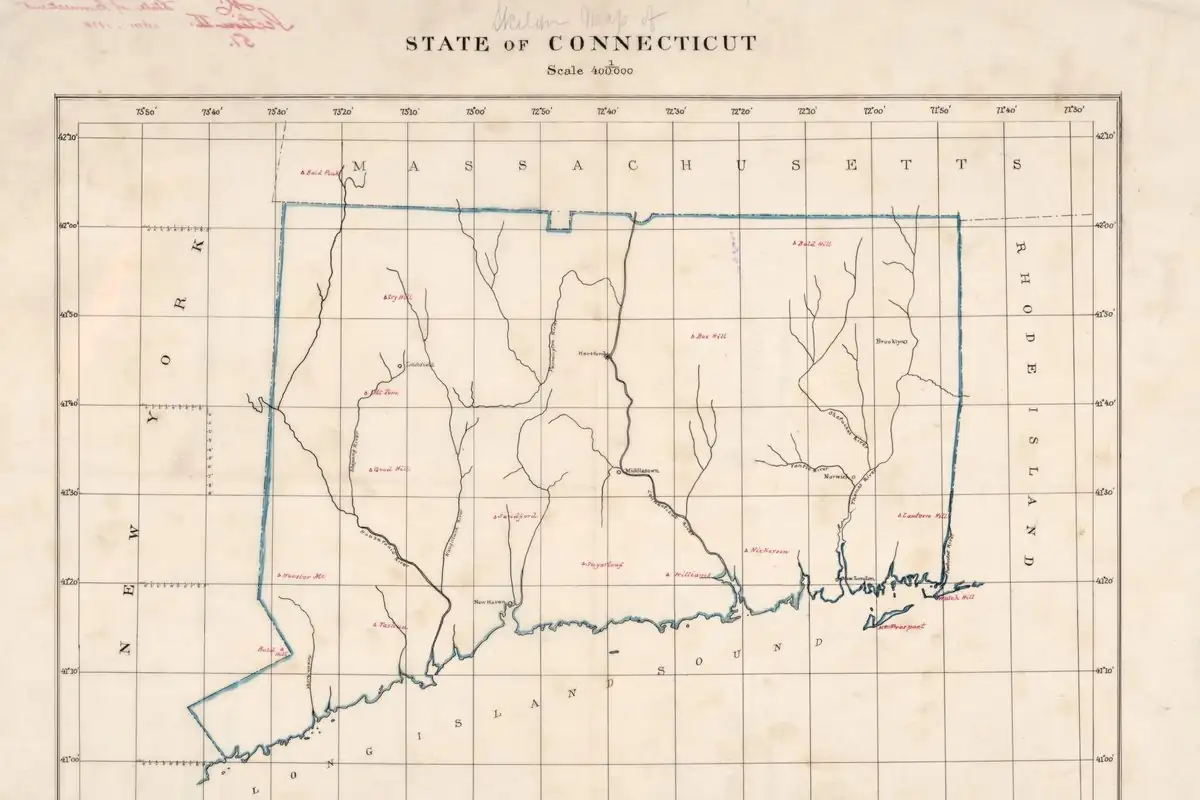
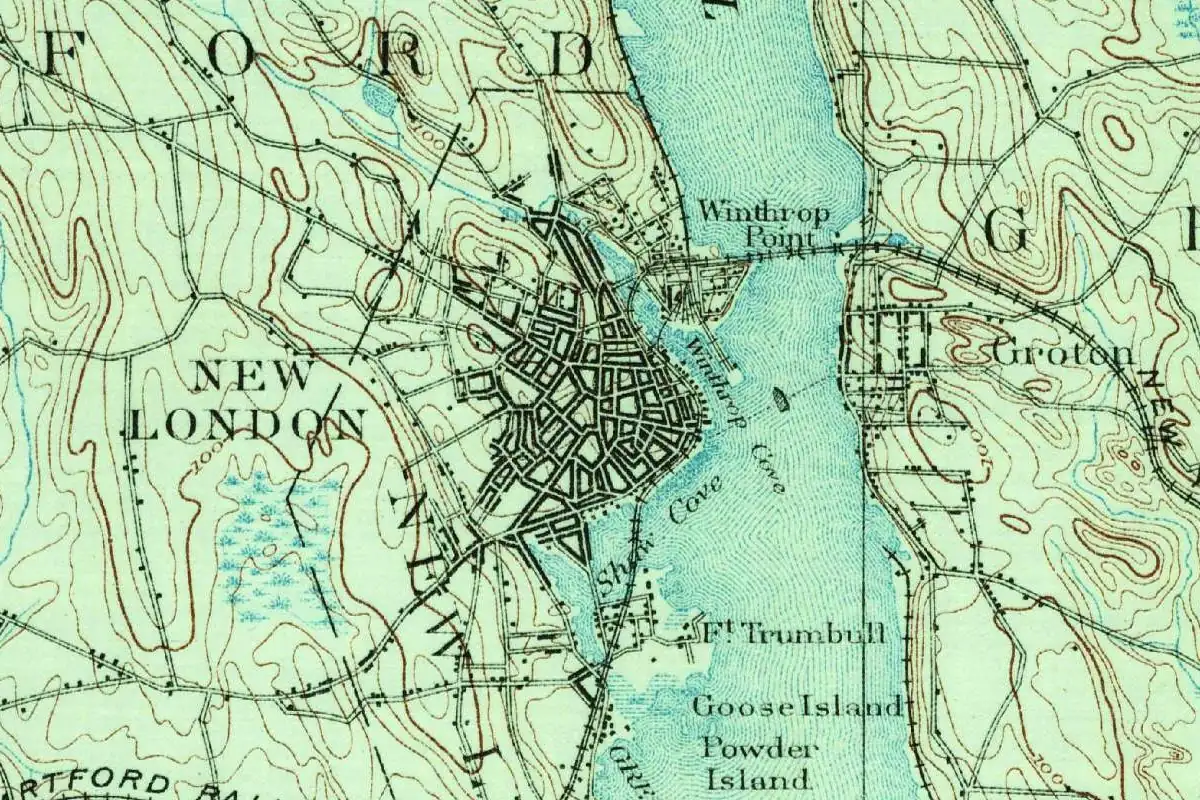
Mystic, Connecticut, isn’t a town: it’s a village split between Groton and Stonington, and it took its name from the tidal river that divides them. The Connecticut State Library puts it plainly in its list of the state’s towns: “Mystic is a village located in both Groton & Stonington.” If you go looking for a Town of Mystic on that list, you won’t find one. Groton and Stonington are both towns in New London County, the same county as New London.
So when people ask how Mystic got its name, the honest first answer is that the village didn’t get one. It borrowed the river’s.
Missi-tuk, according to Trumbull
The river’s name is Native, and the oldest detailed reading of it we found comes from J. Hammond Trumbull. In 1870, in The Composition of Indian Geographical Names, he wrote about the word ending -tuk, which he said “denotes a river whose waters are driven in waves, by tides or wind.” Joined with missi, “great,” it gave “missi-tuk,—now written Mystic.” He applied it to two rivers: the one near Boston and “another wide-mouthed tidal river in the Pequot country, which now divides the towns of Stonington and Groton.”
Eleven years later, in his list of Connecticut place names, he gave the old spelling as Mistick, marked it Mohegan, and added a detail that matters here:
“The name properly belongs to the estuary, missi-tuk ‘great tidal-river.’”
In other words, Trumbull didn’t think the word was ever meant for a settlement. It named the wide tidal water. Henry Gannett repeats his reading for the river and the village in The Origin of Certain Place Names in the United States (1905).
That’s one 19th-century linguist’s analysis of the word’s parts, and Gannett simply copied it. Trumbull doesn’t quote a Mohegan or Pequot speaker explaining the name, so it’s best taken as his reading. And no, the name has nothing to do with “mystic” in the English sense, as far as any source we found says.
Which side got to be Mystic
Here’s the part that trips people up. For much of the 1800s, “Mystic” didn’t mean the busy village near the river’s mouth that you’d visit today.
Charles F. Burgess’s Historic Groton, published in 1909, includes a chapter on the hamlet upriver, at what was “familiarly called … ‘Head of the River.’” It says the post office there “was early called ‘Mystic’” and kept that name “until the year 1890, when by order of the post office department it was changed to ‘Old Mystic.’”
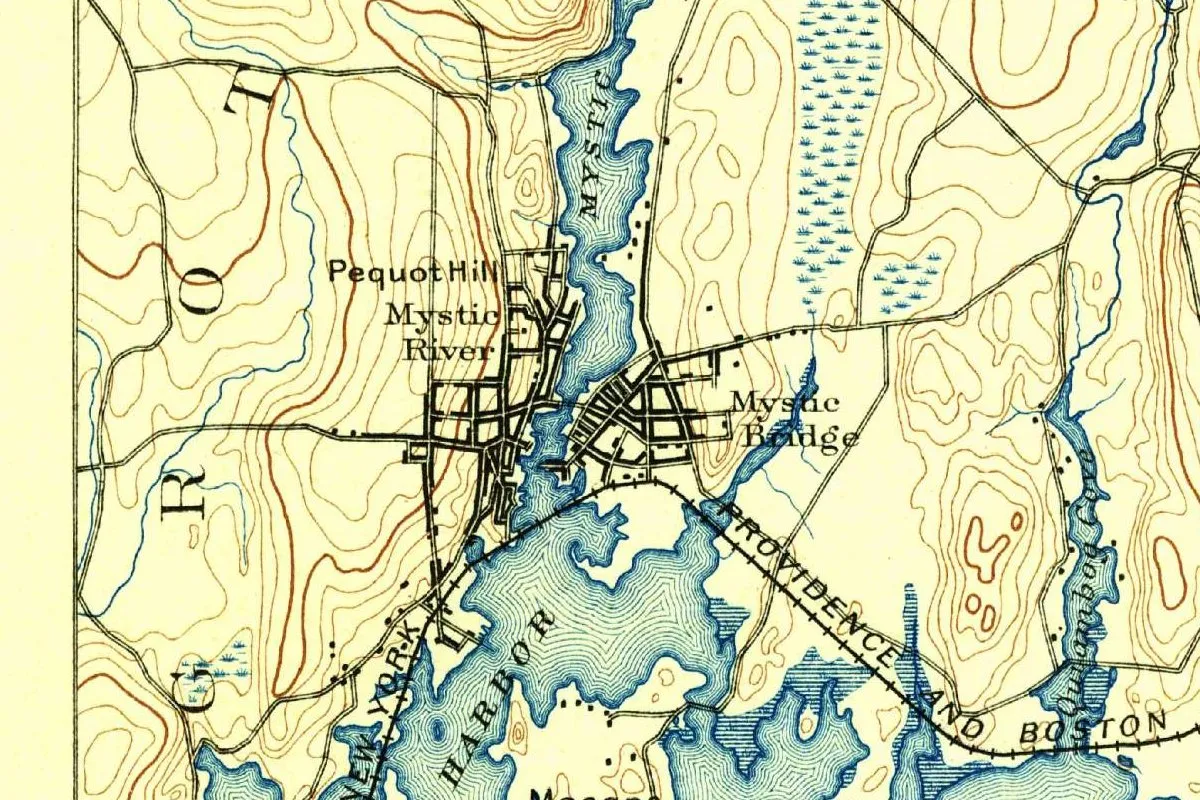
Down near the mouth, the west bank had a different name. Burgess says a bridge went across in 1818, and “the post office on the west side was called Portersville for a number of years until about 1844, it was changed to Mystic River.” The 1889 U.S. Geological Survey map at the top of this page shows what that left: a village labeled Mystic River on the Groton side and one labeled Mystic Bridge on the Stonington side.
Today GNIS lists a single populated place called Mystic. The river had the name first, then the villages took turns with it.
Quick answers
Is Mystic, Connecticut, its own town?
No. Mystic is a village that lies partly in the town of Groton and partly in the town of Stonington, according to the Connecticut State Library.
Where does the name Mystic come from?
From the Mystic River. Linguist J. Hammond Trumbull read the river’s Native name, spelled Mistick in early records, as missi-tuk, “great tidal-river,” and said it belonged to the estuary.
What is Old Mystic?
Old Mystic is the village at the head of the river. Its post office was simply “Mystic” until 1890, when the Post Office Department changed it to “Old Mystic,” Burgess’s Historic Groton says.
Key dates
- 1818A bridge is built across the Mystic River, according to Burgess's Historic Groton.
- 1844About this year the post office on the west bank changes its name from Portersville to Mystic River.
- 1870J. Hammond Trumbull explains Mystic as missi-tuk, 'the great river,' in a study of Native place names.
- 1881Trumbull's list of Connecticut place names gives Mohegan 'Mistick' and says the name belongs to the estuary.
- 1889A U.S. Geological Survey map labels two villages on the river: Mystic River and Mystic Bridge.
- 1890The post office upriver called Mystic is renamed Old Mystic by order of the Post Office Department.
Getting there
Open Mystic in Google Maps
Opens in a new tab. The pin is the center of Mystic in the USGS place-name record.
The closest airports, Amtrak stations and intercity bus stops, measured in a straight line from the center of Mystic.
Airports
- Westerly State (WST) 8 mi 14 km
- Block Island State (BID) 24 mi 39 km
- Bradley International (BDL) Windsor Locks 55 mi 88 km
Amtrak trains
- Mystic station (MYS) under 1 mi 0.5 km
- New London station (NLC) 7 mi 11 km
Intercity buses
- Peter Pan (BZ) Peter Pan Bus Lines · Willimantic - Main and Bank St 28 mi 45 km
- FlixBus Mansfield Royce Circle 34 mi 55 km
- OurBus Providence, RI (On the street below the convention center: 99 W. Exchange St., Providence, RI 02903) 43 mi 69 km
Distances are as the crow flies, not by road. We don't list schedules or fares because they change; check with the airline, Amtrak or the bus company before you go. Official data (FAA commercial service airports (2025), FAA airport locations, Amtrak stations and Intercity Bus Atlas) from the FAA and the U.S. Bureau of Transportation Statistics, checked Nov 13, 2026.
Sponsored
Staying in Mystic?
Compare hotels in Mystic, Connecticut, on Expedia.
See hotels in MysticWe may earn a commission if you buy through this link. It never changes what we write. Read our affiliate disclosure
Sponsored
Want the spooky side of Mystic?
The name has its story above. For the ghost stories, US Ghost Adventures runs walking ghost tours in Mystic.
See ghost tours in MysticWe may earn a commission if you book through this link. It never changes what we write. Read our affiliate disclosure
Historical Sources & References
- J. Hammond Trumbull, The Composition of Indian Geographical Names (1870), p. 8. The ending -tuk for tidal rivers and “missi-tuk,—now written Mystic,” for the river between Stonington and Groton.
- J. Hammond Trumbull, Indian Names of Places, etc., in and on the Borders of Connecticut (1881), p. 31. The entry for “Mistick (Moh.)” and the note that the name “properly belongs to the estuary.”
- Charles F. Burgess, Historic Groton (1909), pp. 76, 93. The 1818 bridge and the Portersville post office renamed Mystic River about 1844 (p. 76); the upriver post office called “Mystic” until it became “Old Mystic” in 1890 (p. 93).
- Henry Gannett, The Origin of Certain Place Names in the United States (USGS, 1905), p. 219. Mystic as a river and village in New London County, with Trumbull’s “great river” reading.
- Connecticut State Library, “Connecticut Towns and Counties”. “Mystic is a village located in both Groton & Stonington.”
- GNIS feature 209165 (U.S. Geological Survey). Mystic’s record as a populated place, with its coordinates.
- U.S. Geological Survey, Stonington sheet (1889). The source of the map at the top of this page.
Spot something wrong, or know more? Tell us here. You can also email us or use our contact page. Corrections are noted here with their date, never made silently.