Why Is It Called Woodstock, NY? Livingston's Choice
Robert Livingston, the landowner who bought a large part of the Hardenbergh Patent, named Woodstock, according to town historian Richard Heppner, but no record explains his choice. The historian Alf Evers wrote that no known evidence tells us why. A Revolutionary militia list already used the name, and the town of Woodstock was formed on April 11, 1787.
Woodstock, New York, was named by Robert Livingston, a large landowner there, but no record has turned up that explains his choice. It’s been Woodstock since before the Revolution ended.
Why is it called Woodstock, New York?
Woodstock’s own historians are frank about it. Richard Heppner, the town historian, told the Hudson Valley magazine Chronogram: “There is no doubt that Robert Livingston … named it Woodstock. However, it is unclear as to the reason why.” The magazine also quotes Alf Evers, from his book Woodstock: History of an American Town: “There is no evidence presently known to tell us why Robert Livingston gave the name of Woodstock to his settlement.”
Which Robert Livingston? The family had a lot of them. In a column for Hudson Valley One about an 1835 farm lease found in a coffee can, Heppner points out that the Robert L. Livingston who signed it wasn’t “the original Robert” who bought a big share of the old Hardenbergh Patent and gave Woodstock its name. The rent on that lease, he notes, included “four fat hens.”
There were older Woodstocks to borrow from. Chronogram says two American places already had the name, the first being the one in Connecticut, which was once part of Massachusetts and was named for Woodstock in Oxfordshire, England. Woodstock, Vermont, chartered in 1761, is another; Henry Gannett’s 1905 list traces its name to the English town too. Connecticut’s Litchfield did the same thing with an English cathedral city in 1719, Lichfield, and picked up an extra “t” on the way. Whether Livingston had any of these in mind, nobody can say.
Livingston’s name stuck early. The 1907 History of Ulster County, edited by A. T. Clearwater, lists a militia company of the Revolution “comprehending the settlements of Woodstock and Little and Great Shandaken,” though it gives no year for that entry.
Woodstock, NY history: from Shandaken to the art colonies
French’s Gazetteer of the State of New York (1860) gives the town’s legal start: Woodstock “was formed April 11, 1787, from the settlements of Great and Little Shandaken,” which had been part of Hurley. The Clearwater history says the new town was big, taking in what are now Woodstock, Shandaken, Denning, most of Hardenbergh and part of Olive. Pieces came off fast. French lists part of Middletown going in 1789, Windham in 1798 and, in 1804, Shandaken. A footnote adds that the first sawmill was Robert Livingston’s.
People came long before the town. The town’s history page says Native Americans followed trails along the Sawkill to their hunting grounds on Overlook Mountain, and that the first white settlers arrived in the mid-1700s.
Woodstock’s life as an art town started in the 1900s. The town dates Ralph Whitehead’s Byrdcliffe colony to 1903; the guild that runs Byrdcliffe today says 1902. Hervey White started the Maverick colony in 1905, and the Art Students League began working in Woodstock a year later, the town says.
You’ve probably heard of the 1969 festival. It took the town’s name, but the town’s own page points out that it took place on Max Yasgur’s dairy farm in Bethel, Sullivan County, almost 60 miles (97 km) away.
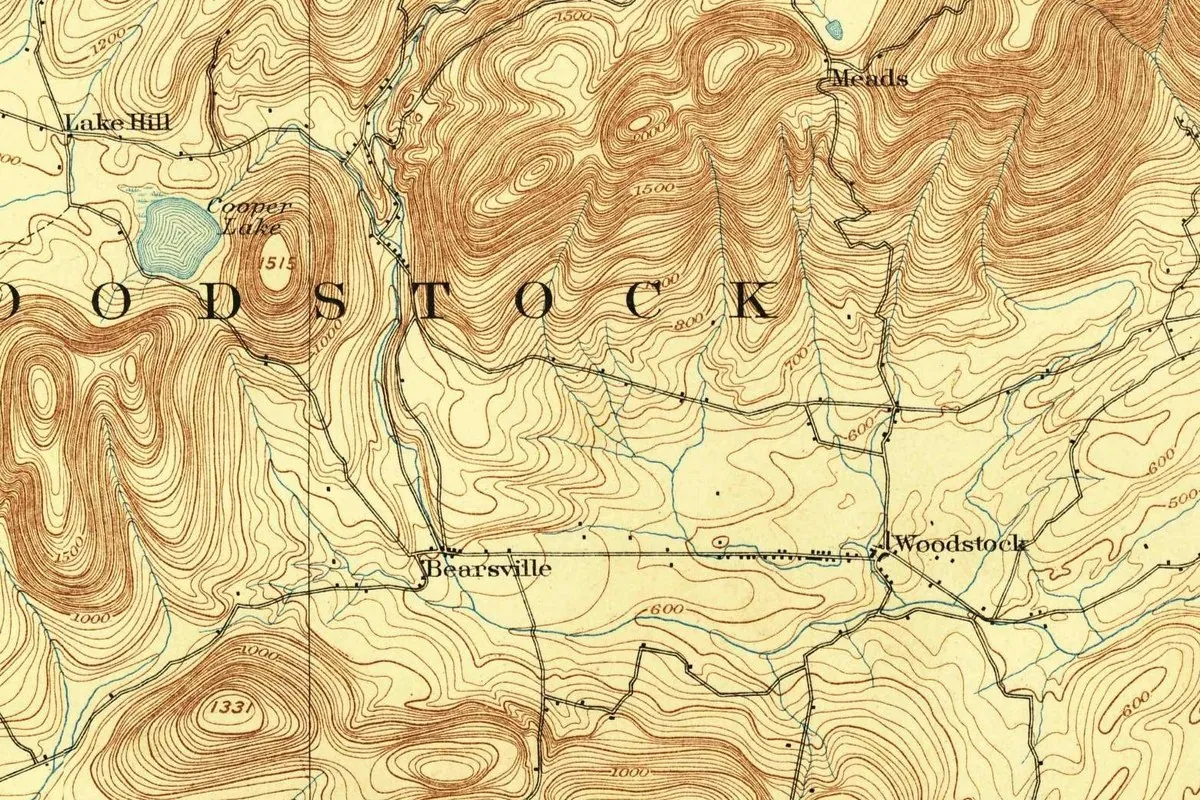
Woodstock on the 1893 map
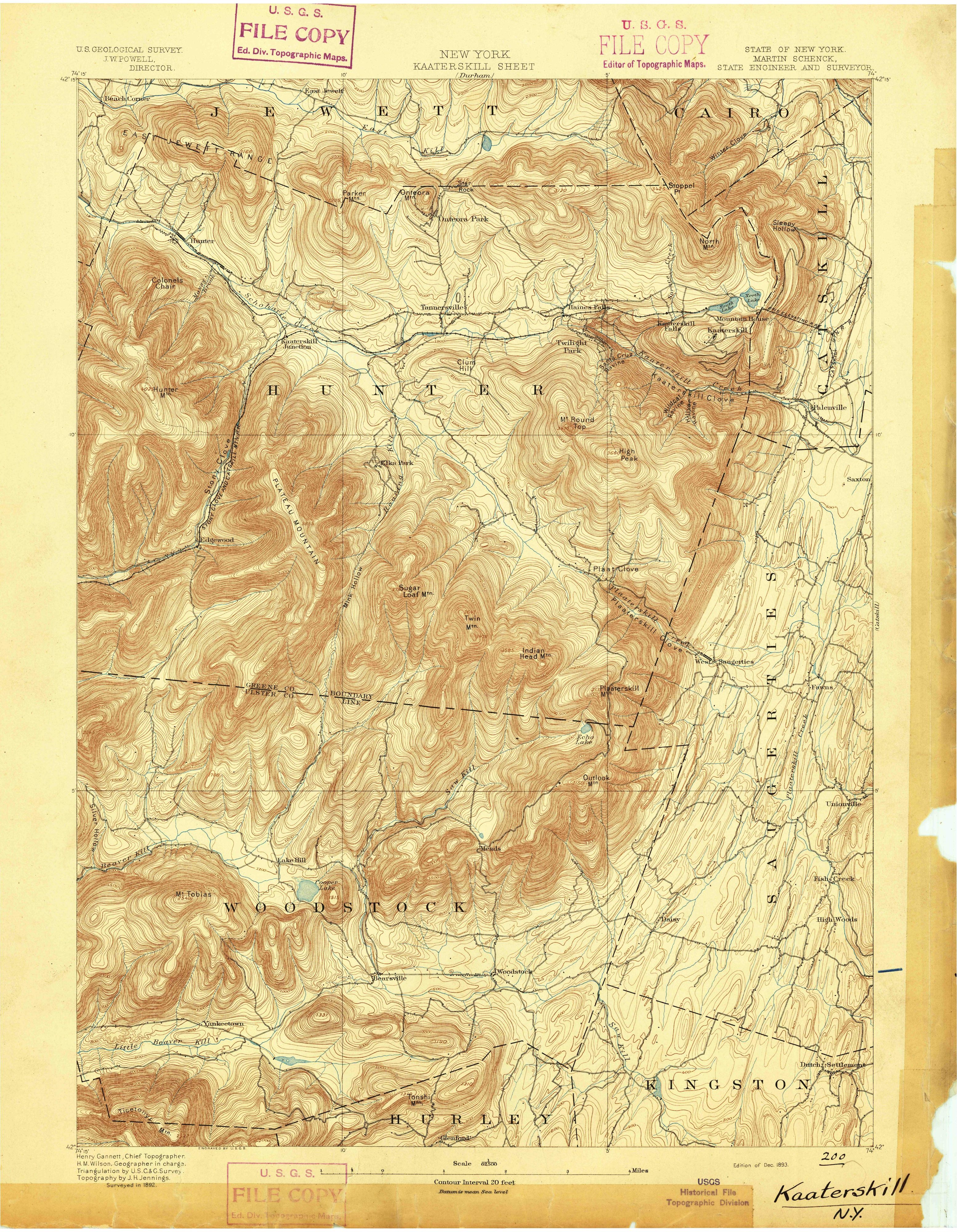
The crop above is from the Kaaterskill sheet, which the Geological Survey drew at 1:62,500 in cooperation with the state. Under J. W. Powell, the Survey’s director, H. M. Wilson was in charge of the geography, Gannett was chief topographer, and J. H. Jennings mapped the ground. The margin reads “Surveyed in 1892” and “Edition of Dec. 1893.”
Two Woodstocks are on it. The small one is the village, in its valley. The big spaced-out letters, trimmed by the crop so that you only see “ODSTOCK,” belong to the town. Bearsville, Cooper Lake and Lake Hill are labeled nearby.
Quick answers
Who named Woodstock, New York?
Robert Livingston, the landowner, according to town historian Richard Heppner and the historian Alf Evers. Neither found a record of why.
When was Woodstock, New York, founded?
The state made it a town on April 11, 1787, out of the Great and Little Shandaken settlements. The name already appears on a militia list from the Revolution.
Was the Woodstock festival in Woodstock, New York?
No. It was held in Bethel, Sullivan County, almost 60 miles away, according to the Town of Woodstock.
Key dates
- 1787April 11: the legislature turns the Great and Little Shandaken settlements into the town of Woodstock.
- 1804Shandaken is taken off from Woodstock as a town of its own.
- 1893The Geological Survey's Kaaterskill sheet, surveyed in 1892, is issued in an edition of December 1893 showing Woodstock and Bearsville.
- 1903Ralph Whitehead founds the Byrdcliffe art colony, according to the town; the colony's guild dates it to 1902.
- 1905Hervey White starts the Maverick art colony.
- 1969The Woodstock festival borrows the town's name but takes place in Bethel, Sullivan County, almost 60 miles away.
Things to do in Woodstock, New York
Woodstock Byrdcliffe Guild
The guild carries on the Byrdcliffe Arts Colony, which it dates to 1902, with exhibitions, classes in ceramics and jewelry, artist residencies and a shop of local crafts. The town describes its mountainside campus as 250 acres (101 ha).
Overlook Mountain Wild Forest
The spur trail climbs 2.4 miles (3.9 km) and 1,370 feet (418 m) on an old carriage road, past the ruins of the unfinished Overlook Mountain House, to a fire tower at 3,140 feet (957 m). A ledge nearby looks over the Hudson River and the Ashokan Reservoir.
Historical Society of Woodstock
Founded in 1929 by artists, writers, academics and townspeople, the society shows exhibits in the historic Eames House on Comeau Drive and keeps an archive of more than 10,000 items on Woodstock's past.
Woodstock Artists Association and Museum
At 28 Tinker Street, the association was founded in 1919 to promote the visual arts and artists, and it puts on exhibitions and programs, according to the town.
Getting there
Open Woodstock in Google Maps
Opens in a new tab. The pin is the center of Woodstock in the USGS place-name record.
The closest airports, Amtrak stations and intercity bus stops, measured in a straight line from the center of Woodstock.
Airports
- New York Stewart International (SWF) Newburgh 38 mi 62 km
- Albany International (ALB) 51 mi 83 km
- Bradley International (BDL) Windsor Locks 76 mi 123 km
Amtrak trains
- Rhinecliff station (RHI) 14 mi 23 km
- Hudson station (HUD) 23 mi 37 km
Intercity buses
- Adirondack Trailways Trailways · Shady under 1 mi 1 km
- OurBus Hunter Mountain 11 mi 17 km
- ShortLine Hudson Kerhonkson 21 mi 33 km
Distances are as the crow flies, not by road. We don't list schedules or fares because they change; check with the airline, Amtrak or the bus company before you go. Official data (FAA commercial service airports (2025), FAA airport locations, Amtrak stations and Intercity Bus Atlas) from the FAA and the U.S. Bureau of Transportation Statistics, checked Nov 22, 2026.
Sponsored
Staying in Woodstock?
Compare hotels in Woodstock, New York, on Expedia.
See hotels in WoodstockWe may earn a commission if you buy through this link. It never changes what we write. Read our affiliate disclosure
Historical Sources & References
- J. H. French, Gazetteer of the State of New York (1860), p. 668. The town formed on April 11, 1787, from Great and Little Shandaken, the towns taken off and Livingston’s sawmill.
- A. T. Clearwater, ed., The History of Ulster County (1907), pp. 147 and 366. The Revolutionary militia company (no year given) and the extent of the town of 1787.
- Chronogram, with town historian Richard Heppner. Livingston as the namer, Heppner’s and Evers’s words on the missing reason, and the Connecticut Woodstock.
- Richard Heppner, “History in a can,” Hudson Valley One. The original Robert Livingston and the 1835 lease.
- Town of Woodstock, History, About and Arts and Museums. The Sawkill trails, the art colonies, the festival in Bethel and the museums.
- Woodstock Byrdcliffe Guild, Overlook Mountain Wild Forest and the Historical Society of Woodstock. The details in the things-to-do list.
- U.S. Geological Survey, GNIS feature 979655. The town’s federal record.
- Kaaterskill sheet, edition of December 1893. The sheet the map at the top was cropped from.
Sponsored
Put this 1893 map on your wall
The Geological Survey's Kaaterskill sheet, surveyed in 1892 and issued in December 1893: Woodstock, Bearsville and Overlook Mountain, ten years before the art colonies arrived. It is in the public domain: download the full-size scan for free, then have it printed on canvas with CanvasOnTheCheap.
Print a map on canvasDownload the full-size mapWe may earn a commission if you buy through this link. It never changes what we write. Read our affiliate disclosure
Spot something wrong, or know more? Tell us here. You can also email us or use our contact page. Corrections are noted here with their date, never made silently.