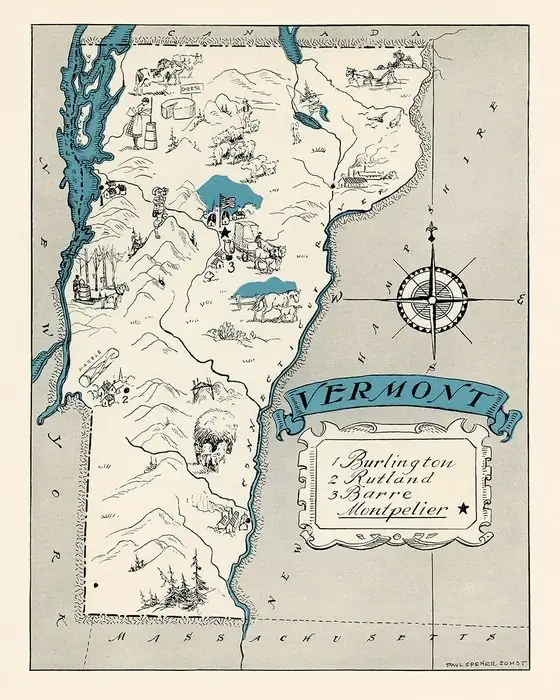
Woodstock, Vermont: An English Name From the 1761 Charter
Woodstock, Vermont, is named from the town of Woodstock in England, Henry Gannett wrote in 1905. The name goes back to the charter that Benning Wentworth, New Hampshire's royal governor, granted on July 10, 1761. A 1766 petition to New York offered to take it as Raynham Hall instead; Henry Swan Dana says it seems to have been dismissed.
Woodstock, Vermont, takes its name from a town in England, and it has carried that name since New Hampshire’s governor chartered the township in 1761. That’s the town. The village at its center grew up later around a green and got its own government in 1837.
Three charters on one July day
Benning Wentworth, New Hampshire’s royal governor, granted Woodstock along with two neighbors. The Woodstock History Center says that on July 10, 1761, Bridgewater, Hartland and Woodstock became the 26th, 27th and 28th townships he granted west of the river. Zadock Thompson’s 1824 Gazetteer of Vermont has the same date. Henry Swan Dana, whose History of Woodstock came out in 1889, says that at least 60 townships were granted that year alone, and that Woodstock went “to David Page and others.”
Dana prints the charter in his appendix, from a certified copy made in 1795, since the original couldn’t be found. It incorporates the land “into a Township by the name of Woodstock” and divides it into 68 shares. The History Center counts 62 proprietors, speculators chosen mostly for political reasons who soon sold out to others. Wentworth’s grants are all over the region: he named Bennington after himself in 1749, and in the same year as Woodstock he chartered Hanover, New Hampshire, also in 68 shares.
Why Woodstock?
Here the sources get thin. Dana never says why the name was picked, and neither does the charter. Henry Gannett, who traced the origins of American names for the Geological Survey, puts the Connecticut and the Vermont towns side by side in 1905: they were “named from the town in England.” He doesn’t say which part of England, and he doesn’t say who chose it.
The only source here that names a county is a phone call. When Woodstock switched to dial service in 1963, the History Center says, two town officials placed the first call to the mayor of Woodstock, Illinois, a Mr. Emricson. He told them there were 56 Woodstocks around the world and that the first “was in Oxfordshire, England and the second was in Connecticut,” with Vermont’s third. That’s the mayor’s tally, as the History Center passes it along.
The name New York tried to change
For a few years the name wasn’t safe. Dana describes several petitions about the township sent to New York’s governor in 1766. One of them, presented by William Kelly on December 22, said Lord Viscount Townshend would accept a grant of the township “by the name of Raynham Hall.” Dana says the memorial “seems to have been dismissed without any notice.”
When New York finally granted a patent in 1772, it kept the old name. Dana quotes it as covering “the parcel of land known by the name of Woodstock, in the county of Cumberland and province of New York.” So the name came through the New York patent intact, and it’s still the town’s name in Vermont today, where Gannett filed it under Windsor County.
The town and the village
The national names database entry for Woodstock, feature 1460316 in Windsor County, is the village. The town around it is bigger. The History Center lists hamlets that grew up around mills and stores: Taftsville, South Woodstock, West Woodstock and Prosper, which used to be English’s Mills.
The village began, the History Center says, when Joab Hoisington’s family settled there in 1772, and its old names were the North Village and “the Green.” It became the Village of Woodstock in January 1837, organized on that month’s first Monday, with five trustees in charge. John Hayward’s 1849 Gazetteer of Vermont still calls the place “Woodstock Green,” a beautiful village, and Woodstock was Windsor County’s shire town, the old word for county seat.
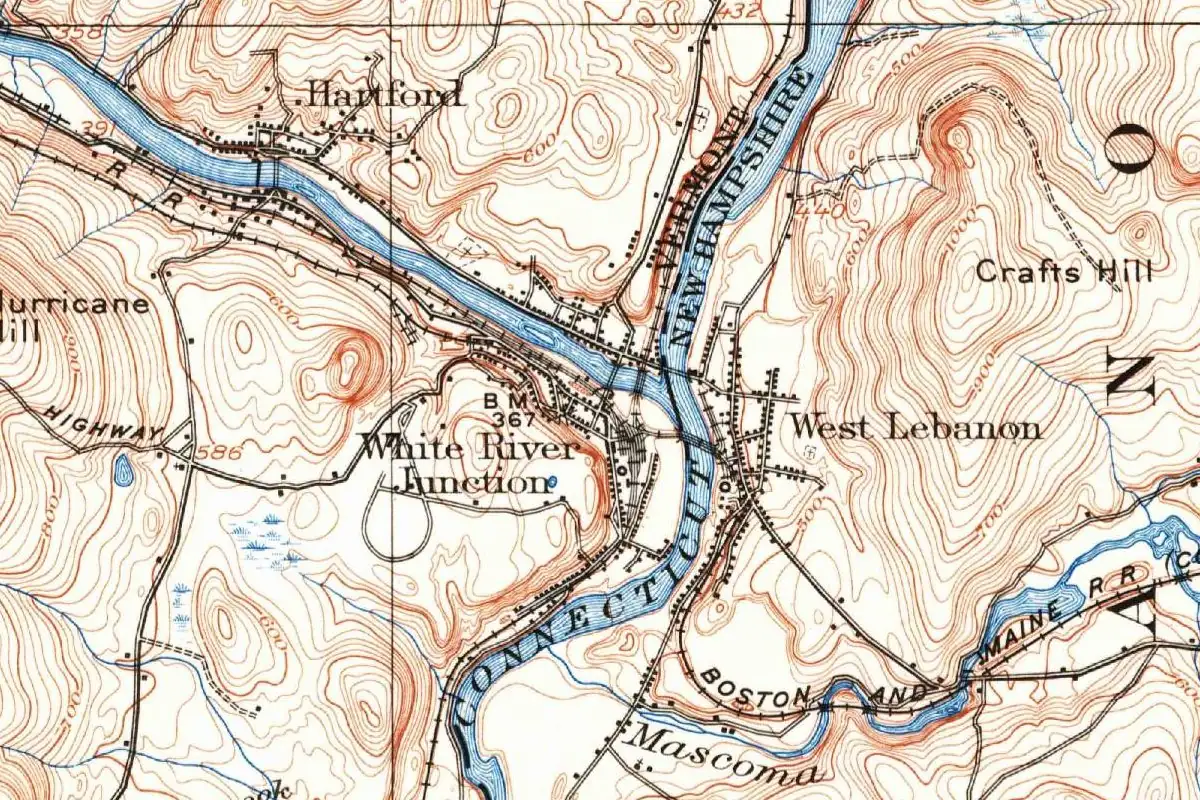
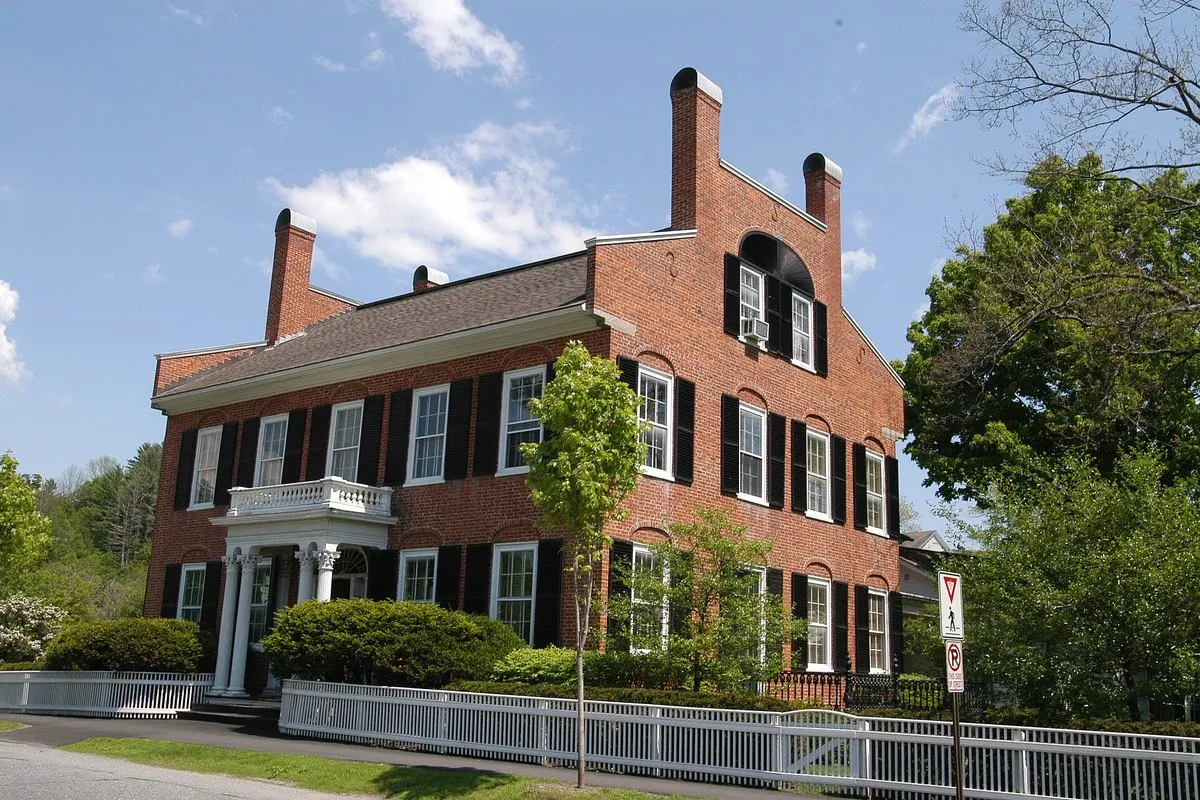
The village grew on the Ottauquechee River. In 1875 the Woodstock Railroad opened as a 14-mile (23 km) branch from White River Junction, and summer visitors from Boston and New York followed, the History Center says. If you look at the photo below, you’re on the Green, at the General Lyman Mower House, which the Wikimedia Commons file dates to 1823.
Where the name went next
Woodstock, Vermont, passed the name on at least once. Gannett lists Woodstock, Illinois, as “named from the town in Vermont,” and the Illinois mayor on that 1963 call had the story: Joel Johnson left Woodstock, Vermont, settled in a place known as Centerville, and on his recommendation it became Woodstock in 1845. That Illinois town is where Groundhog Day was filmed, as SAH Archipedia points out in its essay on Punxsutawney, Pennsylvania, home of the Groundhog Day ceremony.
Woodstock on the 1911 map
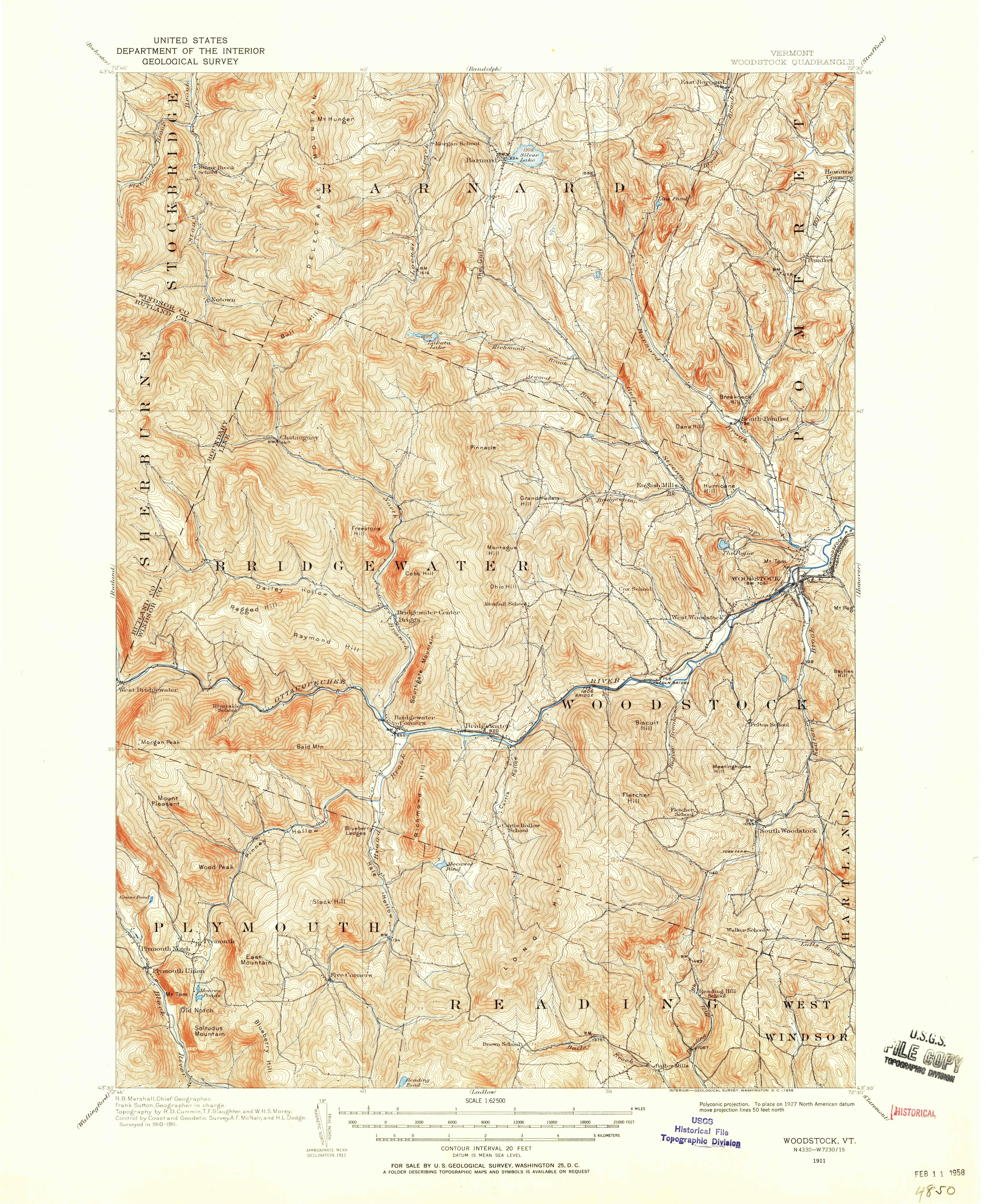
The map at the top comes from the Geological Survey’s Woodstock quadrangle. The bottom margin names R. B. Marshall as chief geographer and Frank Sutton as geographer in charge. The topography is by R. D. Cummin, T. F. Slaughter and W. H. S. Morey, with control by the Coast and Geodetic Survey, A. F. McNair and H. L. Dodge. It says “Surveyed in 1910-1911” and carries the date 1911. But the printer’s line at the bottom reads 1958, and a stamp says FEB 11 1958, so what you’re seeing is a 1958 printing of the 1911 edition.
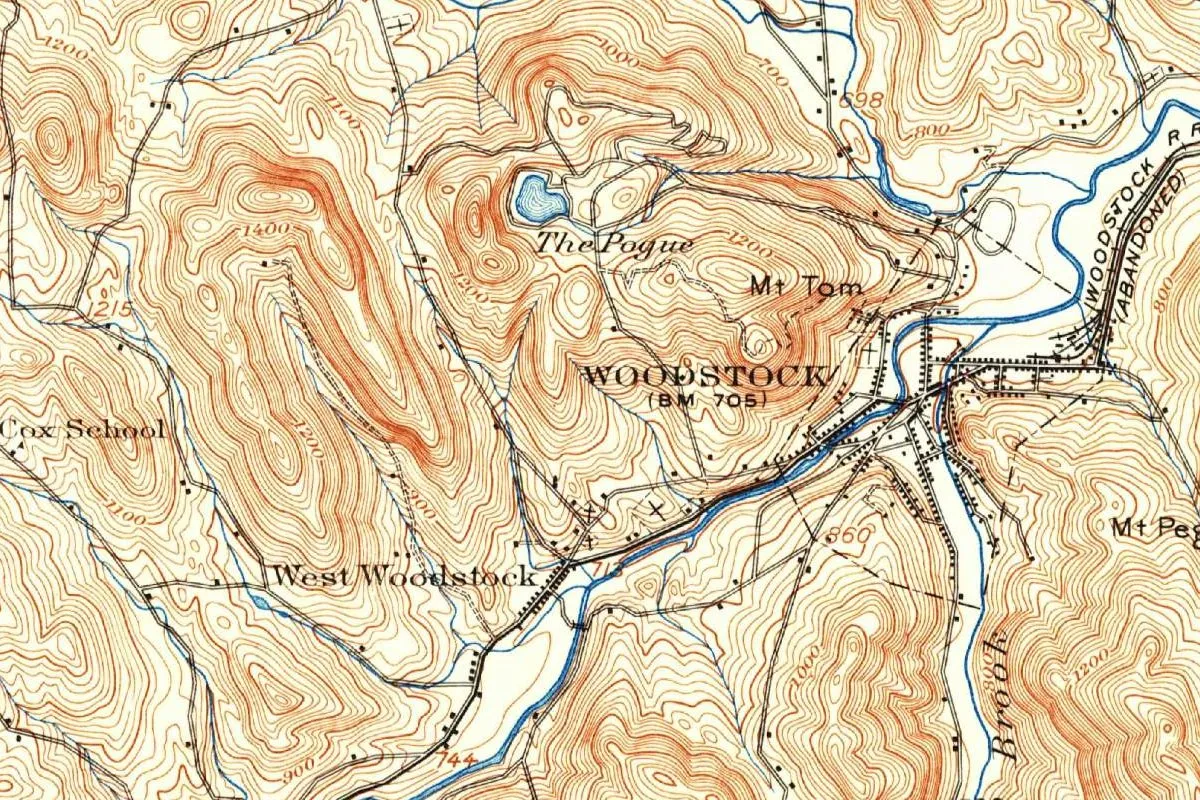
In the crop, WOODSTOCK sits at bench mark 705 next to Mt Tom, with The Pogue on the mountain’s slope. West Woodstock and Cox School are to the west, Mt Peg is cut off at the edge, and a line is labeled WOODSTOCK R R (ABANDONED).
Quick answers
What is Woodstock, Vermont, named after?
A town in England, according to Gannett (1905). The mayor of Woodstock, Illinois, said in 1963 that the first Woodstock was in Oxfordshire.
When was Woodstock, Vermont, founded?
Benning Wentworth chartered the township on July 10, 1761. The village on the Green began in 1772, the History Center says, and was organized in 1837.
Who named Woodstock, Vermont?
No source here says. The name is in the charter New Hampshire’s governor granted, but nobody recorded who picked it.
Is Woodstock, Illinois, named after Woodstock, Vermont?
Yes, says Gannett. The Illinois mayor credited Joel Johnson of Woodstock, Vermont, with suggesting the name in 1845.
Key dates
- 1761On July 10, Gov. Benning Wentworth charters Bridgewater, Hartland and Woodstock west of the Connecticut River.
- 1766A memorial to New York's governor offers to take the township under the name Raynham Hall; Dana says it seems to have been dismissed.
- 1772New York issues a patent for the land 'known by the name of Woodstock'; the Hoisington family starts the village on the Green.
- 1837The Village of Woodstock is organized in January, with five trustees.
- 1845Woodstock, Illinois, takes the name on the advice of Joel Johnson, a man from Woodstock, Vermont, by its mayor's account.
- 1875The Woodstock Railroad opens, a 14-mile (23 km) spur from White River Junction.
- 1905Henry Gannett traces the town's name to a town in England.
- 1911The Geological Survey publishes its Woodstock quadrangle, surveyed in 1910 and 1911; the copy shown here was printed in 1958.
Things to do in Woodstock, Vermont
Woodstock History Center
The keepers of local history for Woodstock and the towns around it, with education programs rooted in the place and a center for research.
Marsh-Billings-Rockefeller National Historical Park
A national park about conservation history, with more than 25 miles (40 km) of carriage roads and trails in the Mount Tom Forest, which the park ranks as the country's oldest scientific forest under continuous management.
Billings Farm & Museum
A working dairy farm and museum run by the Woodstock Foundation, where you can meet the farm animals, see the milking and take in exhibits on Vermont farm life past and present.
Middle Bridge and Taftsville Bridge
Two covered bridges over the Ottauquechee: Middle Bridge, built in 1969 by Milton Graton in peg-framed style, and the Taftsville Bridge of 1836, which the History Center calls the oldest in Windsor County.
Getting there
Open Woodstock in Google Maps
Opens in a new tab. The pin is the center of Woodstock in the USGS place-name record.
The closest airports, Amtrak stations and intercity bus stops, measured in a straight line from the center of Woodstock.
Airports
- Patrick Leahy Burlington International (BTV) 67 mi 107 km
- Manchester Boston Regional (MHT) 72 mi 117 km
- General Edward Lawrence Logan International (BOS) Boston 116 mi 187 km
Amtrak trains
- White River Junction station (WRJ) 10 mi 16 km
- Windsor-Mt. Ascutney station (WNM) 12 mi 19 km
Intercity buses
- FlixBus White River Junction Bus Stop 9 mi 15 km
- Greyhound Hanover (Hanover Inn) 13 mi 20 km
- Vermont Translines Marble Valley Regional Transit Center 23 mi 37 km
Distances are as the crow flies, not by road. We don't list schedules or fares because they change; check with the airline, Amtrak or the bus company before you go. Official data (FAA commercial service airports (2025), FAA airport locations, Amtrak stations and Intercity Bus Atlas) from the FAA and the U.S. Bureau of Transportation Statistics, checked Nov 18, 2026.
Sponsored
Staying in Woodstock?
Compare hotels in Woodstock, Vermont, on Expedia.
See hotels in WoodstockWe may earn a commission if you buy through this link. It never changes what we write. Read our affiliate disclosure
Historical Sources & References
- Henry Gannett, The Origin of Certain Place Names in the United States (1905), p. 330. Woodstock in Connecticut and Vermont “named from the town in England,” and Woodstock, Illinois, “named from the town in Vermont.” Checked against the page image.
- Henry Swan Dana, History of Woodstock, Vermont (1889), pp. 1-5 and 559. The grant to David Page and others in 1761, the Raynham Hall memorial of 1766, the New York patent of 1772 and the charter in 68 shares. Checked against the page images.
- Zadock Thompson, Gazetteer of the State of Vermont (1824) and John Hayward, Gazetteer of Vermont (1849), p. 143. The charter date; “Woodstock Green” and the shire town.
- Woodstock History Center, “Historic Resources”. The three grants of July 10, 1761, the 62 proprietors, the village of 1837, the hamlets, the railroad of 1875 and the bridges.
- Woodstock History Center, “The Telephone: Making Connections”. The first dial call of 1963, the mayor of Woodstock, Illinois, Oxfordshire and Joel Johnson.
- Town of Woodstock, “History”; Marsh-Billings-Rockefeller NHP; Billings Farm & Museum. The charter year and the details in the things-to-do list.
- U.S. Geological Survey, GNIS feature 1460316. The village of Woodstock in Windsor County.
- Woodstock quadrangle, surveyed 1910-11, 1911 edition, 1958 printing. The sheet the map at the top was cropped from.
Sponsored
Put this 1911 map on your wall
The Geological Survey's 1911 Woodstock sheet, surveyed in 1910-11 and shown here in a 1958 printing, with the town beside Mt. Tom, is in the public domain. Download the full-size scan for free, then have it printed on canvas with CanvasOnTheCheap.
Print a map on canvasDownload the full-size mapWe may earn a commission if you buy through this link. It never changes what we write. Read our affiliate disclosure
Spot something wrong, or know more? Tell us here. You can also email us or use our contact page. Corrections are noted here with their date, never made silently.