Rutland, Vermont: Named From Massachusetts, or a Duke?
Rutland's name dates to Benning Wentworth's charter of September 7, 1761. An 1886 county history says the first named grantee, John Murray of Rutland, Massachusetts, is thought to have given the town that name, and Henry Gannett agreed in 1905. Modern local histories add a second possibility: the Duke of Rutland.
Rutland, Vermont, got its name in a 1761 charter, and the oldest histories point to Massachusetts, where the first grantee on the list lived. Newer local accounts keep a second candidate in the running, an English duke, so Rutland’s name comes with two stories.
A charter from New Hampshire
On September 7, 1761, Governor Benning Wentworth of New Hampshire signed a charter for a township called Rutland on the west side of the Green Mountains. The West Rutland Historical Society says it covered 26,000 acres and took in what’s now Rutland City, Rutland Town, West Rutland and Proctor.
H. P. Smith and W. S. Rann, in their 1886 History of Rutland County, say Rutland’s was one of sixty charters New Hampshire issued that year, and that Wentworth “did not forget his personal interests” and kept 500 acres for himself. Then they get to the name:
“The charter was procured by Colonel Josiah Willard, of Winchester, N. H., and the first named grantee was John Murray, an Irishman. The latter was a prominent citizen of Rutland, Mass., and it is thought gave the same name to this town.”
Notice the hedge: “it is thought.” The book doesn’t say who thought so, and it doesn’t point to a document.
The Massachusetts version
Henry Gannett didn’t hedge. When his Geological Survey bulletin came out again, revised, in 1905, it disposed of the Vermont town and county in a sentence: “Rutland; county, and city in same county, in Vermont, named from the town in Massachusetts.”
Two lines up, Gannett takes the trail one step further back. Rutland, Massachusetts, in Worcester County, was “said to have been named from Rutland, near Leicestershire, England.” So if you follow his entries, the name traveled from England to Massachusetts and then north into Vermont.
Murray didn’t hold on to his share. Smith and Rann say he sold his right in Rutland, about 350 acres, “for two shillings—at the rate of about ten acres for one cent!” Most of the grantees lived in New Hampshire, they add, and none of them ever settled permanently in Rutland. The West Rutland Historical Society agrees that none of the 64 grantees settled there and that each sold his rights.
The duke version
The other candidate comes from the politics of the charter. The West Rutland Historical Society says Wentworth “preferred to name towns for prominent people in the hope that they would back his territorial claims on the west side of the Green Mountains over those of the Governor of New York.” It then says the town “was likely named after the Duke of Rutland or John Murray, from Rutland. Massachusetts.”
Amtrak’s Great American Stations profile of the city puts it the same way, with more caution. “The origin of the town’s name remains uncertain,” it says. It’s possible the name “recalls Rutland, Massachusetts, home to the first grantee of the 1761 charter,” while others believe Wentworth named it after the 3rd Duke of Rutland, “perhaps in an attempt to gain support for New Hampshire’s claim on the land.”
So which one wins? The Massachusetts link is the one you’ll find in the 19th- and early 20th-century sources here, Smith and Rann in 1886 and Gannett in 1905. The duke shows up only in the modern accounts, and both of them present it as a possibility. Neither side has a document from 1761 that explains the choice, so the name stays disputed.
Wentworth did put a prominent name on at least one Vermont town: Bennington carries his own first name.
Fairfield, the other grant
Smith and Rann add a detail about a rival claim. A second grant was made the same year, they say, covering the same territory “under the name of” Fairfield. The grantor was Colonel John Henry Lydius, then of Albany, whose claim rested on a deed from Mohawk chiefs confirmed by Governor Shirley of Massachusetts. Lydius started surveying, and other speculators started paying attention.
The New Hampshire charter is the one whose name survived. The Great American Stations profile notes that New York, New Hampshire and Massachusetts all claimed the land before Vermont existed as a separate entity in 1777.
The first settler came after all that. Smith and Rann name James Mead as the first white man to settle permanently in the town of Rutland, and the West Rutland society says he bought 20 rights, covering most of Center Rutland and nearly all of West Rutland. Great American Stations says the area wasn’t permanently settled until the end of the 1760s, and that by the end of 1770 only four or five families had moved in.
Marble, rails and a town split in pieces
According to Great American Stations, deposits of fine white marble were found north and west of town in the 1830s, but the industry didn’t really take off until the railroads arrived. By December 1849 the Rutland and Burlington Railroad ran from Bellows Falls through Rutland to Burlington on Lake Champlain, and Rutland became the hub of southern Vermont’s rail network.
All that growth broke the old township apart. In 1886, the profile says, the marble quarry and mill areas became the new towns of West Rutland and Proctor, and six years later Rutland itself divided into Rutland City and Rutland Town. The West Rutland society dates its town’s incorporation to November 19, 1886.
Gannett’s map
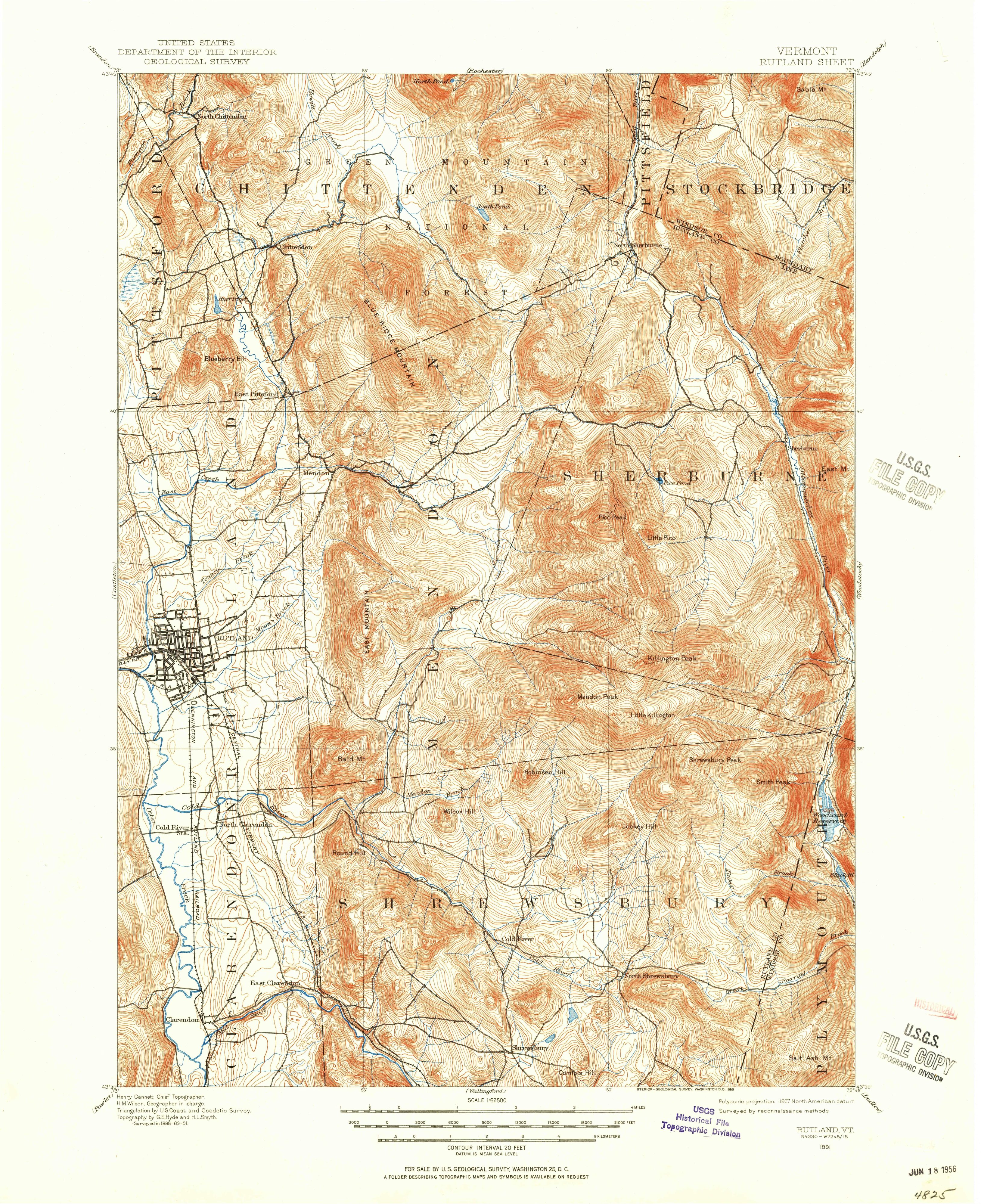
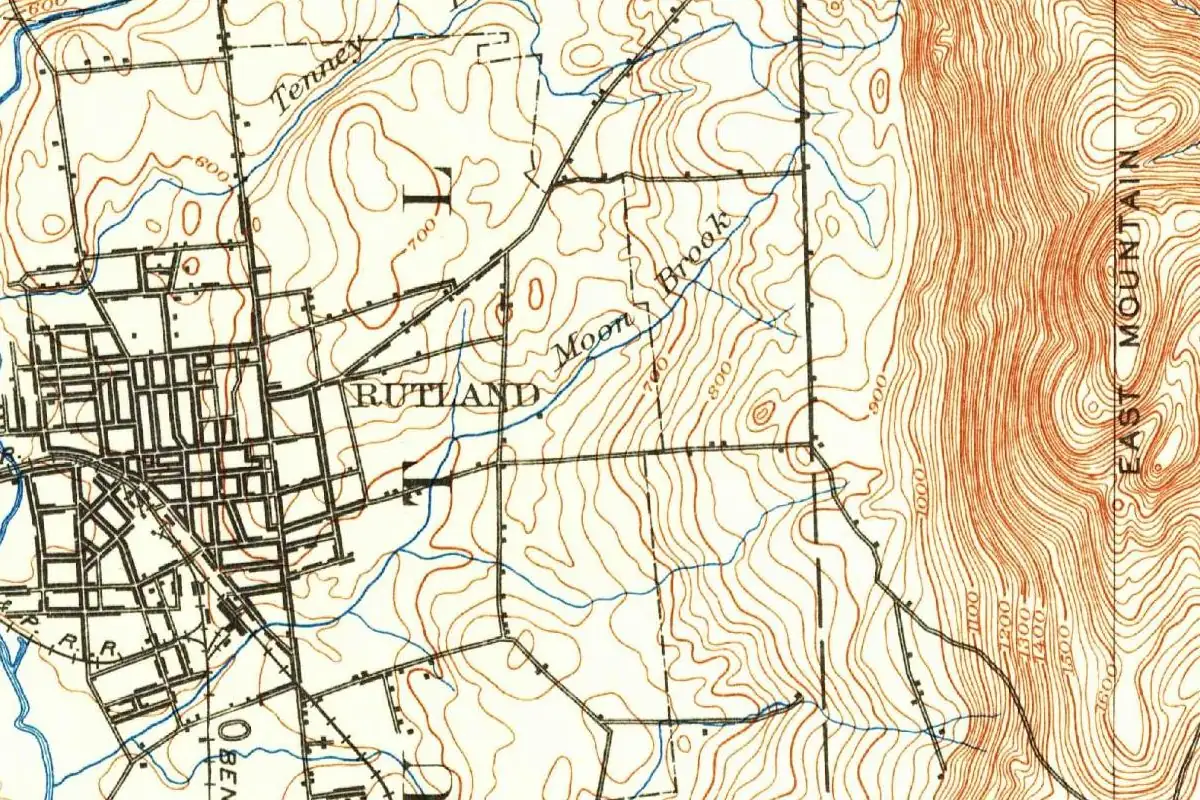
The map at the top of this page is the U.S. Geological Survey’s Rutland sheet, surveyed between 1888 and 1891. It shows the street grid and the rail lines, Moon Brook running across the fields, and East Mountain rising on the right.
Look at the bottom margin of the full sheet and you’ll find a familiar name: “Henry Gannett, Chief Topographer.” The chief topographer of this survey is the same Gannett who, fourteen years later, wrote down in a single line that Vermont’s Rutland was named from the one in Massachusetts.
There’s more about the state’s names on our Vermont page.
Quick answers
Why is Rutland, Vermont, called Rutland?
Nobody knows for certain. An 1886 county history says the first named grantee, John Murray of Rutland, Massachusetts, “it is thought gave the same name to this town,” and Gannett’s 1905 bulletin says it was named from the Massachusetts town. Modern local accounts add the Duke of Rutland as another possibility.
Was Rutland, VT, named after the Duke of Rutland?
Possibly, but it’s not proven. The West Rutland Historical Society says the town was “likely” named for the duke or for John Murray of Rutland, Massachusetts, and Great American Stations calls the origin uncertain.
When was Rutland, Vermont, chartered?
On September 7, 1761, by Governor Benning Wentworth of New Hampshire. A rival grant from the same year called the land Fairfield.
When did Rutland split into a city and a town?
In 1892. West Rutland and Proctor had already separated in 1886, and six years later Rutland divided into Rutland City and Rutland Town.
Key dates
- 1761Benning Wentworth signs the charter of Rutland on September 7; a rival grant to John Henry Lydius calls the same land Fairfield.
- 1849The Rutland and Burlington Railroad is completed through Rutland by December.
- 1886West Rutland and Proctor are split off from Rutland.
- 1892Rutland divides into Rutland City and Rutland Town.
Things to do in Rutland, Vermont
Paramount Theatre
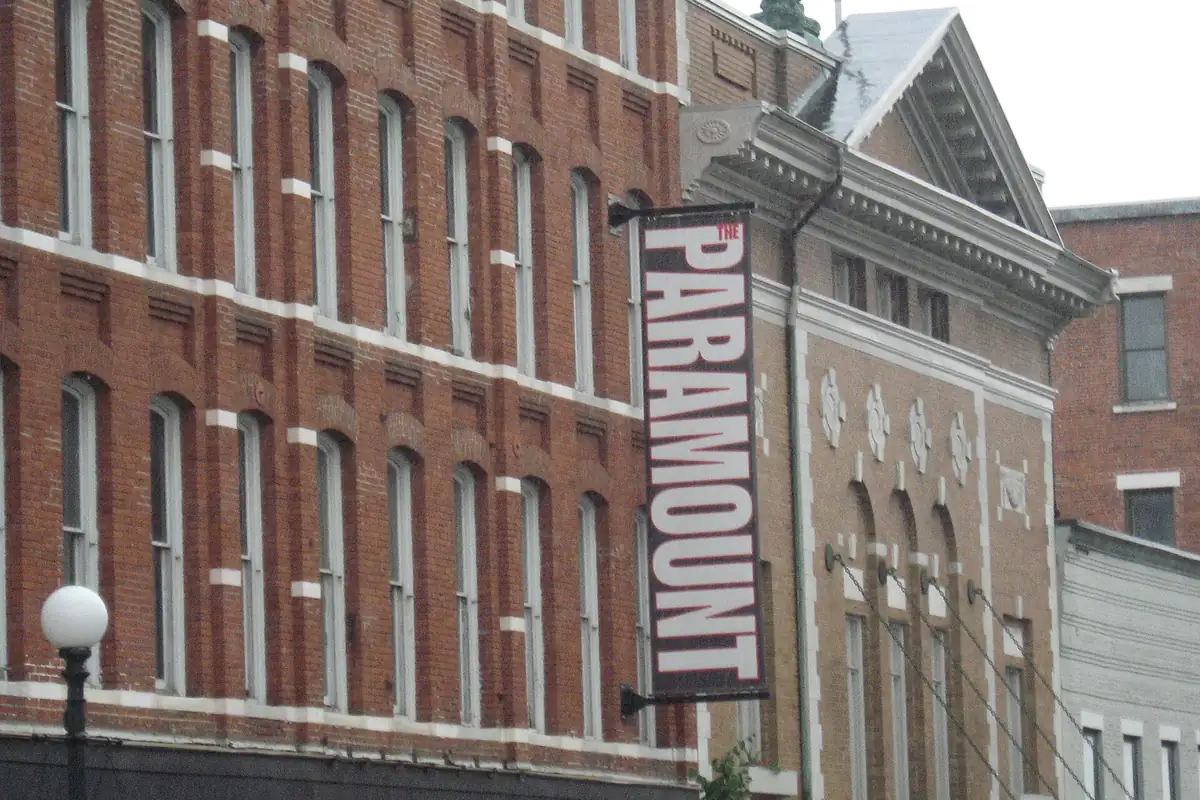
A theater built by George T. Chaffee that opened as the Playhouse on January 16, 1914, was renamed the Paramount in 1931, closed in 1975 and came back as a restored 830-seat performing arts center.
Chaffee Art Center
An art center in Sunny Gables, the Queen Anne mansion that businessman George Thrall Chaffee built between 1892 and 1895, run by the Rutland Area Art Association since 1961.
Pine Hill Park
A 300-acre city park in the northwest corner of Rutland City with a 16-mile (26 km) single-track trail system.
Rutland Historical Society
The local historical society, whose archives and online image galleries cover Rutland's history since its founding.
Getting there
Open Rutland in Google Maps
Opens in a new tab. The pin is the center of Rutland in the USGS place-name record.
The closest airports, Amtrak stations and intercity bus stops, measured in a straight line from the center of Rutland.
Airports
- Patrick Leahy Burlington International (BTV) 60 mi 97 km
- Albany International (ALB) 73 mi 117 km
- Bradley International (BDL) Windsor Locks 116 mi 187 km
Amtrak trains
- Rutland station (RUD) under 1 mi 0.9 km
- Castleton station (CNV) 10 mi 16 km
Intercity buses
- Vermont Translines Marble Valley Regional Transit Center under 1 mi 0.6 km
- FlixBus White River Junction Bus Stop 32 mi 52 km
- Greyhound Hanover (Hanover Inn) 35 mi 56 km
Distances are as the crow flies, not by road. We don't list schedules or fares because they change; check with the airline, Amtrak or the bus company before you go. Official data (FAA commercial service airports (2025), FAA airport locations, Amtrak stations and Intercity Bus Atlas) from the FAA and the U.S. Bureau of Transportation Statistics, checked Nov 14, 2026.
Sponsored
Staying in Rutland?
Compare hotels in Rutland, Vermont, on Expedia.
See hotels in RutlandWe may earn a commission if you buy through this link. It never changes what we write. Read our affiliate disclosure
Historical Sources & References
- H. P. Smith and W. S. Rann, History of Rutland County, Vermont (1886), p. 307. The charter of September 7, 1761; Wentworth’s 500 acres; the quoted passage on Josiah Willard and John Murray of Rutland, Mass.; the grantees who never settled; the rival “Fairfield” grant of John Henry Lydius; Murray’s sale for two shillings; James Mead as first permanent settler.
- Henry Gannett, The Origin of Certain Place Names in the United States, 2nd ed. (1905), p. 268. Rutland, Vermont, “named from the town in Massachusetts,” and Rutland, Massachusetts, “said to have been named from Rutland, near Leicestershire, England.”
- Town of West Rutland, Historical Society page. The 26,000-acre charter and the towns it covered; Wentworth’s preference for names of prominent people; the town “likely named after the Duke of Rutland or John Murray”; the 64 grantees; James Mead’s 20 rights; West Rutland’s incorporation on November 19, 1886.
- Amtrak, Great American Stations, “Rutland, VT”. The uncertain origin of the name and its two versions; the claims of New York, New Hampshire and Massachusetts; settlement at the end of the 1760s; marble in the 1830s; the Rutland and Burlington Railroad in 1849; the splits of 1886 and 1892.
- GNIS feature 1461361 (U.S. Geological Survey). The USGS naming record for Rutland, Rutland County, with its coordinates.
- U.S. Geological Survey, Rutland sheet (1891). The 1:62,500 map, surveyed 1888-1891, that the image at the top of this page was cropped from.
Sponsored
Put this 1891 map on your wall
The 1891 USGS Rutland sheet, in a 1956 reprint, is in the public domain. Download the full-size scan for free, then have it printed on canvas with CanvasOnTheCheap.
Print a map on canvasDownload the full-size mapWe may earn a commission if you buy through this link. It never changes what we write. Read our affiliate disclosure
Spot something wrong, or know more? Tell us here. You can also email us or use our contact page. Corrections are noted here with their date, never made silently.