White River Junction, Vermont: Lyman's Point Renamed
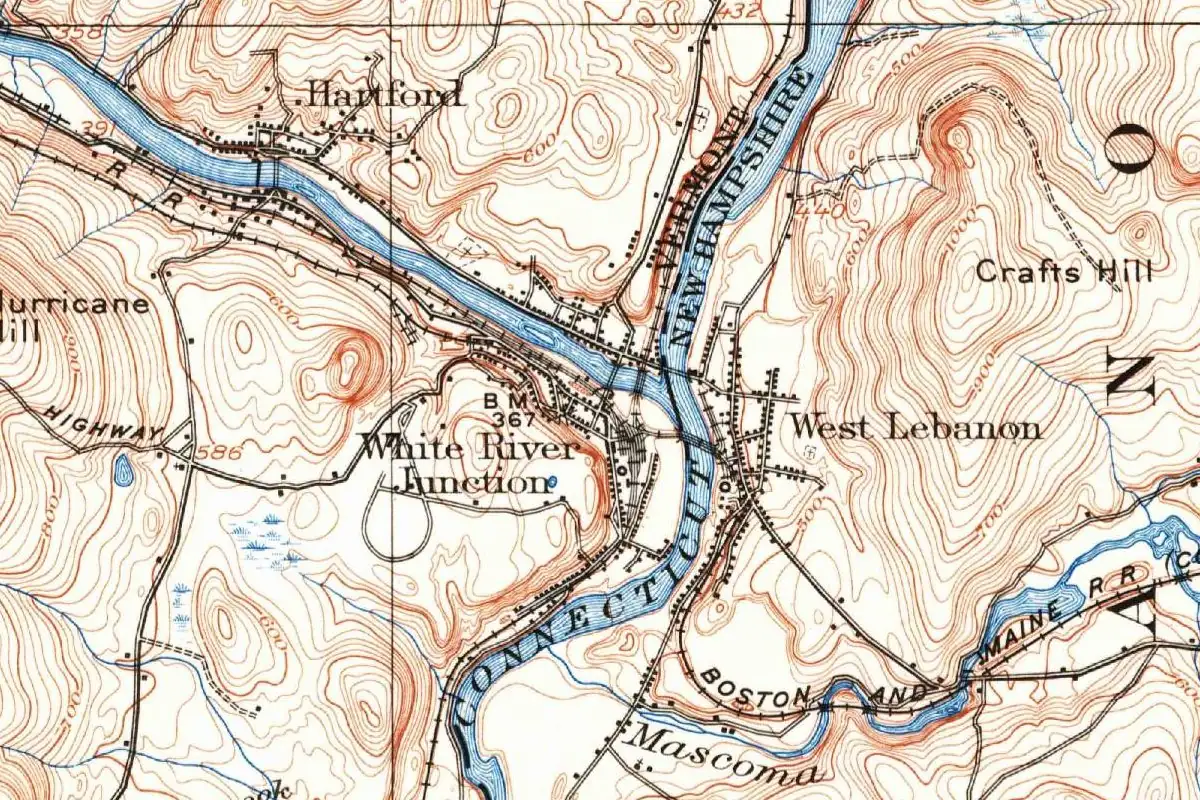
White River Junction, Vermont, owes its name to the railroads that met at the mouth of the White River; before that, its north side was Lyman’s Point. The river was there first, the trains came second, and the name is simply both of them put together.
Lyman’s Point, then a junction
William Howard Tucker’s 1889 history of the town of Hartford explains the change in a footnote. The part of the village on the north side of the White River “bore the name of ‘Lyman’s Point’ until the Central, Passumpsic and Northern railroads were completed, since which time the territory on both sides of the river has been called White River Junction.”
Tucker doesn’t spell out who the Point was named for, but he ties the place to Elias Lyman, the third of that name, who started out as a flatboatman on the Connecticut River, became a merchant and settled on the north side of the White River near its mouth around 1793. Tucker pairs him with Col. Samuel Nutt, another river boatman, who bought the land that he “lived to see occupied by the stations, offices and other buildings erected by the railway companies.”
So you can read the name as a map. The White River comes down out of the hills, it meets the Connecticut right here, and the railroads followed the valleys to the same spot.
The first train in Vermont
Tucker gives the railroad dates on page 155. The Vermont Central chose a route from Windsor up the Connecticut to the mouth of the White River, then up that river and on to Burlington. The first rail was laid at White River Junction, on Nutt’s farm, early in 1847, and an assistant engineer named Isaac B. Culver drove the first spike.
Regular passenger trains started running from White River Junction to Bethel on June 26, 1848. Tucker calls it “the first railroad train and first passenger train run in Vermont.” A year later, on June 20, 1849, the road opened through to Burlington. By the time he wrote, the line also connected here with the Northern New Hampshire road to Concord and Boston, with the Passumpsic road north to Wells River and Newport, and with a branch to Woodstock.
Tucker didn’t hide what he thought of all this:
“This village owes its present importance and its growth to the construction of the various railways which centre at that point.”
He went further and called it “the most important railway centre north of Boston.” That’s his boast, not ours, but the name backs him up.
A village, not a town
If you look for White River Junction among the towns in Tucker’s Vermont, you won’t find it. In 1889 it was a village inside Hartford, along with Hartford village, West Hartford and Quechee, and Tucker treats it that way. Fittingly, his history says Hartford’s first land surveyors started work right here, at the river mouth, in the fall of 1761. More than eighty years before the first rail, the place where the rivers meet was already the place where things began.
Quick answers
Where does the “Junction” in White River Junction come from?
Because railroads met at the mouth of the White River, where it joins the Connecticut. Tucker (1889) dates the name to the years after the Central, Passumpsic and Northern railroads were completed.
Who was Lyman’s Point named for?
Tucker (1889) doesn’t say it in so many words. He ties the place to Elias Lyman, the third of that name, a merchant who settled on the north side of the White River around 1793, and to Col. Samuel Nutt.
Did the first train in Vermont leave from White River Junction?
Yes, according to Tucker. Regular passenger trains ran from White River Junction to Bethel on June 26, 1848, “the first railroad train and first passenger train run in Vermont.”
Key dates
- 1761The grantees' committee begins laying out the first division of Hartford's land at the river mouth.
- 1847The first rail of the Vermont Central is laid at White River Junction, on Samuel Nutt's farm.
- 1848On June 26, regular passenger trains start running from White River Junction to Bethel.
- 1849The road opens through to Burlington on June 20.
Getting there
Open White River Junction in Google Maps
Opens in a new tab. The pin is the center of White River Junction in the USGS place-name record.
The closest airports, Amtrak stations and intercity bus stops, measured in a straight line from the center of White River Junction.
Airports
- Manchester Boston Regional (MHT) 67 mi 107 km
- Patrick Leahy Burlington International (BTV) 70 mi 113 km
- General Edward Lawrence Logan International (BOS) Boston 111 mi 178 km
Amtrak trains
- White River Junction station (WRJ) under 1 mi 0.2 km
- Windsor-Mt. Ascutney station (WNM) 12 mi 20 km
Intercity buses
- FlixBus White River Junction Bus Stop under 1 mi 1 km
- Greyhound Hanover (Hanover Inn) 4 mi 6 km
- Concord Coach Lines Plymouth (Chase St) 32 mi 52 km
Distances are as the crow flies, not by road. We don't list schedules or fares because they change; check with the airline, Amtrak or the bus company before you go. Official data (FAA commercial service airports (2025), FAA airport locations, Amtrak stations and Intercity Bus Atlas) from the FAA and the U.S. Bureau of Transportation Statistics, checked Nov 6, 2026.
Sponsored
Staying in White River Junction?
Compare hotels in White River Junction, Vermont, on Expedia.
See hotels in White River JunctionWe may earn a commission if you buy through this link. It never changes what we write. Read our affiliate disclosure
Historical Sources & References
- William Howard Tucker, History of Hartford, Vermont, July 4, 1761-April 4, 1889 (1889), pp. 21, 27-28 and 155. “Lyman’s Point” and the change of name after the railroads; Elias Lyman and Samuel Nutt; the four villages of Hartford; the 1761 committee; the first rail of 1847, the first train of June 26, 1848, and the opening to Burlington on June 20, 1849.
- GNIS feature 1460224 (U.S. Geological Survey). The national name registry’s entry for White River Junction, a village in Windsor County.
Spot something wrong, or know more? Tell us here. You can also email us or use our contact page. Corrections are noted here with their date, never made silently.