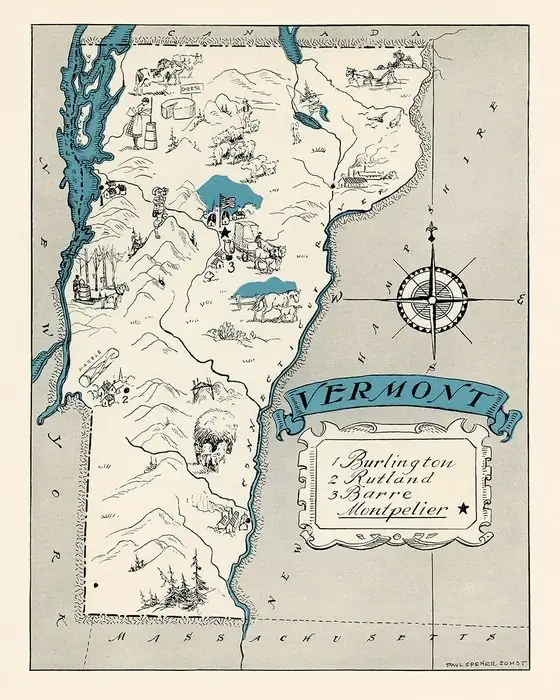
Stowe, Vermont: Chartered as Stow, Given Its E in 1838
Stowe was chartered as Stow by New Hampshire governor Benning Wentworth on June 8, 1763, and the Stowe Historical Society's timeline says the "e" was added at a town meeting in 1838. Why Stow? A 1916 local history said it came from "Lord Stow of Stow England," but admitted nobody knew when the name was given.
Stowe, Vermont, was chartered in 1763 as plain Stow and didn’t get its final “e” until a town meeting in 1838, but where Stow came from is less certain. The only explanation in our sources comes from a speech given 153 years after the charter.
A charter for a town nobody lived in
On June 8, 1763, Benning Wentworth, governor of New Hampshire, chartered the township to 64 proprietors. That’s how the Stowe Historical Society’s timeline puts it, adding that “none of whom settled in Stowe.” The original town covered 36 square miles (93 square km), or 23,040 acres, the figure Mrs. M. N. Wilkins gave in her chapter on Stowe in The Vermont Historical Gazetteer in 1871.
The same governor’s charter for Burlington is dated the day before, June 7, 1763. He also has a Vermont town named for him, though it’s his first name that stuck: Bennington.
For years, Stow existed mostly as paperwork. A history read in town in 1916 says the proprietors first met on April 24, 1770, in Salisbury, at the home of Elias Read, then in Sharon, where they kept meeting from time to time until 1775. The records of the 17 or 18 years after that, it says, “are not very clear, and if not much interest.”
The “e” arrived in 1838
The timeline has the spelling change as a single line under 1838: “‘e’ added to ‘Stow’ in warned Town Meeting.” The timeline doesn’t say who proposed it or why.
You’ll notice the 1871 Gazetteer already spells it Stowe throughout. By then the new spelling was 33 years old.
“Lord Stow of Stow England”
Here’s the only explanation of the name in our sources. In August 1916, during Old Home Week, a history of the town was read at a reception. The Stowe Historical Society has posted the text, credited to Ellen Lovejoy Hunter. Partway through comes this:
“The name of Stowe came from Lord Stow of Stow England. Some of his descendants were among the early settlers but when the name was given has not been learned.”
Look at that second sentence. Hunter was sure about the namesake but admitted not knowing when the name was given. The talk doesn’t say which settlers descended from Lord Stow, or where she heard it.
It’s also worth knowing what the older history doesn’t say. Mrs. Wilkins’s 1871 chapter covers the charter, lists all the proprietors by name and tells the story of the first settlers, but it doesn’t explain the name. The 1916 talk follows her opening closely, down to Stowe lying “about 60 miles from the Canada line” between the “Hogback” range and Mansfield Mountain. The Lord Stow line isn’t in her version.
Henry Gannett doesn’t help, either. His 1905 bulletin lists a Stow in Massachusetts, “named from the town in England,” but has no entry at all for the Vermont town.
So: Stow is the name on the 1763 charter, the “e” came in 1838, and the Lord Stow story is a local tradition from 1916 that its own author couldn’t date.
Oliver Luce and the hand sled
The settlers came three decades after the charter. In 1794, the 1916 history says, Oliver Luce set out from Hartland, Vermont, with a span of horses, a sleigh, his wife and a little furniture. At Joshua Hill’s place in Waterbury the road turned into a bridle path, so he left the team, moved part of the load, “including his wife,” onto a hand sled and pulled it himself for about six miles (10 km).
Captain Clement Moody and his family moved in the next day. Luce built the first log house about a mile (1.6 km) from the Center Village, and his son Harry was the first child born in Stowe. The timeline dates Luce’s arrival to April 16, 1794, while the society’s home page says March. Either way, it was 31 years after the charter.
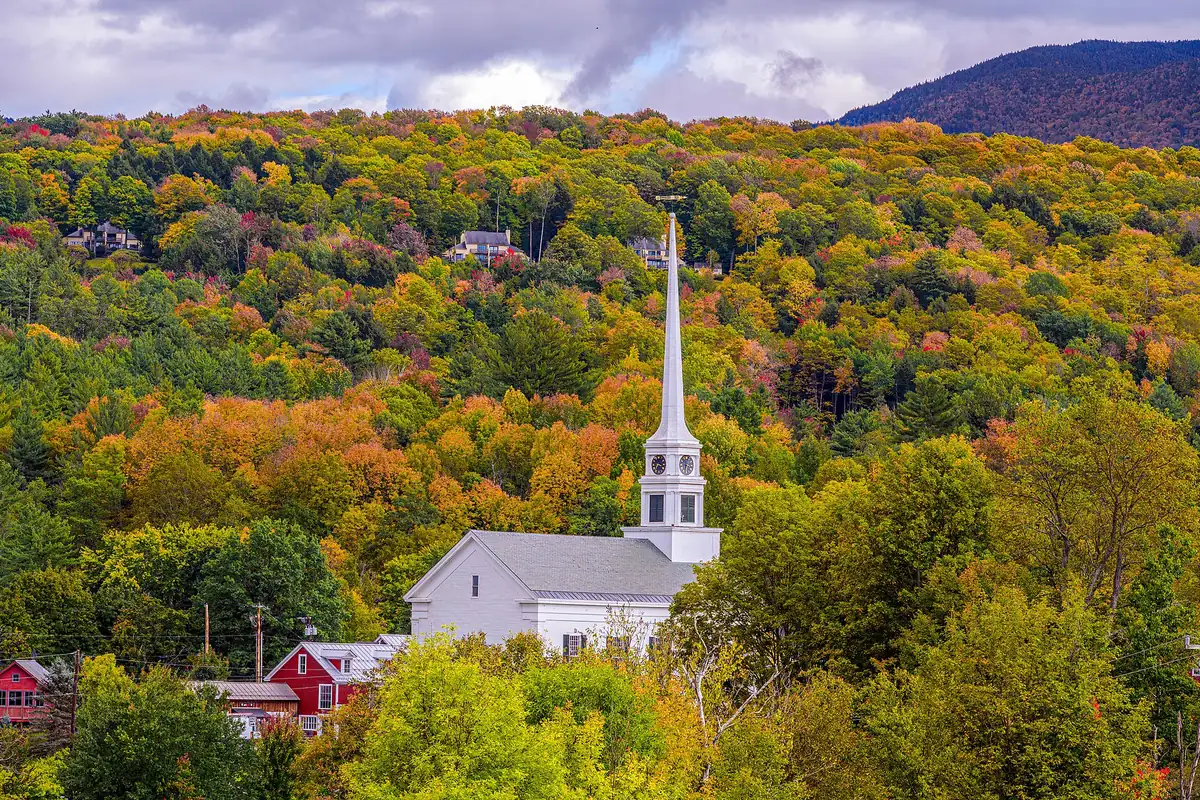
The town was organized in 1797. In 1818 it built a meeting house that every denomination used in turn, on the lot where the Stowe Community Church stands today, the white steeple in the photo below. The old meeting house was later moved, and it’s still standing.
Bigger than the charter
If you compare a map of today’s town with the 1763 grant, you’ll find Stowe is larger than its charter. In 1848 the legislature passed an act annexing the town of Mansfield to Stowe, if both towns voted for it, and they did. Mrs. Wilkins says the annexation was “most vigorously resisted” by Ivory Luce, one of Mansfield’s first settlers and its longtime representative. He got himself elected to represent Mansfield anyway and claimed his seat in the House, which ruled he wasn’t entitled to it. A test case went to the state Supreme Court, and the act was held constitutional. In 1855, part of the town of Sterling was added too.
The timeline also marks the turns that made Stowe famous: skiing introduced by Swedish families living in town in 1913, the first ski trails cut by the Civilian Conservation Corps in 1933, and the first single chairlift on Mt. Mansfield in 1940. None of that touched the name, which had carried its “e” since 1838.
The last word, from 1916
The 1916 talk ended with a pun on the town’s own name. Stowe, it said, is “a good place to be born in, to live in,” and, when our bodies are tired, “a good place to be stowed away to rest.”
There’s more on the state’s names on our Vermont page.
Quick answers
Why is Stowe, Vermont, spelled with an E?
Because the town added it. The Stowe Historical Society’s timeline says the “e” was added to “Stow” at a warned town meeting in 1838. The 1763 charter name was Stow.
Who was Stowe, Vermont, named after?
It isn’t documented. A town history read in 1916 said the name “came from Lord Stow of Stow England,” but it also said that “when the name was given has not been learned.” No older source in this article explains the name.
When was Stowe, Vermont, founded?
It was chartered on June 8, 1763, but none of the 64 proprietors settled there. The first settler, Oliver Luce, arrived in 1794, and the town was organized in 1797.
Key dates
- 1763On June 8, Gov. Benning Wentworth charters Stow to 64 proprietors, none of whom settle there.
- 1770The proprietors hold their first meeting, in Salisbury, on April 24.
- 1794Oliver Luce arrives from Hartland and builds the first log house; Clement Moody's family follows the next day.
- 1797The town is organized and holds its first town meeting.
- 1818The town meeting house goes up, shared by every denomination in turn.
- 1838An "e" is added to "Stow" at a warned town meeting.
- 1848Most of the town of Mansfield is annexed to Stowe.
- 1916A history read at Old Home Week says the name came from "Lord Stow of Stow England."
Things to do in Stowe, Vermont
Vermont Ski and Snowboard Museum
A nonprofit museum of Vermont skiing and riding, with its Hall of Fame, in Stowe's 1818 Town Meeting House, the town's oldest active public building, moved by a team of oxen to South Main Street to make room for a church.
Stowe Recreation Path
A paved, mostly flat 5.3-mile (8.5 km) public path that starts in Stowe Village and ends at a covered bridge, used by cyclists, runners and walkers, and groomed for Nordic skiing in winter.
Smugglers' Notch State Park
A narrow pass through the Green Mountains with cliffs nearly 1,000 feet (300 m) high, used by smugglers after the Embargo Act of 1807, by freedom seekers bound for Canada and by liquor runners during Prohibition.
Stowe Historical Society
Two one-room schoolhouses on School Street that hold the society's books, letters, maps, photographs and everyday objects from Stowe's past.
Getting there
Open Stowe in Google Maps
Opens in a new tab. The pin is the center of Stowe in the USGS place-name record.
The closest airports, Amtrak stations and intercity bus stops, measured in a straight line from the center of Stowe.
Airports
- Patrick Leahy Burlington International (BTV) 23 mi 37 km
- Plattsburgh International (PBG) 41 mi 65 km
Amtrak trains
- Waterbury-Stowe station (WAB) 10 mi 15 km
- Montpelier-Berlin station (MPR) 15 mi 24 km
Intercity buses
- FlixBus Montpelier Transit Center 15 mi 24 km
- Vermont Translines Burlington International Airport 23 mi 37 km
- Greyhound St. Albans Bus Stop 31 mi 50 km
Distances are as the crow flies, not by road. We don't list schedules or fares because they change; check with the airline, Amtrak or the bus company before you go. Official data (FAA commercial service airports (2025), FAA airport locations, Amtrak stations and Intercity Bus Atlas) from the FAA and the U.S. Bureau of Transportation Statistics, checked Nov 14, 2026.
Sponsored
Staying in Stowe?
Compare hotels in Stowe, Vermont, on Expedia.
See hotels in StoweWe may earn a commission if you buy through this link. It never changes what we write. Read our affiliate disclosure
Historical Sources & References
- Ellen Lovejoy Hunter, “A History of Stowe” (1916), Stowe Historical Society. The history read at the Old Home Week reception on August 15, 1916: the charter of June 8, 1763, the proprietors’ meeting of 1770, “Lord Stow of Stow England,” Oliver Luce’s trip and the closing line about being “stowed away to rest.”
- Stowe Historical Society, “Stowe Timeline”. The 64 proprietors who never settled, the original 36 square miles, Luce’s arrival on April 16, 1794, the meeting house of 1818 and the “e” added to “Stow” in 1838.
- Mrs. M. N. Wilkins, “Stowe,” The Vermont Historical Gazetteer, vol. 2 (1871), p. 695. The charter from Benning Wentworth to 64 proprietors, the original 23,040 acres, the town’s position “about 60 miles from Canada line,” and the 1848 annexation of Mansfield that Ivory Luce “most vigorously resisted.” Checked against the page image; the chapter doesn’t explain the name.
- Stowe Historical Society, home page. Settlement in March 1794 by Oliver Luce, followed the next day by Clement Moody.
- Vermont Ski and Snowboard Museum, “VTSSM History”. The 1818 meeting house on the lot where the Stowe Community Church now stands, and its move to South Main Street.
- Henry Gannett, The Origin of Certain Place Names in the United States, 2nd ed. (1905), p. 291. “Stow; town in Middlesex County, Massachusetts, named from the town in England.” The bulletin has no entry for Stowe, Vermont.
- GNIS feature 1459745 (U.S. Geological Survey). USGS place-name entry for Stowe, Lamoille County, with its coordinates.
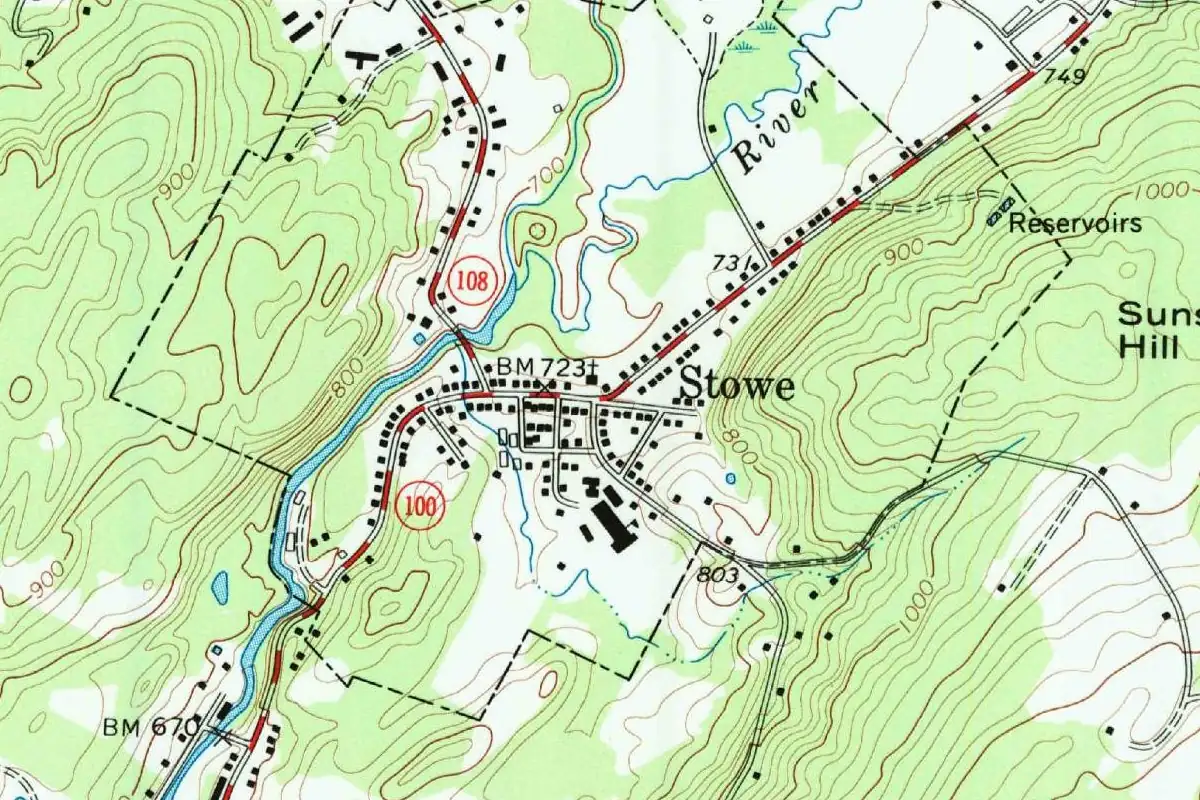
- U.S. Geological Survey, Stowe quadrangle (1968). The 1:24,000 map the image at the top of this page was cropped from.
Spot something wrong, or know more? Tell us here. You can also email us or use our contact page. Corrections are noted here with their date, never made silently.