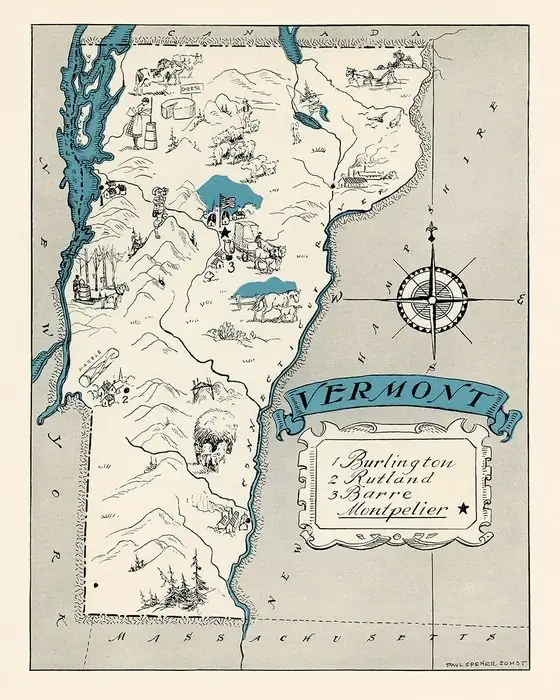
Brattleboro, Vermont: William Brattle's Borough
Brattleboro is named for Col. William Brattle Jr., a prominent Massachusetts man who acted as agent for a group of Boston-area owners when New Hampshire chartered the town in December 1753. The charter called it Brattleborough. Brattle kept his home in Cambridge, never lived in the town, and later sided with the British.
A borough named for a man who stayed home
Brattleboro, Vermont, is short for “William Brattle’s Borough,” after a Massachusetts colonel who took out its 1753 charter and never lived there. That’s how the Brattleboro Historical Society puts it, and it says where he did live: Cambridge, Massachusetts, about 80 miles (130 km) away.
So the town carries the name of a landowner, not a settler. To see how that happened, you have to start a few decades earlier, with a fort.
Fort Dummer came first
Before the 1700s, the historical society notes, this was Abenaki country. In 1724, Lt. Gov. William Dummer of the Massachusetts Bay Colony built Fort Dummer on the Connecticut River as protection against the Abenaki. The society calls it the first English settlement in Vermont. It was a wooden, walled outpost at the northern edge of the river settlements, and by 1728 it had become a trading post too.
The fort stood just south of today’s town. You won’t find it there now: Vermont State Parks says the site was flooded in 1908 when the Vernon Dam was built, and the fort lies underwater near the river’s western bank.
Keep the two Williams apart. Fort Dummer is named for Dummer, the colony’s lieutenant governor. The town is named for Brattle. Same valley, same era, different men.
Colonel Brattle takes out the charter
By the 1750s, settlers were starting to build outside the fort, where the West River meets the Connecticut. That’s when the paperwork arrived.
Mary R. Cabot’s Annals of Brattleboro, published in 1921, sketches William Brattle Jr. as a man who seemed to do everything. Born in Cambridge and educated at Harvard, he trained as a preacher, then practiced law, sat in the legislature and the Governor’s Council, practiced medicine “extensively,” and rose to major-general of militia. By the time of the grant he was Colonel Brattle, married to a daughter of Governor Saltonstall.
Cabot explains the name in one sentence. Brattle “acted as agent for the other owners and for himself in taking out the charters,” and “as he chose shares of land on which the town of Brattleboro was subsequently built, his name was given to the town.” The historical society describes him the same way, as the acting member of a group of Boston-based owners.
The charter itself came from New Hampshire, which then claimed this side of the Connecticut. Cabot prints its text. Issued in the name of King George II, with the advice of Gov. Benning Wentworth and his council, it divides the land into shares and then gets to the point:
“…and that the same be and is incorporated into a Township by the name of Brattleborough…”
It’s dated December 26, 1753, and William Brattle’s name is first on the list of grantees. The charter even sets aside “his Majestys Fort Dummer” and a tract of land around it, reaching 50 rods (about 825 feet, or 250 meters) to the west. So the old fort and the new name ended up on the same sheet of parchment.
Brattleborough, then Brattleboro
Notice the spelling. The charter says Brattleborough, with the full English “borough” on the end. Cabot keeps that long form for her chapter title, while her own sentences use Brattleboro.
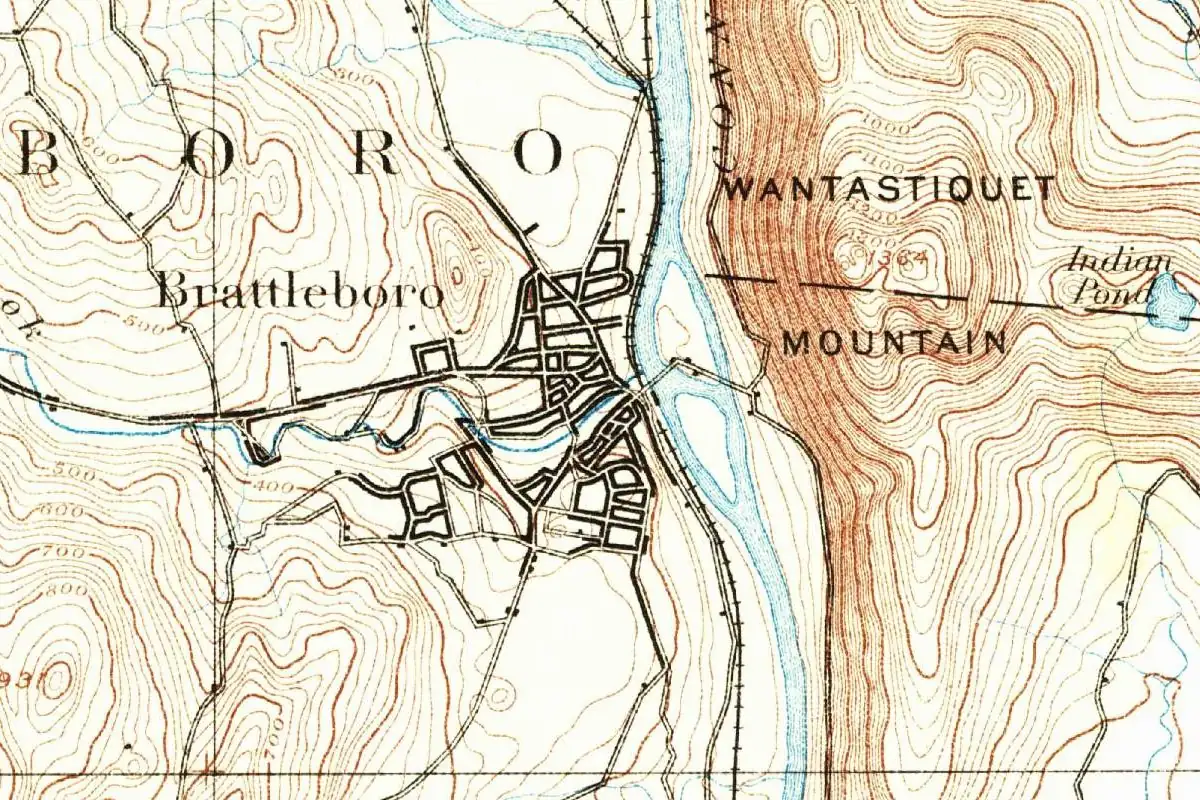
By the time the federal surveyors got here, the short form had won on paper. The U.S. Geological Survey map at the top of this page, printed in 1891, labels the village “Brattleboro.” In 1905 Henry Gannett, compiling place-name origins for the Survey, gave the town one line: “named for Col. William Brattle, a citizen of Boston.”
None of the sources here dates the exact switch from one spelling to the other. What you can say is that the “-ugh” was gone from the government’s map well before 1900.
A namesake who never moved in
Here’s where Brattle’s story stops matching the town’s. Cabot notes that his claim also covered some of the best land in neighboring Putney, and that “none of the other grantees became settlers” in Brattleboro, which was still a dense forest. The people who actually cleared the land weren’t the people on the charter.
Then came the Revolution. Brattle’s social connections, “especially his attachment to General Gage,” as Cabot puts it, pulled him toward the British. He fled to Nova Scotia when the war began and died at Halifax in 1776.
The town didn’t drop his name. By then it was simply what the place was called, and it had already survived another fight over who was in charge.
Two colonies, one township
The historical society’s account of early government explains that fight. In 1764 the King fixed the boundary between New Hampshire and New York at the Connecticut River, and suddenly the New Hampshire grants, Brattleborough among them, were in question.
Twenty settlers petitioned New York for recognition, and New York’s Governor Moore granted them the township of Brattleboro. For a while the town worked as part of the colony of New York, inside a county called Cumberland, while deeds from both colonies were treated as valid even when they clashed. It’s a confusing stretch, and the town admits its own records don’t help much: its earliest records are incomplete, and an 1832 effort to copy the legible manuscripts saved town records from 1781 forward.
Through all of it, the name held. New Hampshire, New York and eventually Vermont all called the place after the same absentee colonel.
Wentworth’s other towns
The governor who signed Brattleborough’s charter left his mark all over this region. Benning Wentworth named Bennington after himself in 1749, and across the river he named Keene, New Hampshire, for Sir Benjamin Keene, a British diplomat and friend of his. In Brattleboro, the honor went to the man who handled the paperwork. If you’d like to see where Brattle actually lived, his hometown has its own story on our Cambridge, Massachusetts page, and there’s more from this state on our Vermont page.
So the next time you cross the river into Brattleboro, you’re entering a borough that belonged, on paper, to a man who stayed home in Cambridge.
Quick answers
Who is Brattleboro, Vermont, named after?
Col. William Brattle Jr. of Massachusetts. He acted as agent for a group of owners when New Hampshire chartered the township in 1753, and the historical society says the name comes from “William Brattle’s Borough.”
Did William Brattle ever live in Brattleboro?
No. The Brattleboro Historical Society says he never lived in town and kept his home in Cambridge, Massachusetts.
Is Brattleboro named after Fort Dummer?
No. Fort Dummer, built in 1724 just south of town, was named for Lt. Gov. William Dummer of Massachusetts Bay. The town’s name honors William Brattle.
Why was it spelled Brattleborough?
That’s the spelling in the 1753 charter. By 1891 the U.S. Geological Survey’s map already printed the shorter Brattleboro; the sources here don’t say exactly when the change happened.
Key dates
- 1724Fort Dummer is built on the Connecticut River, just south of today's Brattleboro.
- 1753On December 26, New Hampshire charters the township "by the name of Brattleborough."
- 1764The Crown fixes the New Hampshire-New York line at the Connecticut River, putting the old grants in question.
- 1776William Brattle, a Loyalist, dies at Halifax, Nova Scotia.
- 1908The Vernon Dam floods the site of Fort Dummer.
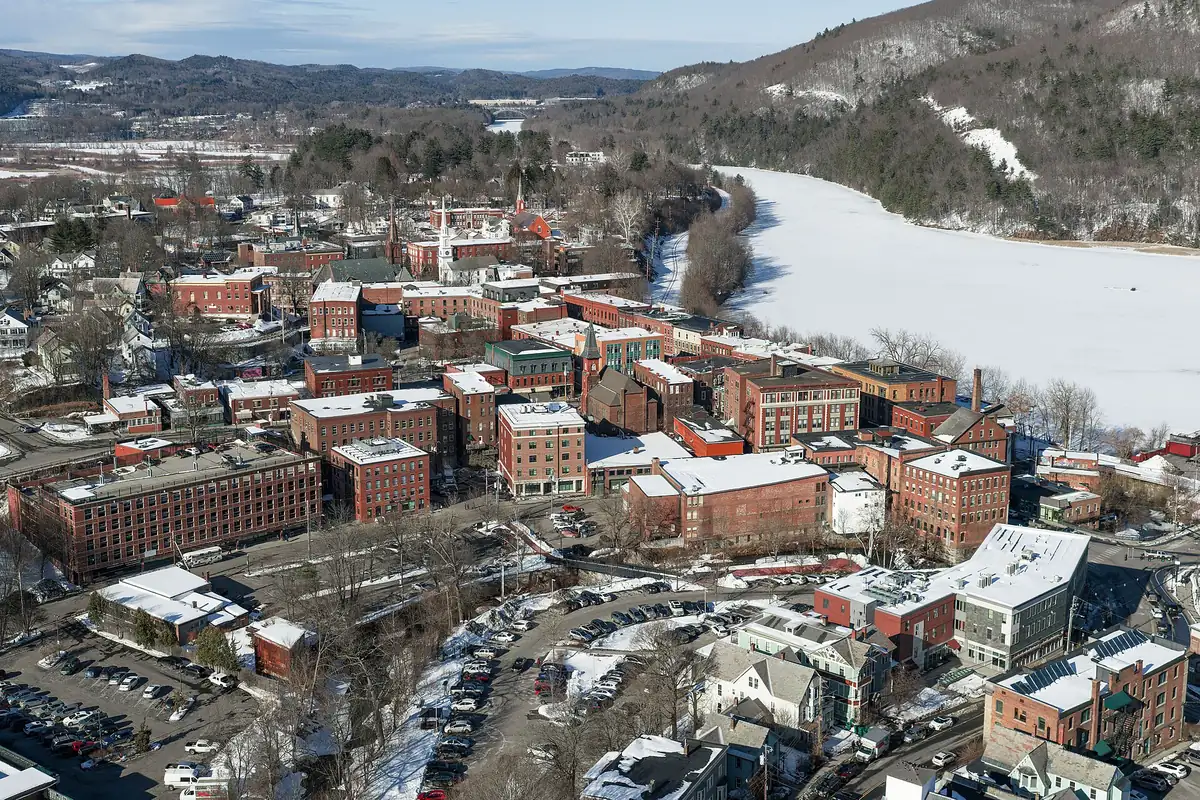
Things to do in Brattleboro, Vermont
Fort Dummer State Park
A 217-acre state park in the Connecticut River Valley just outside Brattleboro, named for the fort built in 1724. The fort's site was flooded in 1908, and you can view it from the northernmost scenic vista on the Sunrise Trail.
Retreat Farm
A nonprofit farm with 500 acres of conserved forests, farmland, trails and waterways. Its historic nine-structure farmstead sits where the West River meets the Connecticut.
Brattleboro Museum & Art Center
A contemporary art museum focused on living artists, founded in 1972 by citizens who saved the town's historic Union Station train station from the wrecking ball. It presents 15 to 20 exhibitions a year.
Estey Organ Museum
A museum dedicated to the history and heritage of the Estey Organ Company of Brattleboro, which for nearly a century was known worldwide for its reed, pipe and electronic organs.
Getting there
Open Brattleboro in Google Maps
Opens in a new tab. The pin is the center of Brattleboro in the USGS place-name record.
The closest airports, Amtrak stations and intercity bus stops, measured in a straight line from the center of Brattleboro.
Airports
- Worcester Regional (ORH) 53 mi 86 km
- Manchester Boston Regional (MHT) 57 mi 92 km
- Bradley International (BDL) Windsor Locks 63 mi 102 km
Amtrak trains
- Brattleboro station (BRA) under 1 mi 0.1 km
- Greenfield station (GFD) 18 mi 30 km
Intercity buses
- Greyhound Brattleboro Shell under 1 mi 1 km
- FlixBus University of Massachusetts Amherst 32 mi 52 km
- OurBus Amherst, MA (UMass Amherst - Haigis Mall bus stop in front of Bromery Center for the Arts) 32 mi 52 km
Distances are as the crow flies, not by road. We don't list schedules or fares because they change; check with the airline, Amtrak or the bus company before you go. Official data (FAA commercial service airports (2025), FAA airport locations, Amtrak stations and Intercity Bus Atlas) from the FAA and the U.S. Bureau of Transportation Statistics, checked Nov 14, 2026.
Sponsored
Staying in Brattleboro?
Compare hotels in Brattleboro, Vermont, on Expedia.
See hotels in BrattleboroWe may earn a commission if you buy through this link. It never changes what we write. Read our affiliate disclosure
Historical Sources & References
- Brattleboro Historical Society, “Brattleboro’s Beginnings”. The Abenaki before the 1700s, Fort Dummer in 1724 and its later use as a trading post, the first settlers near the West River, William Brattle Jr. as acting member of the Boston-based owners, his shares in 1753, his Cambridge home, the phrase “William Brattle’s Borough,” and his flight to Nova Scotia.
- Brattleboro Historical Society, “Early local government (1753-1803)”. The 1753 charter as part of the New Hampshire Grants, the 1764 boundary ruling, the settlers’ petition to New York and Governor Moore’s grant, and Cumberland County.
- Town of Brattleboro, “Local History”. The 1753 charter, the incomplete early records and the 1832 transcription that saved records from 1781 forward.
- Mary R. Cabot, Annals of Brattleboro, vol. 1 (1921), pp. 27-30. Brattle’s life and career, his role as agent “in taking out the charters,” the sentence on why “his name was given to the town,” the grantees who never settled, and his death at Halifax (p. 27); the full text of the charter “by the name of Brattleborough” (p. 28), its date of December 26, 1753, the list of grantees headed by William Brattle, and the land reserved around Fort Dummer (p. 30).
- Henry Gannett, The Origin of Certain Place Names in the United States (USGS, 1905), p. 55. Brattleboro, Windham County, “named for Col. William Brattle, a citizen of Boston.”
- Vermont State Parks, “Fort Dummer State Park”. The fort’s 1724 date and the flooding of its site in 1908 when the Vernon Dam was built.
- GNIS feature 1456556 (U.S. Geological Survey). The national names database entry for Brattleboro, a populated place in Windham County.
- U.S. Geological Survey, Brattleboro sheet (1891). The 1:62,500 quadrangle the map at the top of this page was cut from, with the village already labeled “Brattleboro.”
Spot something wrong, or know more? Tell us here. You can also email us or use our contact page. Corrections are noted here with their date, never made silently.