Hanover, New Hampshire: A Name Carried Up From Connecticut
Hanover most likely takes its name from a parish called Hannover in Norwich, Connecticut. Most of the people who received the town's 1761 charter came from Connecticut, and historian Frederick Chase wrote in 1891 that the names of the towns chartered that day were transplanted from the grantees' homes. The charter spelled it Hannover; the extra n soon dropped.
A charter with an extra n
Hanover, New Hampshire, was chartered on July 4, 1761, with an extra n, Hannover, and its name most likely came up the river from a parish in Connecticut. That’s the explanation Frederick Chase settled on in 1891, in the first volume of his history of Dartmouth College and the town around it. So it isn’t, at least not directly, a nod to the Duke of Hanover who became George I of England.
The charters handed out that summer day came as a set. Chase counts five that passed the provincial seal on July 4, 1761, the first grants in that western stretch of the province since the Indian war had broken out seven years earlier. Four of them went largely to the people named on one petition, and they covered the towns of Hanover, Norwich, Hartford and Lebanon. The fifth was Enfield.
They didn’t even land where the petitioners had asked. Chase says the block of towns ended up some 35 miles (56 km) downriver from the tract they’d requested, at the mouth of the White River instead of the Wells River. His guess was that people closer to Portsmouth, with more pull there, already had their eye on the upper tract, which took in the Great Ox-bow, then considered the choicest land in the whole valley.
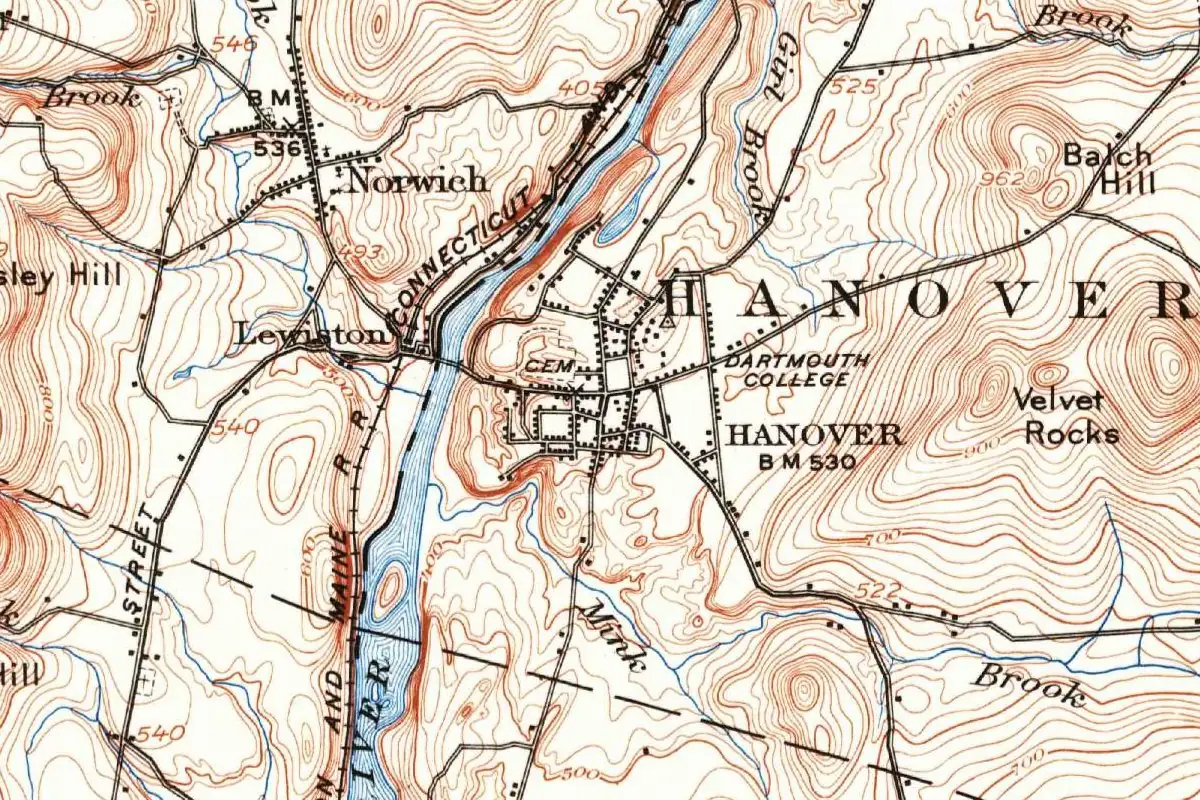
If you look at the 1906 map at the top of this page, you can still see the neighbors. Hanover sits on the east bank of the Connecticut River, and right across the water, on the Vermont side, is Norwich.
Names packed for the trip north
Where did the names come from? Chase had a simple answer for the group:
“The names of these towns were evidently, as in other cases, transplanted from the homes of the grantees.”
Three of them, he wrote, were “sufficiently obvious.” Hanover was the puzzle. Chase called it “at first glance obscure,” and then went with the explanation that seemed to fit: there was at that time, in the Connecticut town of Norwich, a parish called “Hannover.” By his day the old parish had been split up among the towns of Lisbon, Windham and Canterbury, but the name still hung on there.
The spelling backs him up. That Connecticut name, Chase noted, was spelled with a double n, and so was the New Hampshire charter. In Hanover, “the superfluous letter was here almost immediately dropped.” Dartmouth’s library still describes the town as chartered by Gov. Benning Wentworth in 1761 “as ‘Hannover.’”
Notice how carefully Chase put it, though. The parish idea “seems to be satisfactorily explained by the suggestion,” he wrote. It’s the best fit, not a line in the charter saying so, and none of the sources on this page quotes a reason given in 1761.
Who got the land
The people behind the name were mostly from Connecticut. Of the 68 shares in the town, Chase counted 55 that went to Connecticut people named by the petitioners. The Hanover Historical Society’s timeline puts it more simply: 22,400 acres chartered to 68 proprietors living in Connecticut, who “call their new township Hanover.”
The other 13 shares went to people the governor picked. Chase says Wentworth’s habit was to reward members of his government, his friends and himself, and to keep 500 acres in each new township for his own benefit. In Hanover he took the southwest corner.
It’s worth remembering whose land this already was. The Historical Society notes that the area was home for centuries to native peoples known collectively as the Abenaki, and Dartmouth’s library describes it as originally occupied by the Abenaki.
A college, a settler and a brief rebellion
Nobody moved in right away. Dartmouth’s archives say the first settler, proprietor Edmund Freeman, arrived with his family in 1765; the Historical Society calls him Edmund Freeman III, the son of one of the proprietors. Most of the settlers who followed came from Connecticut too.
Then came the college. In 1770, with the encouragement and promised money of the Hanover proprietors, the Rev. Eleazar Wheelock moved his young Dartmouth College to town, setting it up at a level spot called “the Plain,” about a mile (1.6 km) above the river. That’s where the college sits on the 1906 map, with Hanover village grown up around it.
The name even survived a brief political detour. In the 1780s, Hanover joined other towns along the Connecticut River in forming “Dresden,” part of the then-independent republic of Vermont, according to Dartmouth’s archives. The library’s place notes add that it was the town’s southwest corner, called Dresden, that went over. Either way, Hanover came out of it still Hanover.
A common name with a local route
There are a lot of Hanovers in America. Henry Gannett’s survey of name origins, printed by the U.S. Geological Survey in 1905, has a single Hanover entry. It lists a Kansas city, a Massachusetts town, a Virginia county “and several other places,” all named for the Duke of Hanover, who became George I of England, or for the Prussian province and city. He didn’t list the New Hampshire town by name.
That’s why the New Hampshire story is a little different. According to Chase, its name came by way of a Connecticut parish, carried north by the people who got the charter.
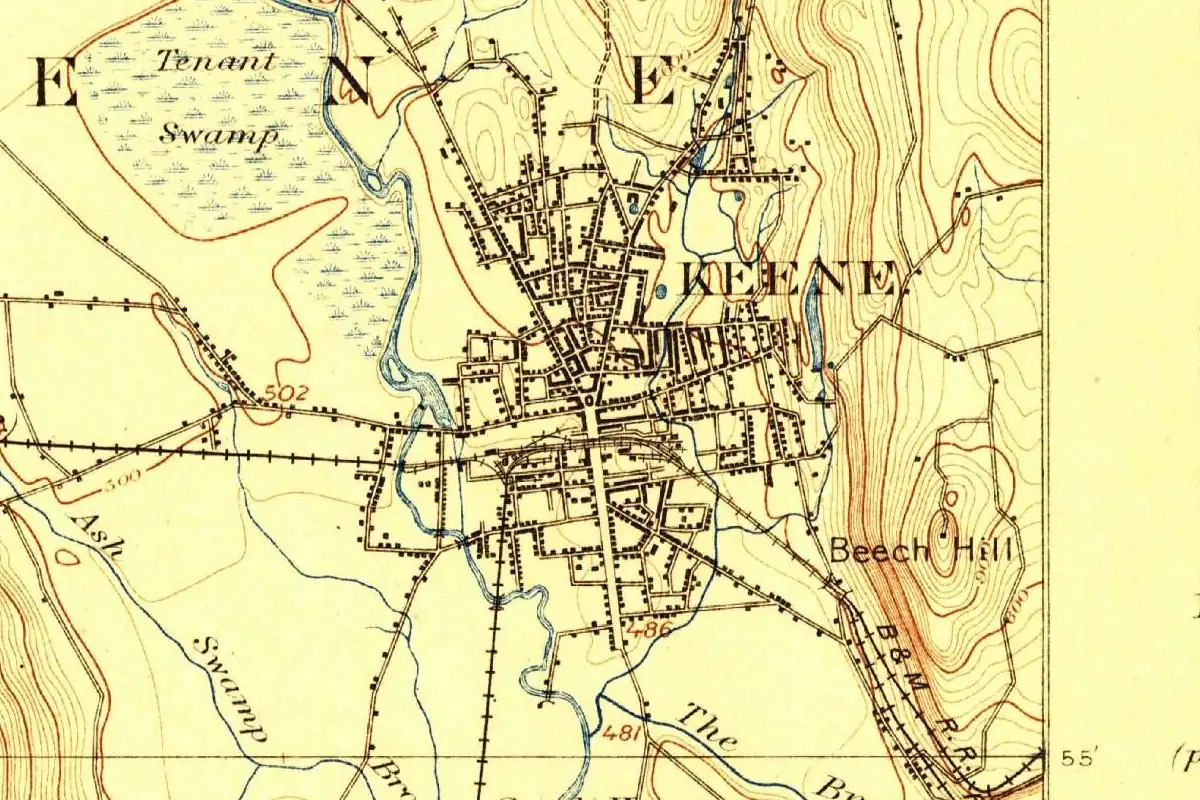
Wentworth’s charters left their mark all over this part of New England. He’s also behind the names of Keene, named for a British envoy who tried to help him, and Bennington, named after himself. And White River Junction sits at the mouth of the White River, where Chase placed this whole block of 1761 towns. The rest of the Granite State’s towns are gathered on our New Hampshire page.
Quick answers
Why is it called Hanover, New Hampshire?
Most likely after a parish called Hannover in Norwich, Connecticut. Frederick Chase wrote in 1891 that the town names chartered that day were transplanted from the grantees’ homes, and that this suggestion “seems” to explain Hanover’s.
Is Hanover, New Hampshire, named after the German city?
Not directly, as far as the sources go. Chase traced it to a Connecticut parish with the same spelling, and none of the sources here says where that parish got its name. Gannett’s 1905 entry says many American Hanovers honor the Duke of Hanover or the Prussian province, but it doesn’t name this town.
Why was Hanover once spelled Hannover?
Because the 1761 charter used a double n, like the Connecticut parish, and Chase says the extra letter was dropped almost immediately.
Who were Hanover’s first proprietors?
Mostly people from Connecticut. Chase counted 55 of the 68 shares going to Connecticut grantees; the other 13 went to people chosen by Gov. Benning Wentworth.
Key dates
- 1761On July 4, Hanover's charter passes the provincial seal, spelled Hannover, along with Norwich, Hartford, Lebanon and Enfield.
- 1765Edmund Freeman, son of one of the proprietors, arrives with his family as the first settler.
- 1770Eleazar Wheelock moves Dartmouth College to Hanover with the proprietors' backing.
Things to do in Hanover, New Hampshire
Hood Museum of Art
Dartmouth's art museum, with more than 74,000 objects from six continents, among them six Assyrian stone reliefs from the palace of Ashurnasirpal II, from about 900 BCE.
Orozco's The Epic of American Civilization
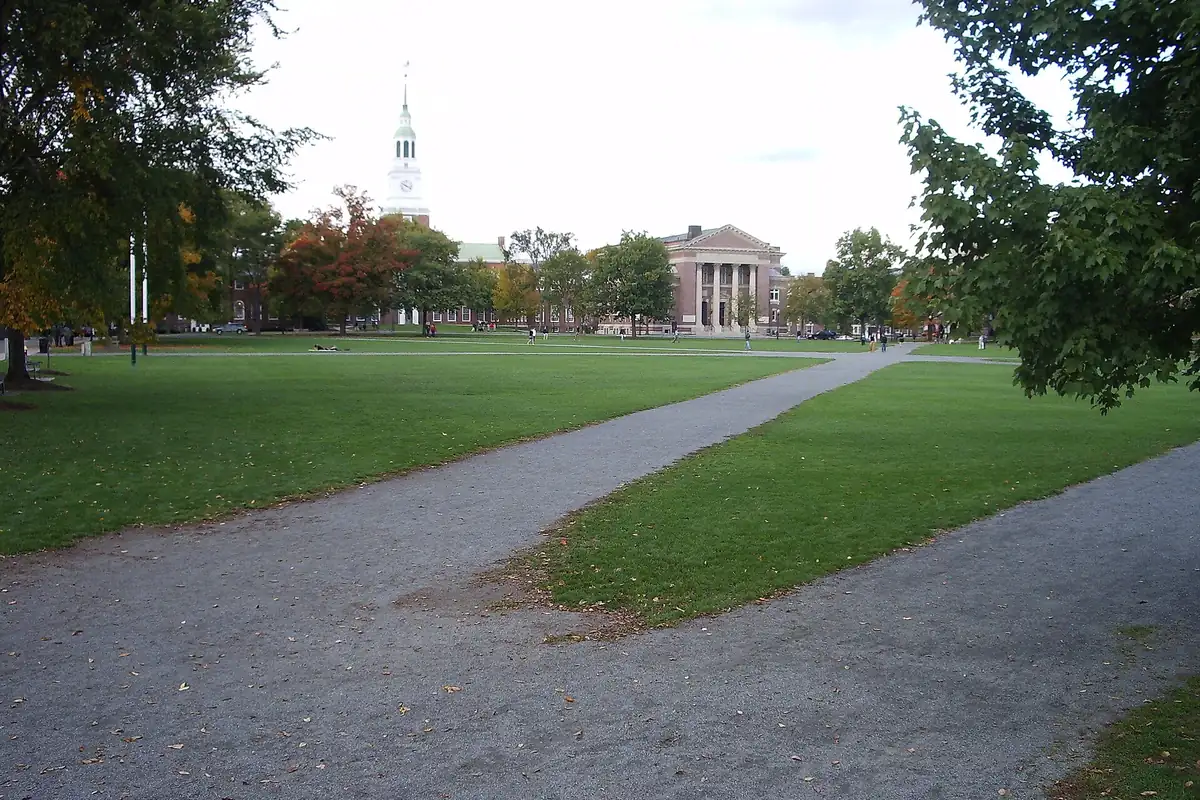
José Clemente Orozco's 24-panel fresco cycle, painted from 1932 to 1934 in the Orozco Room of Baker Library and covering nearly 3,200 square feet (about 300 square meters), a National Historic Landmark since 2013.
Dartmouth Outing Club and the Appalachian Trail
The oldest and largest collegiate outing club in the country, formed in 1909; in 1926 its trail became a founding link of the Appalachian Trail, and in the 1970s students started a tradition of hiking the 50 miles (80 km) from Hanover to Moosilauke.
Hopkins Center for the Arts
Dartmouth's arts center at 4 East Wheelock Street, whose stated mission is to cultivate art as central to life and to connect people through creative experiences.
Getting there
Open Hanover in Google Maps
Opens in a new tab. The pin is the center of Hanover in the USGS place-name record.
The closest airports, Amtrak stations and intercity bus stops, measured in a straight line from the center of Hanover.
Airports
- Patrick Leahy Burlington International (BTV) 68 mi 110 km
- Manchester Boston Regional (MHT) 68 mi 110 km
- General Edward Lawrence Logan International (BOS) Boston 113 mi 182 km
Amtrak trains
- White River Junction station (WRJ) 4 mi 6 km
- Windsor-Mt. Ascutney station (WNM) 16 mi 26 km
Intercity buses
- Greyhound Hanover (Hanover Inn) under 1 mi 0.1 km
- FlixBus White River Junction Bus Stop 4 mi 7 km
- Concord Coach Lines Plymouth (Chase St) 30 mi 49 km
Distances are as the crow flies, not by road. We don't list schedules or fares because they change; check with the airline, Amtrak or the bus company before you go. Official data (FAA commercial service airports (2025), FAA airport locations, Amtrak stations and Intercity Bus Atlas) from the FAA and the U.S. Bureau of Transportation Statistics, checked Nov 14, 2026.
Sponsored
Staying in Hanover?
Compare hotels in Hanover, New Hampshire, on Expedia.
See hotels in HanoverWe may earn a commission if you buy through this link. It never changes what we write. Read our affiliate disclosure
Historical Sources & References
- Frederick Chase, A History of Dartmouth College and the Town of Hanover, New Hampshire, vol. 1 (1891), p. 158. The five charters of July 4, 1761 (Hanover, Norwich, Hartford, Lebanon, and Enfield); the quoted line on names “transplanted from the homes of the grantees”; Hanover “at first glance obscure” and the suggestion of a parish called “Hannover” in Norwich, Connecticut, later divided among Lisbon, Windham and Canterbury; the double n; the block of towns at the mouth of the White River.
- Frederick Chase, A History of Dartmouth College and the Town of Hanover, New Hampshire, vol. 1 (1891), p. 159. The superfluous letter “almost immediately dropped”; 55 of 68 shares to Connecticut grantees and 13 chosen by the governor; Wentworth’s 500 acres and his southwest corner; 22,400 acres in the charter.
- Dartmouth Library, The Occom Circle, “Hanover”. Abenaki homeland; chartered by Benning Wentworth in 1761 “as ‘Hannover’”; settlers mostly from Connecticut; Wheelock at “the Plain,” about a mile (1.6 km) above the river; the southwest corner called Dresden.
- Dartmouth Libraries, Archives & Manuscripts, “Hanover (N.H.: Town)”. Royal charter of July 4, 1761; Edmund Freeman, first settler, in 1765; Wheelock moving Dartmouth to Hanover in 1770 with the proprietors’ support; Dresden in the 1780s.
- Hanover Historical Society, “Timeline of Hanover History”. The Abenaki; 22,400 acres chartered to 68 proprietors living in Connecticut, who “call their new township Hanover”; Edmund Freeman III, son of a proprietor, in 1765.
- Henry Gannett, The Origin of Certain Place Names in the United States, 2nd ed. (1905), p. 149. The general Hanover entry: Kansas, Massachusetts, Virginia “and several other places,” named for the Duke of Hanover, later George I, or the Prussian province and city.
- GNIS feature 867358 (U.S. Geological Survey). The USGS listing for Hanover, in Grafton County.
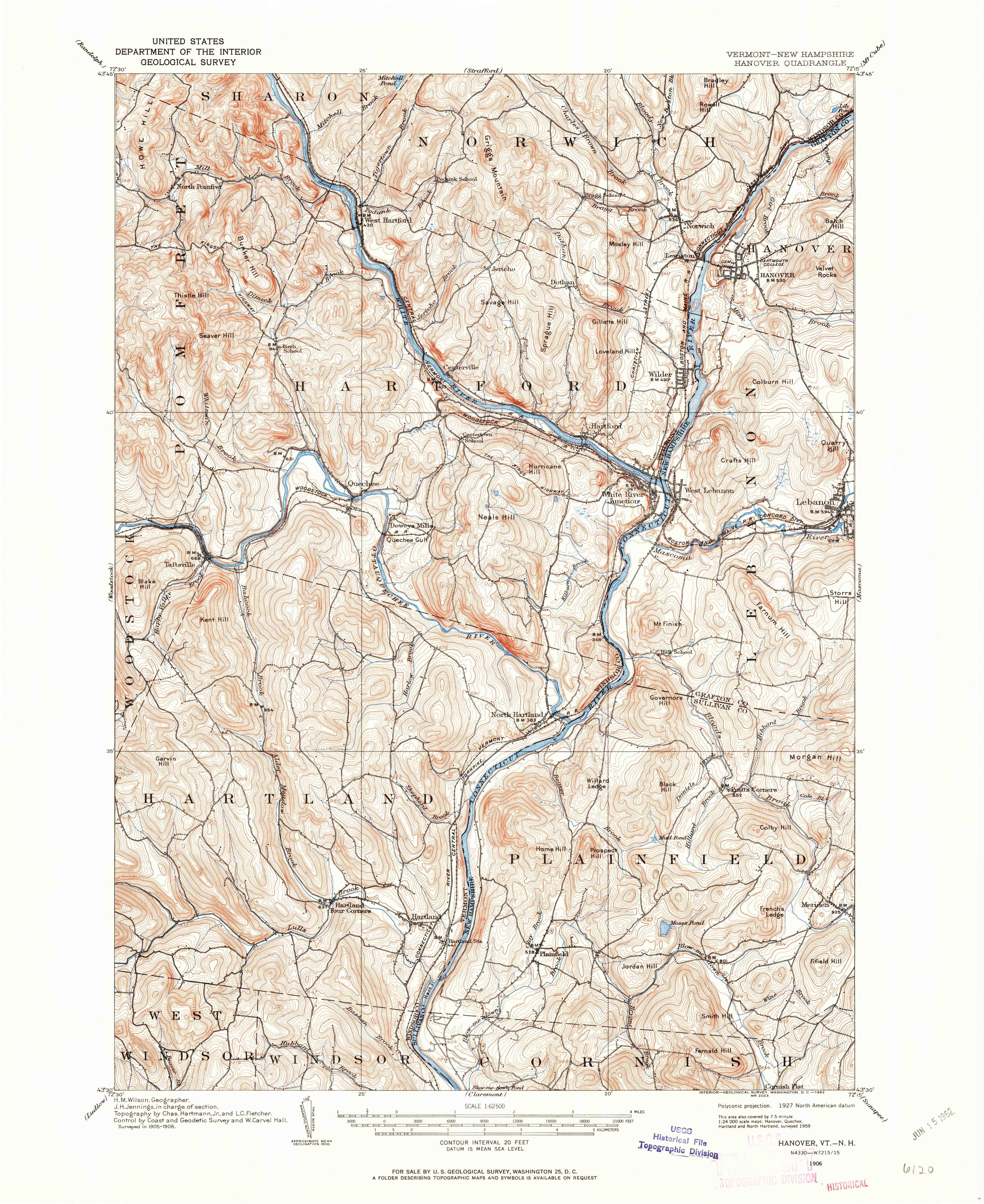
- U.S. Geological Survey, Hanover (Vt.-N.H.) sheet (1906, 1962 reprint). The 1:62,500 quadrangle the map at the top of this page was cropped from.
Sponsored
Put this 1906 map on your wall
The 1906 USGS Hanover sheet (Vermont and New Hampshire), in a 1962 reprint, is in the public domain. Download the full-size scan for free, then have it printed on canvas with CanvasOnTheCheap.
Print a map on canvasDownload the full-size mapWe may earn a commission if you buy through this link. It never changes what we write. Read our affiliate disclosure
Spot something wrong, or know more? Tell us here. You can also email us or use our contact page. Corrections are noted here with their date, never made silently.