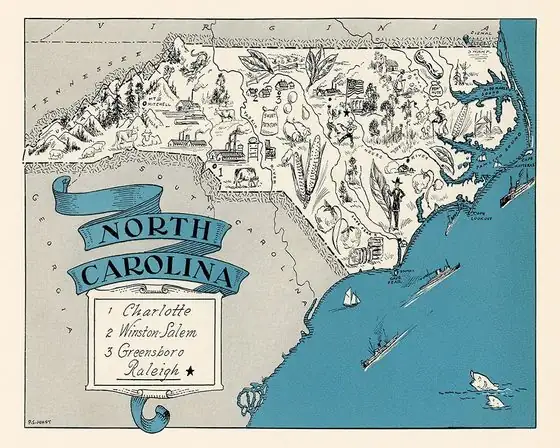
Who Was Wilmington, North Carolina Named After?
Wilmington is named for Spencer Compton, Earl of Wilmington, the patron of North Carolina's colonial governor Gabriel Johnston. The Cape Fear River settlement was first called New Liverpool, then Newton. Johnston backed it over its rival, Brunswick, and an act of the Assembly that historians date to 1739 made Newton a town by the name of Wilmington.
Wilmington, North Carolina, was New Liverpool and then Newton before Governor Gabriel Johnston renamed it for his patron, the Earl of Wilmington. The law that made the change doesn’t mention the earl at all. The reason comes from the historians.
New Liverpool, then Newton
In the early 1730s, the older town on the lower Cape Fear was Brunswick. Its roadstead proved unsafe in stormy weather, and trade started drifting to a spot about 15 miles (24 km) farther up the river, where the two big branches of the Cape Fear meet. James Sprunt, who wrote Chronicles of the Cape Fear River in 1914, traces the new village through three names: “New Liverpool, afterwards Newton, and lastly Wilmington.”
The details depend on who you read. Sprunt says John Maultsby took out a warrant for 640 acres in 1731, that a few traders settled on his grant in 1732 and “called the place New Liverpool,” and that the next spring Michael Higgins, Joshua Grainger, James Wimble and John Watson laid off a town on Watson’s land “which they called Newton.” Alfred Moore Waddell’s 1909 county history puts New Liverpool at “about the year 1730” and says the name “was changed to Newtown or Newton” in 1732.
A governor picks a side
Gabriel Johnston arrived as governor in November 1734 and, Sprunt says, “at once espoused the cause of Newton as against Brunswick.” He bought land there, had the land office opened there, and ordered the courts and his Council to meet at Newton in 1735. Then “he sought to have the village incorporated under the name of Wilmington.”
Brunswick held him off for a while, Sprunt says, and Waddell didn’t think much of how Johnston finally won. In one account he describes a Council vote on February 25, 1740, where William Smith voted as a member to make a tie and then, as presiding officer, voted again to break it. Waddell called it “the first sample of ‘machine’ politics in our history.”
The act that made it Wilmington
Sprunt printed the act of incorporation, which he dates to 1739. The key sentence says:
“the village heretofore called Newton, lying on the east side of the northeast branch of Cape Fear River, in New Hanover County, shall, from and after the passage of this Act, be a town and township, and the said village is hereby established a town and township by the name of Wilmington”
Notice what the law leaves out. It names the town and gives no reason. That part comes from the historians. Sprunt says the name was given “in honor of his patron, Spencer Compton, Earl of Wilmington and Viscount Pevensey.” Waddell says the Assembly passed the act at its session in New Bern on February 25, 1739, “the new name having been suggested by the Governor in honor of the Earl of Wilmington.” Henry Gannett’s 1905 federal list of place names agrees on the earl.
The one loose end is the date. Waddell, in an earlier chapter, refers to “the Act of 1736 (changing the name of Newton to Wilmington)” and to “the bill passed in 1736” that was attacked in that 1740 Council fight. So you’ll see 1736, 1739 and 1740 attached to the change, and the sources don’t fully explain the gap.
One earl, more than one Wilmington
Gannett’s list gives the same earl as the namesake of towns called Wilmington in Massachusetts and Vermont, too. Up the coast, Wilmington, Delaware is a harder case, since the old references disagree on whether its name honors the earl or Thomas Willing.
In North Carolina, there’s no such argument. A governor needed a town to beat Brunswick, and he gave it the title of his patron.
Quick answers
Who is Wilmington, NC, named after?
Spencer Compton, Earl of Wilmington. Sprunt’s 1914 history calls him Governor Gabriel Johnston’s patron, and Gannett’s 1905 list gives the same namesake.
What was Wilmington, NC, called before?
New Liverpool, then Newton (also spelled Newtown). Sprunt and Waddell agree on the order but not the exact years, which they put between about 1730 and 1733.
When did Newton become Wilmington?
Sprunt and Waddell give 1739, when an act made Newton a town “by the name of Wilmington.” Waddell also mentions a bill of 1736 and a deciding Council vote on February 25, 1740.
Key dates
- 1731John Maultsby takes out a warrant for 640 acres on the Cape Fear, and John Watson locates another next to it.
- 1732Sprunt says traders settle on Maultsby's grant and call the place New Liverpool. Waddell says this is the year it became Newton.
- 1734November: Governor Gabriel Johnston arrives and takes Newton's side against the older town of Brunswick.
- 1735Johnston has the land office, courts and Council meet at Newton.
- 1739An act erects "the village called Newton" into a town and township "by the name of Wilmington."
- 1740February 25: a tie vote in the Council, broken by its presiding officer's second vote, goes in Wilmington's favor, according to Waddell.
Getting there
Open Wilmington in Google Maps
Opens in a new tab. The pin is the center of Wilmington in the USGS place-name record.
The closest airports, Amtrak stations and intercity bus stops, measured in a straight line from the center of Wilmington.
Airports
- Wilmington International (ILM) 4 mi 6 km
- Albert J Ellis (OAJ) Richlands 46 mi 74 km
- Raleigh-Durham International (RDU) 124 mi 199 km
Amtrak trains
- Fayetteville station (FAY) 78 mi 126 km
- Dillon station (DIL) 83 mi 133 km
Intercity buses
- Greyhound Wilmington NC (WMN) 4 mi 7 km
- Sunway Charters Amtrak Connecting Service · Wilmington Amtrak Station 4 mi 7 km
Distances are as the crow flies, not by road. We don't list schedules or fares because they change; check with the airline, Amtrak or the bus company before you go. Official data (FAA commercial service airports (2025), FAA airport locations, Amtrak stations and Intercity Bus Atlas) from the FAA and the U.S. Bureau of Transportation Statistics, checked Nov 13, 2026.
Sponsored
Staying in Wilmington?
Compare hotels in Wilmington, North Carolina, on Expedia.
See hotels in WilmingtonWe may earn a commission if you buy through this link. It never changes what we write. Read our affiliate disclosure
Sponsored
Want the spooky side of Wilmington?
The name has its story above. For the ghost stories, US Ghost Adventures runs walking ghost tours in Wilmington.
See ghost tours in WilmingtonWe may earn a commission if you book through this link. It never changes what we write. Read our affiliate disclosure
Historical Sources & References
- James Sprunt, Chronicles of the Cape Fear River (1914), pp. 45-46 and 84. The village “called New Liverpool, afterwards Newton, and lastly Wilmington,” Maultsby’s 1731 warrant, the names New Liverpool (1732) and Newton (the next spring), and Johnston’s arrival in November 1734 (p. 45); the courts and Council at Newton in 1735 and the text of the act of incorporation, cited to Swann’s collection of 1739 public acts (p. 46); the name given “in honor of his patron, Spencer Compton, Earl of Wilmington and Viscount Pevensey” (p. 84).
- Alfred Moore Waddell, A History of New Hanover County and the Lower Cape Fear Region (1909), pp. 23, 191-192. The 1736 bill, the Council vote of February 25, 1740, and Johnston’s “patron, the Earl of Wilmington” (p. 23); New Liverpool about 1730, Newton in 1732, and the “machine” politics remark (p. 191); the act passed at New Bern on February 25, 1739, with the name “suggested by the Governor” (p. 192).
- Henry Gannett, The Origin of Certain Place Names in the United States (USGS, 1905), p. 327. Wilmington in New Hanover County, North Carolina, “named for Spencer Compton, Earl of Wilmington,” along with towns of the name in Massachusetts and Vermont.
- GNIS feature 1023269 (U.S. Geological Survey). Record 1023269, the New Hanover County city, not the Delaware one.
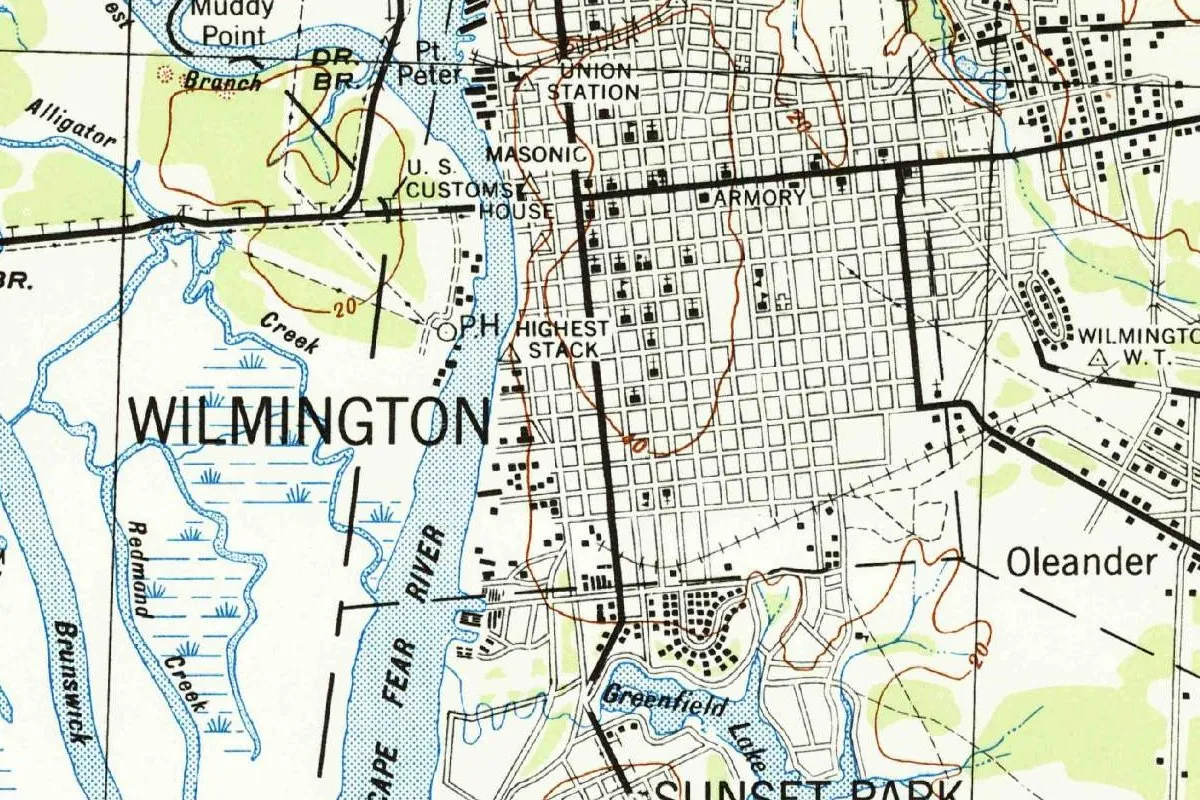
- U.S. Army Corps of Engineers (War Department), Wilmington sheet (1:62,500), 1942. The 1942 edition, the oldest sheet listed for this spot in the USGS historical topographic collection, which distributes it.
Spot something wrong, or know more? Tell us here. You can also email us or use our contact page. Corrections are noted here with their date, never made silently.