Hamlet, North Carolina: The Junction That Kept a Small Name
Hamlet, North Carolina, may owe its name to a prediction: the mill owner who gave the railroad its right-of-way said the place would soon be a hamlet. An older government list tells it another way, and the two don’t fit together.
A mill owner’s guess
The prediction story comes from a 1993 historic structures survey that Laura A. W. Phillips wrote for a proposed waste disposal site in Richmond County. The state’s historic preservation office keeps it on file. She says her whole section on Hamlet is taken from an earlier history of the town’s Main Street by Edmisten.
In 1876, she writes, “the site of the present town of Hamlet was occupied only by the woolen mill, sawmill, and house of John D. Shortridge, along with a few small houses.” That year Shortridge “deeded a strip of land to the Raleigh & Augusta Air-Line Railroad for a track right-of-way and predicted that the small settlement would soon be a larger village, or ‘Hamlet.’”
“The first train from Raleigh arrived on August 10, 1877,” she goes on, “and the settlement indeed began to grow.”
A founder named Hamlet?
Henry Gannett’s 1905 book of place-name origins, done for the Geological Survey, says something else. Its whole entry reads: “Hamlet; village in Richmond County, North Carolina, named for its founder.” Gannett doesn’t name the founder, and he doesn’t explain how a founder’s name would come out as Hamlet.
Those two accounts are hard to square. If Shortridge was the founder, his name isn’t Hamlet; if someone named Hamlet founded the town, the survey doesn’t mention him. Neither source quotes a document from the 1870s, so this article leaves the question open. If you’ve heard the word story told as settled fact, now you know it has a rival.
The Seaboard’s crossroads
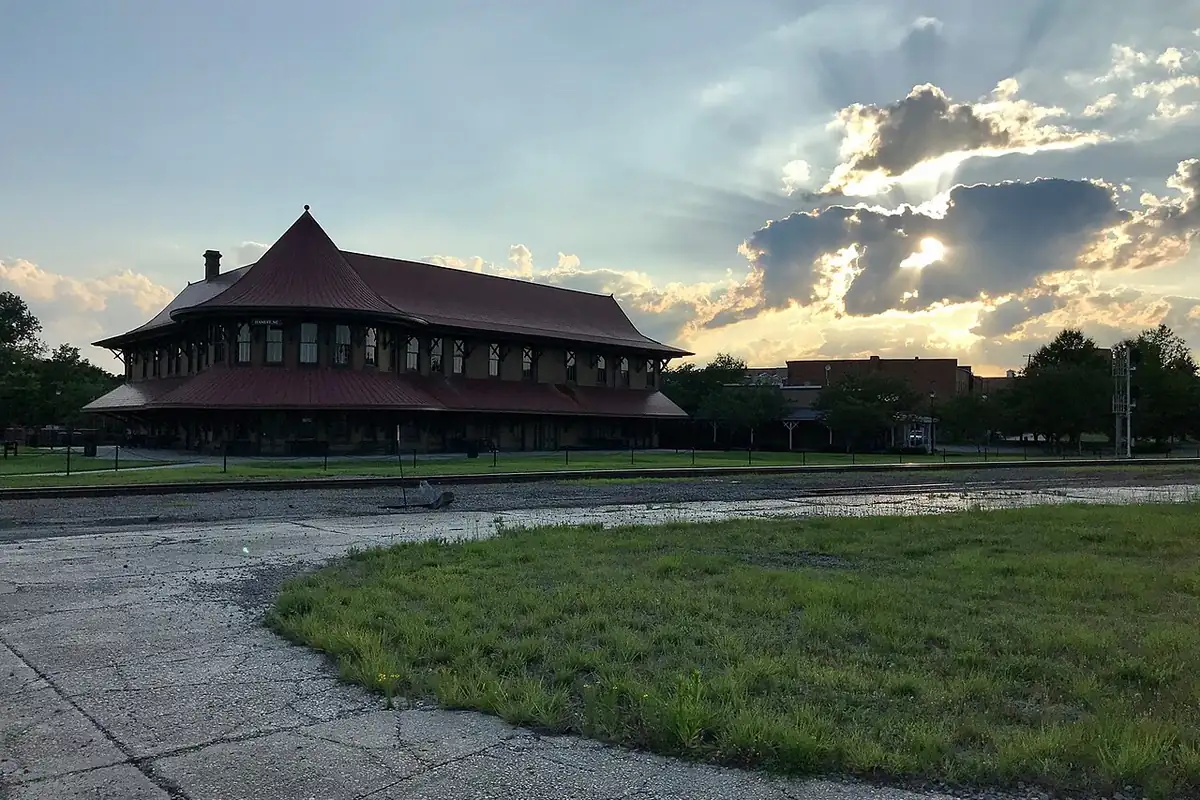
The railroad is what turned the hamlet into a town. Phillips writes that Hamlet was formally incorporated in 1897, and that “during the first decade of the twentieth century Hamlet’s population nearly quadrupled, from 639 to 2173.” In 1900 the Seaboard Air Line Railway was formed, taking in the Raleigh & Augusta and the Carolina Central, and “Hamlet became a major interstate railroad crossroad.” A two-story, L-shaped frame building went up that year as the Seaboard’s passenger depot and the offices of its North Carolina division.
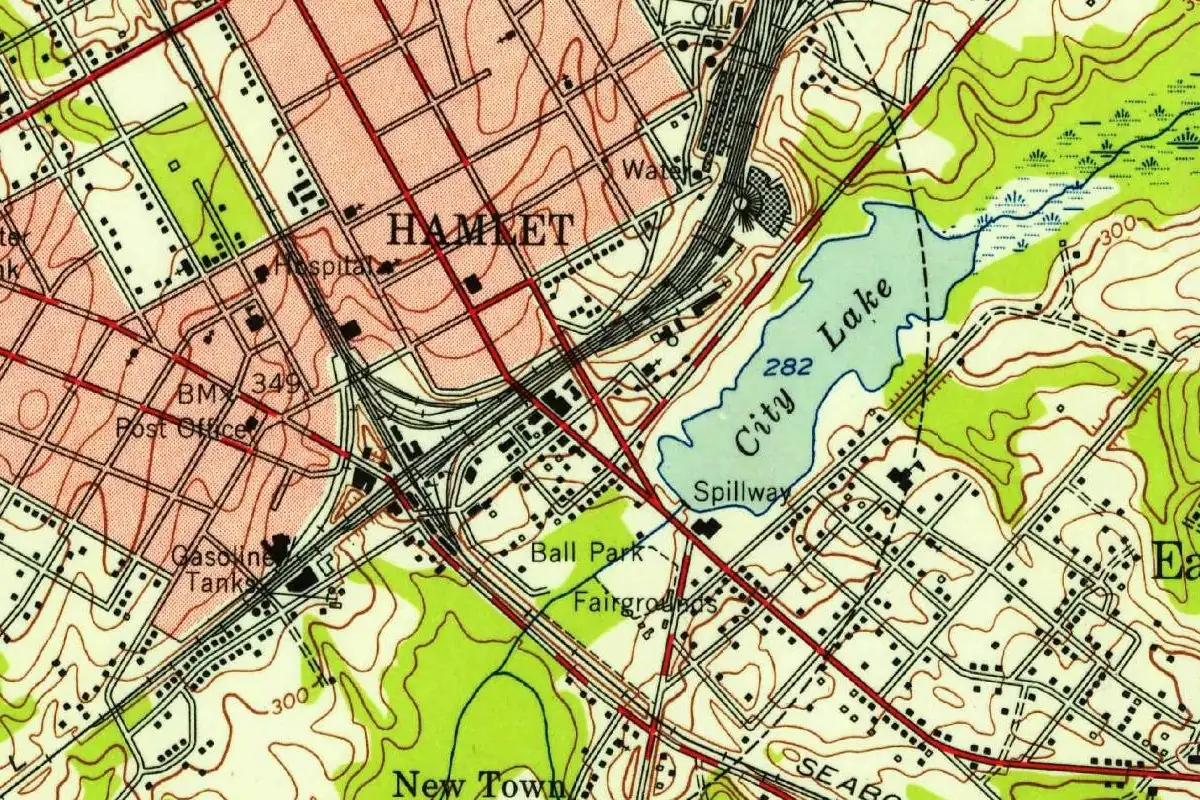
By 1939, the WPA’s guide to North Carolina called Hamlet simply “a railroad center and trading point for peach- and tobacco-growing sections.” On the 1949 survey map, you can see what that meant: several lines run into a big yard in the middle of town, right next to City Lake.
Quick answers
Why is it called Hamlet, North Carolina?
The sources disagree. A 1993 historic structures survey on file with the state, based on Edmisten’s history of Main Street, says John D. Shortridge predicted in 1876 that the settlement would become a larger village, or “Hamlet.” Gannett’s 1905 bulletin says it was “named for its founder,” without a name.
When did the railroad reach Hamlet?
The first train from Raleigh, on the Raleigh & Augusta Air-Line, arrived on August 10, 1877, according to the 1993 survey.
Which railroad made Hamlet a junction?
The Seaboard Air Line Railway, formed in 1900. It absorbed the Raleigh & Augusta and the Carolina Central, and its depot and division offices went up in Hamlet that year.
Key dates
- 1876John D. Shortridge, who owns a woolen mill and a sawmill here, deeds a right-of-way to the Raleigh & Augusta Air-Line Railroad.
- 1877August 10: the first train from Raleigh arrives.
- 1897Hamlet is incorporated.
- 1900The Seaboard Air Line Railway is formed, and a two-story depot is built at Hamlet.
Getting there
Open Hamlet in Google Maps
Opens in a new tab. The pin is the center of Hamlet in the USGS place-name record.
The closest airports, Amtrak stations and intercity bus stops, measured in a straight line from the center of Hamlet.
Airports
- Fayetteville Regional/Grannis Field (FAY) 47 mi 75 km
- Florence Regional (FLO) 48 mi 78 km
- Charlotte/Douglas International (CLT) 75 mi 120 km
Amtrak trains
- Hamlet station (HAM) under 1 mi 0.5 km
- Rockingham station (RKH) 8 mi 12 km
Intercity buses
- Greyhound Rockingham King Fuel Station 5 mi 8 km
- Sunway Charters Southern Pines 26 mi 43 km
- FlixBus Florence Sc 45 mi 73 km
Distances are as the crow flies, not by road. We don't list schedules or fares because they change; check with the airline, Amtrak or the bus company before you go. Official data (FAA commercial service airports (2025), FAA airport locations, Amtrak stations and Intercity Bus Atlas) from the FAA and the U.S. Bureau of Transportation Statistics, checked Nov 6, 2026.
Sponsored
Staying in Hamlet?
Compare hotels in Hamlet, North Carolina, on Expedia.
See hotels in HamletWe may earn a commission if you buy through this link. It never changes what we write. Read our affiliate disclosure
Historical Sources & References
- Laura A. W. Phillips, Historic Structures Survey, Richmond County Potentially Suitable Site (1993), p. 21. Shortridge’s mills and his right-of-way of 1876, the prediction of a “Hamlet,” the first train of August 10, 1877, incorporation in 1897, the population of 639 and 2,173, and the Seaboard Air Line and its depot of 1900. The section on Hamlet is taken from Edmisten, “Main Street.”
- Henry Gannett, The Origin of Certain Place Names in the United States, 2nd ed. (1905), p. 148. “Hamlet; village in Richmond County, North Carolina, named for its founder.”
- Federal Writers’ Project, North Carolina: A Guide to the Old North State (1939), p. 538. Hamlet as “a railroad center and trading point for peach- and tobacco-growing sections.”
- GNIS feature 1020599 (U.S. Geological Survey). Hamlet’s record in the government gazetteer, Richmond County, with an empty history field.
Spot something wrong, or know more? Tell us here. You can also email us or use our contact page. Corrections are noted here with their date, never made silently.