Cary, North Carolina: Named for a Temperance Orator
Frank Page, a lumberman and the father of diplomat Walter Hines Page, named Cary after Samuel Cary of Ohio, a temperance speaker he admired. Page banned liquor in his land deeds, and the 1871 law that incorporated the town, spelled Carey, banned it within two miles (3 km).
A lumberman’s corner by the tracks
Frank Page settled by the railroad west of Raleigh around 1854, and the town that grew there, Cary, North Carolina, honors an Ohio temperance orator. Page could have kept his own name on the map. For a while, people did: they just called the place “Page’s.”
Most of what we know about those early years comes from Burton J. Hendrick, who wrote the life of Page’s son Walter Hines Page, the editor and ambassador to Great Britain. Hendrick’s 1928 book says Frank and Catherine Page made their living from turpentine, logging and lumber, moving on whenever a pine field was used up. About 1854 Page bought four hundred acres of woods about eight miles (13 km) west of Raleigh. The big draw, besides the timber, was the railroad that had just been built. Walter was born there on August 15, 1855.
Hendrick is blunt about what the spot looked like: “the place did not even have a name; it was popularly described as ‘Page’s.’”
The name came with the liquor ban
Page owned nearly all of the land, and he had firm ideas about drink. Hendrick says every deed he wrote for a settler’s lot carried a clause that alcohol could never be brought onto the property. When the village grew big enough to incorporate, Page put the same rule in its charter, and then he picked a name:
“…he now gave his local habitation a name, and herein once more his temperance principles came to the front, for he called it Cary, in honour of General Samuel Cary, of Ohio, a ‘temperance orator’ who had recently visited the settlement in advocacy of the great cause.”
The name wasn’t a family name or a local landmark, then. It was a nod to a visiting speaker whose cause Page shared, stamped on a town where you legally couldn’t buy a drink.
Henry Gannett’s 1905 bulletin on American place names says the same thing in a single line, calling Cary a village “named for the temperance lecturer of Ohio.” The state of North Carolina’s historical marker text for Walter Hines Page gives his whole name, Samuel Fenton Cary, and calls him “an Ohio prohibitionist admired by Page.”
Carey with an e
The charter itself survives in the state’s printed laws. The North Carolina legislature ratified “An act to incorporate the town of Carey, in Wake county” on April 3, 1871. It opens by incorporating “the village in Wake county known as Carey,” and it does exactly what Hendrick describes: any license to sell “spirituous liquor, wine or cordial at Carey, or within two miles thereof” is void, and nobody may keep a “tippling house” there. The same act names five town commissioners and makes A. F. Page the mayor.
Two things stand out. The spelling in the law is Carey, not Cary. And the act talks about a village already “known as Carey,” which means the name was in use before the charter passed.
When did Page name it?
This is where the sources don’t line up, so if you see different dates, that’s why. The state’s marker text says that in 1854 Page bought three hundred acres “and named the area Cary.” Hendrick gives four hundred acres and tells it as a later step: the place was “Page’s” for years, more families came “immediately after the war,” and Page named it when it was ready to be incorporated. The 1871 law can’t settle it, since all it shows is that “Carey” was already the village’s name by then.
What every source agrees on is the man behind the name. Page’s son grew up to edit magazines and serve as ambassador to Great Britain, but the town he was born in honors someone else’s speeches. If you’ve ever wondered why a North Carolina suburb carries an Ohio man’s surname, the answer is a lumberman who wanted his village dry.
Quick answers
Who is Cary, North Carolina, named after?
Samuel Cary of Ohio, a temperance speaker. Hendrick’s 1928 biography says Frank Page named the town for him; the state’s marker text gives his full name as Samuel Fenton Cary.
Was Cary ever spelled Carey?
Yes, in its charter. The act ratified on April 3, 1871, incorporates “the village in Wake county known as Carey” as “The town of Carey.”
Did Samuel Cary ever visit Cary?
According to Hendrick, yes. He calls Cary a “temperance orator” who “had recently visited the settlement” when Page chose the name.
When did Cary get its name?
The sources differ. The state’s marker text ties the naming to Page’s 1854 land purchase, Hendrick places it at incorporation, and the 1871 charter shows the name was already in use.
Key dates
- 1854Frank Page buys woodland by the railroad west of Raleigh: 400 acres about 1854, says a 1928 biography; 300 acres in 1854, says the state marker text.
- 1855August 15: Walter Hines Page, Frank's son, is born at the new place.
- 1871April 3: the legislature incorporates 'the village in Wake county known as Carey,' bans liquor within two miles (3 km) and names A. F. Page mayor.
- 1905Henry Gannett's federal bulletin lists Cary as named for the temperance lecturer of Ohio.
Getting there
Open Cary in Google Maps
Opens in a new tab. The pin is the center of Cary in the USGS place-name record.
The closest airports, Amtrak stations and intercity bus stops, measured in a straight line from the center of Cary.
Airports
- Raleigh-Durham International (RDU) 6 mi 10 km
- Fayetteville Regional/Grannis Field (FAY) 56 mi 89 km
Amtrak trains
- Cary station (CYN) under 1 mi 0.4 km
- North Carolina State Fair station (NSF) 4 mi 7 km
Intercity buses
- FlixBus Raleigh Bus Station 9 mi 15 km
- Sunway Charters Raleigh 9 mi 15 km
- Greyhound Sanford Sam'S Place 31 mi 50 km
Distances are as the crow flies, not by road. We don't list schedules or fares because they change; check with the airline, Amtrak or the bus company before you go. Official data (FAA commercial service airports (2025), FAA airport locations, Amtrak stations and Intercity Bus Atlas) from the FAA and the U.S. Bureau of Transportation Statistics, checked Nov 13, 2026.
Sponsored
Staying in Cary?
Compare hotels in Cary, North Carolina, on Expedia.
See hotels in CaryWe may earn a commission if you buy through this link. It never changes what we write. Read our affiliate disclosure
Historical Sources & References
- Burton J. Hendrick, The Training of an American: The Earlier Life and Letters of Walter H. Page (1928), pp. 13, 26 and 27. The Pages’ turpentine and lumber work, the purchase of four hundred acres about eight miles west of Raleigh about 1854, the railroad and Walter’s birth on August 15, 1855, and the place “popularly described as ‘Page’s’” (p. 13); more families arriving “immediately after the war” (p. 26); the no-liquor clause in deeds and charter and the quoted passage on naming the town for “General Samuel Cary, of Ohio” (p. 27).
- Private Laws of the State of North-Carolina, 1870-’71, chapter 80, pp. 143-144. The act ratified April 3, 1871, incorporating “the village in Wake county known as Carey,” voiding liquor licenses within two miles (3 km), and naming the commissioners and A. F. Page as mayor.
- Henry Gannett, The Origin of Certain Place Names in the United States (USGS, 1905), p. 71. Cary, Wake County, “named for the temperance lecturer of Ohio.”
- North Carolina Department of Natural and Cultural Resources, “Walter Hines Page 1855-1918 (H-20)”. Walter’s birth in 1855, Frank Page’s purchase of three hundred acres in 1854, and the naming for Samuel Fenton Cary, “an Ohio prohibitionist admired by Page.”
- GNIS feature 1019552 (U.S. Geological Survey). Today’s official spelling, Cary, without the charter’s extra e, in Wake County.
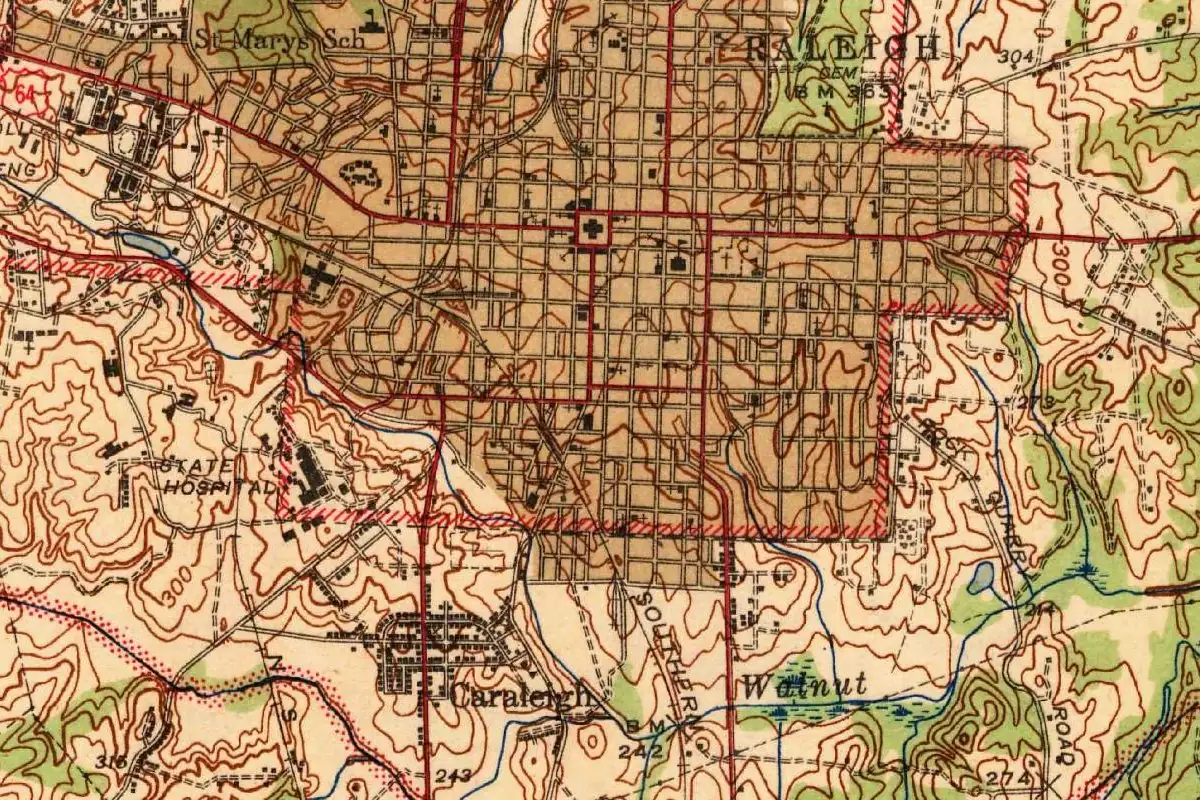
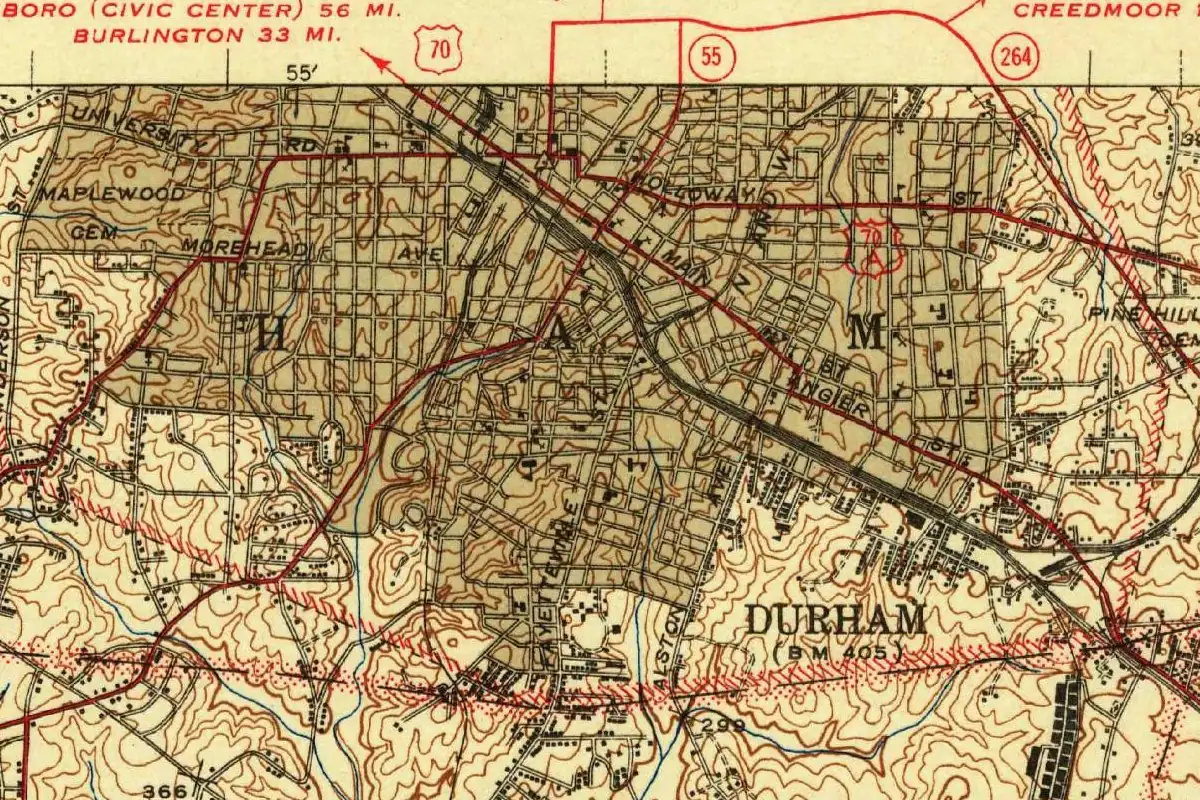
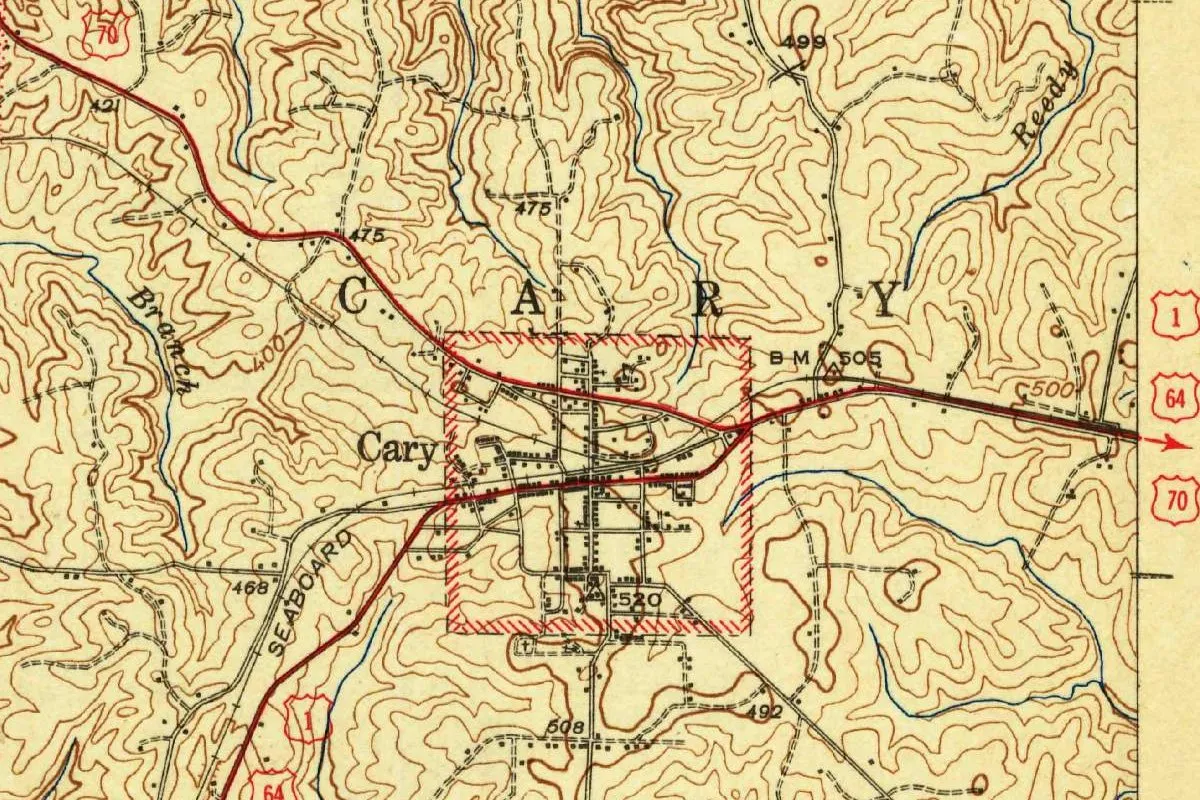
- U.S. Geological Survey, Durham South sheet (1943). A 1943 survey sheet with Cary on the Seaboard tracks, where U.S. 1, 64 and 70 meet.
Spot something wrong, or know more? Tell us here. You can also email us or use our contact page. Corrections are noted here with their date, never made silently.