Durham, North Carolina: The Doctor Who Gave the Depot Land
Durham, North Carolina, got its name in 1852 because a doctor gave the railroad the land for a depot that William Pratt wouldn’t. Pratt kept his land, the doctor got the station, and the station got his name.
Pratt says no
Before the railroad, there was Prattsburg. The WPA writers’ 1939 guide to North Carolina says it was a settlement with “wheat and corn mills serving the farmers” when the North Carolina Railroad was built through the area in 1852-56. Then the guide gets to the turn: “William Pratt, a large landowner, refused to give a right-of-way or land for a station.” A doctor named Durham “offered 4 acres about 2 miles west of Prattsburg,” or about 3 km, “and the station was named for him. The railroad detoured around Prattsburg and the Pratt property.”
Hiram V. Paul’s History of the Town of Durham, printed in 1884, tells it the same way, from inside the town:
The depot of the N. C. R. R., in this town, was established in 1852, with Dr. B L. Durham as agent. Prattsburg was originally intended for the depot site, but Mr. Pratt, the owner, refused to grant the land, and the present site was donated by our venerable townsman, Dr. Durham, in honor of whom the station was called Durham.
So the doctor wasn’t only the landowner. Paul says he was also the depot’s first agent.
Bartholomew or Bartlett?
The sources agree on the man and the land. They don’t agree on his first name. Henry Gannett, writing his place-name bulletin for the Geological Survey in 1905, says Durham was “named for Dr. Bartholomew Durham, owner of the town site,” and the federal gazetteer repeats that wording almost word for word. The WPA guide calls him “Dr. Bartlett Durham.” Paul’s 1884 history uses only his initials, B. L. Durham, which doesn’t settle it either way.
If you see both names in different places, that’s why.
Durham Station
The post office followed the tracks. Paul writes that the area’s first post office opened at Prattsburg “about the year 1845, with William Pratt as Postmaster,” and that in 1852, “soon after the erection of the N. C. R. R. Depot,” it “was moved to Durham Station.” By April 1865, when the generals Sherman and Johnston met in a little house nearby, Paul calls Durham “an insignificant railroad station, with only about 200 inhabitants.” The WPA guide puts it lower, at fewer than 100 people that year.
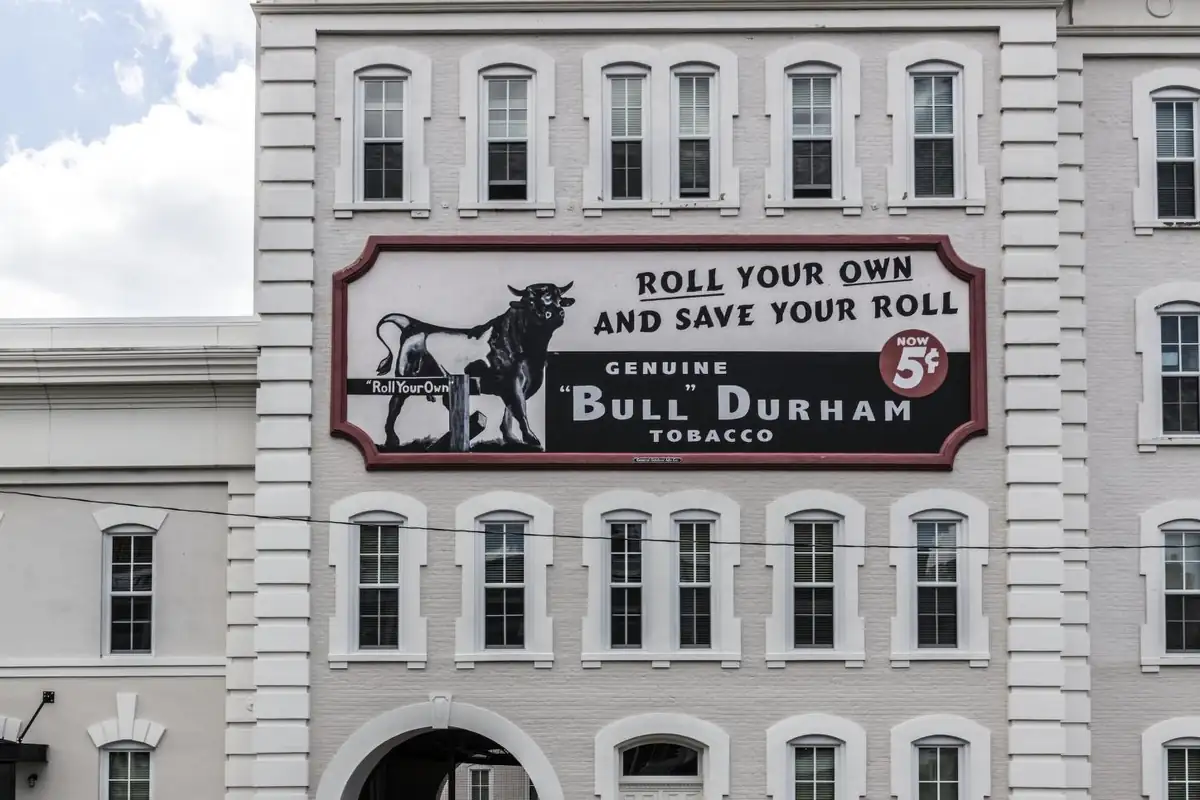
Tobacco came next. The WPA guide says Robert F. Morris was making it here as early as 1858, and that by 1865 the factory was run by John R. Green, “originator of the Bull Durham blend.” That’s the brand on the sign in the photo below.
The station became a town. The WPA guide gives 1867 for its incorporation, and in 1881 Durham County was carved out of Orange and Wake with Durham as the seat. By 1884, Paul was writing about “Redmond Grove — formerly known as Prattsburg.”
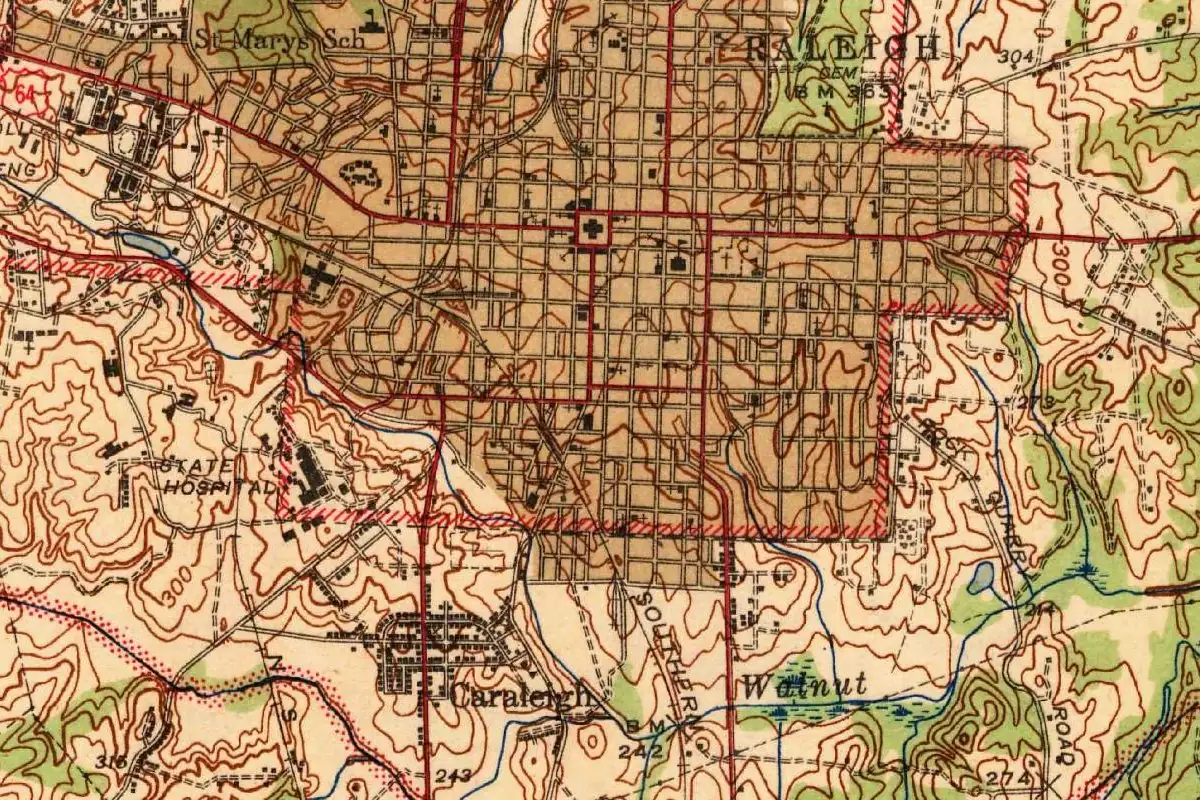
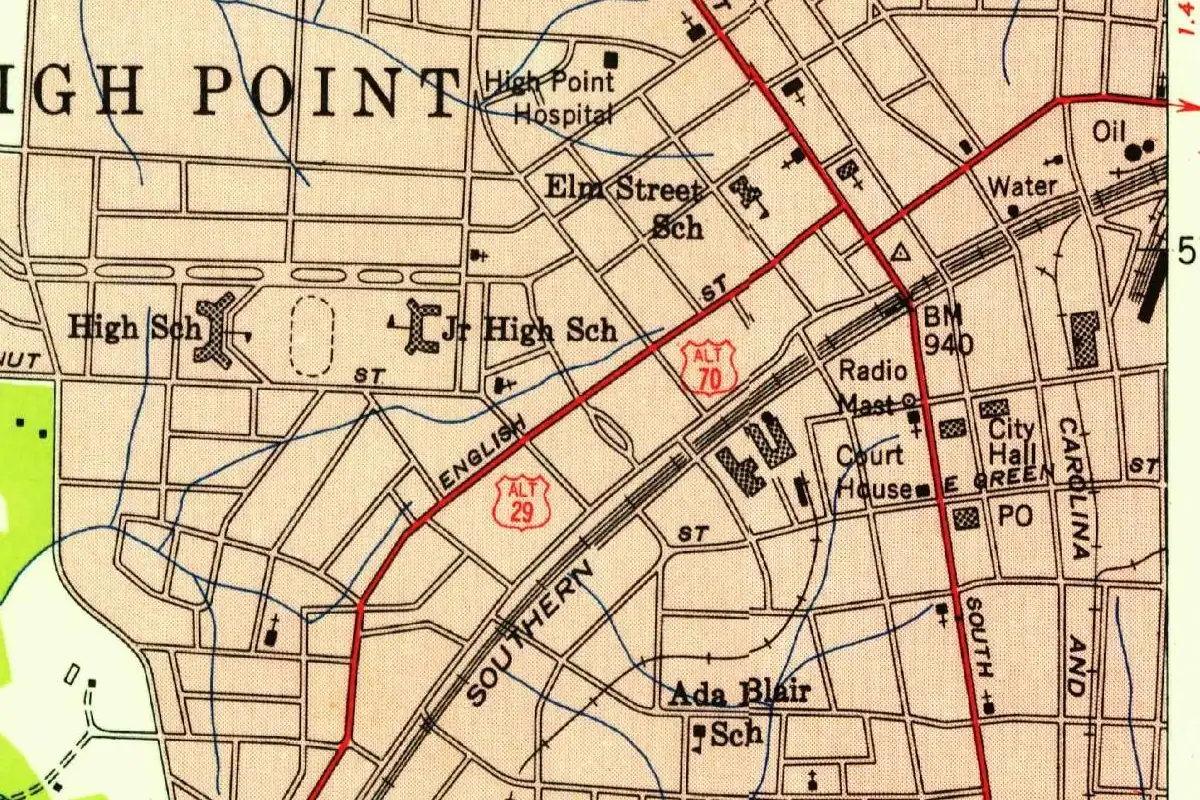
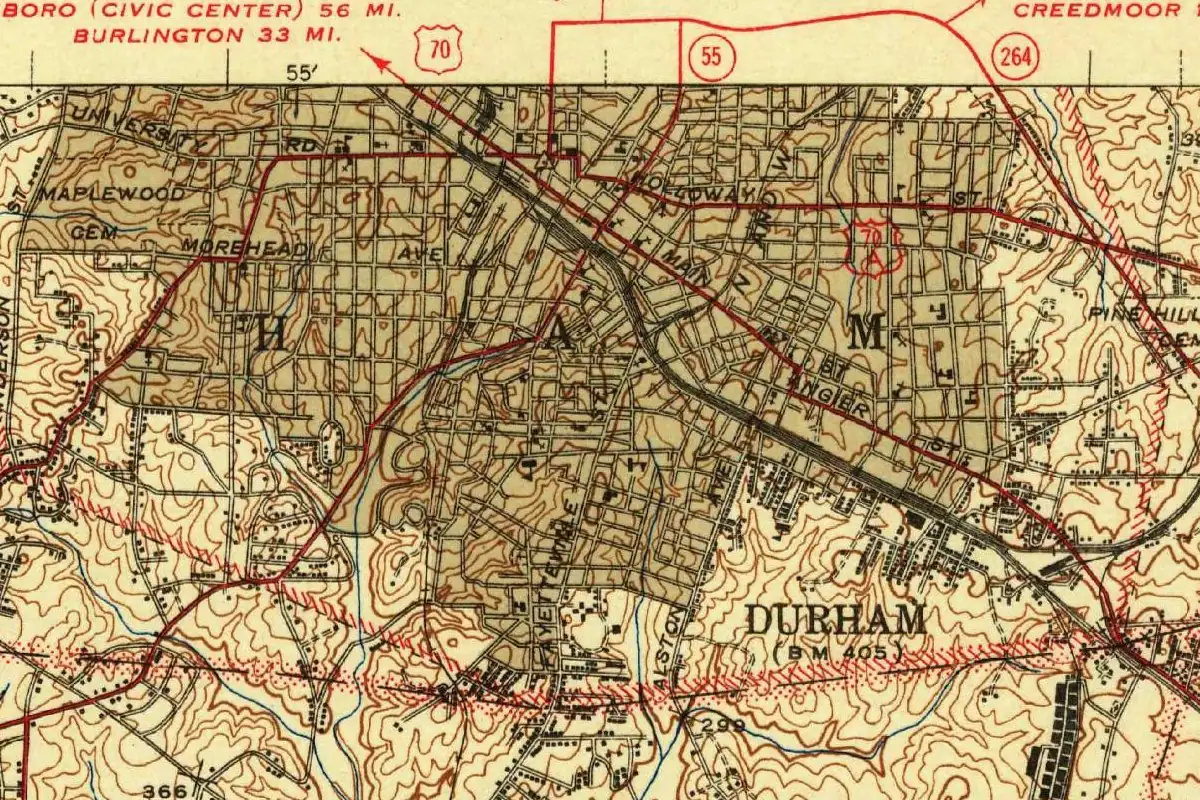
The 1943 survey map lets you follow the railroad straight through the middle of the city’s grid, and there’s a street labeled Angier near it. Paul says the first store in town, opened by B. L. Durham and two partners, stood at what was “then known as the Angier corner.” Farther west along the same North Carolina Railroad is High Point, a town named for where it sat on that line.
Quick answers
Who is Durham, North Carolina, named after?
Dr. Durham, who gave the North Carolina Railroad the land for its depot after William Pratt refused. Hiram Paul’s 1884 history calls him Dr. B. L. Durham; Gannett and the federal gazetteer say Bartholomew, and the WPA guide says Bartlett.
What was Prattsburg?
A small mill settlement about 2 miles (3 km) east of the depot site. Its owner, William Pratt, refused to give land for the railroad station, so the station went to Dr. Durham’s land instead.
When was Durham’s railroad depot built?
In 1852, Paul writes, with Dr. Durham as its agent. The WPA guide says the railroad itself was built through the area between 1852 and 1856.
Key dates
- 1845A post office opens at Prattsburg, with William Pratt as postmaster.
- 1852The North Carolina Railroad's depot is established on land given by Dr. Durham, and the station is named for him; the post office moves to Durham Station.
- 1867The town of Durham is incorporated.
- 1881Durham County is created from Orange and Wake, with Durham as its seat.
Getting there
Open Durham in Google Maps
Opens in a new tab. The pin is the center of Durham in the USGS place-name record.
The closest airports, Amtrak stations and intercity bus stops, measured in a straight line from the center of Durham.
Airports
- Raleigh-Durham International (RDU) 10 mi 16 km
- Piedmont Triad International (GSO) Greensboro 59 mi 94 km
Amtrak trains
- Durham station (DNC) under 1 mi 0.8 km
- Cary station (CYN) 16 mi 25 km
Intercity buses
- FlixBus Durham W Pettigrew St Bus Station under 1 mi 0.8 km
- Sunway Charters Raleigh 20 mi 33 km
- Greyhound Henderson Rosemart 206 35 mi 57 km
Distances are as the crow flies, not by road. We don't list schedules or fares because they change; check with the airline, Amtrak or the bus company before you go. Official data (FAA commercial service airports (2025), FAA airport locations, Amtrak stations and Intercity Bus Atlas) from the FAA and the U.S. Bureau of Transportation Statistics, checked Nov 6, 2026.
Sponsored
Staying in Durham?
Compare hotels in Durham, North Carolina, on Expedia.
See hotels in DurhamWe may earn a commission if you buy through this link. It never changes what we write. Read our affiliate disclosure
Historical Sources & References
- Hiram V. Paul, History of the Town of Durham, N.C. (1884), pp. 25, 28-29 and 85. Durham as “an insignificant railroad station, with only about 200 inhabitants” in 1865 (p. 25); Redmond Grove, “formerly known as Prattsburg” (p. 28); the depot of 1852 with Dr. B. L. Durham as agent, Pratt’s refusal, the land “donated by our venerable townsman, Dr. Durham,” and the first store at the Angier corner (p. 29); the post office moved from Prattsburg to Durham Station in 1852 (p. 85).
- Federal Writers’ Project, North Carolina: A Guide to the Old North State (1939), p. 170. Prattsburg’s mills, the railroad of 1852-56, William Pratt’s refusal, “Dr. Bartlett Durham” and his 4 acres, fewer than 100 people in 1865, the tobacco of Robert F. Morris and John R. Green, incorporation in 1867 and Durham County in 1881.
- Henry Gannett, The Origin of Certain Place Names in the United States, 2nd ed. (1905), p. 111. “Named for Dr. Bartholomew Durham, owner of the town site.”
- GNIS feature 1020059 (U.S. Geological Survey). Durham’s federal name page, which carries the line “Named for Dr.Bartholomew Durham, owner of the town site.”
Spot something wrong, or know more? Tell us here. You can also email us or use our contact page. Corrections are noted here with their date, never made silently.